Cost of Owning a Car vs Using Public Transport: A Financial Comparison
Deciding between owning a personal vehicle and relying on public transportation in Germany is a massive financial choice. This comprehensive analysis breaks down vehicle depreciation, strict insurance mandates, and highly subsidized transit networks to help expats optimize their monthly mobility budget.
Disclosure: This post may contain affiliate links. We may earn a commission at no extra cost to you if you make a purchase through these links. Read full disclosure.
The True Cost of Car Ownership in Germany
Depreciation and Financing Realities
When assessing the financial impact of car ownership in Germany, the most significant yet often ignored expense is depreciation (Wertverlust). Expats arriving from car-centric countries like the US or Canada often instinctively purchase a vehicle upon arrival, viewing it as a necessity. However, a brand-new car in Germany typically loses up to 25% of its total value the moment it is driven off the dealership lot. Over the first three years of ownership, that depreciation can easily reach 45% to 50% of the initial purchase price. For a mid-range Volkswagen or BMW costing €35,000, you are effectively burning thousands of euros annually in invisible equity loss.
Financing a vehicle compounds this financial drain. While German banks offer specific auto loans (Autokredite), the interest rates significantly increase the total cost of ownership. If you are a newly arrived expat without a fully established Schufa (German credit score), securing a competitive interest rate can be incredibly difficult. You may be forced into higher-tier interest brackets, adding hundreds of euros in pure banking friction to your monthly overhead.
Choosing to buy a reliable used vehicle (Gebrauchtwagen) mitigates the steepest curve of depreciation, but it requires a lump sum of liquid capital. If you need to transfer your savings from a foreign account to purchase a used car in cash, executing a standard international wire transfer through a legacy bank will destroy your purchasing power via terrible exchange rates. By utilizing a borderless platform like Wise, you can convert your home currency into Euros at the real, mid-market exchange rate, saving you hundreds of euros in hidden banking markups on a €10,000 vehicle purchase.
Mandatory Insurance and Vehicle Taxes
The German regulatory environment for automobiles is famously strict, and the mandatory ongoing costs reflect this. To legally register a car, you must possess at least third-party liability insurance (Kfz-Haftpflichtversicherung). However, if you are financing the car or want to protect your investment from accidents and vandalism, you must purchase comprehensive coverage (Vollkaskoversicherung). For expats with no recognized European driving history, insurance providers will default you to the highest risk class (Schadenfreiheitsklasse), meaning your annual insurance premium can easily exceed €1,000 to €1,500.
In addition to heavy insurance premiums, every registered vehicle is subject to the annual motor vehicle tax (Kfz-Steuer). The German government structures this tax to heavily penalize high-emissions vehicles. The tax is calculated based on engine size (cubic capacity) and the exact CO2 emissions output of the car. While a small, efficient city car might only cost €60 to €100 annually in taxes, older diesel vehicles or large SUVs can cost upwards of €400 to €600 per year.
These recurring, inescapable expenses must be meticulously tracked to prevent budget overruns. Utilizing an agile digital banking platform like N26 allows you to establish dedicated sub-accounts for your vehicle expenses. You can automatically set aside a specific percentage of your salary each month into a “Car Tax and Insurance” space, ensuring you have the liquid capital available when these massive annual bills are automatically withdrawn via direct debit. To understand how these expenses fit into your broader financial landscape, review our comprehensive Cost of Living Comparison: Germany vs UK/USA/Canada.
Maintenance, Fuel, and the Infamous TÜV
The daily operational costs of driving in Germany are significantly higher than in North America. Fuel prices (Spritpreise) are heavily taxed to fund infrastructure and environmental initiatives. It is entirely common for unleaded gasoline (Super 95) or diesel to fluctuate around €1.70 to €2.00 per liter. If you have a daily round-trip commute of 40 kilometers, your monthly fuel budget alone can easily surpass €150. Furthermore, finding parking in major urban centers like Munich, Stuttgart, or Berlin is a daily battle, and paying for residential parking permits (Anwohnerparkausweis) or daily commercial garage fees adds another silent layer to your transit overhead.
Beyond fuel, German engineering requires precise, scheduled maintenance. The absolute cornerstone of vehicle safety in Germany is the mandatory general inspection known as the Hauptuntersuchung (HU), universally referred to by the name of the testing agency: the TÜV. Every vehicle must undergo this rigorous, multi-point safety and emissions test every two years. If your car fails the TÜV inspection for even minor issues like worn brake pads, a cracked light casing, or minor rust, it is legally barred from the road until repaired.
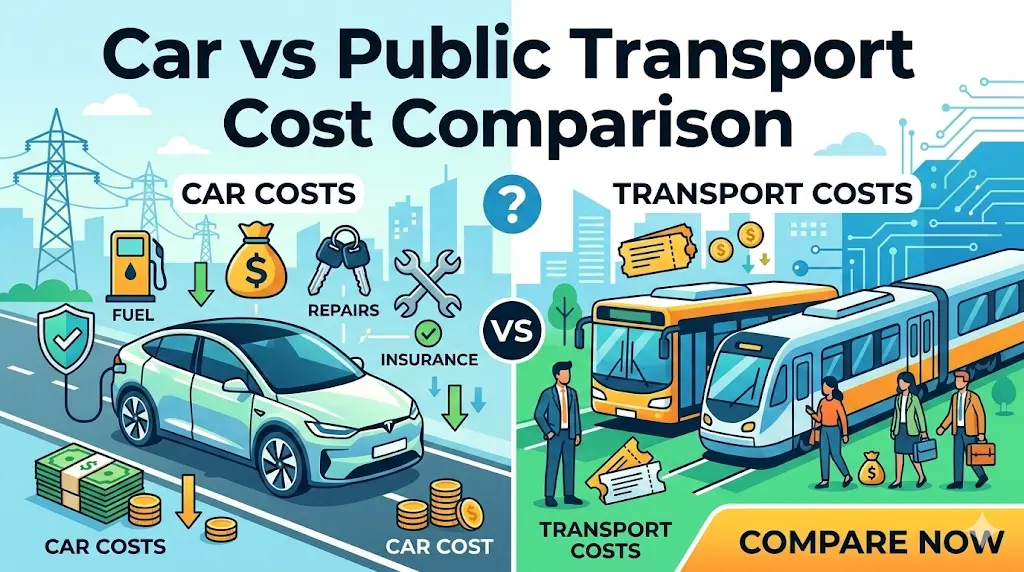
Preparing a vehicle to pass the TÜV often requires expensive preventative maintenance at certified mechanics (Werkstätten). A routine service, tire changes (Germany legally mandates changing between summer and winter tires), and minor repairs can easily cost a driver between €500 and €1,000 annually. When you aggregate depreciation, insurance, taxes, fuel, and the TÜV, the true cost of owning a mid-range car in Germany typically ranges between €400 and €700 every single month. For deeper insights into managing massive regional expenses, read Budgeting for Life in Germany: Tips to Save Money as an Expat.
The Financial Case for Public Transportation
The Deutschlandticket Revolution
Public transportation in Germany underwent a monumental paradigm shift with the introduction of the nationwide transit pass, currently known as the Deutschlandticket. For a flat, subsidized fee (historically €49, scaling to €63), this digital subscription grants you absolute, unlimited access to all local and regional public transportation across the entire Federal Republic. This single ticket replaces the archaic, highly fragmented, and outrageously expensive local tariff zones that previously punished commuters.
With the Deutschlandticket, you can ride the U-Bahn, S-Bahn, trams, and city buses in your local metropolis. More importantly, the ticket covers all regional train networks (Regionalbahn and Regional-Express). This means you can execute a weekend trip from Berlin to the Baltic Sea, or from Munich to the Bavarian Alps, using regional trains without paying a single extra cent. The only exclusions are the high-speed intercity trains (ICE, IC, EC) operated by Deutsche Bahn.
When compared to the €400 to €700 monthly cost of car ownership, a €60-range nationwide transit pass represents an unparalleled financial victory. It completely eliminates fuel costs, the stress of the TÜV, and parking anxieties. Setting up the recurring SEPA direct debit for your transit pass is seamless with modern tools. Using a streamlined interface like N26 ensures your subscription is paid flawlessly every month, granting you uninterrupted access to the country’s vast rail network.
Jobtickets and Employer Subsidies
The financial case for public transit becomes even more compelling when you factor in corporate subsidies. To promote sustainability and reduce urban congestion, the German government heavily incentivizes companies to cover their employees’ commuting costs. This benefit is officially known as a Jobticket.
If you negotiate a Jobticket as part of your employment contract, your company can subsidize the cost of your Deutschlandticket entirely tax-free. Under current regulations, if the employer contributes a minimum 25% subsidy toward the ticket, the federal government frequently provides an additional 5% discount. In many progressive corporations and tech startups, the employer covers the entire remaining balance, rendering your nationwide regional transit network absolutely 100% free.
This represents pure, untaxed value hitting your wallet directly, bypassing Germany’s steeply progressive income tax brackets. When weighing a job offer, recognizing the monetary value of a fully subsidized Jobticket is just as critical as analyzing the base salary. To decode how these transit perks interact with other corporate benefits, explore our detailed guide on Employee Benefits in Germany: From Vacation Days to Parental Leave Payments.
High-Speed Rail for Long Distance Travel
While the Deutschlandticket covers regional transit, business trips or rapid cross-country vacations require the high-speed ICE (Intercity-Express) network operated by Deutsche Bahn. Walking up to a ticket machine on the day of travel and purchasing a standard flexible fare (Flexpreis) is astronomically expensive. However, savvy expats master the Sparpreis (saver fare) system to travel across Germany for less than the cost of a tank of gas.
Deutsche Bahn releases these heavily discounted tickets up to six months in advance. By booking your high-speed travel three to four weeks prior to your departure, you can frequently secure cross-country ICE tickets for under €30. To amplify these savings, frequent travelers invest in a BahnCard 25 or BahnCard 50. For a flat annual fee, the BahnCard grants a guaranteed 25% or 50% discount on all tickets, which critically applies on top of the already discounted Sparpreis fares.
When booking these international or cross-country train tickets online, particularly if you are searching for deals while traveling and using public Wi-Fi networks in hotels or stations, digital security is paramount. European data privacy laws are strict, but public networks remain vulnerable to packet-sniffing. Activating a premium Virtual Private Network like NordVPN ensures your booking sessions and credit card details are wrapped in unbreakable encryption, protecting your financial data from malicious actors while you secure the cheapest travel fares.
| Expense Category | Personal Car Ownership | Public Transport (Deutschlandticket + BahnCard) |
| Initial Capital Required | High (€5,000 – €35,000+) | Zero (Subscription model) |
| Monthly Operating Cost | Very High (€400 – €700) | Very Low (~€60, or €0 with employer subsidy) |
| Depreciation Risk | High (Loses value daily) | None |
| Maintenance & Taxes | High (TÜV, Kfz-Steuer, Insurance) | None |
| Geographic Flexibility | Infinite point-to-point access | Limited to rail/bus networks and schedules |
Car Sharing and Bicycle Leasing Alternatives
Urban Car Sharing Economics
For expats living in dense urban environments like Berlin, Hamburg, or Cologne, the concept of private car ownership is rapidly becoming obsolete due to the explosion of the car-sharing economy. Platforms like Miles, ShareNow (Free2move), and Sixt share have saturated German cities with thousands of vehicles that you can unlock and drive instantly using a smartphone app.
The financial brilliance of car-sharing is that it operates on a pay-per-minute or pay-per-kilometer basis, and the provider covers absolutely everything: fuel, insurance, parking fees, and maintenance. If you only need a car twice a month to buy heavy groceries at a suburban hardware store, or to transport furniture from an IKEA, paying €15 for a two-hour car-sharing rental is infinitely cheaper than maintaining a €500-a-month personal vehicle that sits parked and depreciating 95% of the time.
Car-sharing provides the exact utility of a personal vehicle precisely when you need it, without the relentless, crushing overhead. For expats attempting to aggressively maximize their savings rate, integrating car-sharing into a broader transit strategy is a masterclass in modern European frugality.
E-Bikes and the JobRad Program
Bicycling is deeply woven into the German concept of urban mobility and work-life balance. German cities feature extensive, dedicated cycling infrastructure, making the bicycle a faster, healthier, and vastly cheaper commuting option than a car. However, high-quality commuter bicycles and modern E-bikes (Pedelecs) can cost several thousand euros, presenting a steep upfront barrier.
To bridge this gap, the German government established aggressive tax incentives for bicycle leasing, popularized by platforms like JobRad. Similar to a company car, your employer can lease a premium E-bike on your behalf. The monthly leasing fee is deducted directly from your gross salary before income tax and social security contributions are calculated (Entgeltumwandlung).
Because the cost is extracted from your pre-tax income, your actual net take-home pay decreases by significantly less than the actual cost of the lease. This tax shield essentially grants you a 30% to 40% discount on a top-tier E-bike, which you are legally allowed to use for your daily commute, weekend leisure, and family holidays. After the 36-month lease concludes, you typically have the option to buy the bike outright for a nominal residual value.
Combining Modes for Ultimate Flexibility
The most financially sophisticated expats in Germany do not lock themselves into a single mode of transport. Instead, they embrace a multimodal strategy. This involves utilizing the Deutschlandticket for the daily work commute, taking advantage of a tax-deductible JobRad E-bike for local errands and fitness, and relying on apps like Miles or traditional rental cars (Sixt, Europcar) solely for specialized weekend excursions.
This hybrid approach guarantees that you always have the most efficient, cost-effective tool for the specific journey required. You maintain the absolute flexibility of an automobile without absorbing the catastrophic depreciation and maintenance costs. By consciously uncoupling from the North American mindset that mandates personal car ownership for survival, expats unlock massive amounts of disposable income that can be redirected toward wealth creation and travel.
Calculating the Breakeven Point for Expats
Urban versus Rural Living Dependencies
While the financial math heavily favors public transit, geography is the ultimate determining factor. If you relocate to the center of a major German metropolis, owning a car is a deliberate financial luxury. The U-Bahn runs every five minutes, grocery stores are within walking distance, and car-sharing vehicles are parked on every corner. In this environment, a personal car is an expensive burden that provides diminishing returns.
However, if your career takes you to the Mittelstand—the backbone of medium-sized German enterprises often located in rural towns, deep in the Black Forest, or on the outskirts of smaller cities—the equation flips. Rural public transport in Germany can be sparse, with buses running only once an hour or ceasing operation entirely late at night.
In a rural setting, a reliable car transforms from a financial liability into a strict survival necessity. You must calculate the cost of your time. If taking the train requires three transfers and turns a 20-minute drive into a 90-minute commute, the sheer opportunity cost of your lost time justifies the expense of a vehicle. Determining this balance requires evaluating your specific geographic reality.
Opportunity Cost of Trapped Capital
The most advanced financial argument against car ownership in Germany revolves around the concept of opportunity cost. When you purchase a €30,000 vehicle, that capital is trapped in a rapidly depreciating asset. It is actively losing wealth every single day it sits in a German parking garage. If you instead utilize the €60 Deutschlandticket, that €30,000 remains liquid.
Leaving massive amounts of capital uninvested is a critical error for long-term expat planning. By deploying that preserved capital into the global markets, you transform a depreciating liability into a compounding asset. Savvy international professionals overwhelmingly utilize sophisticated, low-cost brokerages to execute this strategy.
By opening an account with Interactive Brokers, you gain unparalleled access to global stock exchanges. You can instantly funnel the €30,000 you saved by not buying a car—along with the €500 a month you save on maintenance and insurance—into diversified, broad-market ETFs. Interactive Brokers offers incredibly low execution fees and multi-currency support, ensuring your wealth compounds efficiently. Over a decade, the difference between driving a depreciating car and investing that capital globally can equal hundreds of thousands of euros.
Managing Cross-Border Transport Finances
For expats who ultimately decide that car ownership is necessary, managing the financial execution requires precision. If you are importing a car from your home country, purchasing a vehicle near the border, or settling auto loans initiated before your relocation, relying on traditional banking infrastructure will heavily penalize you through terrible exchange rates and SWIFT network fees.
To seamlessly manage cross-border transport expenses, you must utilize borderless financial technology. By linking your accounts to Wise, you completely bypass legacy banking extortion. Wise allows you to transfer large sums to international dealerships or foreign loan providers at the exact, real mid-market exchange rate, ensuring your cross-border auto logistics are executed with maximum capital efficiency.
Furthermore, maintaining a highly agile local banking setup is crucial for tracking your daily transit overhead. Utilizing a platform like N26 ensures that your car insurance direct debits, your fuel expenditures, and your occasional train tickets are automatically categorized into visual charts. This provides immediate, real-time feedback on your mobility budget, empowering you to make data-driven decisions about whether your chosen transport mix is genuinely serving your financial goals in Germany.
Conclusion
The decision between car ownership and public transportation in Germany is rarely a close financial contest; the structural design of the German state heavily rewards the latter. By avoiding the catastrophic depreciation, strict TÜV maintenance costs, and exorbitant insurance premiums associated with personal vehicles, expats can immediately reclaim hundreds of euros per month. Embracing the heavily subsidized Deutschlandticket, negotiating a tax-free Jobticket, and utilizing JobRad E-bike leases provides unparalleled urban mobility at a fraction of the cost.
When you bypass legacy banking fees using N26 and Wise, secure your digital bookings with NordVPN, and redirect your massive transportation savings into global markets via Interactive Brokers, you transform the cost of getting to work into a powerful engine for long-term wealth creation. Unless profound rural isolation mandates a vehicle, trading the steering wheel for the train network is the ultimate expat financial hack.
References
Primary sources (official)
- Federal Statistical Office (Destatis): Official governmental data on household consumption expenditure, breaking down the exact percentage of income German citizens spend on private transport versus public transit. https://www.destatis.de/EN/Themes/Society-Environment/Income-Consumption-Living-Conditions/Consumption-Expenditure-Equipping-Households/_node.html
- Federal Ministry for Digital and Transport (BMDV): Comprehensive legislative overviews of the Deutschlandticket funding, infrastructure projects, and the regulatory framework of the TÜV (Hauptuntersuchung). https://bmdv.bund.de/
Other helpful sources
- ADAC (Allgemeiner Deutscher Automobil-Club): Europe’s largest motoring association, providing highly granular, authoritative “true cost of ownership” (Autokosten) calculators detailing depreciation, insurance, and maintenance for specific vehicle models. https://www.adac.de/rund-ums-fahrzeug/auto-kaufen-verkaufen/autokosten/
- Deutsche Bahn (DB) Official Portal: The central commercial hub for purchasing the nationwide regional transit pass, managing BahnCard subscriptions, and booking high-speed ICE Sparpreis tickets. https://www.bahn.com/en/offers/regional/deutschland-ticket
Disclaimer
The information provided in this article is for general informational and educational purposes only and does not constitute professional financial, tax, or legal advice. German vehicle taxation (Kfz-Steuer), mandatory insurance premiums, TÜV inspection requirements, and public transportation tariffs (including the pricing and corporate subsidy rules of the Deutschlandticket) are highly dynamic and subject to continuous legislative updates. The opportunity cost calculations and the tax advantages of programs like JobRad will vary significantly based on your individual Steuerklasse, corporate benefits package, and geographic location. Always consult directly with a certified Steuerberater (tax advisor) or a financial planner when making significant long-term budgeting or investment decisions in Germany.