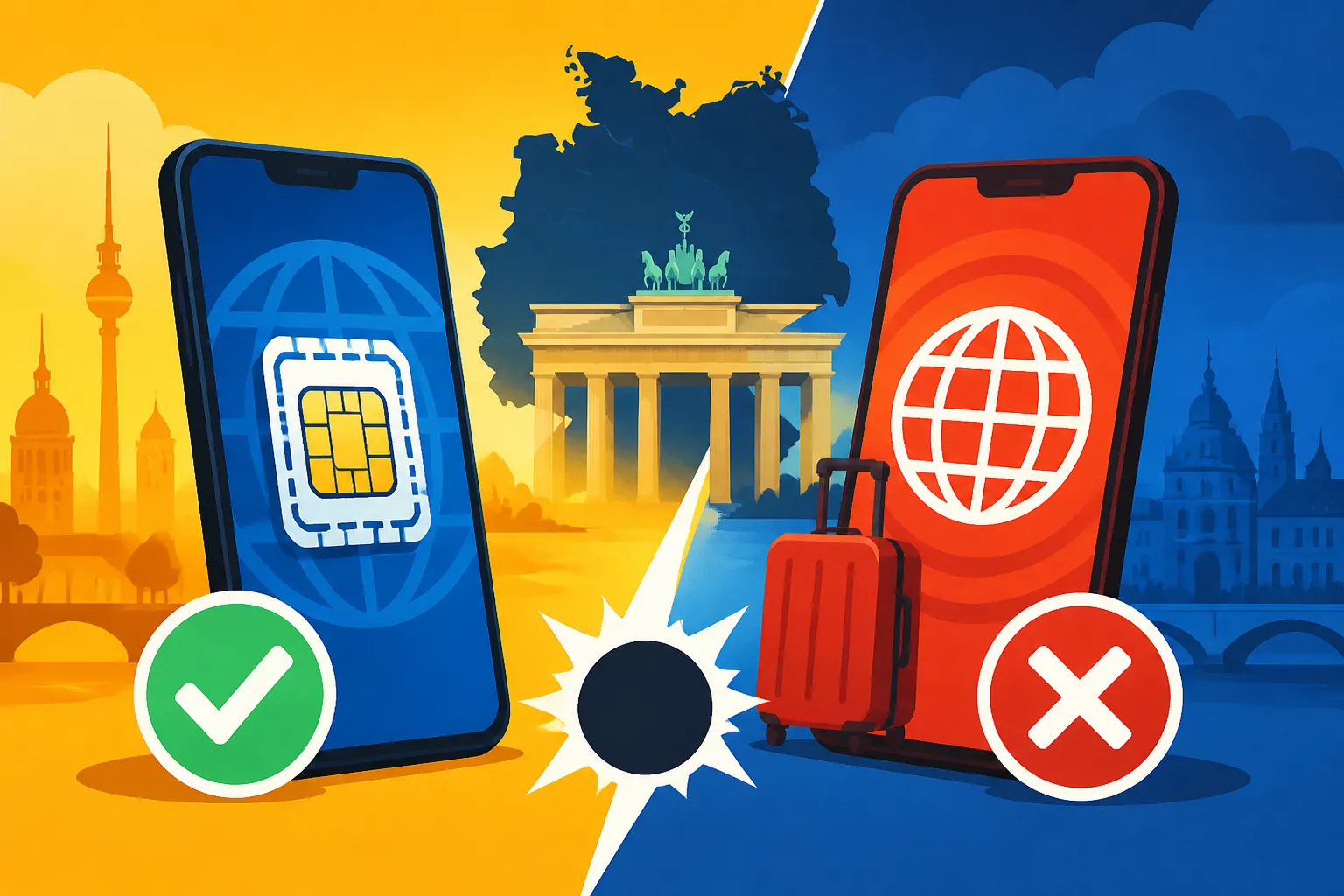
eSIM vs EU Roaming in Germany: What a Home SIM Actually Costs You
Oh, the joy of arriving in Germany, stepping off that plane, and realizing your phone just isn't working the way you thought it would. Or worse, it is working, but every little notification from home is secretly draining your bank account with exorbitant roaming charges. Many of us expats and tourists have been there, facing the frustrating dilemma of staying connected without breaking the bank. This comprehensive guide will pull back the curtain on the real costs and hassles of relying on your home SIM for EU roaming, compare it to the traditional German prepaid option, and introduce you to a much smoother, more affordable alternative that’s changing the game for connectivity in Germany: eSIMs, with a special look at Airalo.
Disclosure: This post may contain affiliate links. We may earn a commission at no extra cost to you if you make a purchase through these links. Read full disclosure.
The Sneaky Costs and Headaches of Traditional EU Roaming
When you think about "EU roaming," a lot of people outside the EU assume it means seamless, affordable connectivity across Europe. If you're coming from an EU country, you might feel a false sense of security, believing your "Roam Like at Home" policy has you covered. But let me tell you, it's never as straightforward as it seems, and for many, it can lead to some seriously unpleasant surprises on your phone bill.
The Myth of Seamless Connectivity for Non-EU Visitors
If you're visiting Germany from a non-EU country, like the US, Canada, Australia, or anywhere else outside the European Economic Area, the term "EU roaming" often doesn't apply to you in the way you might imagine. Your home network likely has some sort of international roaming package, but these are almost universally incredibly expensive. We’re talking about data rates that can hit several euros per megabyte – a quick scroll through Instagram could cost you more than your daily pretzel and beer combined!
Imagine this: you land at Frankfurt Airport, excited to start your German adventure. You quickly pull out your phone to message loved ones, check directions on Google Maps, or upload that first "I've arrived!" selfie. Without realizing it, your phone is now connecting to a German network, and your home provider is charging you premium rates. That WhatsApp message might be free to send, but the data it uses? Not so much. Before you know it, you could accumulate charges easily topping €50 or even €100 for just a few days of moderate usage. It's a classic trap for unsuspecting tourists and new arrivals, and it's certainly not the kind of welcome anyone wants.
The "Fair Use" Clause and Hidden Throttling for EU Residents
Even if you're lucky enough to be an EU citizen and benefit from "Roam Like at Home," there are still significant caveats. This policy, designed to make travel easier within the EU, isn't a blank check for unlimited data. Most providers have a "Fair Use Policy." This means if you spend too much time roaming in Germany – say, you've moved here for work or study and haven't gotten a local SIM yet – your provider can start charging you extra, or worse, significantly throttle your data speeds. They might even send you an SMS warning you that you're exceeding your fair use limit, and then suddenly, your lightning-fast connection slows to a snail's pace, making navigation, video calls, or even just browsing frustratingly slow.
And let's not forget the unexpected. Sometimes, depending on your specific plan and provider, certain services might not be covered, or calls to non-EU numbers (or even certain premium numbers within Germany) can incur charges you didn't anticipate. It’s always crucial to dive deep into the terms and conditions of your home provider's roaming agreement, but who has time for that when you're busy planning your relocation or vacation? It’s another layer of bureaucracy that foreign residents often encounter, similar to deciphering your first German rental contract.
The Hassle of Traditional German Local SIM Cards
For many years, the default advice for anyone staying in Germany for more than a few days was "just get a local SIM card." While certainly cheaper than international roaming, this path isn't always a walk in the park, especially if you're fresh off the plane and still grappling with German bureaucracy and language barriers.
The Bureaucratic Gauntlet for a German SIM
Getting a German prepaid SIM card isn't quite as simple as picking one up from a corner shop and popping it into your phone. Thanks to German regulations designed to prevent fraud, all SIM cards need to be registered and activated. This process, known as "Ident-Verfahren," typically requires you to show a valid ID (passport or national ID card) and often your German address. While some providers offer online video identification, many still require an in-person visit to a post office (PostIdent) or a physical store.
Imagine you've just arrived, you don't speak much German, you're tired, and you're dragging luggage. Now you need to find a phone store, navigate a queue, explain what you need, and complete a registration process that involves showing your passport and providing a local address, which you might not even have formally registered yet via an Anmeldung Address Registration. It's an additional hurdle when you're already overwhelmed, and it means you can't be immediately connected when you land. Even if you're only here for a two-week holiday, the time and effort involved can feel disproportionate to your needs.
Limited Flexibility and Potential Overspending
While local prepaid SIMs like those from Telekom, Vodafone, or O2 offer decent rates, they sometimes come with rigid data bundles or a minimum monthly spend. If you only need data for a few days, or if your usage varies wildly, you might end up paying for more than you actually use. What if you finish your data bundle unexpectedly? Topping up can be another minor headache, involving obscure codes or navigating German-only websites or machines.
Furthermore, if you're planning to travel beyond Germany's borders to other EU countries, your German SIM card will then become the "home SIM" for roaming. While still subject to "Roam Like at Home" policies, you'll still be tied to the same fair-use limitations mentioned earlier. This means that if you're an avid traveler exploring the broader European continent, constantly managing different physical SIMs for various countries or worrying about fair-use policies can quickly become tiresome. For those simply visiting Germany, the initial effort to acquire a physical SIM might outweigh the benefits for shorter stays.
Enter the eSIM: A Game-Changer for Seamless Connectivity in Germany
This is where technology swoops in to save the day for so many of us. The eSIM, or embedded SIM, is revolutionizing how we stay connected abroad, offering unparalleled convenience, flexibility, and often, much better value. It eliminates the physical SIM card entirely, allowing you to activate a mobile plan digitally.
What is an eSIM and How Does it Work?
Think of an eSIM as a digital SIM card that’s built directly into your phone (or tablet, smartwatch, etc.). Instead of swapping tiny plastic cards, you simply download a "profile" from a mobile provider. This profile contains all the network information you need, allowing your device to connect to a local network in Germany, just as if you had inserted a physical SIM. The beauty of it is that you can have multiple eSIM profiles stored on your device and switch between them as needed. This means you can keep your home SIM active for calls and texts (if you still need that number) while using an eSIM for data.
The process is incredibly simple:
- Check Compatibility: Ensure your phone is eSIM-compatible (most newer iPhones, Google Pixels, Samsung Galaxy phones, etc., are).
- Choose a Plan: Select a data plan for Germany (or Europe) from an eSIM provider.
- Activate: Scan a QR code or manually enter details, and voilà, you're connected!
Airalo: Your Connectivity Hero for Germany
When it comes to eSIM providers, Airalo truly stands out as a hero for expats and tourists in Germany. It’s exactly what many of us wished we had when we first arrived, fumbling with unreliable roaming or hunting for a phone store. Airalo offers local, regional, and global eSIM data packages that you can purchase and activate before you even leave home, or minutes after landing, all from the comfort of your smartphone.
Why is Airalo such a game-changer?
- Instant Activation: No more searching for stores, no queues, no paperwork, and no German required for registration. You simply buy a plan through the Airalo app, scan a QR code, and you’re online almost instantly. You can do this from your sofa before your flight, or even while your plane is taxiing to the gate at Munich Airport.
- Cost-Effective Data: Airalo plans are highly competitive and transparent. You know exactly what you’re paying for – a specific amount of data for a specific duration. No hidden fees, no surprise roaming charges, just clear-cut costs. For example, a few gigabytes for a week might cost you less than a single day of unexpected roaming.
- Flexibility: Need more data? Top up directly from the app. Traveling beyond Germany to Austria or France? Airalo offers regional plans that cover multiple European countries, saving you the hassle of buying a new eSIM for each border crossing. This flexibility is something traditional SIMs just can't match.
- Keep Your Home Number: With an Airalo eSIM, you can continue using your primary SIM card for calls and texts (if desired) while routing all your data through the eSIM. This means friends and family can still reach you on your familiar number, but you’re not bleeding money for data.
Let's imagine our Frankfurt Airport scenario again. This time, before you even board your flight, you've downloaded the Airalo app and purchased a 5GB eSIM for Germany. As soon as you land, you switch on your phone, navigate to your cellular settings, activate the Airalo eSIM, and immediately have access to high-speed data. No stress, no searching, just instant connectivity to order a taxi, find your hotel, or send that "I've arrived!" message with photos – all without fear of a shocking bill. This convenience is priceless, especially for those navigating their first moments in a new country.
Are you ready to experience hassle-free connectivity in Germany? Check out Airalo and get connected today!
eSIM vs. EU Roaming: A Direct Comparison for Your Germany Trip
To truly understand the value an eSIM brings, let's put it head-to-head with traditional EU roaming (which, as we've established, often translates to expensive international roaming for many non-EU visitors, or limited fair-use for EU residents).
Here's a breakdown of the key differences:
| Feature | Traditional EU Roaming (Home SIM) | German Local SIM (Prepaid) | eSIM (e.g., Airalo) |
|---|---|---|---|
| Activation | Automatic (just turn on phone) | In-person registration/ID check, store visit/PostIdent required | Digital download via app/QR code, no ID check, instant activation |
| Cost (Data) | Highly variable, often exorbitant for non-EU; fair-use limits for EU | Generally affordable, but tied to specific bundles; top-up needed | Very competitive, transparent pricing for specific data/duration plans |
| Flexibility | Limited to your home plan; no choice of local networks | Tied to one provider | Choose from various plans, top-up easily, regional/global options |
| Ease of Use | Plug-and-play, but with potential for bill shock | Initial setup can be complex/time-consuming, especially for newcomers | Simple, intuitive app-based management, seamless switching |
| Keep Home Number | Yes, your primary number is used | No, new German number, or dual-SIM phone needed | Yes, primary SIM active for calls/texts, eSIM for data |
| Paperwork | None (already registered) | Required (ID, address) | None |
| Availability | Anywhere your home provider has roaming agreements | Requires being in Germany to purchase and activate | Purchase and activate from anywhere, even before arrival |
As you can see from this table, while traditional EU roaming might seem simple on the surface, its hidden costs and limitations make it a less-than-ideal choice for most. German local SIMs are better for long-term residents, but the initial bureaucratic hurdles can be a pain. Airalo and other eSIM solutions, however, offer the best of both worlds: the ease of instant connectivity with transparent, affordable pricing and unparalleled flexibility. This makes them a great solution when you're considering How to Set Up Internet in Germany Without German Skills or trying to manage your budget for Cost of Living in Germany: Breakdown of Expenses.
Choosing the Right Connectivity for Your Germany Adventure
Deciding how to stay connected in Germany really depends on your specific needs, duration of stay, and comfort level with bureaucracy. As a seasoned expat, I've seen firsthand the headaches and unexpected expenses that poor connectivity choices can bring, but also the relief when a solution truly works.
When to Stick with Traditional Roaming (Carefully)
If you're an EU citizen on a very short trip (a day or two) and your home provider has a genuinely generous "Roam Like at Home" policy, and you don't anticipate heavy data usage, then relying on your home SIM might be acceptable. However, always double-check the fine print, especially regarding data caps and fair use policies. For non-EU citizens, I would almost universally advise against relying on your home country's international roaming for anything beyond absolute emergencies. The costs are simply too prohibitive.
When a Local German SIM Might Still Be for You
For those planning an extended stay in Germany – perhaps you're moving here for work, Studying in Germany, or aiming for Permanent Residence in Germany – a traditional German physical SIM card can still make sense after you've settled in and completed your Anmeldung: Registering Your Address in Germany. They offer a local German number, which can be useful for official registrations, setting up utilities, or even just calling local restaurants or services. Major providers like Telekom, Vodafone, and O2 offer a range of contract and prepaid options. But remember, this is a solution for when you're rooted, not for immediate arrival.
Why an eSIM is Your Best Bet for Most Scenarios
For the vast majority of tourists, short-term visitors, and even new expats who need immediate, stress-free connectivity upon arrival, an eSIM like Airalo is, hands down, the superior choice. Its advantages are clear:
- Immediate Connectivity: You land, and you're online. Simple as that. No hunting for Wi-Fi, no desperate searches for phone stores. This is invaluable when navigating a new city, trying to reach your accommodation, or just staying in touch with family. For travelers wanting to explore Germany’s regions and cities, an eSIM ensures seamless navigation and communication. For more general travel tips, consider checking out Travel Logistics in Germany: Money, Safety, and Connectivity.
- Cost Efficiency and Transparency: With Airalo, you purchase a data package upfront. There are no hidden charges, no surprises, and you can easily monitor your usage. This allows for far better budgeting, especially when considering the overall Cost of Living in Germany.
- Flexibility for European Travel: If your German adventure is part of a larger European tour, Airalo's regional eSIMs simplify connectivity across borders. Instead of buying new local SIMs in France, Italy, or Spain, one regional eSIM can cover your needs, providing peace of mind as you explore the Continent. This is a game-changer for those enjoying Day Trips and Weekend Getaways Across Germany and beyond.
- Retain Your Primary Number: The ability to keep your original phone number active for calls and SMS while using an eSIM for data is a huge perk. It means you won't miss important calls or texts from your home country, but you'll avoid the excessive data roaming fees.
In summary, for ease, affordability, and flexibility when visiting or first moving to Germany, choosing an eSIM from a reputable provider like Airalo is a smart move. It allows you to focus on enjoying your time in Germany, rather than worrying about your phone bill or hunting down a physical SIM card. Stay connected the smart way!
Disclaimer
Please note that while we strive to provide accurate and up-to-date information, rules and regulations regarding telecommunications, roaming, and SIM card registration in Germany can change. Always check the latest terms and conditions with your home provider, the German network operators, or your chosen eSIM provider like Airalo, before making any decisions. This guide is for informational purposes only and does not constitute professional advice.