Business Travel to Germany: Expensing eSIM Data and Getting Invoices
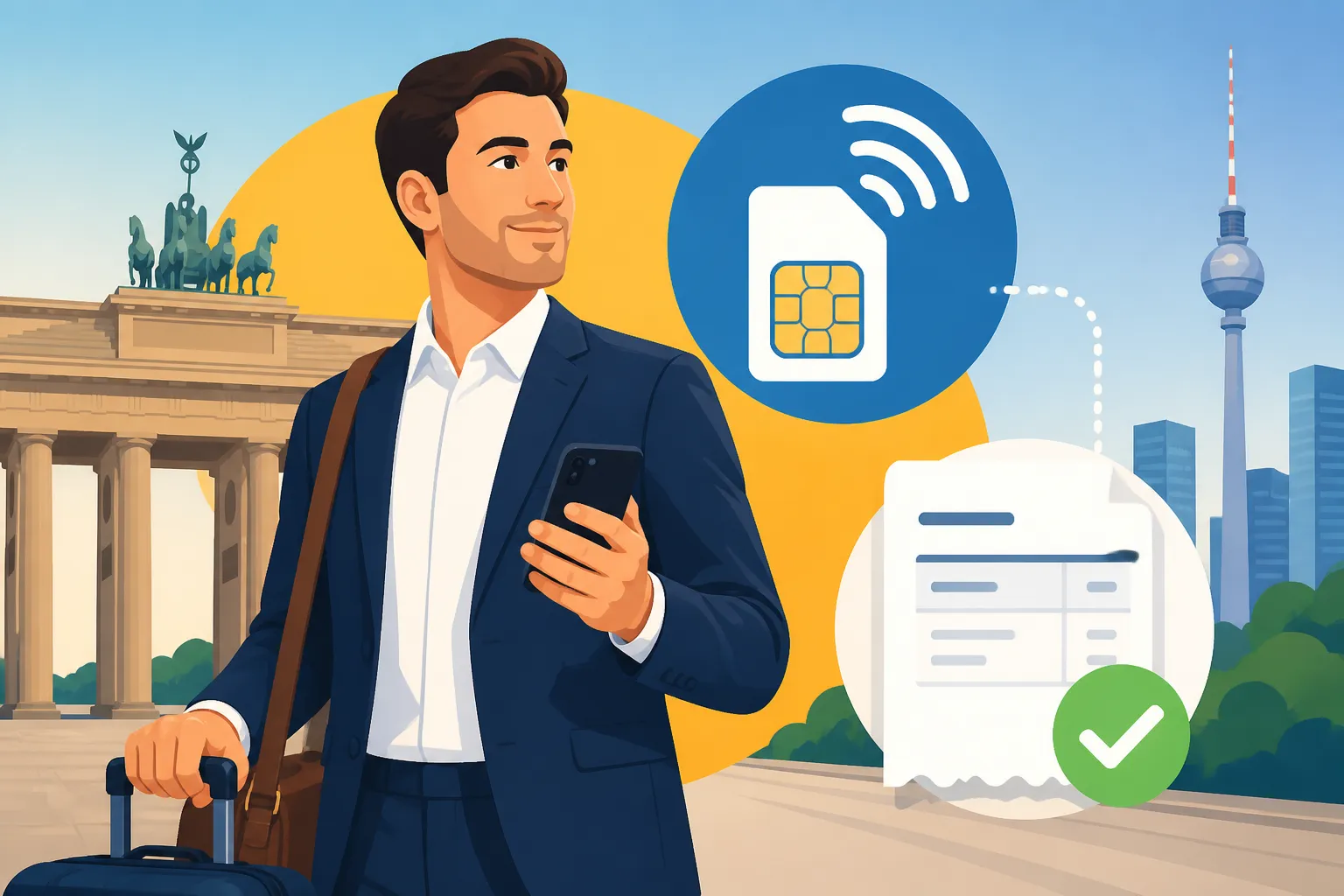
Ah, the German business trip! It sounds so official and streamlined on paper, doesn't it? But for us expats who’ve navigated these streets and their notoriously particular bureaucracy, we know the reality is often less "efficient German engineering" and more "head-scratching administrative maze." One of the biggest headaches? Staying connected without breaking the bank or losing your mind trying to get proper invoices for your expenses. This guide is here to cut through the confusion, showing you how to manage your mobile data with an eSIM like Airalo, ensuring you're always connected, and more importantly, always ready for that expense report.
Disclosure: This post may contain affiliate links. We may earn a commission at no extra cost to you if you make a purchase through these links. Read full disclosure.
The Frustration of Business Travel Connectivity in Germany
Let's be real, the last thing you want when you land in Frankfurt or Munich for a critical meeting is to be scrambling for Wi-Fi or staring at a monstrous roaming bill. Business travel demands constant, reliable connectivity, and frankly, Germany's options can be a bit of a mixed bag if you don't know the ropes. You're here to work, to make connections, not to battle with technology or finance departments over a data charge.
Why Traditional Roaming and Local SIMs Fall Short for Business Travelers
Remember the good old days of international roaming? Or perhaps more accurately, the bad old days? You’d return home, open your phone bill, and practically need a defibrillator. Those exorbitant charges for simply checking emails or using maps were, and often still are, a nightmare for personal finances and corporate expense accounts alike. While roaming has gotten slightly better with some providers, it's rarely truly cost-effective for anything beyond a few emergency texts.
Then there's the local physical SIM card route. On paper, it seems like a sensible option. Get to Germany, find a phone shop, buy a local SIM, and you're good to go, right? Well, not quite. First, there's the immediate hassle upon arrival. After a long flight, navigating a foreign airport or city to find a mobile provider, then dealing with potential language barriers to explain your needs, is the last thing you want. Moreover, in Germany, registering a local SIM card often requires Anmeldung (address registration) or at least a local German address for the process, which can be a real pain if you're only here for a short business trip. It's a bureaucratic hurdle that adds unnecessary stress when your focus should be on your meetings and work. You certainly don't want to be wasting precious business hours wrestling with paperwork when you could be preparing for your next presentation.
The Hidden Costs and Inconveniences of Relying on Public Wi-Fi
"Oh, I'll just use hotel Wi-Fi," you might think. Or "I'll find a café with free internet." And sure, these options exist. But let's talk about the reality of public Wi-Fi, especially for business-critical tasks.
Firstly, security. Public Wi-Fi networks are notoriously insecure. For a business traveler dealing with sensitive company data, client information, or confidential communications, connecting to an unsecured network is a huge risk. Anyone with basic hacking skills can potentially intercept your data, making it a non-starter for serious work. You'd need a robust VPN, which is another layer of complexity to manage.
Secondly, availability and reliability. You might find Wi-Fi in your hotel, but is it fast enough for a video conference with your team back home? Is it consistently available throughout the day, or does it cut out every time a dozen other guests log on? What about when you're on the go, navigating between appointments, or needing to quickly respond to an urgent email while in a taxi or train? Relying solely on public Wi-Fi means constant searching, hoping for a stable connection, and often ending up frustrated. Time spent hunting for Wi-Fi is time taken away from productivity, and for a business trip, that's simply not acceptable. I know the feeling of trying to download a critical document only to have the hotel Wi-Fi choke, it’s infuriating. This constant uncertainty and potential for delays can quickly derail a well-planned schedule. For more general connectivity options when settling in, you might find our guide on Internet and Mobile Phone Plans in Germany: Getting Connected Fast useful, but for short-term business travel, it's a different beast.
Why eSIMs are a Game-Changer for German Business Trips
This is where eSIM technology steps in as a true lifesaver for business travelers. Imagine landing in Germany, stepping off the plane, and your phone already has a local data plan, ready to go. No searching for SIM cards, no registration forms, no exorbitant roaming fees. That's the power of an eSIM, and for me, it's one of the best advancements for modern travel. And when it comes to reliability and ease of use, I've found Airalo to be an absolute champion in this space.
The Simplicity and Cost-Effectiveness of eSIM Technology
So, what exactly is an eSIM? Think of it as a digital SIM card embedded directly into your phone. Instead of fumbling with a tiny physical chip, you simply download a "profile" to your device. Most modern smartphones, including recent iPhone models (XS and newer) and many Android flagships (like Google Pixel 3 and newer Samsung Galaxy models), come with eSIM capabilities.
The advantages are manifold, especially for business travelers:
- Instant Connectivity: You can purchase and activate your eSIM plan before you even leave your home country. This means the moment your plane touches down in Germany, you can switch on your data plan and be connected. No more airport anxiety about getting online.
- No Physical Swapping: You keep your home country's physical SIM card in your phone, allowing you to receive calls or texts on your main number, while using the eSIM for data. No more tiny tools, lost SIM cards, or fumbling around.
- Multiple Profiles: Many phones allow you to store multiple eSIM profiles. This is brilliant if you're a frequent international traveler, hopping between Germany, France, and Spain. You can simply switch between activated plans as needed.
- Cost-Effective: eSIMs, particularly from providers like Airalo, offer local data rates that are significantly cheaper than international roaming. You buy exactly what you need – a specific amount of data for a specific duration – avoiding hidden costs. This gives you much better control over your travel budget and makes expensing data far more straightforward.
I've personally used Airalo on numerous trips, and the process couldn't be simpler: download the app, choose your destination (Germany, in this case), pick a plan, and install it. It's truly a seamless experience that allows you to hit the ground running, which is precisely what you need on a business trip.
Choosing the Right eSIM Plan for Your Business Needs
Selecting the perfect eSIM plan depends entirely on your individual travel habits and data consumption. Airalo offers a fantastic range of options that cater to different durations and data needs, ensuring you're not paying for more than you'll use, nor running out unexpectedly.
Here are some factors to consider when picking your plan:
- Trip Duration: Are you in Germany for a quick 2-day conference or a week-long project? Airalo has plans ranging from 7 days to 30 days or even longer, so you can align your data package with your stay.
- Data Usage: How much data do you typically consume? Think about your daily activities:
- Light User (1-3 GB for a week): Primarily emails, checking maps, occasional web browsing, instant messaging.
- Moderate User (5-10 GB for a week): Regular email, video calls, using cloud-based documents, streaming some content during downtime.
- Heavy User (10+ GB for a week): Frequent video conferences, large file transfers, heavy navigation, significant streaming.
- Bundles vs. Top-ups: Some plans offer a fixed amount of data, while others allow for easy top-ups if you unexpectedly run low. Airalo makes topping up incredibly easy directly from their app, saving you any last-minute stress.
To help you visualize, here's a general idea of how different plan sizes might fit typical business travel scenarios:
| Scenario | Recommended Airalo Plan Size | Typical Duration | Usage Pattern |
|---|---|---|---|
| Short Conference (1-3 days) | 1 GB – 3 GB | 7 days | Essential emails, map navigation, messaging apps. Minimal video calls. Great for quick in-and-out trips where Wi-Fi might cover heavier tasks. |
| Standard Business Trip (4-7 days) | 5 GB – 10 GB | 7 – 15 days | Regular emails, multiple video calls, accessing cloud documents, navigating, social media. Enough for a comfortable week of productive work and some downtime browsing. |
| Extended Project Work (1-2 weeks) | 10 GB – 20 GB | 15 – 30 days | Heavy use: frequent video conferencing, large data transfers, constant online research, navigation, and some personal streaming. Ideal for longer engagements where you need consistent, high-volume connectivity. |
| Frequent Traveler (Multiple trips) | Regional or Global eSIM | 30+ days | For those whose business takes them across multiple European countries, Airalo also offers regional (e.g., Eurolink) or global plans that simplify connectivity across borders, eliminating the need to buy individual country-specific eSIMs for each leg of your journey. |
This flexibility is a major plus for business travelers. You can often buy the data you need for Germany specifically, ensuring you're getting local rates. This strategic approach to connectivity means more time focusing on your work, and less time worrying about connectivity costs or reliability. It's about being prepared, connected, and financially savvy – which is exactly what a smart business traveler in Germany needs.
Mastering Expense Reports: Getting Invoices for Your eSIM Data
Now, let's tackle the elephant in the room for many business travelers: expensing. It's not enough to just have the data; you need to prove what you spent and why. German financial regulations, and consequently most company expense policies here, are quite strict about proper documentation. A simple credit card statement isn't always going to cut it, especially for services. This is where getting a proper, clear invoice from your eSIM provider is absolutely crucial.
Understanding German Expense Requirements for Business Travel
Germany has a reputation for bureaucracy, and for good reason! The Finanzamt (tax office) and company finance departments are sticklers for detail. For any business expense, they typically require an ordentliche Rechnung (proper invoice) that includes specific details. Without this, your reimbursement might be delayed, or worse, rejected.
Key elements generally expected on a German-compliant invoice include:
- Service Provider Details: Full name, address, and VAT ID (Umsatzsteuer-Identifikationsnummer) of the eSIM provider.
- Customer Details: Your company's full name and address (if the expense is directly for the company), or your name if it's a personal reimbursement that needs to be tied to a business trip.
- Date of Issue: When the invoice was generated.
- Invoice Number: A unique identifier for the transaction.
- Description of Service: What was purchased (e.g., "eSIM data package for Germany, 5GB").
- Amount: The net amount, the VAT rate (if applicable), the VAT amount, and the gross amount.
- Date of Service: The period the data package covers.
While a small data package might sometimes slip through with less formal documentation, consistently having proper invoices shows diligence and makes life much easier for your finance department, reducing queries and ensuring smooth reimbursement. It's a small step that saves a lot of headaches in the long run. Understanding your German payslip (Gehaltsabrechnung) will also give you an idea of how much detail the German system likes!
How to Obtain a Proper Invoice from eSIM Providers (Focus on Airalo)
This is another area where Airalo really shines for business travelers. They understand the need for clear documentation. Instead of having to jump through hoops or send emails back and forth, you can usually access all your transaction history and download invoices directly from your account.
Here’s a step-by-step guide to typically get your invoice from Airalo:
- Log In to Your Airalo Account: Access your account either through the Airalo mobile app or their website.
- Navigate to Purchase History: Look for a section like "My eSIMs," "Orders," or "Purchase History." This is where all your past eSIM purchases are listed.
- Select the Relevant Purchase: Find the specific eSIM data package purchase for your German business trip.
- Download Invoice/Receipt: There should be an option, often labeled "View Receipt," "Download Invoice," or "Download Tax Invoice." Click this to generate a PDF document.
- Check Details and Add Your Company Information:
- Once you download it, quickly check that the invoice includes the necessary Airalo details (name, address).
- Crucially, Airalo allows you to add billing details, including your company name and address, to your account profile. Make sure this information is entered before you make a purchase if possible, or update your profile to ensure future invoices reflect your company’s details. If you've already made a purchase, sometimes you can edit the billing details for past invoices within a certain window, or you might need to contact their support to have it updated.
The invoice generated by Airalo is generally comprehensive and includes the necessary transaction details. While it might not always show a separate VAT breakdown for every country's specific tax authority (as eSIM data packages often involve cross-border digital services), it provides robust proof of purchase, cost, and service, which is usually sufficient for internal company expense policies and a good starting point for German tax compliance. Always double-check with your company's finance department about their specific requirements, especially regarding VAT on digital services from non-German entities. Having a clear record like the one Airalo provides will significantly ease your mind.
Practical Tips for a Connected & Compliant Business Trip
Beyond just buying an eSIM, there are a few practical considerations to ensure your business trip to Germany runs smoothly, both in terms of connectivity and paperwork. Think of these as little tricks of the trade that save you from the usual expat hiccups.
Pre-Trip Preparation and On-Arrival Activation
Preparation is key, especially when you're flying in for work. A little foresight can save you a lot of stress.
- Install Airalo Before You Depart: The biggest tip I can give you: download the Airalo app, choose your German eSIM plan, and follow the installation steps before you even head to the airport. Many modern phones allow you to install the eSIM profile without activating it immediately. You can choose to activate it manually or set it to activate upon arrival in Germany. This way, the moment you land, you just toggle it on, and poof! – instant data. No hunting for Wi-Fi in the airport, no queuing. This level of preparedness is invaluable.
- Check Compatibility: Ensure your phone is eSIM compatible and unlocked before you purchase. Most newer flagship phones are, but a quick search online for your specific model will confirm.
- Understand Your Phone Settings: Familiarize yourself with how to manage cellular plans on your device. You'll want to set the eSIM as your primary data line and, if desired, keep your home SIM active for calls/texts. Airalo provides clear instructions for both iOS and Android, but knowing your way around your phone's settings will make the transition effortless.
- Screenshot Confirmation: Once your eSIM is installed and active, take a screenshot of the confirmation in your Airalo app. This serves as an immediate visual proof of purchase and activation, which can be handy.
Data Management and Security Best Practices
Staying connected is one thing; staying secure and within budget is another. Especially on a business trip, you want to be mindful of both.
- Monitor Data Usage: The Airalo app makes it super easy to track your data consumption in real-time. Regularly check how much data you've used and how much is remaining. This prevents unexpected run-outs and helps you decide if a top-up is needed, allowing you to manage costs effectively. If you realize your usage is higher than anticipated, topping up through Airalo is usually a quick process.
- Utilize Wi-Fi When Available and Secure: If your hotel offers secure, fast Wi-Fi (e.g., requiring a password and ideally offering a WPA2 or WPA3 security protocol), use it for heavy tasks like large downloads or long video calls to conserve your eSIM data. However, for any truly sensitive business communication, always use your company's VPN, regardless of the network. This adds a crucial layer of protection. For general tips on staying safe, our Staying Safe in Germany: Common-Sense Tips for Travelers article has broader advice.
- Disable Data Roaming on Your Home SIM: To avoid accidental charges from your primary provider, make sure data roaming is turned off for your physical SIM card in your phone settings. This ensures all your data usage goes through your Airalo eSIM.
- Keep Proof of Travel: For expense purposes, always retain your flight tickets, hotel booking confirmations, and any other documents that prove your business travel dates and destination. This, combined with your Airalo invoices, creates a solid paper trail for your company's finance department.
- Explore Company Policies: Some companies might even have preferred eSIM providers or specific expense codes for mobile data. A quick chat with your finance or travel department before your trip can clarify any specifics.
By taking these proactive steps, you're not just ensuring seamless connectivity; you're also being a savvy business traveler, navigating Germany's administrative landscape with confidence and efficiency. You'll be able to focus on the why of your trip – your business goals – rather than the how of staying connected or getting reimbursed.
Disclaimer
Please note that while this guide provides comprehensive advice based on expat experiences and general German regulations, individual circumstances and specific company policies may vary. Tax laws and immigration rules in Germany are subject to change. Always consult with your company's finance department, a qualified tax advisor, or the relevant authorities for personalized advice regarding your specific situation and for the most up-to-date information.