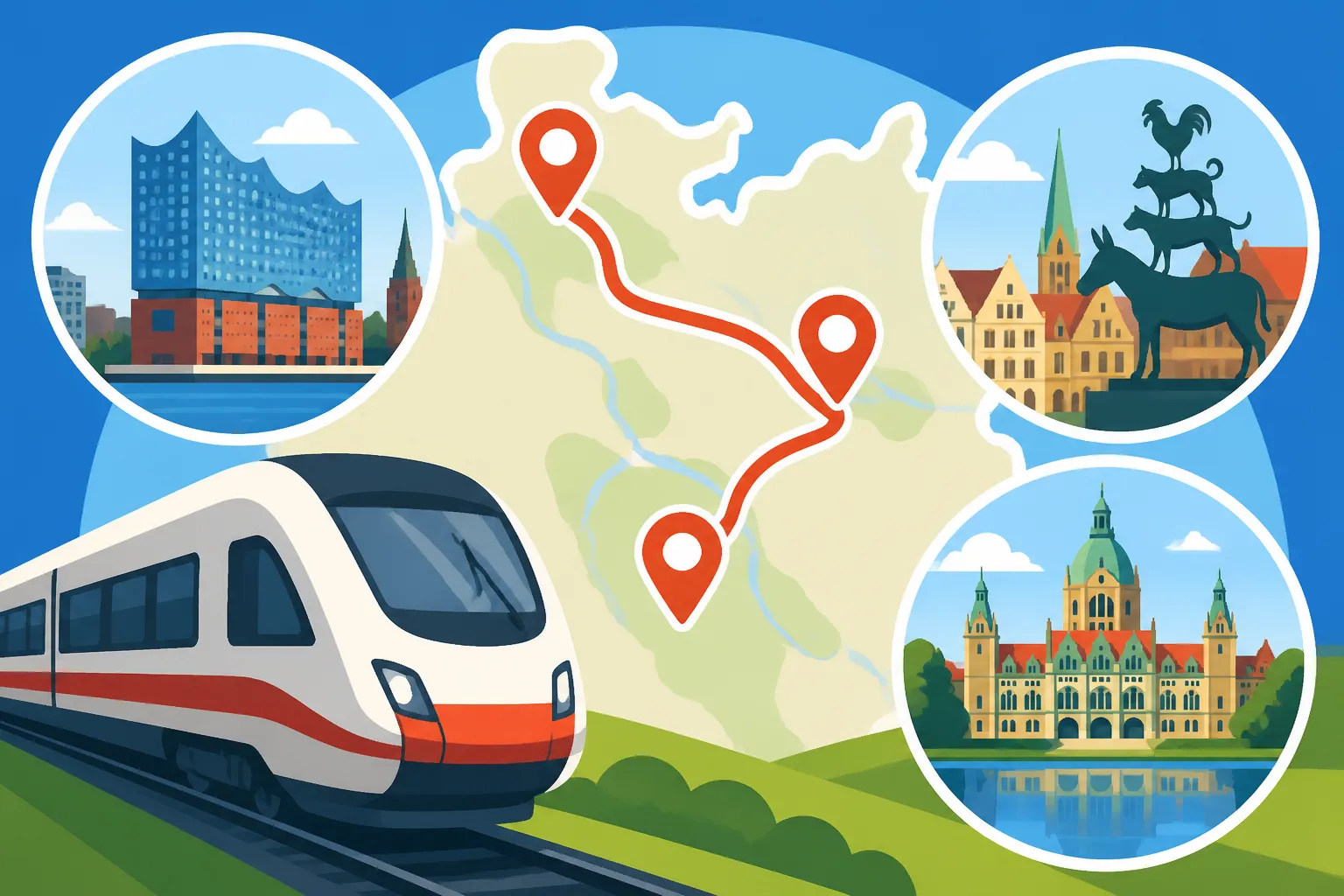
Hamburg to Bremen and Hannover: Northern Regional Ticketing
Standing at Hamburg Hauptbahnhof with a ticket machine offering a dozen fare types is a common way to start a trip north. Should you take the fast ICE to Bremen, the cheaper metronom, or a regional day ticket? This guide explains how ticketing works between Hamburg, Bremen and Hannover, and how to compare your options before you pay.
Disclosure: This post may contain affiliate links. We may earn a commission at no extra cost to you if you make a purchase through these links. Read full disclosure.
Understanding the Northern Rail Triangle
Look at a map and Hamburg, Bremen and Hannover form a rough triangle across the north. The ticketing is harder to read than the map. I lived in Hamburg for years and travelled to both cities for work, for football away days and for friends’ birthdays. For months I paid more than I needed to, and more than once I had the wrong ticket for the train I was on.
The main confusion is political. Hamburg is its own federal state, a city-state. Bremen is also its own federal state: a city-state made up of Bremen and Bremerhaven, sitting like an island inside Lower Saxony. Hannover is the capital of Lower Saxony. A short trip from Hamburg to Bremen therefore crosses from one city-state, through a strip of Lower Saxony, into another city-state. Each area has its own local transport association, so the price on your screen depends on whether you are riding a long-distance train, a regional train or a city tram.
The Three Kinds of Trains You Will Meet
On these corridors you will see three types of service. Long-distance trains are the ICE and IC services run by Deutsche Bahn. They are fast, comfortable and have reservable seats. Their fares change with demand, so the same journey can cost very different amounts depending on when you book and when you travel.
Regional trains come next. Between Hamburg and Bremen the best-known operator is metronom, whose double-decker trains run through towns like Buchholz, Tostedt and Rotenburg on the Wümme. Between Hamburg and Hannover you can also go by regional train via Lüneburg, Uelzen and Celle. Expect a change in Uelzen and a slower journey. Between Bremen and Hannover, regional express trains run through towns like Verden and Nienburg. These trains do not take seat reservations, their fares are fixed rather than demand-based, and they are covered by regional passes.
Then there are the city networks. Hamburg has the HVV, Bremen has the VBN and Hannover has the GVH. Once you step off the train at Bremen Hauptbahnhof or Hannover Hauptbahnhof, your next tram or bus is covered by that city’s local tariff unless your ticket includes it. For background on the regional side, see Regional Trains and the Deutschland-Ticket Explained.
Why Foreigners Get Caught Out
The classic mistake goes like this. You buy a cheap regional fare for Hamburg to Bremen. You see an ICE on the departure board leaving five minutes earlier and you get on it, assuming a train is a train. When the conductor checks your ticket, you find out that regional fares are not valid on long-distance trains. Explaining that in English while the carriage watches is not a good start to the day.
The opposite mistake is just as common and costs money. Visitors buy a full-price, flexible long-distance ticket for a simple Bremen day trip on a Saturday. A regional ticket or an early-booked saver fare would have done the same job for less, with only a little more travel time.
A third trap is buying through several apps at once: a Deutsche Bahn ticket for one leg, a FlixBus ticket for the return, and a city ticket from a machine on arrival. That works, but you end up with three accounts, three payment methods and three sets of cancellation rules. Many people now start with a single search on a comparison platform like Omio so they can see trains and buses side by side before choosing.
Choosing the Right Ticket for Each Route
Each leg of the triangle has its own character, and the best ticket depends on how fast you need to travel, how flexible your plans are and how many people are with you. The table below summarises how the main options behave. Fares change often, so check the operator’s or platform’s own page for current prices.
| Ticket or Service | Valid On | Price Behaviour | Seat Reservation | Best For |
|---|---|---|---|---|
| ICE or IC saver fare | Specific long-distance train you booked | Changes with demand, usually cheaper when booked early | Optional, at extra cost | Fixed plans and speed |
| ICE or IC flexible fare | Any long-distance train on that route and day | Higher and stable | Optional, at extra cost | Business trips and changing plans |
| Regional single ticket | Regional trains like metronom only | Fixed tariff | Not available | Simple one-way trips |
| Niedersachsen-Ticket | Regional trains across Lower Saxony, also reaching into Bremen and Hamburg | Fixed day price, structured for small groups | Not available | Day trips with friends or family |
| Deutschland-Ticket | Regional and local transport nationwide | Monthly subscription | Not available | Residents who travel often |
| Long-distance bus | The specific coach booked | Changes with demand | Seat often assigned or selectable | Lowest fares |
Hamburg to Bremen
This is the busiest leg and the one most visitors ask about. The fast option is the ICE or IC from Hamburg Hauptbahnhof, often stopping at Hamburg-Harburg, and it takes around an hour. The metronom is slower because it stops more often, but it runs frequently and costs the same whatever the time of day.
Take Lena, a student who has just moved to Hamburg. Her friend in Bremen invites her to a Sunday brunch in the Viertel. Lena has a Deutschland-Ticket for her daily commute, so she simply takes the metronom. Her ticket covers the regional train and the Bremen trams. Paying for an ICE seat would only save her a little time.
Now take Marcus, a consultant flying into Hamburg for a meeting near the Bremen Überseestadt. He has to be there at a set hour and might need to leave early. For him the speed and flexibility of a long-distance train are worth paying for. He searches on Omio, compares the morning ICE and IC departures with a FlixBus option, and books the train that fits his meeting. The ticket goes into the same app he uses for his other European trips.
Hamburg to Hannover
This leg gives the strongest case for long-distance trains. The ICE runs directly between the two main stations in a little over an hour. The regional route goes via Lüneburg and Uelzen, usually needs a change, and takes noticeably longer. It suits patient travellers on a regional pass better than someone with a timetable to keep.
Messe weeks in Hannover change the picture. During Hannover Messe and other big trade fairs, long-distance trains between Hamburg and Hannover fill up and saver fares disappear fast. If your trip falls in one of those weeks, book as early as you can. See Trade Fair Weeks: How Messe Dates Distort Transport Prices to understand how strongly demand moves prices.
For flexible leisure travellers, the regional route has some appeal. Lüneburg’s old town is worth a stop, and Celle’s timber-framed centre is lovely on a quiet weekday. Some visitors turn the slow route into a day of sightseeing and arrive in Hannover by evening.
Bremen to Hannover
This leg is more relaxed. Regional express trains connect the two cities directly, and long-distance trains also run on the route. Both cities sit inside the same regional ticket area for the Niedersachsen-Ticket, so this is the leg where a regional day pass looks best, especially for groups.
Picture a family of four visiting relatives in Hannover from Bremen. A flexible long-distance ticket for every person adds up quickly. A regional day ticket designed for small groups usually comes out far cheaper, and the extra time is often small. Check the current group size limit and validity hours on the issuing operator’s page before you travel. Weekday morning restrictions have applied to some regional day tickets in the past.
Booking Step by Step and Avoiding Common Mistakes
Once you know which train type suits you, the actual booking is simple, as long as you follow a clear order. I learned this the hard way after a trip where I had a valid long-distance ticket but no idea it did not cover the tram to my hotel in Bremen.
A Simple Booking Process for Long-Distance Trips
Here is the process I use for any Hamburg, Bremen or Hannover trip that involves an ICE, IC or long-distance bus:
- Open Omio and enter your departure and arrival cities, for example Hamburg to Hannover, along with your date and an approximate time.
- Compare the train and bus results side by side. Look at journey time, number of changes and the fare conditions, not just the headline price.
- Check whether the fare is a saver or a flexible type. Saver fares are usually tied to the specific train shown. Flexible fares let you take another train that day.
- Decide whether you want a seat reservation. On busy Friday evening and Sunday afternoon trains it can save you from standing in the vestibule with your suitcase.
- Enter your name exactly as it appears on the ID you will carry. Conductors can ask to see identification that matches a personalised ticket.
- Pay with a card your bank allows for online purchases, then save the mobile ticket somewhere you can open it without signal.
- On arrival, check whether your ticket includes local transport in the destination city. If not, buy a local ticket for the city network before boarding a tram or bus.
Following these steps through Omio has another advantage for visitors: the interface works well in English, and you can compare operators in one search instead of moving between apps. If foreign cards or name formats have caused you trouble before, see Booking German Trains From Abroad: Foreign Cards, Names, and Failures.
When to Buy Regional Tickets Instead
Regional travel works differently. If you are riding only metronom or other regional trains, you do not need to book ahead because prices are fixed. You can buy a single ticket or a day pass from a machine at the station, at a ticket counter, or through the operator or Deutsche Bahn apps.
If you live in Germany and travel regularly, the Deutschland-Ticket is a monthly subscription covering regional and local transport across the country. It does not cover ICE or IC trains, so it suits the slower routes. To decide whether it is worth it for your habits, see What Is the Deutschland-Ticket and Is It Worth It?. Once you have it, see How to Use Regional Trains With the Deutschland-Ticket for how to plan journeys.
Many residents combine the two. They use the Deutschland-Ticket for everyday regional travel and buy a long-distance ticket only when speed matters. On those days, a quick check on Omio shows whether an ICE fare, an IC fare or a FlixBus coach is the better deal for that specific journey. For how to combine different ticket types on one trip, see Combining Long-Distance and Regional Tickets in One Journey.
Mistakes I See Expats Make Again and Again
The first is ignoring fare conditions. A saver fare can look like a bargain, but if your plans change, the rules on changes and refunds matter. Before you click buy, read Sparpreis vs Flexpreis on Deutsche Bahn: Change Rules and Refunds so you know what you are giving up.
The second is underestimating luggage. Metronom trains have plenty of space on the lower deck, but on a busy Friday afternoon, a large suitcase plus a bike plus a pram can turn a regional train into a puzzle. Long-distance buses have their own baggage limits. Check Luggage and Bike Rules on German Trains and Buses before you pack for a long stay.
The third is not planning for disruption. Northern Germany sometimes sees weather problems in winter, and engineering work at weekends can replace trains with buses on parts of these routes. If your train is delayed or cancelled, know your rights. See DB Strikes and Delays: Your Rights, Compensation, and Rebooking for what you can claim and how to rebook.
Making the Most of Your Northern Trip
Ticketing is only part of the story. Hamburg, Bremen and Hannover each have their own personality, and the way you book can shape the whole trip. A rushed ICE dash can work well for business, while a slow regional day can become a small adventure.
Building a Multi-City Itinerary
One of my favourite routes for visiting friends is a loop: Hamburg to Bremen on a morning train, a full day in the Schnoor quarter and along the Schlachte promenade, then on to Hannover the next morning for the Herrenhausen Gardens and the Maschsee, and finally back to Hamburg by ICE. It covers three distinct cities without hiring a car.
Planning a loop like this is where a comparison platform helps. On Omio you can search each leg separately and compare trains and buses for every segment. That lets you choose a cheap FlixBus for one leg, a fast ICE for another and a regional train for the shortest hop. For more on coaches, see Long-Distance Buses in Germany: FlixBus and Networks.
For where to sleep on a multi-city trip, see Where to Stay in Bremen and Hannover: Northern City Options. If you are starting from Hamburg and want to spend a day or two there first, see Hamburg City Guide: Harbor, Music, and Nightlife.
Pros and Cons of Each Approach
To make the decision easier, here is how the main approaches compare.
| Approach | Advantages | Drawbacks |
|---|---|---|
| Long-distance train booked in advance | Fast, comfortable, reservable seats, cheaper when booked early | Saver fares are usually tied to one train and can sell out at busy times |
| Flexible long-distance ticket | Freedom to change trains on the day | Usually the most expensive option |
| Regional train with single ticket | No booking needed, fixed price, frequent departures | Slower, no reservations, crowded at peak times |
| Regional day pass for groups | Good value for families and friends | Validity hours and group rules need checking |
| Deutschland-Ticket | Covers regional and local transport nationwide | Subscription commitment, no long-distance trains |
| Long-distance bus | Often the lowest fare, generous luggage in some cases | Traffic delays, less space to move around |
Most travellers do not need to commit to one approach for every trip. Use the cheapest valid option for flexible leisure travel and pay for speed and flexibility only when they matter.
Final Tips From Years of Northern Travel
Check the departure board as well as your app. Platform changes at Hamburg Hauptbahnhof are common, and the station is busy, so give yourself a few extra minutes to find the right platform.
Look at journey times with a sceptical eye. A connection that saves a few minutes but needs a tight change in Uelzen or Verden can cost you much more time if the first train runs late. A direct regional or long-distance train is often the less stressful choice.
Above all, compare before you commit. The north of Germany has excellent rail and bus connections, but the range of fares and operators can confuse even long-term residents. When I plan a trip between Hamburg, Bremen and Hannover now, I start with a search on Omio, look at every option for my date, and then decide whether to book the train or bus there or take a regional train with my existing pass. That habit has saved me money and plenty of awkward conversations with conductors.
Disclaimer
This article is for general informational purposes only and does not constitute professional advice. Laws, prices and regulations vary by location and change over time. Consult a qualified professional for guidance on your specific situation.