Combining Long-Distance and Regional Tickets in One Journey
Picture this: you’ve booked a cheap ICE from Berlin to Munich, then realise your guesthouse is in a tiny Alpine village two regional trains away. Do you need another ticket? Will it still be valid if the ICE runs late? This guide explains how combined long-distance and regional journeys work in Germany, and how to book them in one go with Omio.
Disclosure: This post may contain affiliate links. We may earn a commission at no extra cost to you if you make a purchase through these links. Read full disclosure.
Why Combining Tickets Trips Up So Many Travellers in Germany
I still remember my first attempt at this. I had a Sparpreis ticket from Frankfurt to Hamburg and wanted to continue to a small town on the Baltic coast. I stood at a ticket machine at Hamburg Hauptbahnhof for ten minutes, scrolling through zone maps and tariff names I couldn’t pronounce. Meanwhile my regional train was boarding two platforms away. I bought something, boarded, and spent the whole ride worrying that a conductor would tell me I had the wrong fare. If that sounds familiar, you’re in good company.
Germany has one of the best-connected rail networks in Europe. The way it’s sold, though, still reflects a patchwork of operators, regional transport associations and fare systems. Long-distance trains such as the ICE and Intercity are mostly run by Deutsche Bahn. Regional trains may be run by Deutsche Bahn or by private operators with their own branding, and local buses and trams belong to city or regional transport associations. A trip that looks simple on a map can involve three or four of these systems.
The good news is that you don’t need to understand every tariff zone in the country. You need to grasp one key distinction, know where the handover points are, and use a booking tool that shows you the whole journey before you pay. For broader background on how the national rail operator works, see Deutsche Bahn Guide: Using Trains for City and Long-Distance Travel.
Through Tickets Versus Stitched-Together Tickets
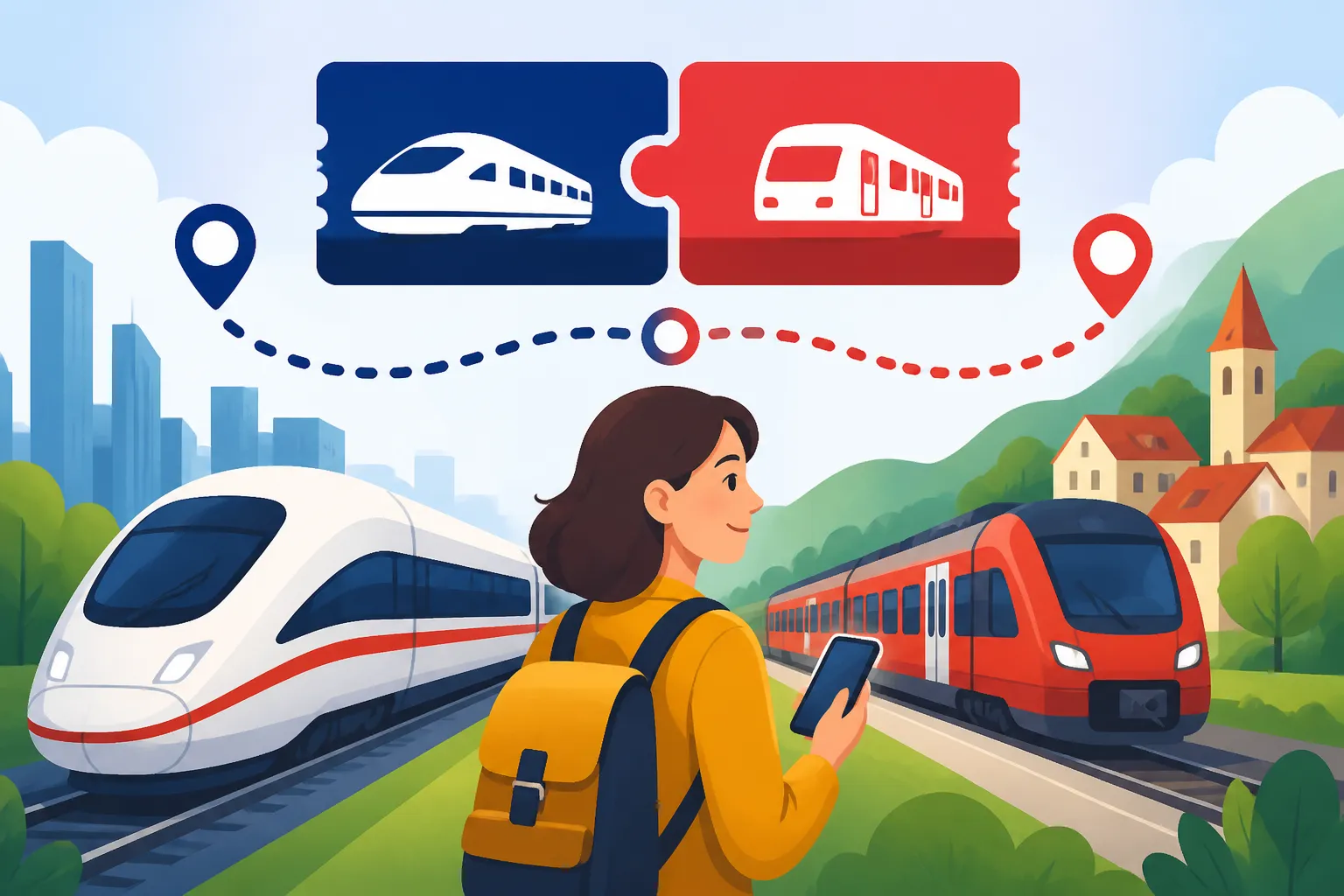
The most important concept is the difference between a single through ticket and several separate tickets bought for different legs. A through ticket covers your whole journey, say from Cologne to a village in the Allgäu, on one booking. It includes the ICE leg and the regional legs, and the itinerary is treated as one contract of carriage.
That matters enormously when things go wrong. If your ICE arrives late and you miss the regional connection on a through ticket, you are generally allowed to take the next suitable train to your destination. If you hold separate tickets, the regional operator has no obligation to care that your ICE was delayed. Your second ticket may be tied to a specific train, and you could end up paying again. This is the trap that catches most first-timers, and it’s why I always check what kind of ticket I’m holding before I travel.
Stitching tickets together isn’t always a mistake. Sometimes it’s the smartest money move, especially if you already hold a regional travel pass. You just have to make that choice knowingly and plan your buffers.
Where the Long-Distance Network Ends and the Regional One Begins
Long-distance trains connect major hubs: Berlin, Hamburg, Frankfurt, Cologne, Munich, Stuttgart, Leipzig, Hannover and Nuremberg, plus a few dozen mid-sized cities. Once you head for a ski resort, a wine village on the Moselle, a North Sea ferry port or a Black Forest valley, you will almost certainly switch to a regional train, a local bus, or both.
Typical handover points include Munich for the Bavarian Alps, Freiburg and Offenburg for the Black Forest, Koblenz for the Moselle and Middle Rhine, Hamburg and Bremen for the North Sea coast, and Dresden for Saxon Switzerland. Each region has its own regional rail lines and often its own bus network for the final stretch. If the mountains are your goal, see Reaching Alpine Resort Towns by Rail: Tickets, Changes, and Journey Times. Island-hoppers should read Reaching the Frisian Islands: Combined Rail and Ferry Ticketing, because the ferry adds yet another layer.
Regional trains are usually labelled RE, RB or S-Bahn on departure boards. Long-distance trains are ICE, IC or EC. Learning those few letters will save you plenty of confusion on the platform. The Deutschland-Ticket subscription is valid on the regional categories but not on the long-distance ones, and that’s where many mixed-ticket strategies come from.
How to Book a Combined Journey Step by Step With Omio
You can book combined journeys through several channels, but Omio is the one I recommend most often to visitors and newer expats. It searches trains, buses and in some cases flights in one place, shows full door-to-door itineraries including the regional legs, and works in English. It also accepts international payment cards without much drama. If you’ve ever had a foreign card rejected on a German booking site, you’ll appreciate that. The common failure points are covered in Booking German Trains From Abroad: Foreign Cards, Names, and Failures.
Here’s the process I follow when I plan a trip that mixes an ICE with regional trains.
- Open Omio on the website or the app and enter your real final destination, not just the nearest big city. Type the village or small-town station name. Omio will route you through the right hub.
- Pick your travel date and a rough departure time. Set your passenger details accurately, including any rail discount cards you hold, since these can affect the fares shown.
- Scan the results list. Each option shows total journey time, number of changes and the operators involved. Expect one long-distance leg and one or two regional legs for most countryside destinations.
- Tap into an itinerary to see each leg in detail: train numbers, change stations and connection times. This is the most important screen in the whole process, so don’t skip it.
- Check whether the journey is sold as a single ticket or as separate tickets. The booking details and fare conditions will tell you, and the difference matters for your connection rights.
- Compare fare types if several are offered. Cheaper fares usually tie you to specific trains, while flexible fares let you travel on any train that day. Read the conditions before you choose.
- Complete payment and save your mobile ticket in the Omio app. Download it for offline access too, because signal can drop in tunnels and valleys.
- Before travel day, check the itinerary again for schedule changes. Engineering works sometimes swap a regional train for a replacement bus.
Reading the Itinerary Before You Pay
The itinerary screen is where you avoid most problems. I look at three things. The first is connection time at each change. A tight transfer at a large station like Frankfurt Hauptbahnhof or Köln Hbf, where platforms can be a long walk apart, is riskier than the same transfer at a small station with two platforms.
The second is the number of operators. If the regional leg is run by a private company, that’s normal and nothing to worry about. Just know which train you’re looking for on the departure board, because the branding may not say Deutsche Bahn. Note the train number and final destination shown in your Omio booking. That’s what appears on platform displays.
The third is the ticket structure. A single through booking gives you the most protection. If the itinerary combines separately issued tickets, perhaps a long-distance train with a bus from another operator, plan a generous buffer and accept that a delay on leg one won’t automatically protect leg two. Omio displays these details in the booking flow, so take thirty seconds to read them.
Real Scenario: Hamburg to a Black Forest Village
Last autumn a friend visiting from Canada wanted to go from Hamburg to Triberg, the Black Forest town famous for its waterfalls and cuckoo clocks. She’d assumed she needed to book an ICE to Offenburg on one site and then work out the regional Black Forest Railway separately at the station. That plan had her standing in Offenburg with a suitcase, trying to decode a ticket machine.
Instead, we searched Hamburg to Triberg directly on Omio. The results showed itineraries with an ICE south and a change onto the regional line that climbs through the valleys. Connection times were visible upfront, so we picked an option with a comfortable buffer at Offenburg instead of the fastest one with a very short change. She had everything on her phone before she left the café.
The ICE ran a little late, as they sometimes do, but her buffer absorbed it. She stepped onto the regional train with time to spare and spent the climb watching the forest roll past. That’s how a combined journey should feel. For more on reaching the region, see How to Plan a Black Forest Trip Without a Car.
Deutschland-Ticket Plus Long-Distance Fares: When Mixing Pays Off
Now the clever stuff. Many residents and long-stay visitors hold the Deutschland-Ticket, a monthly subscription for unlimited travel on regional trains and local public transport nationwide. If you already have one, buying a through ticket that includes the regional legs can mean paying for something you’re already covered for.
The workaround is to book only the long-distance leg, for example Berlin to Munich on an ICE, and use your Deutschland-Ticket for the regional train onward to Garmisch-Partenkirchen or Berchtesgaden. In fares alone, that can be the cheaper route. For a full breakdown of how the subscription works on regional lines, read Regional Trains and the Deutschland-Ticket Explained and How to Use Regional Trains With the Deutschland-Ticket. If you’re deciding whether the subscription is worth it at all, see Deutschlandticket vs ICE Tickets: Break-Even by Route and Journey Time.
Omio is useful here too. Search the long-distance leg on its own to book the ICE portion. Then search the full journey to see the regional connection times you’ll be relying on. That gives you a clear picture of how much buffer to leave.
Here’s how the main approaches compare.
| Approach | What You Buy | Connection Protection | Best For | Main Drawback |
|---|---|---|---|---|
| Single through ticket | One booking covering ICE and regional legs | Strongest, as you can generally continue on the next suitable train if you miss a link | Visitors, first-timers, tight schedules | You may pay for regional legs you could cover another way |
| Long-distance ticket plus Deutschland-Ticket | ICE or IC fare to the hub, subscription for onward regional travel | Weaker, as the regional leg is not part of the long-distance contract | Residents and long-stay visitors who already hold the subscription | A delay on the ICE leaves you managing the onward trip yourself |
| Long-distance ticket plus separate regional ticket bought at the station | ICE or IC fare, then a regional ticket on arrival | Weakest, as the two tickets are fully independent | Rarely ideal, mostly last-minute situations | Machine confusion, wrong fare zones, no linked rights |
| Mixed operators in one search, such as train plus bus | Multi-operator itinerary through a booking platform | Depends on how the tickets are issued, so check the booking details | Remote destinations with poor rail coverage | Requires careful reading of the conditions for each leg |
The Connection Risk Nobody Warns You About
Mixing the Deutschland-Ticket with a long-distance fare has a hidden catch, and I learned it the hard way. With the regional leg outside your long-distance contract, things get thin when the ICE is late. The regional train is, in a sense, your problem. Your Deutschland-Ticket still works on the next regional train, so you’re rarely stranded. But if that next train comes an hour later, or it’s the last one of the evening into a mountain valley, you have a real issue.
The reverse direction matters even more. Say you take a regional train on your Deutschland-Ticket to connect with a cheap, train-bound long-distance fare. If the regional train is late and you miss the ICE, that cheap fare may not be honoured on a later train, because the delay happened outside its contract. You could end up buying a brand new long-distance ticket at full price. For a closer look at fare flexibility, see Sparpreis vs Flexpreis on Deutsche Bahn: Change Rules and Refunds.
My rule of thumb: when you mix tickets, put the generous buffer in front of the leg that’s hard to replace. If the long-distance train is the expensive, inflexible one, give yourself plenty of time to reach it. If the final regional link is infrequent, choose an earlier long-distance train. When in doubt, a through ticket booked on Omio buys peace of mind, and on a short holiday that’s often worth more than the saving.
Practical Tips for Changing Trains Without the Stress
Even with the perfect booking, changing trains in Germany can feel chaotic the first few times. Platform changes get announced in rapid German, trains split in two, and replacement buses appear without much warning. Here’s what years of trial and error have taught me.
Build in Realistic Buffer Times
Booking engines show the fastest possible connections, and those can be very short. The connection may be technically valid, but a short change at a big hub, with heavy luggage, kids or limited mobility, can turn into a sprint. I usually choose an itinerary with a longer change at major stations, especially on Friday afternoons, Sunday evenings and during holiday periods.
Consider the layout as well. At Munich Hauptbahnhof, some regional services leave from wings of the station that take several minutes to reach from the main long-distance platforms. Frankfurt has a deep underground S-Bahn level. Cologne’s platforms are close together but extremely crowded. When I view an itinerary on Omio, I look at the change station name and think about how big and busy it is before I accept the default suggestion.
A longer buffer also gives you a chance to grab a coffee and a pretzel, find the toilet and check the departure board calmly. You’ll arrive at your village relaxed rather than sweaty. The long-distance side of the network is covered in more depth in High-Speed Trains in Germany (ICE): Deutsche Bahn Routes and Savings.
What to Do When a Connection Breaks
It will happen eventually. Your ICE crawls into the hub and your regional train has already left. First, stay calm, because the German network usually has a next train, even if you wait a while. Check your booking to see whether you’re on a through ticket. If you are, you can generally board the next suitable connection to your destination. Keep any delay information, and if possible get confirmation of the delay at a service point.
If you hold separate tickets, check the conditions on the second one. A Deutschland-Ticket works on any regional train, so just catch the next one. A train-bound regional or long-distance ticket is trickier, and you may need to speak to staff or buy a new fare. This is when I’m most grateful I booked through a platform that keeps every leg in one app. I can see the whole journey at a glance rather than digging through emails from different operators.
Strikes and major disruptions are a different matter, with their own compensation rules and rebooking options. Before relying on tight connections during a period of announced industrial action, read DB Strikes and Delays: Your Rights, Compensation, and Rebooking.
Keep Your Tickets and Information Organised
Store everything in one place on your phone and download it for offline use. Mountain valleys, forest lines and long tunnels can kill your signal at exactly the wrong moment. The Omio app holds your mobile tickets, so you’re not juggling PDFs and screenshots when a conductor comes through. Carry the ID you used for the booking as well, since conductors may ask to see it alongside a personalised ticket.
Watch the train number, not just the destination, because regional trains sometimes split. The front half heads to one town and the back half to another. Platform signs usually show which section goes where. If you’re unsure, ask the conductor or a fellow passenger. Most Germans will happily point you in the right direction, even if they sound stern doing it.
If you’re planning a multi-stop trip across the country, map out where you’ll need regional connections before you book anything. Some destinations are simple. Others need a regional train plus a bus with a limited schedule. How to Plan a Germany Itinerary by Train walks through building a route that flows well.
Combining long-distance and regional tickets doesn’t have to be the headache it was on my first trip. Understand the difference between through and separate tickets, know your handover stations, and give yourself honest buffers, and the system works beautifully. When you want the whole journey in one booking, with connection times and operators laid out in plain English, start your search on Omio, enter your real final destination, and let it do the stitching for you.
Disclaimer
This article is for general informational purposes only and does not constitute professional advice. Laws, prices and regulations vary by location and change over time. Consult a qualified professional for guidance on your specific situation.