Deutsche Bahn Guide: Using Trains for City and Long-Distance Travel
Staring at a massive departure board reading “Zug fällt aus” while hauling three heavy suitcases is an expat initiation ritual. I once spent six freezing hours stranded in Hannover because I didn’t understand how my ticket tied me to a specific train. This guide demystifies the Deutsche Bahn network, ticketing rules, and passenger rights so you can travel across Germany with confidence.
Disclosure: This post may contain affiliate links. We may earn a commission at no extra cost to you if you make a purchase through these links. Read full disclosure.
Decoding the Deutsche Bahn Train Network
Regional vs Long Distance Trains Explained
The German rail network is massive, intricate, and broadly split into two distinct categories: local or regional transport (Nahverkehr) and long-distance transport (Fernverkehr). Understanding this foundational divide is absolutely crucial because your tickets are almost always strictly valid for one category and completely useless on the other. Boarding the wrong type of train will result in steep fines from unforgiving conductors who have zero tolerance for confused tourists or newcomers.
Regional trains include the Regionalbahn (RB) and Regional-Express (RE). These trains are the workhorses of the daily German commute. They stop frequently, connecting smaller suburban towns to major city hubs. They are usually painted a distinctive bright red and feature basic seating with plenty of standing room. Long-distance trains, such as the Intercity (IC) and Eurocity (EC), bypass the smaller towns entirely to connect major metropolitan areas across federal states. You cannot use a standard regional city ticket to hop on an IC train just because it happens to be stopping at your local platform.
For expats looking to explore their new home state, regional trains offer a fantastic, budget-friendly way to travel, albeit at a significantly slower pace. Figuring out how to string these regional trains together to traverse the country cheaply is a skill that takes time to master. If you are trying to understand how these local networks intertwine with city subways and trams, you should review our comprehensive guide on Public Transport Tickets and Passes: Navigating German Transit Systems.
Understanding the High Speed ICE Network
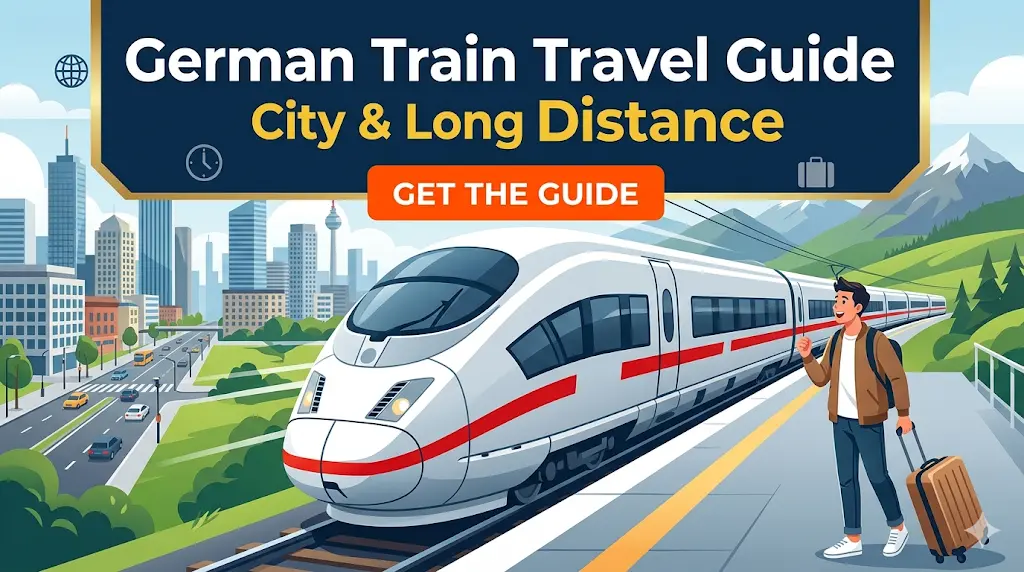
The undisputed crown jewel of Deutsche Bahn (DB) is the Intercity Express (ICE). These sleek, white, aerodynamic high-speed trains can reach speeds of up to 300 km/h, slicing across the German countryside and connecting major economic hubs like Berlin, Munich, Cologne, and Frankfurt in mere hours. For long-distance domestic travel, the ICE is essentially a ground-level airline, offering dining cars, onboard Wi-Fi, and panoramic windows.
However, the ICE experience comes with its own set of rigid, unwritten cultural rules that expats must learn quickly. The trains are divided into 1st and 2nd class carriages, and unlike the loud, chaotic regional trains, ICE trains feature dedicated quiet zones (Ruhebereich) and mobile phone zones. If you sit in the Ruhebereich and decide to take a loud business call or play a video without headphones, you will be swiftly and fiercely reprimanded by angry German passengers. Furthermore, seats on ICE trains are not automatically assigned when you buy a basic ticket unless you pay a specific, extra reservation fee.
Without a paid reservation, you are technically allowed on the train, but you must hunt for a seat that doesn’t have a digital reservation indicator lit up above it. During peak holidays, Friday afternoons, or Sunday evenings, this often means standing in the cramped aisle or sitting on your suitcase by the bathroom for four hours. Booking a seat reservation for an extra few euros is absolutely non-negotiable for long, comfortable trips, especially if you are hauling luggage.
The S Bahn Connection for City Commuting
While the ICE connects the far-flung corners of the country, the S-Bahn (Stadtschnellbahn) connects the quiet suburbs to the bustling city core. Unlike the underground U-Bahn, which is typically run by local municipal transit authorities, the S-Bahn is usually operated by a subsidiary of Deutsche Bahn. This is a critical distinction to remember when it comes to nationwide transport strikes; if DB train drivers strike, your local S-Bahn will stop running, but the U-Bahn might continue unaffected.
The S-Bahn is heavily utilized by commuters who prioritize cheaper rent and green spaces in satellite towns but work in the city center. The trains run above ground and are strategically synchronized with the arrival of major regional and long-distance trains at the Hauptbahnhof (central station). If you are budgeting your monthly living and commuting costs, balancing the distance of your S-Bahn ride against your rent is a major factor, a topic we discuss deeply in Cost of Living in Germany: A Realistic Budget for Expats.
When you are first moving to Germany, you might want to test different neighborhoods before signing a rigid, permanent lease. Using Wunderflats to secure a furnished apartment near a major S-Bahn ring allows you to experiment with your commute without committing to a permanent location. Finding a Wunderflats listing right on an S-Bahn line means you are perfectly plugged into the broader DB network from day one, allowing easy, seamless weekend escapes while you search for long-term housing.
Navigating the Ticketing System and Fares
Super Sparpreis vs Flexpreis Tickets
Buying a ticket for a high-speed ICE train is exactly like buying an airline ticket: prices fluctuate wildly based on passenger demand and how early you book. If you book several weeks in advance, you can snatch a “Super Sparpreis” (Super Saver) ticket for under €20. However, this incredibly cheap ticket comes with an ironclad, highly enforced restriction called “Zugbindung.”
Zugbindung translates to “train tie,” meaning your ticket is legally valid exclusively for the exact train number and exact departure time printed on it. If you miss that specific train because you overslept or got lost in the station, your ticket is immediately worthless, and you must buy a brand new one at the station for the full, walk-up price. The “Flexpreis” (Flexible Fare), on the other hand, is significantly more expensive but allows you to take any train on that specific route on that specific day. You are paying a premium for peace of mind.
For expats who crave flexibility or have unpredictable work schedules, the Flexpreis is a lifesaver, but it eats into your travel budget rapidly. You must always weigh the risk of missing your train against the massive financial savings of a Sparpreis. And if you are relying on your smartphone to display these digital tickets to the conductor, ensure your data connection is stable by checking Getting a German SIM Card and Setting Up Internet at Home.
The BahnCard System Explained
If you plan to travel across Germany more than three or four times a year, purchasing a BahnCard is almost economically mandatory. The BahnCard is a yearly subscription that acts as a massive discount multiplier applied at checkout. It comes in three primary tiers: the BahnCard 25, the BahnCard 50, and the elusive, highly expensive BahnCard 100.
The BahnCard 25 gives you a flat 25% discount on both Super Sparpreis and Flexpreis tickets. It is so effective that it usually pays for itself within just two round trips. The BahnCard 50 gives you 50% off Flexpreis tickets and 25% off saver fares, making it the ideal choice for spontaneous business travelers who need to book trains at the last minute. You must present the physical or digital BahnCard alongside your discounted ticket when the conductor checks; failing to prove you own the card will result in a hefty fine.
Keep in mind that the BahnCard is a legally binding subscription contract that automatically renews for another year unless you cancel it exactly six weeks before it expires. The German bureaucracy is notoriously unforgiving with subscription traps. If you are unaccustomed to how rigid German contract cancellations are, you should definitely read up on Bureaucracy Basics: Understanding Bescheinigung, Anträge, and Other Paperwork.
The Deutschlandticket Revolution
In 2023, the German government introduced the Deutschlandticket, a revolutionary flat-rate digital pass that completely transformed local travel. For a set monthly subscription fee, this ticket grants you unlimited travel on all local and regional transport (S-Bahn, U-Bahn, trams, buses, RE, and RB trains) anywhere within the borders of Germany. It effectively erased the confusing regional tariff boundaries that previously plagued commuters.
However, there is a massive catch that catches out new expats constantly: the Deutschlandticket is absolutely NOT valid on long-distance trains (ICE, IC, EC). If you board a high-speed ICE train holding only a Deutschlandticket, you are considered to be fare evading and will be fined immediately. You can, however, use it to travel slowly across the entire country by patiently stringing together multiple regional RE trains, a popular strategy for budget-conscious students.
Managing this digital-only subscription requires a smartphone and a registered German bank account for the monthly SEPA direct debit mandate. If you are struggling to set up your foundational life and secure local banking, consulting our Moving to Germany: Comprehensive Visa & Immigration Guide will help you get your residency and finances sorted so you can easily access these national transit perks.
| Ticket Type | Best Suited For | Flexibility (Zugbindung) | Valid on ICE and IC? |
| Super Sparpreis | Budget-conscious planners | None (Tied to exact train) | Yes |
| Flexpreis | Spontaneous or business travelers | High (Any train on that day) | Yes |
| Deutschlandticket | Daily commuters & regional explorers | High (Any local transport) | No (Regional only) |
Surviving Delays and the Realities of DB Travel
Understanding Passenger Rights and Compensation
Despite the global stereotype of flawless German efficiency, Deutsche Bahn is currently notoriously plagued by delays, canceled trains, and missed connections. The national infrastructure is aging, and constant, massive construction projects create a highly fragile network. When the inevitable delay happens, you must learn to aggressively claim your passenger rights (Fahrgastrechte).
Under strict EU and German regulations, if your arrival at your final destination is delayed by 60 minutes or more, you are legally entitled to a 25% refund of your ticket price. If the delay exceeds 120 minutes, you are entitled to a 50% refund. You can submit this compensation claim seamlessly and digitally through the DB Navigator app, or by mailing a physical form if you purchased a paper ticket.
Crucially, if a delay of more than 20 minutes is expected at your destination, the dreaded Zugbindung (train tie) on your cheap Sparpreis ticket is automatically lifted. You are legally allowed to hop on the next available train—even a higher-class ICE—to reach your destination without buying a new ticket. Do not wait in line at the customer service desk to ask permission; just check the app, find the next train going your way, and board it confidently.
Navigating Cancellations and Missed Connections
When a train is canceled entirely, the ensuing chaos at the station can be overwhelming for a non-German speaker. If you miss your final connection late at night due to a preceding DB delay and there are absolutely no other trains running to your destination, Deutsche Bahn is legally obligated to either provide alternative transport (like a taxi voucher) or cover the reasonable cost of a hotel room for the night.
You must go to the DB Information desk, which is usually a large, lit-up counter located in the center of the main hall, to get these official vouchers. Never book your own €200 hotel room in a panic and expect DB to blindly reimburse you later without getting their explicit approval or exhausting their provided options first.
The stress of these situations is deeply compounded if you are traveling with a lot of heavy luggage. Navigating broken elevators and crowded platforms while panicked is an exhausting expat rite of passage. If you are in the middle of a major relocation and hauling your entire life in suitcases, settling into a temporary Wunderflats apartment gives you a secure, immediate base. Dropping your heavy bags at a Wunderflats property before attempting complex cross-country DB journeys makes exploring your new country infinitely more manageable and enjoyable.
Packing Essentials for Unpredictable Journeys
Because a scheduled four-hour ICE trip can easily turn into a seven-hour ordeal due to a sudden signal failure or track trespasser, packing strategically is vital for your sanity. You cannot rely on the onboard ICE bistro, which frequently runs out of hot food or suffers from broken coffee machines during long delays. Always pack your own water and heavy snacks before boarding.
More importantly, protect your mental health and your devices. The Wi-Fi on ICE trains is wildly inconsistent, dropping constantly as the train passes through rural German dead zones. Download your movies or podcasts offline before you board. I always buy a high-capacity power bank on Amazon Germany because the seat outlets on older train models are frequently broken or in use. Ordering a fast-charging power bank on Amazon Germany with next-day delivery before a big cross-country trip will absolutely save you when you need to access your digital tickets or reroute your journey on a dying phone.
Additionally, the trains can be incredibly noisy, especially if you are stuck sitting near the sliding doors, a loud stag-do party, or crying children. Investing in premium noise-canceling headphones from Amazon Germany is arguably the best purchase you can make for surviving German train travel. Combine that with a decent, supportive travel pillow from Amazon Germany, and you can comfortably sleep through the most frustrating track delays.
Station Logistics and Finding Your Way
Decoding Platform Displays and Wagenstandsanzeiger
German train platforms are massive pieces of concrete, sometimes stretching over 400 meters long to accommodate double-length ICE trains. If you have a reserved seat in carriage 21, but you stand at the wrong end of the platform, you will simply not have time to run the entire length of the train before the doors lock and the train departs. You must learn to read the “Wagenstandsanzeiger.”
This is a physical poster display (or a digital screen on modern platforms) showing the exact graphical composition of the incoming train. The platform itself is divided into overhead lettered sectors (A, B, C, D, E). The display will tell you that Carriage 21 will stop exactly in Sector C. Walk to Sector C and wait there before the train arrives to ensure a smooth, stress-free boarding process.
You must also constantly monitor the overhead digital displays (Zugzielanzeiger) for last-minute changes. A scrolling white text often announces “Umgekehrte Wagenreihung” (reverse coach order), meaning the train is arriving backward, and Carriage 21 is now stopping in Sector A instead of Sector C. If your German reading skills are still basic, the sudden panic of deciphering this and sprinting down the platform is very real.
Luggage Storage and Station Amenities
Major German stations (Hauptbahnhofs) are essentially large, heavily trafficked shopping malls. They feature grocery stores, pharmacies, bakeries, and fast-food chains that operate even on Sundays when the rest of the country’s retail sector is strictly legally shut down. If you need emergency groceries or medicine on a Sunday, the Hauptbahnhof is often your only sanctuary.
If you have a long layover or want to explore a city unburdened before your apartment check-in time, utilizing the station’s luggage lockers (Schließfächer) is incredibly convenient. They are highly secure and usually cost between €4 and €6 for 24 hours of storage. Just make sure you carry physical €1 and €2 coins, as many older locker systems across Germany still do not accept credit cards or mobile payments.
It is also vital to know that station bathrooms are not free. They are usually managed by a private hygiene company called Sanifair and cost around €1 to enter. You receive a small printed voucher for €0.50 that you can use toward purchases in the station’s shops. It is a frustrating hidden cost of travel, but the facilities are generally kept exceptionally clean and safe.
Strategic Housing Near Major Hauptbahnhofs
If your job requires frequent domestic travel, or if you simply plan to spend your weekends exploring the castles of Bavaria and the dense forests of Baden-Württemberg, where you choose to live drastically impacts your travel fatigue. Commuting 45 minutes on a crowded, delayed bus just to reach the central train station before a long journey is exhausting.
When expats ask for relocation advice, I highly recommend looking at neighborhoods adjacent to the Hauptbahnhof. Using Wunderflats to secure a furnished, move-in-ready apartment within a 10-minute walk of the central station is a massive lifestyle upgrade. Wunderflats landlords often cater to highly mobile professionals, and being able to walk out your front door and step onto an ICE train in 15 minutes completely removes the friction of travel. By securing a well-located Wunderflats rental, you maximize your weekend getaways and minimize the stress of early morning departures, giving you more energy to navigate complex documents like those detailed in Understanding German Rental Contracts: Key Terms and Conditions.
References
Primary sources (official)
- Deutsche Bahn Passenger Rights: https://int.bahn.de/en/booking-information/passenger-rights
- Deutsche Bahn Deutschlandticket Information: https://int.bahn.de/en/faq/deutschlandticket-what-is-the-ticket
- Deutsche Bahn BahnCard Overview: https://int.bahn.de/en/offers/bahncard
Other helpful sources
- European Union Rail Passenger Rights: https://europa.eu/youreurope/citizens/travel/passenger-rights/rail/index_en.htm
Disclaimer
The information provided in this guide is for general informational purposes only and is based on the real-world experiences of expats navigating the German rail system. Fares, ticketing rules, train schedules, and passenger rights regulations (including specific compensation thresholds and alternative transport obligations) are highly complex and subject to change by Deutsche Bahn and the German federal government. This article does not constitute legal or financial advice. Always consult the official Deutsche Bahn website or the DB Navigator app for the most current, legally binding transit requirements, live updates, and official pricing prior to purchasing your tickets.