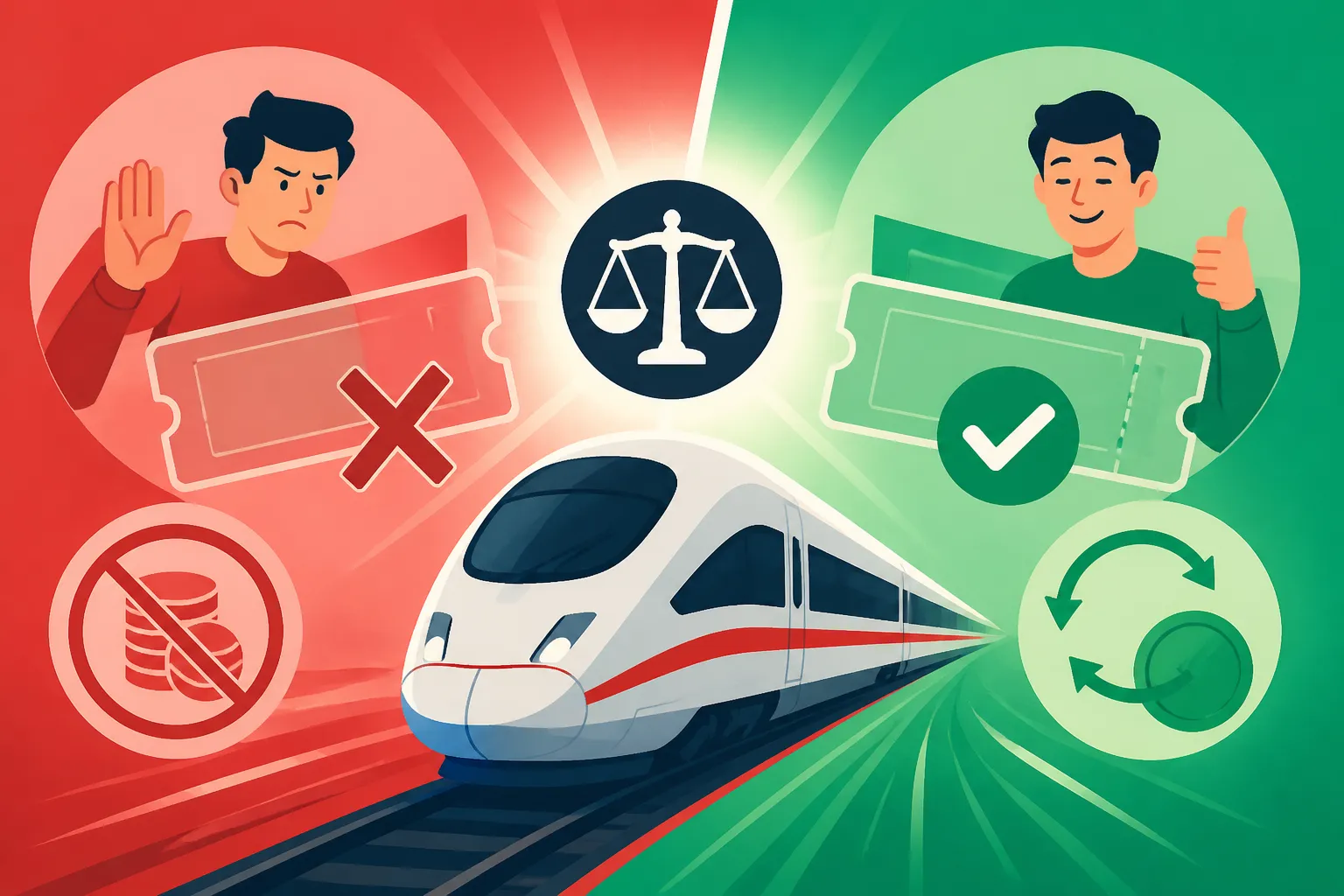
Sparpreis vs Flexpreis on Deutsche Bahn: Change Rules and Refunds
Oh, the joys of German train travel! If you've been in Germany for any length of time, you've probably experienced the simultaneous wonder of its efficient rail network and the utter confusion that can arise when you need to book a ticket, especially if your plans aren't set in stone. The moment your schedule shifts, or a train gets cancelled, that cheap "Sparpreis" ticket can quickly turn into a financial headache. This guide is here to untangle the often-frustrating differences between Deutsche Bahn's Sparpreis and Flexpreis tickets, explain their change rules and refund policies in excruciating detail, and show you how to navigate these choices wisely, making your German adventures smoother, perhaps with a little help from platforms like Omio.
Disclosure: This post may contain affiliate links. We may earn a commission at no extra cost to you if you make a purchase through these links. Read full disclosure.
The German Train System: A Blessing and a Bureaucratic Maze
When you first arrive in Germany, the idea of a train system that can whisk you from city center to city center, often at impressive speeds, feels like a revelation. No airport security lines, no battling traffic, just hop on and go. But as any expat quickly learns, behind that gleaming facade of punctual ICE trains (mostly!) lies a ticketing system that can be as complex as German grammar.
The Deutsche Bahn Experience for Expats
Let's be real, the Deutsche Bahn (DB) system can be a steep learning curve. You arrive, full of excitement, ready to explore, and then you're faced with ticket machines that only speak German, online portals with a million options, and the constant fear of accidentally buying the wrong fare. I remember my first few times trying to decipher the various ticket categories. It felt like I needed a degree in railway economics just to understand if I could save a few euros or if I was locking myself into an irreversible journey.
The frustration is real when you’re new here. You’re trying to balance seeing everything, managing a budget, and dealing with the inevitable surprises that life in a new country throws at you – like that sudden illness that cancels your weekend trip, or a spontaneous invitation to a friend's Geburtstag in another city. Suddenly, the train ticket you bought weeks ago feels like a trap. Don't worry, you're not alone in feeling this way. We've all been there, staring blank-faced at a cancelled train screen, clutching a non-refundable ticket.
Why Understanding Ticket Types Matters
In Germany, your train ticket isn't just a pass to get from A to B; it's a contract with specific terms and conditions that dictate your flexibility, your ability to change plans, and ultimately, how much stress you'll endure if something goes awry. The fundamental dilemma when booking with Deutsche Bahn boils down to two main choices: the "Sparpreis" (saver fare) or the "Flexpreis" (flexible fare). On one hand, you have the enticingly cheap Sparpreis, which promises significant savings if you book early. On the other, the Flexpreis offers peace of mind and adaptability, but at a higher cost.
Knowing the ins and outs of these two ticket types is absolutely crucial, not just for saving money, but for maintaining your sanity. It's about weighing the risk of saving a few euros against the potential headache of a completely wasted ticket. For instance, if you're planning a concrete trip, like visiting family for Christmas, where the dates are firm and unlikely to change, a Sparpreis could be your golden ticket. But if you're heading to a job interview or have a tight connection to an international flight, that flexibility offered by a Flexpreis might be worth every cent. Finding the balance requires understanding the fine print, which, let's be honest, is often in German and buried deep within DB's website. This is where tools like Omio can become a lifesaver, cutting through the jargon to present you with clear options and allowing you to compare these vital differences easily. It’s like having a seasoned expat whisper the pros and cons in your ear as you book.
Sparpreis Tickets: The Art of the Early Bird (and the Risks)
Ah, the siren song of the Sparpreis! It's how most of us start our German train adventures, lured by the promise of affordable travel. These tickets are often the reason you can snag an ICE journey across the country for less than a local bus fare, provided you book far enough in advance. But like all good things in life, there's a catch, and it's usually tied to flexibility.
What Exactly is a Sparpreis Ticket?
The term "Sparpreis" literally means "savings price," and that's precisely what it is. It's Deutsche Bahn's way of encouraging early bookings and filling up trains, using a dynamic pricing model similar to airlines. The earlier you book, generally, the cheaper the fare. There are actually a couple of variants here:
- Super Sparpreis: This is the cheapest of the cheap. It offers the lowest prices but comes with absolutely no flexibility. Once you buy it, it's pretty much set in stone. There's no option to change your journey, and you can't get a refund. It's non-exchangeable and non-refundable. Think of it as a commitment – you're committing to that specific train, on that specific day, at that specific time.
- Sparpreis: This is a slightly less rigid version of the saver fare. While still very affordable, it offers a tiny bit of wiggle room. You can change your ticket up to one day before your journey for a fee (currently €10, though this can change). However, you can only change it to another Sparpreis ticket for the same route, and if the new ticket is more expensive, you'll pay the difference. If it's cheaper, you won't get a refund on the difference. A full refund is generally not possible, though you might be able to convert it into a voucher for a fee, but only for certain conditions.
Both Sparpreis variants tie you to a specific train connection. This means you must take the train(s) indicated on your ticket. If you miss your specific connection for reasons unrelated to DB (e.g., your alarm didn't go off, you got stuck in traffic), you're out of luck and will need to buy a new ticket. It's a fantastic option for those meticulously planned trips, say, a visit to family in the Ruhr region or a long weekend to explore the stunning Bavarian Alps. If your dates and times are absolutely fixed, this is where you'll find the best deals.
Change Rules and Restrictions for Sparpreis
This is where the rubber meets the road, or perhaps, where your carefully laid plans meet the unforgiving German rail system. For the Super Sparpreis, the rule is brutally simple: no changes, no refunds. Period. If you wake up with a nasty flu the morning of your trip, or your boss suddenly springs an urgent task on you, that ticket is gone. You cannot convert it, you cannot transfer it, and you cannot get your money back. It's a hard pill to swallow, especially when you're used to more flexible systems in other countries. I once had a friend who bought a Super Sparpreis to Hamburg for a concert, only to have the concert cancelled due two days before. Poof! Ticket money gone. It’s a stark reminder that while the price is attractive, the lack of a safety net is very real.
For the standard Sparpreis, as mentioned, you have a small window of opportunity. You can technically change it up to the day before your journey. Let's say you're traveling from Munich to Berlin on a Sparpreis ticket, and on Tuesday, you realize your Wednesday meeting has been pushed to Thursday. You could, theoretically, go to a DB travel center, or log onto the DB website, pay the €10 fee, and switch your Wednesday ticket for a Thursday one. However, there are caveats. You can only switch it for another Sparpreis ticket on the same route. If no Sparpreis tickets are available for your new desired time/date, or only more expensive ones, you'll have to pay the difference. If the new Sparpreis ticket is cheaper, you won't be reimbursed for the price drop. And again, a full refund in cash or to your card is generally not an option once purchased, save for very specific scenarios related to DB's own operational issues.
This limited flexibility means that for anything other than a guaranteed, no-questions-asked journey, you're taking a calculated risk. If your plans are fluid, or if there's even a slight chance of unexpected events (which, let's face it, is a constant in expat life), a Sparpreis ticket might save you money upfront but cost you much more in the long run. When you're browsing for tickets, especially if you're not a German speaker, distinguishing between these nuances can be tricky. This is where using a platform like Omio can really help. It often presents these different fare types clearly, making it easier to understand the trade-offs at a glance without diving deep into German terms. You can compare the cost savings versus the flexibility right on one screen.
When Sparpreis is Your Best Friend (and When it's Not)
So, when should you embrace the Sparpreis, and when should you steer clear?
When Sparpreis is your best friend:
- Fixed Plans: This is the most crucial factor. If your travel dates and times are 100% confirmed, and you have a low probability of needing to change them, Sparpreis is the way to go. Think planned holidays, visiting family for a specific event, or a weekend getaway with friends that's been on the calendar for months.
- Budget Travel: If you're on a tight budget and every euro counts, booking Sparpreis tickets well in advance can lead to significant savings. Sometimes the difference between a Super Sparpreis and a Flexpreis can be €50 or more for a long-distance journey.
- Early Bird: The golden rule of Sparpreis is "the earlier, the better." If you're planning a trip two or three months out, you'll find the absolute best deals.
When Sparpreis is NOT your best friend:
- Uncertainty: Any ambiguity in your schedule, whether it's related to work, health, or personal matters, makes Sparpreis a risky choice. Missing your train due to an unforeseen event means losing your money entirely (for Super Sparpreis) or paying a fee plus potential fare difference (for standard Sparpreis).
- Business Travel: If your company requires you to be flexible, or if meetings often run over, a Sparpreis ticket could leave you stranded or force you to buy another expensive last-minute ticket.
- Tight Connections: If your train journey relies on a tight connection, especially one involving a flight or another non-DB mode of transport, the rigidity of Sparpreis adds a layer of stress. If your initial flight or bus is delayed, you'll likely miss your connecting train, and your Sparpreis ticket becomes invalid.
- Spontaneous Travel: Forget about finding a cheap Sparpreis for a spur-of-the-moment decision to visit Frankfurt next weekend. These tickets sell out quickly, and prices skyrocket closer to the travel date.
Consider this: you've booked a Super Sparpreis for a non-stop ICE from Cologne to Berlin for a fixed time. Your apartment hunting is done, your job is secured, and you’re just enjoying the simple journey. That's a perfect Sparpreis scenario. Now, imagine you're traveling to a critical visa appointment at the Ausländerbehörde in a different city, with multiple train changes, and a chance of unforeseen delays on public transport to the main station. A Sparpreis here would be a gamble I wouldn't recommend. You can compare these options and their attached conditions easily on platforms like Omio, which can be immensely helpful when you’re still wrestling with the intricacies of How to Buy Deutsche Bahn Tickets and Save Money.
Flexpreis Tickets: The Freedom of Flexibility (at a Cost)
Now, let's talk about the Flexpreis ticket, the antithesis of the Sparpreis. While it might make your wallet feel a little lighter, it brings a level of peace of mind that can be invaluable in the often-unpredictable world of expat life. This is your "go-to" option when certainty is a luxury you just can't afford.
Defining the Flexpreis Ticket
"Flexpreis" directly translates to "flexible price," and it lives up to its name. This is Deutsche Bahn's standard fare, offering the highest degree of freedom for your journey. When you purchase a Flexpreis ticket, you're not committing to a specific train at a specific time; rather, you're buying a ticket for a day (or sometimes two days, for longer routes).
Here's what that freedom entails:
- Train Choice: On the day(s) your ticket is valid, you can take any train on your chosen route. So, if you bought a Flexpreis for a 9:00 AM ICE from Berlin to Munich, but wake up feeling energetic and want to catch the 7:00 AM train instead, you can simply hop on! No need to change your ticket, no extra fees. The same applies if you miss your intended train, need to leave later, or decide to break your journey midway.
- Breaking Your Journey: With a Flexpreis, you're permitted to break your journey and continue later on the same day or the next (if valid for two days). For example, if you're traveling from Hamburg to Stuttgart and want to spend a few hours exploring Hannover, you can get off, wander around, and then continue on a later train using the same ticket, as long as you stay on the original route.
- Refunds and Changes: This is where Flexpreis truly shines. You have significant leeway to change your plans without financial penalty.
The cost, naturally, reflects this premium on flexibility. Flexpreis tickets are consistently more expensive than Sparpreis tickets, especially when booked in advance. However, unlike Sparpreis, the price of a Flexpreis ticket for a particular route doesn't fluctuate much closer to the travel date; it remains relatively stable. This predictability can be a comfort, even if the base price is higher. It means you won't be penalized for booking last minute, making it ideal for those sudden, unplanned trips.
Unpacking Flexpreis Change and Refund Policies
The robust change and refund policies of Flexpreis tickets are their biggest selling point for many travelers, particularly expats whose lives can often involve last-minute adjustments.
- Before the First Day of Validity: If you realize you need to cancel your trip entirely or change your travel date before the first day your ticket is valid, you can get a full refund without any fees. This means if you buy a ticket for a trip next Friday, and on Wednesday you decide you can't go, you'll get 100% of your money back. This is huge! No hidden fees, no arguments, just your money back.
- On or After the First Day of Validity: Even if the first day of validity has passed, you still have options. You can return your ticket and receive a voucher (Gutschein) for the full value, minus a small processing fee (currently €19, but always check DB's current terms, as these things change). This voucher can then be used for future train travel with Deutsche Bahn. While not a cash refund, it's certainly better than losing the entire ticket value, as you would with a Super Sparpreis.
- Changing Trains on the Day: As mentioned, the ability to simply hop on any train on your route, within the validity period, is a massive benefit. No need to inform anyone, no booking changes needed – just show up, find a seat (or ensure you have a separate seat reservation if desired), and present your ticket to the conductor. This is incredibly liberating for those days when you're just not sure if that morning meeting will end on time, or if your little one might throw a tantrum right when you need to leave for the station.
Think about a scenario where you're attending a German language course in a different city, and you're not sure how long the class will run, or if you might want to spend extra time exploring. A Flexpreis ticket means you don't have to stress about catching a specific train home. Or perhaps a sudden family emergency back home requires you to change your travel plans completely. With a Flexpreis, you can cancel or postpone with minimal financial loss, a stark contrast to the rigidity of its cheaper counterpart. Platforms like Omio make it easy to see these refund and change policies at a glance, right when you're comparing prices, so you can make an informed decision without having to dig through dense legalistic German text.
The Ideal Scenarios for Choosing Flexpreis
The Flexpreis ticket might seem like a luxury, but in many situations, it's a sound investment for your peace of mind and flexibility.
When Flexpreis is your ideal choice:
- Uncertain Schedules: If your travel times are subject to change due to work commitments, appointments, or personal circumstances, Flexpreis is your safety net. This is especially true for business travelers, freelancers with unpredictable schedules, or anyone attending events with variable end times.
- Connecting Flights/International Travel: If your train journey is part of a larger international itinerary, such as catching a flight from Frankfurt Airport, the flexibility to adjust for flight delays or early arrivals is invaluable. Missing a connecting train due to an initial delay is a common expat nightmare.
- Family Travel: Traveling with kids can be unpredictable. Delays, sudden sickness, or simply needing more time at a destination can easily throw off rigid schedules. Flexpreis gives you the buffer you need to manage these situations without panic.
- Spontaneous Decisions: Fancy a last-minute weekend trip to a Germany's Most Beautiful Small Towns to Visit? With Flexpreis, you can often book shortly before departure without a massive price hike (compared to a last-minute Sparpreis, which is usually gone or exorbitantly priced).
- Breaking Journeys: If you enjoy taking your time, exploring a city briefly en route to your final destination, or simply need to stretch your legs, Flexpreis allows you to break your journey without penalty.
Considerations for the cost:
The main downside, of course, is the price. A Flexpreis ticket can be significantly more expensive than a Sparpreis, sometimes double or triple the cost for the same route. You need to weigh the financial impact against the value of the flexibility. For a short, direct journey that's absolutely firm, a Flexpreis might feel unnecessary. But for any long-distance or complex trip where unforeseen events are a real possibility, that extra investment can save you from a much larger financial loss or significant stress. Tools like Omio are brilliant for this comparison, allowing you to quickly see the price difference and decide if the added flexibility is worth the investment for your specific journey, helping you to decide when you need Public Transport Tickets and Passes: Navigating German Transit Systems.
Navigating Delays and Cancellations with Both Ticket Types
Even the most meticulously planned journey in Germany can sometimes go awry. Train delays and cancellations are an unfortunate reality, no matter how much you pay for your ticket. The good news is that when Deutsche Bahn itself is the cause of the disruption, passenger rights kick in, offering a layer of protection that applies to both Sparpreis and Flexpreis ticket holders.
Passenger Rights in Germany (Fahrgastrechte)
Understanding your Fahrgastrechte (passenger rights) is absolutely essential when traveling by train in Germany. These rights are rooted in EU law and ensure that passengers are compensated or assisted when their journey is significantly disrupted due to circumstances within the railway's control (not external factors like extreme weather that can be argued as höhere Gewalt or 'force majeure').
Crucially, these rights apply regardless of the type of ticket you hold – whether it's a cheap Super Sparpreis or a premium Flexpreis. The principle is that if DB cannot deliver the service it promised due to its own operational issues, you are entitled to certain compensations.
Here's a quick overview of what you're entitled to:
- Delay of 60 minutes or more: You can claim 25% of the ticket price back.
- Delay of 120 minutes or more: You can claim 50% of the ticket price back.
- Cancelation or Expected Delay of 60 minutes or more at your departure station: You have several options:
- Cancel your journey: You can get a full refund of your ticket price. If you’ve started your journey and it becomes pointless due to the delay, you can return to your starting point and get a full refund.
- Continue your journey on a different train: You can take the next available train (even if it's a higher-category train like an ICE, typically without paying the fare difference), possibly via a different route, to reach your destination. If you need to buy a new ticket because your original train was cancelled and you weren't immediately offered an alternative, you can claim the cost of the new ticket back (up to a certain amount).
- Overnight Stay: If a delay or cancellation means you can't reach your destination on the same day and an overnight stay is necessary, DB will often cover accommodation costs (within reason) or provide a hotel voucher.
- Compensation for missed connections: If you miss a connecting train due to a delay with a prior DB train, and you won't reach your final destination with a delay of 60 minutes or more, you also have the right to continue on another train or seek compensation.
To claim compensation, you typically need to fill out a "Fahrgastrechte-Formular" (passenger rights form), which you can get from the train conductor, at a DB travel center, or download online. You'll need your ticket and proof of delay (which the conductor can often provide or you can track via the DB Navigator app). Always keep your original ticket! Even if it’s a digital one, save the PDF or screenshot.
Specific Scenarios: When DB Compensates You
Let's look at how these rights play out in real life, especially clarifying the common misconception that Sparpreis tickets are always worthless in case of disruption.
- Your Super Sparpreis train is cancelled: This is the ultimate "get out of jail free card" for Sparpreis holders. If DB cancels your specific Super Sparpreis train, your ticket is no longer tied to that specific service. You are now entitled to take the next available train to your destination, even if it's a Flexpreis train, without extra charge. Yes, you read that right – your non-flexible ticket suddenly becomes highly flexible due to DB's fault! It's an often-overlooked perk. You can also opt for a full refund if the cancellation means you can no longer make your journey.
- Your train is delayed by more than 60 minutes: If your train, regardless of ticket type, arrives at your destination 60 minutes or more late, you are entitled to compensation. For example, if you paid €20 for a Sparpreis ticket and your train is 70 minutes late, you can claim back €5 (25%).
- You miss a connection due to a prior DB delay: Imagine you have a Sparpreis ticket from Dresden to Hamburg, with a connection in Berlin. If your Dresden-Berlin train is delayed, causing you to miss your Berlin-Hamburg connection, and this ultimately leads to a 60+ minute delay to your final destination in Hamburg, you are covered. You can take the next available train from Berlin to Hamburg and claim compensation based on your original ticket price.
- Your train is diverted and takes much longer: Sometimes trains are diverted due to track issues or other problems, leading to a much longer journey time. If this diversion results in a 60+ minute delay to your arrival, you can claim compensation.
It’s important to note that these rights are for delays or cancellations caused by Deutsche Bahn, not by you. If you simply decide you don't want to take your Super Sparpreis train, you don't get compensation. But if DB fails to deliver, your rights protect you. This makes even a Super Sparpreis slightly less terrifying for a crucial journey, as long as you understand these protections. I always advise expats to familiarize themselves with Deutsche Bahn Guide: Using Trains for City and Long-Distance Travel and keep the Fahrgastrechte in mind.
How Omio Can Help When Things Go Wrong
While Omio isn't directly responsible for Deutsche Bahn's operations or compensation claims, it can still be a valuable tool when unexpected disruptions occur:
- Real-time Information: Omio often integrates real-time departure and arrival information, which can help you stay updated on delays or cancellations of your booked train. This means you might know about a significant delay even before the station announcements are fully understood in English.
- Finding Alternatives Quickly: If your train is cancelled, or you miss a connection, Omio can quickly show you alternative routes or connections. While DB allows you to take the next available train, sometimes seeing all the options (including buses or flights if truly stuck) laid out clearly can help you make a faster, more informed decision, especially if the DB app is struggling or you're flustered.
- Centralized Booking Information: Having your ticket details, including booking numbers and passenger names, all in one place within the Omio app can simplify the process of filing a compensation claim with Deutsche Bahn. You'll have all the necessary information readily accessible.
- Customer Support (Initial Assistance): While Omio won't process your Fahrgastrechte claim (that's directly with DB), their customer support might be able to offer initial guidance or assist with rebooking (if applicable to your specific ticket type and circumstances) if you booked through them. This can be a huge relief if you're struggling with German-language instructions or the DB website during a stressful situation.
So, even after you've made your booking, Omio remains a helpful companion for your German train travels, providing clarity and support when you need it most.
Strategic Booking: Making the Right Choice for Your Journey
Choosing between Sparpreis and Flexpreis isn't just about the price tag; it's a strategic decision based on your personal circumstances, risk tolerance, and the nature of your trip. After all, the cheapest ticket isn't always the most economical if it ends up being wasted.
Factors to Consider Before Buying
Before you hit that "buy" button, take a moment to consider these crucial factors:
-
How Certain Are Your Travel Dates and Times?
- Rock-solid plans: If you're 100% sure about your departure and arrival times – perhaps you're visiting a friend on a fixed weekend, or you have a non-negotiable family event – a Sparpreis or Super Sparpreis is likely fine.
- Some wiggle room needed: If your work schedule is unpredictable, you're meeting someone whose arrival time is uncertain, or you simply want the option to sleep in, Flexpreis offers invaluable freedom.
- Connecting travel: If your train is the first leg of a longer journey involving a flight or a specific appointment, that flexibility becomes even more critical. Delays elsewhere can quickly invalidate a rigid Sparpreis ticket.
-
Is the Cost Difference Significant Enough to Justify the Risk?
- Sometimes the difference between a Sparpreis and a Flexpreis for a particular route isn't that huge – maybe €10-€15. In such cases, the peace of mind offered by Flexpreis often outweighs the small savings of a Sparpreis.
- Other times, especially for popular routes booked far in advance, a Super Sparpreis might be €20, while a Flexpreis is €80. That's a substantial difference. Here, you need to weigh your certainty against the potential loss. Is that €60 saving worth the risk of losing the entire amount if your plans change?
- Omio really excels here by showing you both options side-by-side, so you can clearly see the price gap and evaluate if it's worth the trade-off.
-
Are You Traveling Alone or With Others (Compounding Risk)?
- If you're traveling solo, only your plans are on the line. If you're traveling with a partner, family, or a group, the risk of someone's plans changing increases. One sick child, one unexpected work call, and suddenly an entire set of Sparpreis tickets could be at risk. For groups, the Flexpreis often becomes a more attractive option purely due to the compounded risk of needing to change.
- This is especially true for families. If you're bringing the little ones to see the Christmas Markets and Festive Germany or heading to a theme park, the chances of unexpected events (sickness, meltdowns, wanting more time) are always higher.
-
Are You Traveling During Peak Times or Events?
- During major holidays (Christmas, Easter), popular festivals (Oktoberfest, Carnival), or major events, trains can be fully booked. While Flexpreis still offers flexibility in which train you take, it doesn't guarantee a seat. Sparpreis tickets are usually tied to specific trains that might fill up fast.
- Conversely, if you're traveling during off-peak hours or on less popular routes, trains might be emptier, making the pressure to stick to a specific schedule less intense.
Here's a handy table to summarize the key differences:
| Feature | Sparpreis (Super Sparpreis/Sparpreis) | Flexpreis |
|---|---|---|
| Price | Cheapest (especially Super Sparpreis), dynamic pricing, book early! | More expensive, relatively stable price |
| Flexibility (Change) | Super Sparpreis: No changes Sparpreis: €10 fee, up to 1 day before journey, only for another Sparpreis |
Free changes before 1st day of validity |
| Flexibility (Refund) | Super Sparpreis: No refunds Sparpreis: No cash refund, voucher possible for a fee (limited scenarios) |
Full refund before 1st day of validity Voucher (fee) after 1st day |
| Specific Train Binding | YES, must take booked train(s) | NO, can take any train on the route on day(s) of validity |
| Breaking Journey | Not permitted (unless re-booking via Fahrgastrechte) | Permitted (on the valid days) |
| Seat Reservation | Optional, usually extra cost (often recommended) | Included in 1st class, optional for 2nd class (extra cost) |
| Passenger Rights (DB-caused delay/cancellation) | YES, fully applicable (allows taking next train, compensation) | YES, fully applicable (allows taking next train, compensation) |
The Role of Seat Reservations
For both ticket types, it's crucial to understand the role of seat reservations.
- Sparpreis: A seat reservation is typically not included in your Sparpreis ticket price for 2nd class. You can (and often should) add one for a small fee (currently €4.90). Given that Sparpreis tickets are tied to specific trains, securing a seat, especially on busy routes or during peak travel times, is highly recommended. There's nothing worse than getting on your specific, non-flexible train only to find yourself standing for hours.
- Flexpreis: If you book a 1st class Flexpreis ticket, a seat reservation is usually included. For 2nd class Flexpreis, it's generally not included and needs to be purchased separately, just like with Sparpreis. While the flexibility of Flexpreis allows you to jump on any train, a separate seat reservation does tie you to a specific train for that seat. If you value flexibility above all else with Flexpreis, you might skip the reservation, but then risk having to stand or search for an empty seat on a crowded train.
My personal advice? If you're taking a long-distance train, especially on a Friday afternoon or Sunday evening, a seat reservation is a small price to pay for comfort and peace of mind, regardless of your ticket type. You can often add this when booking on Omio as well.
How Omio Simplifies the Decision-Making Process
Navigating these intricacies in a foreign language, possibly while still adjusting to German bureaucracy, can be daunting. This is where platforms like Omio truly shine as a helping hand for expats and tourists alike.
- Clear Comparison: Omio's interface allows you to input your journey details and then presents all available ticket types – Sparpreis, Super Sparpreis, and Flexpreis – clearly laid out. You can immediately see the price difference and often, the key conditions (like refundability) associated with each, without needing to decipher dense German terms on the DB website. This is a game-changer for those who find the official DB site overwhelming.
- User-Friendly Experience: The booking process on Omio is designed to be intuitive and often available in multiple languages, making it much easier to select your desired options, add seat reservations, and complete your purchase without confusion.
- Integrated Travel: Beyond just Deutsche Bahn, Omio lets you compare and book train, bus, and flight options across Europe. This is incredibly useful for expats planning wider European trips or considering alternative transport if train prices are too high. For instance, sometimes a bus for a Day Trips and Weekend Getaways Across Germany is cheaper than even a Sparpreis train.
- Mobile Convenience: The Omio app keeps all your tickets in one place, easily accessible on your phone. This is particularly handy when conductors come through to check tickets – no fumbling with printouts or confusing email attachments.
Ultimately, strategic booking is about making an informed choice that suits your travel style, budget, and specific needs for each journey. Don't let the complex German ticketing system intimidate you. With a clear understanding of Sparpreis and Flexpreis and a user-friendly tool like Omio by your side, you'll be zipping across Germany with confidence. Ready to book your next German train adventure? Give Omio a try and make your journey as smooth as a fresh Pretzel! You can also check out other resources like How to Use the DB Navigator App in Germany to help make your travel seamless.
Disclaimer
Please remember that I am a lifestyle blogger and not a legal expert or financial advisor. While I strive to provide accurate and up-to-date information based on my personal experience as an expat in Germany and available public resources, Deutsche Bahn's terms and conditions, fees, and passenger rights can change. Always refer to the official Deutsche Bahn website (bahn.de) or contact their customer service for the most current and legally binding information regarding your specific ticket and journey.