Cancelling and Restarting the Deutschlandticket: Subscription Mechanics
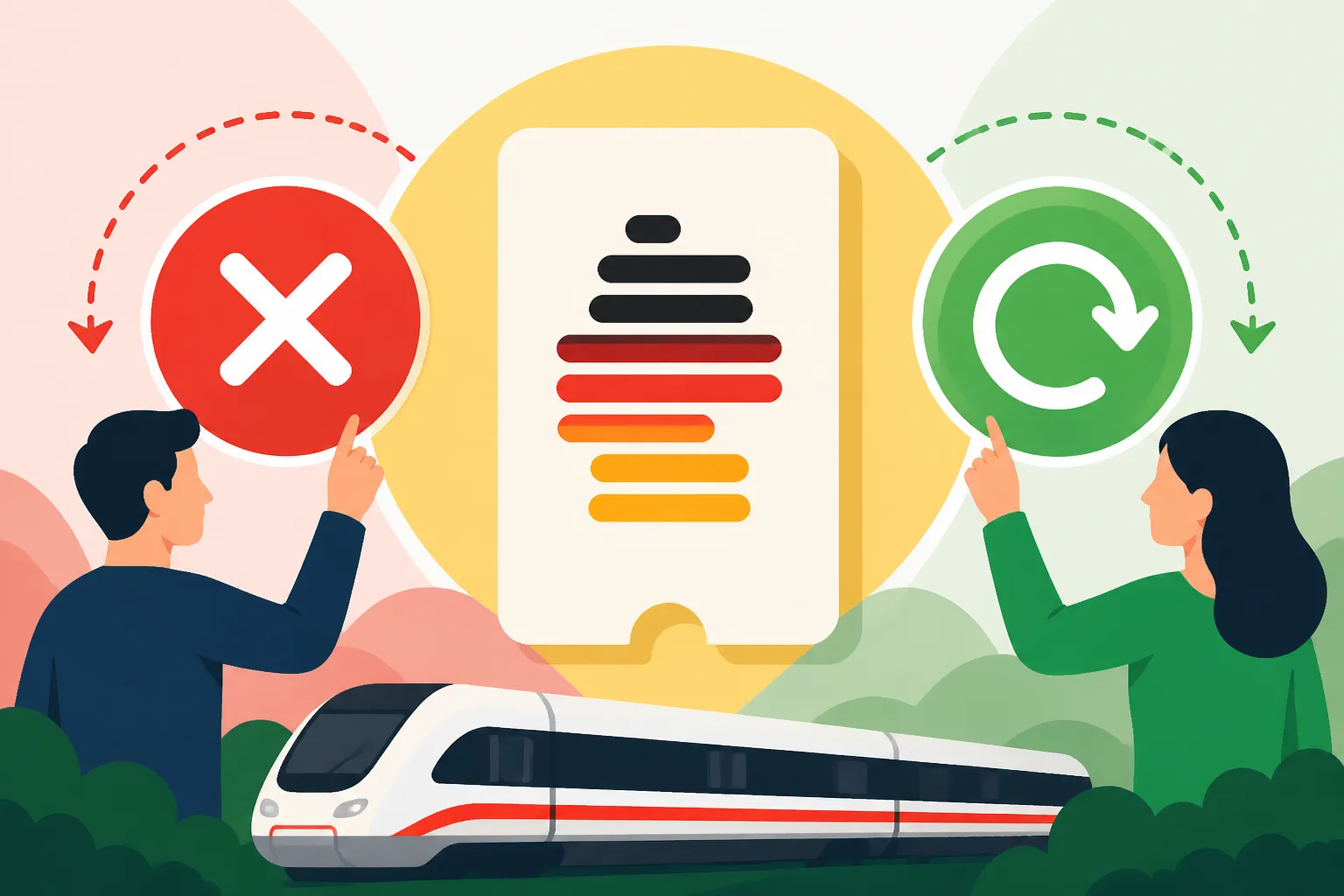
You go away for three weeks, come back, and find your Deutschlandticket charged you for a month you barely used. Or you cancel in a hurry, restart mid-month, and get billed for two full months. This guide explains how cancelling and restarting the Deutschlandticket actually works, which dates matter, and how to cover the gaps without overpaying.
Disclosure: This post may contain affiliate links. We may earn a commission at no extra cost to you if you make a purchase through these links. Read full disclosure.
I’ve watched friends, flatmates and colleagues lose money on this subscription. None of them were careless. The rules are simple once someone spells them out, but nobody does that on the purchase screen. So here is the explanation I wish I’d had.
How the Deutschlandticket Subscription Actually Works
The Deutschlandticket feels like a monthly pass. Legally and technically, it is a subscription that renews automatically every calendar month until you cancel it. It does not run from the day you bought it for thirty days. It runs in calendar months, and nearly every billing surprise comes from forgetting that.
If you’re still deciding whether it suits your routine, see What Is the Deutschland-Ticket and Is It Worth It? first. This article assumes you already have one, or are about to buy one, and want to control the money.
The Calendar Month Is the Unit of Everything
At Deutsche Bahn, you can buy the Deutschlandticket for the current month at any time. It becomes valid from the moment of activation and runs until the last day of that calendar month. You pay the full monthly price for that first month. There is no pro-rata discount for joining late.
The price is EUR 63 per month in 2026. It rises to EUR 66.80 from 1 January 2027. Whether you activate on the 1st or the 27th, the first charge is the full monthly amount.
Here is a scenario I see constantly. Priya, a software developer who just moved to Leipzig, lands on the 20th. She buys the ticket in the DB Navigator app that evening so she can ride the S-Bahn to her flat viewings. Her ticket works immediately and she pays the full EUR 63. On the 1st of the next month, it renews and she pays again. Nothing went wrong, and she did get value from those ten days. But many newcomers expect the first charge to be a fraction of the price, and it never is.
The 10th of the Month Is Your Cancellation Deadline
This is the most important date. To end your subscription at the close of a given month, your cancellation needs to be in by the 10th of that month. Cancel on the 9th and your ticket stops at month’s end. Cancel on the 11th and you’ve missed that month’s window. The subscription runs through the following month and ends there.
This creates a trap for anyone who buys after the 10th. Buy on or after the 11th and you’re already past the current month’s deadline. Your earliest possible end date is the end of the following month. In practice, you pay for both months in full: the partial month you started in and the whole next month.
When I first explained this to my neighbour in Köln-Ehrenfeld, he was baffled. “So if I only need it for a week in late March, I’m paying for March and April?” Yes, if he buys it through Deutsche Bahn after the 10th. That’s why timing your purchase matters as much as timing your cancellation.
Who You Bought It From Matters
You can buy the Deutschlandticket from Deutsche Bahn, but also from many regional transport companies and associations. Examples include BVG in Berlin, MVV in Munich, HVV in Hamburg and the various Verkehrsverbünde across North Rhine-Westphalia. The core product is the same everywhere, valid nationwide on local and regional transport.
The subscription is a contract with whichever company sold it to you. Your cancellation goes to that company, through its app, customer portal or written process. Deutsche Bahn cannot cancel a ticket you bought from BVG, and vice versa. The mechanics described here are the Deutsche Bahn rules. If you bought elsewhere, check that provider’s own terms page, because some handle the process slightly differently.
Before cancelling anything, find your confirmation email and note who actually sold you the ticket. It sounds obvious. I’ve still met three people who spent an afternoon on hold with the wrong company.
Step-by-Step: Cancelling Your Deutschlandticket Without Losing Money
Most of the anger I hear from other expats isn’t about the price. It’s about paying for a month they didn’t want. The fix is a little planning and a calendar reminder.
How to Cancel Through Deutsche Bahn
If your subscription is with Deutsche Bahn, the process is digital and fairly painless. The app and website are available in English, though some confirmation emails arrive in German. Our guide on How to Use the DB Navigator App in Germany walks through the interface in more detail.
- Log in to the Deutsche Bahn account you used to buy the ticket. This is usually the same account linked to your DB Navigator app.
- Open the section for your subscriptions or your Deutschlandticket. It’s typically listed separately from one-off journey bookings.
- Select the option to cancel, called “Kündigen” in the German interface.
- Read the end date shown before you confirm. It should be the last day of the current month if you’re on or before the 10th. It will be the last day of the following month if you’re after the 10th.
- Confirm the cancellation and save the confirmation email or screenshot. Treat it as a receipt.
- Check your account a day later to make sure the subscription status shows the correct end date.
Step four is where you catch your own mistakes. If the end date is a month later than expected, you’re probably past the 10th. At that point you can’t move the date. You can only plan the extra month.
Timing Your Cancellation Around Real Life
Picture three expats, each leaving Germany or going quiet on transport for a while.
Marco works in Frankfurt and knows he’ll spend six weeks in Italy over the summer. He cancels on the 3rd of the month before he leaves. His ticket runs to that month’s end, and nothing is charged while he’s away. He has his cancellation receipt saved, a reminder set to restart when he’s back, and no surprises.
Lena is moving from Hamburg back to Canada. She remembers the subscription on the 14th, while packing. She cancels immediately, but she’s past the 10th. Her ticket stays valid, and charged, through the end of the following month. She’s in Toronto by then, so she pays for a month of German transport she can’t use. Nothing could have been done on the 14th. The fix would have been cancelling when she booked her flight, weeks earlier.
Tomás, a student in Munich, finds the subscription charged him on the 1st even though he barely travelled last month. He hasn’t missed anything. He simply never cancelled. If he does it before the 10th of this month, this will be his last charge.
The pattern is clear. The cost of cancelling is a little attention at the right time. The cost of ignoring it is a full month’s charge.
What Happens After Cancellation
Once cancelled, your ticket stays fully valid until its end date. You can keep riding regional trains, S-Bahn, U-Bahn, trams and buses every day until the last day of that month. Cancelling early doesn’t shorten your access. It just stops the next renewal.
After the end date, the ticket disappears from the app and you have no Deutschlandticket at all. Germany does not let you ride first and sort it out later. Inspectors on regional trains and in city transport will fine you if you can’t show a valid ticket. Plan how you’ll travel in the gap before your last valid day arrives.
Restarting the Deutschlandticket: The New Subscription Rules
There is no real pause function. The way to “pause” is to cancel and buy again later. When you restart, you are not reactivating your old contract. You are starting a brand-new subscription, with the same rules as a first purchase.
Restarting Mid-Month: What You Pay and When It Works
A restart behaves exactly like buying for the first time. Through Deutsche Bahn, you can restart at any point in the month. The new ticket is valid from activation for the rest of that calendar month, and the full monthly price is charged. On the 15th, the ticket works from the 15th to the end of the month, and you pay the full EUR 63.
The 10th rule applies to the new subscription from day one. Restart after the 10th and your earliest end date is the end of the following month. If you only need a few days, a mid-month restart after the 10th commits you to two full monthly charges.
My friend Aisha in Stuttgart learned this the hard way. She had cancelled during a long stretch of working from home. Then her parents visited on the 18th and she wanted to take them on regional trains to Tübingen and Esslingen. She restarted the ticket and it worked instantly. But when she tried to cancel straight away, the app showed an end date at the close of the following month. She paid two months for roughly ten days of use. It still beat buying point-to-point regional tickets for three people’s daily trips, so she wasn’t too upset. But it wasn’t the one-off cost she’d imagined.
Should You Restart Now or Wait for the 1st?
This depends on how many days are left in the month and how much you’ll travel. If it’s late in the month and you only need a ride or two, single tickets for those days often make more sense. Then restart on the 1st, when you get a full month for the full price. If it’s early in the month and you’ll travel almost daily, restarting immediately is usually fine.
There’s also the cancellation question. If you plan to keep the ticket for a while, the 10th rule barely matters, because you won’t cancel soon anyway. It only bites people who want short bursts of coverage. A month on, a month off, a week here and there.
For a fuller comparison of what makes the ticket pay off, our article on Deutschlandticket vs BahnCard 25, 50, and 100: Which Combination Pays Off explains how frequent travellers combine products. It’s useful if your travel mixes daily commuting with occasional long-distance trips.
Purchase and Cancellation Scenarios at a Glance
This table summarises the Deutsche Bahn rules for the most common timings. The monthly figure shown is the 2026 price. From 1 January 2027, read EUR 66.80 wherever EUR 63 appears.
| Situation | When the ticket is valid | What you pay for the first month | Earliest end of subscription |
|---|---|---|---|
| Buy or restart on the 1st | From activation to the last day of that month | Full price, EUR 63 | End of that same month, if cancelled by the 10th |
| Buy or restart on or before the 10th | From activation to the last day of that month | Full price, EUR 63, no pro-rata | End of that same month, if cancelled by the 10th |
| Buy or restart after the 10th | From activation to the last day of that month | Full price, EUR 63, no pro-rata | End of the following month, so both months are paid in full |
| Cancel on or before the 10th of any month | Valid until that month ends | No further charge after that month | End of that month |
| Cancel after the 10th of any month | Valid until the following month ends | One more full monthly charge | End of the following month |
Print it, screenshot it, stick it on your fridge. When I share this table with new arrivals at our Thursday expat meetup in Berlin, it’s usually the moment the whole thing clicks.
Covering the Gaps: Travelling Smart When Your Ticket Is Off
This is where most people lose money in a different way. They cancel the Deutschlandticket to save on a quiet month. Then they book whatever turns up first when they do need to travel, often at a poor price. The gap between subscriptions is exactly when comparison shopping pays off. This is also where I lean on Omio more than any other tool.
Why Omio Is My Go-To During Deutschlandticket Breaks
The Deutschlandticket covers local and regional transport only. It generally does not cover ICE, IC or EC long-distance trains, and it doesn’t cover FlixBus coaches. Our explainer on Regional Trains and the Deutschland-Ticket Explained covers exactly where the line falls. So even with an active subscription, longer trips need a separate ticket. Without one, every trip does.
Omio shows trains, long-distance buses and flights for the same route side by side, in English, with consistent search results. Say I’m going from Berlin to Hamburg without a Deutschlandticket. I don’t want to check the Deutsche Bahn site, then the FlixBus site, then a flight comparison site. I search once on Omio and see the options next to each other: departure times, durations, number of changes and the fare for each. For a busy expat, that saves a lot of time and second-guessing.
It’s especially handy for visitors and newcomers whose German isn’t strong yet. The interface is fully in English, and the booking flow is familiar if you’ve used comparison sites elsewhere. For anyone who’s struggled with payment at German transport sites, our guide on Paying for German Transport With a Foreign Card: Declines and Fixes is worth reading. Many people find a platform like Omio a smoother way to pay with a card issued abroad.
Fares, booking fees and the specific options shown depend on the route and the operator. Always check the final price on the checkout page before you confirm. Prices change constantly, so treat each search as a fresh snapshot.
A Practical Gap Strategy, Step by Step
Here’s the routine I’ve settled into for the months I deliberately let the Deutschlandticket lapse, usually a stretch of winter remote work or a long trip abroad.
- Cancel the subscription before the 10th of the last month you want covered. Save the confirmation.
- Set a phone reminder for the date you expect to need daily local transport again. Ideally that’s the 1st of a month, so you get full value when you restart.
- For long-distance trips during the gap, search the route on Omio and compare train against coach. On many corridors the bus is slower but cheaper, and sometimes the train is barely more expensive.
- For local trips in your own city during the gap, buy single or day tickets from your local operator, such as BVG, MVV or HVV, depending on where you live.
- If you suddenly need heavy local travel mid-month, weigh the options honestly. Restarting gives instant coverage at full price. After the 10th, it also commits you to the following month.
- When the gap ends, restart the subscription, ideally on or near the 1st. Keep using Omio for any long-distance legs the Deutschlandticket doesn’t cover.
The point of step three is to stop overpaying when you do travel. If you’d like a data-driven view of trains against coaches, read FlixBus vs Deutsche Bahn: Total Cost and Time on Germany’s Main Routes. For a broader look at the coach network, see Long-Distance Buses in Germany: FlixBus and Networks.
Real Scenarios Where Searching First Saves You
Here are some trips from my own life and my friends’ lives. Each one came up while someone’s Deutschlandticket was cancelled.
Jonas, a designer in Düsseldorf, cancels each December because he spends the holidays at home in Poland. In January, before restarting, he has a client meeting in Frankfurt. He compares the routes on Omio, books an ICE for the morning and a cheaper coach for the evening return. Then he restarts his Deutschlandticket on the 1st of February, when his daily commute resumes.
Sofia, an au pair in a small town outside Nuremberg, keeps her ticket only during school term. In the summer break she travels around Germany with friends visiting from Spain. None of them have a Deutschlandticket, and the visitors aren’t eligible for the same long-term logic anyway. Our piece on Deutschlandticket for Tourists: Can Short-Stay Visitors Actually Use It? explains the visitor side. They use Omio to plan Nuremberg to Munich, then Munich to Berlin, and each person books the same option in English without confusion.
Then there’s me. Last spring I let my ticket lapse during a heavy deadline month and barely left my flat in Berlin-Neukölln. When a last-minute weekend in Dresden came up, I didn’t guess. I checked train and bus options on Omio, picked the departure that suited my working hours, and booked from my phone on the U-Bahn platform. I restarted the Deutschlandticket on the 1st the following month. No overlap, no wasted charges, no rushed overpriced ticket.
Deciding When the Deutschlandticket Beats Point-to-Point Tickets
For regular regional commuting, nothing in Germany beats the Deutschlandticket on value. The question is whether your next few weeks look like regular commuting or like occasional trips. The table below sums up how I decide, though your own numbers depend on where you live and how you travel.
| Your travel pattern for the coming weeks | Sensible approach | Where Omio fits in |
|---|---|---|
| Daily commuting by S-Bahn, U-Bahn, tram or regional train | Keep the Deutschlandticket active and don’t cancel | Booking ICE, IC or coach trips beyond your regional network |
| A long trip abroad covering one or more full calendar months | Cancel by the 10th of the last month you’ll use it, then restart on the 1st when back | Comparing trains, coaches and flights for the trip itself |
| A few scattered local trips over the month | Let the subscription lapse and buy single or day tickets locally | Comparing occasional intercity routes during the gap |
| Heavy local travel starting suddenly mid-month | Restart now, accepting the full monthly charge and the 10th rule | Covering any long-distance legs the Deutschlandticket excludes |
| Mostly long-distance travel between cities | The Deutschlandticket may not help much, so compare long-distance options | Your main tool for comparing ICE fares against coaches |
If long-distance trains make up most of your travel, the break-even maths changes completely. Deutschlandticket vs ICE Tickets: Break-Even by Route and Journey Time digs into those corridors. Whatever you choose, I’d still run each intercity journey through Omio before booking. It takes a minute and often shows a cheaper departure an hour or two away.
Avoiding the Classic Restart Mistakes
A few errors come up so often they deserve their own list.
- Restarting with a different account than the original. That’s fine in itself, but people then forget which account holds the active subscription and can’t find it when they want to cancel. Use one account and stick to it.
- Assuming a restart is “the same subscription”. It’s new, and the 10th rule resets with it. If you restart on the 20th, check the cancellation end date in the app immediately, so you know what you’ve committed to.
- Forgetting that long-distance trains are excluded. People restart their Deutschlandticket for a “trip to Munich”, board an ICE, and get fined. If it’s an ICE, IC or EC, you need a separate long-distance ticket. That’s precisely when a quick Omio search earns its keep.
- Not keeping proof. Save every cancellation confirmation. If a charge appears that shouldn’t, the confirmation is what you’ll show customer service.
- Ignoring the provider’s own terms. If you bought from a regional association rather than Deutsche Bahn, read its subscription conditions before assuming the same details apply.
If something goes wrong with a separate ticket you booked during the gap, such as a cancelled train or a missed connection, our guide on Refunds and Changes on German Transport: What You Actually Get Back explains your options. For day-to-day riding once your subscription is back, How to Use Regional Trains With the Deutschland-Ticket covers the practical details of boarding, inspections and showing your ticket.
My Honest Take After Years of Cancelling and Restarting
The Deutschlandticket is one of the best things to happen to everyday transport in Germany. I love being able to step onto almost any regional train, tram or bus without thinking about zones. But it’s a subscription, and subscriptions reward people who manage them. The two rules that matter most are easy to remember:
- You always pay the full monthly price, whenever in the month you start.
- The 10th is the cut-off for ending your subscription at that month’s end.
Get those right and the ticket becomes a flexible tool rather than a monthly drain. When you’re between subscriptions, or travelling beyond what it covers, make Omio your first stop. Compare trains, coaches and flights side by side, book in English and keep your spending under control. Set your cancellation reminder for the 1st through the 10th, search your next intercity trip on Omio before you book, and you’ll stop leaking money on German transport for good.
Disclaimer
This article is for general informational purposes only and does not constitute professional advice. Laws, prices and regulations vary by location and change over time. Consult a qualified professional for guidance on your specific situation.