Deutschlandticket vs BahnCard 25, 50, and 100: Which Combination Pays Off
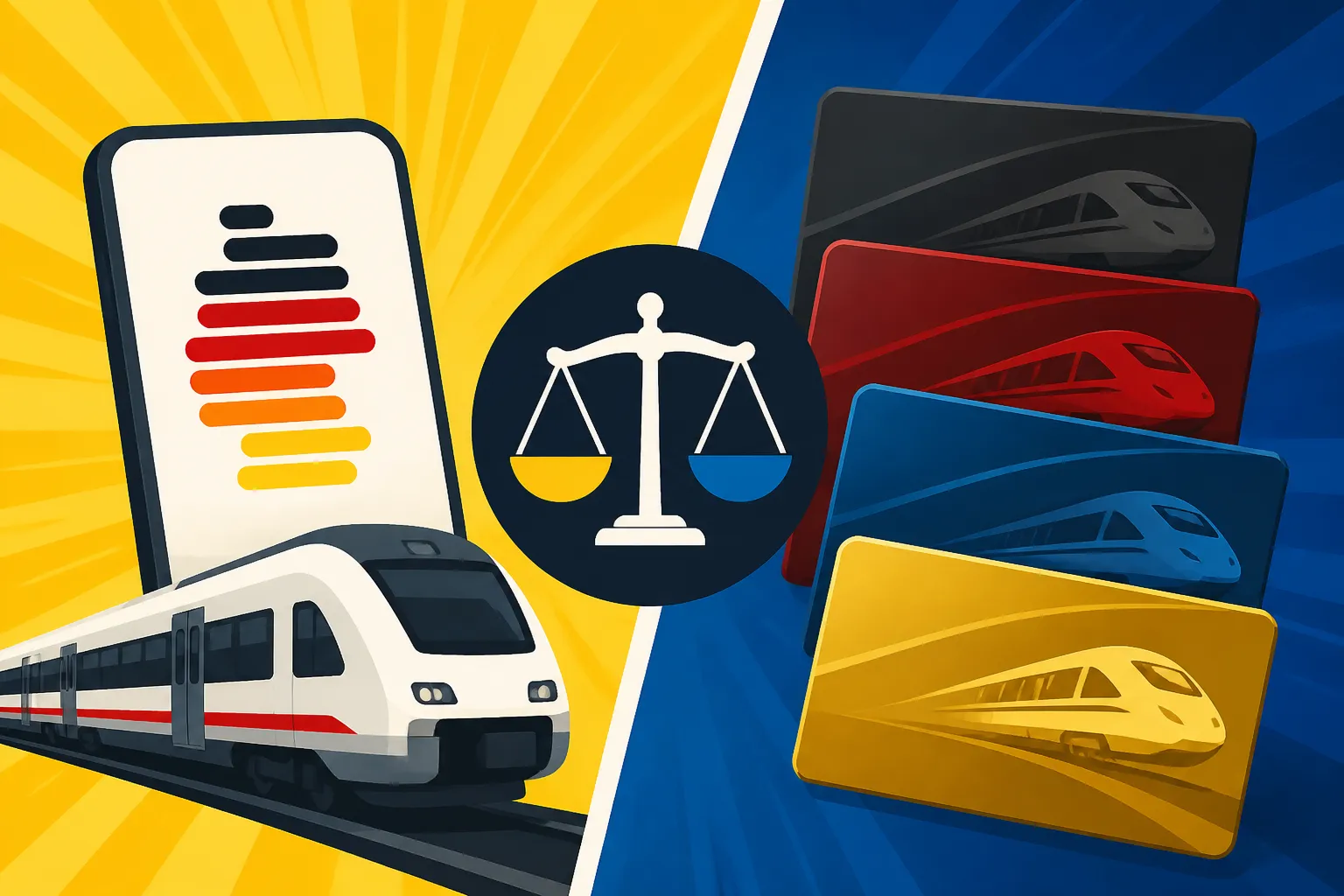
If you live in Germany, you probably know this moment. You have the Deutschland-Ticket on your phone, a few ICE trips to Hamburg or Munich coming up, and a BahnCard offer from Deutsche Bahn in your inbox. You wonder whether you’re paying for the same thing twice. This guide works through the real numbers so you can see which combination pays off for how you actually travel.
Disclosure: This post may contain affiliate links. We may earn a commission at no extra cost to you if you make a purchase through these links. Read full disclosure.
How the Deutschland-Ticket and the BahnCard Family Actually Work
When I first moved here, I treated “the ticket” and “the BahnCard” as two versions of the same product. They aren’t. One is a flat-rate pass for a specific kind of train. The other is a discount card for buying individual tickets. You need to separate the two clearly before any comparison makes sense.
What the Deutschland-Ticket Covers and What It Does Not
The Deutschland-Ticket is a monthly subscription that costs €63 per month. It covers local and regional public transport across the whole country in second class. That includes the U-Bahn in Munich, the S-Bahn in Frankfurt, trams in Leipzig, buses in Cologne, and regional trains marked RE, RB, and S. You can ride a regional train from Hamburg toward the Baltic coast, change to a bus, and finish on a tram in another city, all on the same ticket. Our deeper explainer, Regional Trains and the Deutschland-Ticket Explained, walks through the train categories one by one.
The main limit is long-distance service. Deutsche Bahn’s fast trains, the ICE, IC, and EC, generally sit outside the ticket. Long-distance buses and private long-distance operators also need their own tickets. There is one nuance that many people miss, though. The tariff lists specific IC and ICE sections where the Deutschland-Ticket is accepted, usually stretches where long-distance trains fill a gap in regional service. Before assuming a fast train is off limits, check whether your stretch is on that list in the official tariff conditions. Just don’t board an ICE on a hunch.
The ticket is personal, digital in most cases, and second class only. If you’re new to the whole concept and still deciding whether it suits you, What Is the Deutschland-Ticket and Is It Worth It? is a gentler starting point than this comparison.
BahnCard 25 and BahnCard 50: Discount Cards, Not Passes
The BahnCard 25 and BahnCard 50 don’t let you ride anything for free. They reduce the price of the tickets you buy from Deutsche Bahn for a year. The BahnCard 25 costs €62.90 in second class or €125 in first class. It gives a moderate discount on both saver fares and flexible fares. The BahnCard 50 costs €244 in second class or €492 in first class. It gives a much deeper cut on flexible fares and a smaller one on saver fares.
The best way to think about them is as a membership you pay up front and earn back trip by trip. If you rarely take long-distance trains, you never earn it back. If you take them often, the card pays for itself quickly, and every trip after that is a bonus. Most expats get the card wrong by buying it for a single planned trip and then never using it again.
There is also a practical detail that matters for the combination question. You only feel a BahnCard discount on tickets you actually buy. If the Deutschland-Ticket already covers your regional trips, those trips no longer generate BahnCard savings. Once you hold the Deutschland-Ticket, the BahnCard 25 or 50 becomes a long-distance-only tool.
BahnCard 100: The Flat Rate for Heavy Travelers
The BahnCard 100 is the odd one out. It’s an annual flat rate for Deutsche Bahn trains, including the ICE, so you don’t buy individual DB tickets at all. It costs €4,899 in second class or €7,999 in first class. Spread over a year, the second-class version works out to €4,899 divided by 12, about €408 a month. Compare that with the Deutschland-Ticket at €63 per month and you can see that the BahnCard 100 is for a very particular kind of traveler.
That traveler usually commutes long-distance several times a week, works as a consultant moving between cities, or has a family split across opposite ends of the country. For everyone else it’s a luxury, however comfortable it would be never to think about fares again. I’ve met exactly two expats who genuinely earned back a BahnCard 100, and both were essentially living on the Berlin to Munich corridor.
| Product | Second Class Price | First Class Price | What It Does | Renewal Behaviour |
|---|---|---|---|---|
| Deutschland-Ticket | €63 per month | Not available | Flat rate for local and regional transport, plus listed IC/ICE sections | Monthly subscription, cancel by the 10th of a month, ends at the end of that month |
| BahnCard 25 | €62.90 per year | €125 per year | Moderate discount on saver and flexible DB fares | Renews automatically for a year unless cancelled in text form 4 weeks before the end |
| BahnCard 50 | €244 per year | €492 per year | Deep discount on flexible fares, smaller discount on saver fares | Renews automatically for a year unless cancelled in text form 4 weeks before the end |
| BahnCard 100 | €4,899 per year | €7,999 per year | Flat rate for DB trains including ICE | Does not need cancelling, expires after one year |
Running the Numbers: A Realistic Annual Scenario
Abstract descriptions only get you so far. What helped me decide was building one realistic year of travel and pricing it four different ways. The scenario below is deliberately simple so you can swap in your own figures.
The Assumptions Behind the Scenario
Picture someone living in a mid-sized German city who commutes by local transport every working day. Without the Deutschland-Ticket, they would buy a local monthly pass at €75. Over a year that’s €75 multiplied by 12, which comes to €900.
On top of the daily commute, they take 8 single long-distance ICE trips a year: a couple of visits to friends, a work trip, a holiday departure. Each single ICE trip costs €100 at full price, so the 8 trips add up to €800 before any discount. With a BahnCard 25, the same 8 trips come to €600.
I chose these numbers because they reflect a very common expat pattern. You use public transport every day for ordinary life, and long-distance trains a handful of times a year. You may travel much less, or much more. The method stays the same.
Four Ways to Pay for the Same Year
Here is the same year priced four ways. Every figure in this table follows directly from the assumptions above, and every row adds up.
| Option | Local Transport Cost | Long-Distance Cost | Card Cost | Annual Total |
|---|---|---|---|---|
| No pass, no card | €900 | €800 | €0 | €1,700 |
| Deutschland-Ticket only | €756 | €800 | €0 | €1,556 |
| BahnCard 25 only | €900 | €600 | €62.90 | €1,562.90 |
| Deutschland-Ticket plus BahnCard 25 | €756 | €600 | €62.90 | €1,418.90 |
The Deutschland-Ticket line uses €63 multiplied by 12, which is €756. It replaces the €900 local pass completely. The BahnCard 25 line keeps the €900 local pass but cuts the long-distance spend from €800 to €600, then adds the €62.90 card price.
Why the Combination Wins Here
Notice how close the two single-product options are. The Deutschland-Ticket alone comes to €1,556. The BahnCard 25 alone comes to €1,562.90. Within a few euros of each other, they’re essentially a coin toss in this scenario. That’s why so many people get stuck on this question: each product on its own saves money, but neither stands out.
The combination at €1,418.90 is clearly the cheapest because the two products don’t overlap. The Deutschland-Ticket handles the €900 local problem by turning it into €756. The BahnCard 25 handles the €800 long-distance problem by turning it into €600 for a €62.90 fee. Each tool attacks a different part of your spending. Paying twice for the same thing would mean holding a BahnCard purely for regional trips you already cover with the Deutschland-Ticket. That’s not what happens here.
The BahnCard 100 does not appear in the table because it isn’t close. At €4,899 a year, it costs several times the combination total for this traveler. Its monthly equivalent of about €408 dwarfs the €63 Deutschland-Ticket. For this pattern it would be throwing money at a problem you don’t have.
Which Combination Pays Off for Your Travel Pattern
The scenario is a template, not a verdict. Your own pattern may shift the answer, so here are the three profiles I see most often among expats and longer-term visitors.
The Daily Commuter With Occasional Long Trips
This is the profile from the scenario, and for most people it is the default answer. Hold the Deutschland-Ticket for everyday life, and add a BahnCard 25 if you take more than a few long-distance trips a year. The BahnCard 25 is cheap enough at €62.90 that a modest number of ICE journeys earns it back. Even if a year turns out quieter than planned, the loss is small.
One friend of mine in Dortmund fit this profile exactly. She commuted by S-Bahn and U-Bahn, visited her partner in Berlin every couple of months, and flew home twice a year from Frankfurt. She had been buying full-price ICE tickets for years without a card because she had never checked whether a discount card would pay off. Once she added a BahnCard 25 for the long trips only, the arithmetic looked just like the table above.
The trap for this profile is assuming you need nothing beyond the Deutschland-Ticket. If you live near a regional line and are willing to sit on slower trains, you can cover surprisingly long distances. Weekends in the Harz or along the Rhine are easy. For a quick dash across the country, though, regional connections can turn a few hours into most of a day. That’s where the discount card earns its place. If weekend getaways are your main long-distance use, Weekend Trips for Residents: Booking Domestic German Travel Cheaply has ideas for keeping those trips cheap.
The Frequent Long-Distance Traveler: Where the BahnCard 50 Enters
The BahnCard 50 at €244 asks for a much bigger up-front commitment, so it suits a different traveler. Its strength is the deep discount on flexible fares. Those are the tickets you buy when you need to change plans, travel at short notice, or catch whichever train is leaving. If your long-distance travel is frequent and unpredictable, the BahnCard 50 often pulls ahead of the 25.
The key question is how you book. If you’re disciplined and buy saver fares weeks ahead, the gap between the two cards shrinks, because the BahnCard 50’s saver-fare discount is smaller than its flexible-fare discount. If you’re the kind of person who books on Thursday for a Friday trip, flexible fares become your reality, and the BahnCard 50 starts to look much more attractive. The trade-offs between those fare types are covered in Sparpreis vs Flexpreis on Deutsche Bahn: Change Rules and Refunds.
For this traveler the best combination is usually still the Deutschland-Ticket for local life plus the BahnCard 50 for long distance. The logic is the same as in the scenario: one product per spending category, no overlap. What changes is only which discount card fits your booking habits.
When the BahnCard 100 Finally Makes Sense
The BahnCard 100 only wins when your annual Deutsche Bahn spend would exceed its €4,899 price, even after the best discount card. Think of someone commuting by ICE several days a week between two cities, or a field engineer travelling all over the country every week. For them, the freedom to board any DB train without buying a ticket is worth a lot, and the convenience is real.
There’s also a psychological argument that I hear from heavy travelers. With a BahnCard 100, you stop treating every trip as a pricing decision. You hop on an earlier train because you finished a meeting early. You never wonder whether a saver fare will vanish. For people whose work runs on trains, that peace of mind matters.
For most expats, though, the honest answer is no. If your long-distance travel fits into a handful of trips per year, the combination of Deutschland-Ticket and BahnCard 25 or 50 will cost you a fraction of what the BahnCard 100 does. If you’re commuting across a border rather than within Germany, the picture changes again. Cross-Border Commuting From Germany: Regular Trips to Switzerland and Austria covers that situation separately.
Pricing Your Real Trips With Omio Before You Commit
Every bad pass decision I’ve watched an expat make came from guessing their trip costs instead of checking them. The fix is simple. Before you buy any BahnCard, price the long-distance trips you actually expect to take. Omio is the tool I recommend for this, because it lets you see your options for the same journey side by side in English.
Why a Pass Decision Starts With Actual Fares
The table above uses €100 per ICE trip for clarity. Real fares vary enormously depending on how early you book, the day of the week, and the time of day. A Friday afternoon ICE out of Frankfurt costs something very different from a Tuesday morning one. If you plug a vague guess into your break-even calculation, you get a vague answer. When the decision involves up to €244 for a BahnCard 50, that isn’t good enough.
Searching your typical routes on Omio for a few representative dates gives you a realistic range of fares. That range is the input your calculation needs. You may find that your usual Cologne to Berlin trip is cheap enough on a saver fare that a BahnCard 25 is plenty. You may also discover that your last-minute work trips are so expensive that the BahnCard 50 pays off within a couple of months.
There’s a second benefit. Omio shows you what you would pay without any card at all, which keeps you honest. It’s surprisingly easy to talk yourself into a discount card because discounts feel good. Seeing the plain fare for each trip and multiplying by how often you really go is the most reliable defense against that.
Step by Step: Building Your Own Break-Even Test
Here is the exact process I walk friends through when they ask me whether to buy a BahnCard on top of their Deutschland-Ticket.
- List every long-distance trip you expect in the next twelve months: visits, work trips, holidays, airport runs. Be realistic and include only trips you are confident about.
- For each route, search on Omio for a few typical dates: one booked well ahead, one at short notice, and one at a busy time such as a Friday evening.
- Note the realistic fare you would actually choose for each trip, based on how you normally book.
- Add those fares together. This is your no-card long-distance total, the equivalent of the €800 in the scenario.
- Estimate what that total would be with each BahnCard discount. Use Deutsche Bahn’s own conditions to see how the discount applies to saver and flexible fares.
- Add the card price to each discounted total: €62.90 for the BahnCard 25 or €244 for the BahnCard 50 in second class.
- Add €756 for a year of the Deutschland-Ticket if your local and regional travel justifies it, or your local pass cost if it doesn’t.
- Compare the totals and pick the lowest. If two options land within a few euros of each other, choose the one with more flexibility.
Repeat the exercise once a year, before your BahnCard renewal date. Your life changes: new job, new partner, new city. The best combination changes with it.
Comparing Trains, Buses, and Flights on the Same Screen
One thing that makes Omio especially useful for this decision is that it doesn’t only show trains. For many routes it also shows long-distance buses and flights. That matters because sometimes the cheapest way to cover a long-distance trip isn’t a discounted ICE at all. It might be a bus that takes longer but costs less, or a domestic flight booked far enough ahead.
If a meaningful share of your “long-distance trips” turn out to be cheaper by bus, your BahnCard break-even shifts. You might need a BahnCard 25 instead of a 50, or no card at all. Our comparison FlixBus vs Deutsche Bahn: Total Cost and Time on Germany’s Main Routes goes deep on that trade-off, and Berlin to Munich: Train, Bus, and Flight Priced Side by Side does the same for Germany’s most popular long route.
When you’re ready to book a trip that the Deutschland-Ticket doesn’t cover, Omio is a sensible place to finish the job. Where your BahnCard is supported as a discount card in the passenger details, you can add it so the quoted DB fare reflects it. Then carry the card with you on board for the ticket check. Search your next long-distance trip on Omio, compare the options, and let the real fares tell you which card to buy.
Cancellation, Renewal, and the Fine Print That Catches Expats
The money side is only half the story. The other half is the subscription mechanics, and this is where I’ve seen the most frustration. German subscription rules are precise, deadlines are enforced, and “I didn’t know” doesn’t get you a refund.
Cancelling the Deutschland-Ticket
The Deutschland-Ticket is a monthly subscription. You can cancel it by the 10th of a month, and the cancellation takes effect at the end of that same month. If you cancel on the 8th, your ticket remains valid until the last day of that month and then stops. If you miss the 10th, you pay for the following month as well.
This flexibility is one of the ticket’s great strengths for expats. If you’re spending the summer abroad, or switching to a job where you work from home, you can pause your spending without a long-term penalty. Just set yourself a calendar reminder a few days before the 10th of the month you want to end. For a full walkthrough of pausing and restarting, including how it behaves with different issuers, read Cancelling and Restarting the Deutschlandticket: Subscription Mechanics.
One practical tip: make sure you know which provider issued your ticket. Some people buy through their local transport association, others through Deutsche Bahn or a third-party app. Cancellation goes through the issuer, not through whichever app you happen to have open.
BahnCard 25 and 50 Auto-Renewal and the Four-Week Notice
This is the rule that catches people most often. The BahnCard 25 and BahnCard 50 renew automatically for another year unless you cancel in text form 4 weeks before the end of the validity period. Text form means a written message such as an email or letter. A phone call isn’t enough, and neither is quietly deciding not to use the card any more.
If you bought a BahnCard 50 for a busy year of project travel and your job changes, you need to act before the 4-week deadline. Otherwise you’ll pay €244 again for a card you may not need. I always tell people to put the cancellation deadline in their calendar on the day they buy the card. You can still let it renew if you want to. At least the decision will be yours.
The renewal date is also the perfect moment to rerun the break-even test from the previous section. Your travel last year is the best predictor you have. Price a few typical trips on Omio, check the totals, and decide whether to keep the same card, switch between the 25 and 50, or drop it entirely.
BahnCard 100 Expiry and First-Class Considerations
The BahnCard 100 works differently. It does not need cancelling and simply expires after one year. That is a relief for anyone who bought one for an intense period, such as a year-long commuting contract. You won’t wake up to a surprise €4,899 charge. If you want another year, you buy a new one.
First class adds another layer. The Deutschland-Ticket is valid in second class only. If you prefer first class on long journeys, you need a first-class ticket, which a first-class BahnCard discounts. The BahnCard 25 costs €125 in first class, the BahnCard 50 €492, and the BahnCard 100 €7,999. A common setup among people who value comfort is a second-class Deutschland-Ticket for daily life plus a first-class BahnCard for long trips. Whether that comfort is worth the extra cost is discussed in First Class vs Second Class on German Trains: What the Upgrade Buys.
Common Mistakes and Practical Tips
After years of answering this question for friends, colleagues, and readers, I’ve noticed the same mistakes again and again. Here are the ones worth avoiding, and the habits that consistently save money.
Assuming the Answer Is Always One Product
The biggest mistake is treating the Deutschland-Ticket and the BahnCard as competitors where you must pick a winner. As the scenario shows, they solve different problems. The Deutschland-Ticket handles local and regional travel. The BahnCard handles long-distance DB fares. For most people who use both kinds of travel, holding both is the cheapest arrangement.
The second mistake runs the other way: holding both when you don’t need both. If you take one long-distance trip a year, a BahnCard probably won’t earn back its cost. If you work from home and walk everywhere, the Deutschland-Ticket may cost more than the occasional single ticket. The combination is only clever when both halves are pulling their weight.
The third mistake is forgetting the IC and ICE sections that are included in the Deutschland-Ticket tariff. On a handful of stretches, the pass gets you onto a long-distance train without buying anything extra. If your regular route happens to include one, that changes your calculation. Check the official list for your area rather than assuming either way. For a broader look at when a single long-distance ticket beats relying on regional connections, Deutschlandticket vs ICE Tickets: Break-Even by Route and Journey Time goes route by route.
Tourists, Short Stays, and Newcomers Without Paperwork
Visitors and brand-new arrivals face a slightly different version of this question. A tourist spending two weeks in Germany doesn’t want a BahnCard that renews automatically for a year. A newcomer without a German bank account may struggle to set up any subscription. For short-stay visitors, whether the Deutschland-Ticket is even practical is covered in Deutschlandticket for Tourists: Can Short-Stay Visitors Actually Use It?.
For short trips, buying individual long-distance tickets without a discount card is often the simplest route. This is where a comparison tool earns its keep. You can see at a glance whether the train, bus, or flight is the best option for each leg, and you pay with the card you already have. Omio is particularly handy for visitors because the booking flow is in English and accepts payment methods that international travelers already carry.
If you’re booking from abroad before you arrive, foreign cards and name formatting can cause problems with some booking systems. Booking German Trains From Abroad: Foreign Cards, Names, and Failures covers the most common failures and how to avoid them. Getting a smooth first booking matters, because nobody wants to be stuck at Frankfurt Airport arguing with a payment terminal after a long-haul flight.
Booking Habits That Make Any Combination Cheaper
Whatever combination you choose, your booking habits decide how much you really save. Saver fares reward planning, so if you know your trip dates, book early. How Early Should You Book ICE Trains in Germany? goes into the details of timing. Flexible fares reward spontaneity but cost more, so if you’re often spontaneous, a deeper discount card makes more sense.
Keep a simple log of your long-distance trips for a few months. Note the route, the date, how far ahead you booked, and what you paid. It sounds tedious, but it takes thirty seconds per trip, and it turns your next renewal decision from a guess into a calculation. When renewal time comes, pull up those routes again on Omio and compare what the same trips cost now.
Finally, be kind to yourself. German transport pricing is genuinely complicated, and every expat I know has paid too much at some point while figuring it out. The good news is that once you understand the split, the decision becomes routine. The Deutschland-Ticket covers everyday life and the BahnCard covers long distances. Before you commit, run a quick fare check on Omio to confirm the numbers.
Disclaimer
This article is for general informational purposes only and does not constitute professional advice. Laws, prices and regulations vary by location and change over time. Consult a qualified professional for guidance on your specific situation.