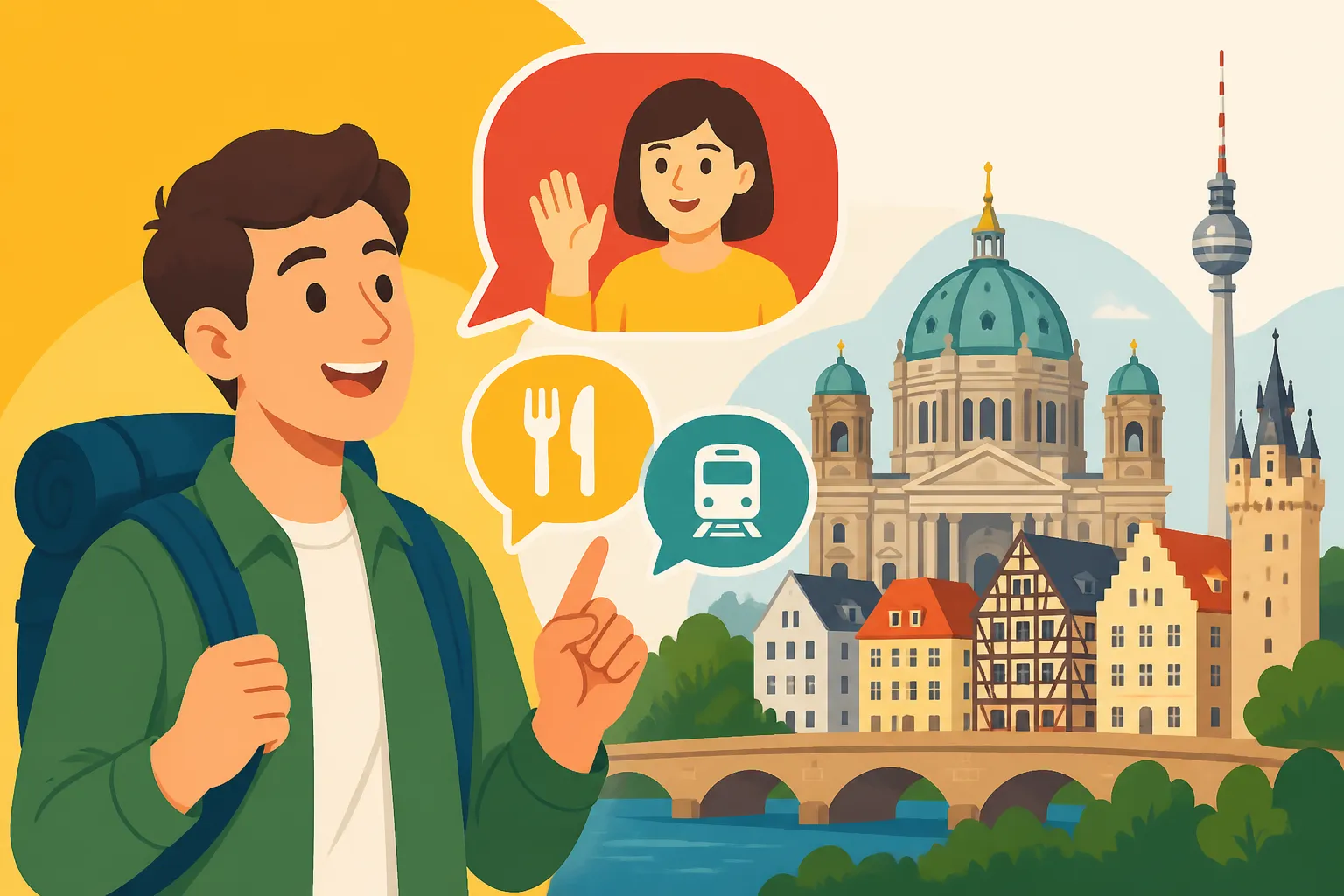
Survival German for Travelers: Key Phrases to Learn First
Arriving in Germany, you quickly realize that while many Germans speak English, especially in larger cities, relying solely on it can leave you feeling isolated and, frankly, a bit helpless. It's a common expat struggle, that sinking feeling when you're faced with a German-only sign or an elderly shopkeeper who doesn't understand "thank you." This guide isn't about becoming fluent overnight, but about arming you with those crucial German survival phrases that will make your daily interactions smoother, more respectful, and far less stressful.
Disclosure: This post may contain affiliate links. We may earn a commission at no extra cost to you if you make a purchase through these links. Read full disclosure.
Mastering the Art of German Greetings and Courtesies
Let's face it, a little courtesy goes a long way, no matter where you are in the world. In Germany, politeness, especially with strangers, is a subtle art that can significantly impact your interactions. Starting with a simple greeting in German can genuinely open doors, or at least encourage a more patient response when you inevitably switch back to English. It shows you're making an effort, and that's always appreciated.
Saying Hello and Goodbye Like a Local
The first step to navigating any new culture is mastering how to say hello and goodbye. Forget the complicated grammar for a moment; these simple phrases are your entry ticket to basic communication. "Guten Tag" (Good day) is your go-to general greeting, usable from morning till evening. It’s safe, respectful, and universally understood. You’ll hear it everywhere, from train stations to bakeries. For more informal settings, especially if you’re younger or in a more relaxed environment, "Hallo" works perfectly fine, much like "hello" in English.
When the day winds down, "Guten Abend" (Good evening) takes over, usually from about 6 PM onwards. If it's truly late and you're heading off to bed, or saying goodbye to someone for the night, "Gute Nacht" (Good night) is appropriate. But what about saying goodbye in general? "Auf Wiedersehen" is the formal and most common way, literally meaning "until we see again." You'll use this with shopkeepers, hotel staff, and anyone you’ve interacted with formally. For a more casual farewell, "Tschüss" is your friend. It's akin to "bye" and perfect for friends, younger people, or after you've established a more relaxed rapport. There’s also "Mach’s gut," which means "take care," a lovely way to end an interaction. Knowing these small nuances makes a huge difference in how you're perceived, moving you from just another tourist to someone genuinely trying to engage.
Please, Thank You, and Excuse Me: Your Politeness Toolkit
These three phrases are arguably the most important tools in your German survival kit. Without them, you're just pointing and grunting, which, trust me, gets old fast. "Bitte" is a wonderfully versatile word. It means "please," "you're welcome," and even "pardon?" or "come in!" Its usage depends entirely on context, which can be a bit confusing at first, but you'll quickly pick it up. For instance, if you ask for a coffee, you'd say "Einen Kaffee, bitte." If someone thanks you, you respond with "Bitte." And if you didn't hear something, a questioning "Bitte?" will prompt them to repeat it.
Then there's "Danke" for "thank you." Simple, effective, and always appreciated. To add more emphasis, "Vielen Dank" means "many thanks" or "thank you very much." Combine them, and you can say "Danke schön" or "Vielen Dank," both expressing a higher degree of gratitude. And what about when you need to get someone’s attention, or apologize for a minor bump? "Entschuldigung" is your word. It covers "excuse me," "pardon me," and "sorry." If you accidentally brush past someone on a crowded train, a quick "Entschuldigung!" is the appropriate response. If you're asking for directions, you might start with, "Entschuldigung, können Sie mir helfen?" (Excuse me, can you help me?). These phrases are the grease that keeps social interactions running smoothly, and using them will show a level of respect that Germans truly value.
Asking for Help and Understanding in German
There will be moments, many of them, when you simply don’t understand or need assistance. That’s perfectly normal, and having a few phrases to express this will save you a lot of frustration. The most basic is "Sprechen Sie Englisch?" (Do you speak English?). While direct, it’s often necessary. Many people, especially younger generations or those in service industries, will likely respond with a "Ja!" and then you can continue in English. However, don't be surprised if you're met with a "Nein" – that's when your other survival phrases kick in.
If you’re struggling to understand, a polite "Ich verstehe nicht" (I don't understand) is crucial. Follow it up with "Können Sie das bitte wiederholen?" (Can you please repeat that?) or "Können Sie bitte langsamer sprechen?" (Can you please speak slower?). These phrases acknowledge your difficulty while still engaging. For moments when you need a little more explanation, "Was bedeutet das?" (What does that mean?) can be very helpful if you're pointing at a word or phrase you don't recognize. Sometimes, simply knowing "Ich brauche Hilfe" (I need help) is enough to signal distress or a need for assistance, prompting a more patient and helpful response. The key is to convey your situation clearly, even if it’s with limited German, to facilitate the help you need. For moments when language is a significant barrier, remember that there are many tools available, and you might find it useful to check out resources on Using Translation Apps in Germany: What Works Best.
Navigating German Transport and Directions
Getting around Germany is incredibly efficient, thanks to its extensive and punctual public transport network. However, understanding the announcements, deciphering ticket machines, and asking for directions can feel like an Olympic sport if you don’t have a few German phrases under your belt. Don't let the thought of a missed connection or a wrong turn ruin your day – a few key phrases will empower you to tackle any journey.
Public Transport Essentials
Whether you're hopping on a U-Bahn, S-Bahn, tram, or bus, knowing how to ask about tickets, destinations, and platforms is vital. Start with "Eine Fahrkarte nach [Ziel], bitte" (A ticket to [destination], please). If you’re unsure which kind of ticket you need, you might ask, "Welches Ticket brauche ich?" (Which ticket do I need?). For those short city hops, a "Einzelfahrschein, bitte" (single ticket, please) or a "Tageskarte, bitte" (day ticket, please) are common requests. Remember, ticket inspectors often do random checks, so always have a valid, validated ticket! You can learn more about specific systems and how to get around efficiently in Getting Around German Cities: U-Bahn, S-Bahn, Trams, and Buses.
Once you're on a platform or at a bus stop, you might need to confirm your route. "Fährt dieser Zug/Bus nach [Ziel]?" (Does this train/bus go to [destination]?) is incredibly useful. To find out when the next connection is, ask, "Wann fährt der nächste Zug/Bus?" (When does the next train/bus leave?). Understanding German numbers for times is crucial here. If you're planning longer trips, especially by train, phrases for booking and understanding schedules become more important. Consider how to utilize resources like Omio for booking, where you'll often encounter German terms. Being prepared with these phrases significantly reduces the stress of using public transport, allowing you to enjoy the journey. To save some money on train travel, you might want to look into How to Buy Deutsche Bahn Tickets and Save Money.
Asking for Directions
Even with Google Maps, there will be times you need to ask a local for directions – maybe your phone died, or the street names are just too confusing. Don't be shy! Most Germans are happy to help, especially if you approach them politely in German. Start with "Entschuldigung, wie komme ich nach [Ort]?" (Excuse me, how do I get to [place]?). If you’re looking for a specific type of building, you can say "Wo ist die nächste [Apotheke/Bank/Toilette]?" (Where is the nearest [pharmacy/bank/toilet]?). The word "Apotheke" for pharmacy is a good one to remember for health needs.
Understanding the response can be the tricky part. Listen for key directional words: "links" (left), "rechts" (right), "geradeaus" (straight ahead), "hier" (here), and "dort" (there). If they say "weit" (far) or "nah" (near), you'll have a sense of the distance. If you're still lost, don't hesitate to say "Ich habe mich verlaufen" (I am lost). Often, locals might even walk a short distance with you to point you in the right direction, especially if they see you genuinely struggling. It's a small gesture that can be a lifesaver in an unfamiliar city.
Taxis and Ride-Shares
While public transport is excellent, there might be situations where a taxi or ride-share is necessary, particularly late at night or with heavy luggage. Knowing how to hail one and state your destination is important. To hail a taxi, simply look for a "Taxi" sign or find a taxi stand. When one pulls up, you can ask, "Ist dieser Taxi frei?" (Is this taxi free?). If it is, open the door and state your destination: "Zum [Adresse/Hotel/Bahnhof], bitte" (To [address/hotel/train station], please).
If you have an approximate idea of the cost, you can ask "Wie viel kostet das?" (How much does that cost?). While many drivers understand English, using German phrases from the start helps clarify your intent and destination. Ride-sharing apps like Uber operate in some German cities, but traditional taxis are still very prevalent and regulated. Always confirm the meter is running. When you arrive at your destination, "Hier halten, bitte" (Stop here, please) is helpful. For payment, cash is still common, but card payment options are increasingly available. Knowing these phrases makes getting a taxi a smooth, rather than a fumbling, experience.
Enjoying German Cuisine: Dining Out with Confidence
German food is much more than just sausages and beer, though those are certainly delicious! From charming local Gasthöfe to bustling city restaurants, eating out is a delightful part of the German experience. However, menus can be daunting, ordering can feel intimidating, and even paying the bill has its own set of customs. Armed with a few simple German phrases, you can navigate the culinary landscape with ease and truly savor your meals. For a deeper dive, consider consulting Ordering Food and Drinks in German: A Practical Phrasebook.
Ordering Food and Drinks
When you first sit down, a waiter will likely approach with "Was möchten Sie trinken?" (What would you like to drink?). Your first decision! Common drinks include "Wasser mit/ohne Kohlensäure" (water with/without gas), "Bier" (beer), "Wein" (wine), "Saft" (juice), or "Kaffee" (coffee). If you need a moment to decide, say "Einen Moment, bitte" (One moment, please). When you’re ready, always remember to add "bitte" to your order, such as "Ein Bier, bitte."
When it comes to food, "Ich hätte gerne [Gericht]" (I would like [dish]) or "Ich nehme [Gericht]" (I'll take [dish]) are polite ways to order. If you have dietary restrictions, a crucial phrase is "Ich bin Vegetarier/Veganer" (I am vegetarian/vegan). You might also ask, "Ist das Gericht vegetarisch/vegan?" (Is this dish vegetarian/vegan?). If you're unsure about an ingredient, "Was ist das?" (What is that?) while pointing to the menu can help. Germans appreciate clear and concise ordering, so be ready when the waiter comes to your table. If you want to order something simple and traditional, you could say "Einen Schnitzel, bitte" or "Einen Apfelstrudel, bitte".
Navigating the Menu
German menus, or Speisekarten, can be a labyrinth of long words. Don't panic! Even if you don't understand every single word, recognizing categories and common ingredients will help. Look for sections like "Vorspeisen" (appetizers), "Hauptgerichte" (main courses), "Salate" (salads), "Suppen" (soups), and "Nachspeisen" or "Desserts" (desserts). Common meats include "Schweinefleisch" (pork), "Rindfleisch" (beef), "Hähnchen" (chicken), and "Fisch" (fish). Side dishes are often listed as "Beilagen" and may include "Kartoffeln" (potatoes), "Reis" (rice), or "Pommes frites" (fries).
If you’re truly lost, you can always ask "Was empfehlen Sie?" (What do you recommend?). Sometimes the waiter might point to a popular dish or seasonal special. Don't be afraid to use your phone's translation app for a quick scan of the menu – it’s a lifesaver in these situations. Remember that many restaurants also have a "Tageskarte," which lists daily specials, often more affordable and seasonal. Taking a moment to familiarize yourself with these terms beforehand can transform a stressful ordering experience into an enjoyable one, allowing you to sample the diverse German Regional Dishes Every Visitor Should Try.
Paying the Bill and Tipping Etiquette
When you're ready to leave, you won't typically be presented with the bill automatically. You need to ask for it. The most common phrase is "Zahlen, bitte" (The bill, please), or "Die Rechnung, bitte." The waiter will then usually come to your table with a small handheld device or a slip of paper. Payment in Germany is often done directly at the table. It's also common practice to state how much you're paying and include the tip in one go. For instance, if the bill is €27.50, and you want to pay €30, you say "Dreißig Euro, bitte" as you hand over the money. The waiter will then know to return €2.50 in change.
Tipping in Germany is not as high as in some other countries, but it is customary. Generally, rounding up to the next full Euro or adding 5-10% for good service is appreciated. For a bill of €12.50, you might say "Dreizehn Euro, bitte." For exceptional service, 10% is generous. Unlike some countries, it’s not common to leave the tip on the table after paying; it’s usually factored into the payment directly with the waiter. This can be confusing at first, so read up more on Tipping in Germany: When, Where, and How Much to avoid any awkward moments. Knowing these payment customs will help you feel more at ease during your dining experience.
Shopping and Services: Everyday Transactions
Shopping in Germany, whether for souvenirs, groceries, or essentials, is part of the daily rhythm. While many stores, especially in tourist areas, will have staff who speak some English, knowing a few key German phrases will significantly ease your transactions, allow you to ask about prices, and help you find what you’re looking for. It's all about navigating those essential exchanges with confidence.
Basic Transactions and Prices
Stepping into a shop, a friendly "Guten Tag!" is always a good start. If you’re just browsing, "Ich schaue nur" (I’m just looking) can be helpful to avoid immediate sales pressure. When you find something you like, you’ll undoubtedly want to know the price. "Wie viel kostet das?" (How much does that cost?) is your essential question. You can also point and say "Was kostet das?" if you're holding the item. The answer will be in Euros, so familiarity with German numbers is key here.
When you're ready to purchase, head to the checkout. The cashier might ask "Haben Sie eine Kundenkarte?" (Do you have a loyalty card?), to which a "Nein, danke" (No, thank you) is a polite reply. They will tell you the total, e.g., "Das macht fünfzehn Euro und fünfzig Cent" (That makes fifteen Euros and fifty cents). When paying, they might ask "Bar oder mit Karte?" (Cash or card?). Remember, Germany is still quite a cash-friendly society, especially in smaller shops, though card payments are increasingly common. Be prepared for either option. You can learn more about this by reading Cash vs Card in Germany: What Visitors Should Know. Always remember your "Danke" and "Auf Wiedersehen" on your way out!
Finding What You Need
Sometimes you need to locate a specific item, or even a type of store. Knowing how to ask for these things can save you a lot of wandering. "Ich suche [Artikel]" (I am looking for [item]) is a straightforward phrase. If you're in a department store and need assistance, you can ask a staff member "Wo finde ich [Artikel]?" (Where can I find [item]?). For instance, "Wo finde ich T-Shirts?" (Where can I find T-shirts?).
If you’re looking for a specific kind of shop, you can ask "Gibt es hier in der Nähe eine [Bäckerei/Metzgerei/Post]?" (Is there a [bakery/butcher shop/post office] nearby?). These specific store names are good to know: "Bäckerei" for bread and pastries, "Metzgerei" for meat, and "Post" for the post office. For electronic needs, it's typically an "Elektronikgeschäft." Remember that shops generally close on Sundays, and often early on Saturdays, which can be a surprise for many expats. Being aware of What Closes on Sundays in Germany? can save you from a disappointing shopping trip.
Shopping for Groceries and Everyday Items
Grocery shopping at a German supermarket like Rewe, Edeka, or ALDI is an experience in itself, with its own unspoken rules, like having your own reusable bags and quickly bagging your items at checkout. Knowing a few basic food item names can be incredibly helpful. "Milch" (milk), "Brot" (bread), "Käse" (cheese), "Obst" (fruit), "Gemüse" (vegetables), and "Wasser" (water) are great starting points.
When selecting items, prices are clearly marked. You might need to weigh some fruits and vegetables yourself at a designated scale before checkout. If you need a specific quantity, you can say "Ein Kilo [Äpfel], bitte" (One kilo of [apples], please) or "Zweihundert Gramm [Käse], bitte" (Two hundred grams of [cheese], please). At the checkout, if you've forgotten your bag, you might be asked "Möchten Sie eine Tüte?" (Would you like a bag?), to which you can say "Ja, bitte" or "Nein, danke." The cashier will scan your items, and you'll pay as described above. Mastering these small interactions will make your daily life in Germany much more comfortable.
Handling Emergencies and Unexpected Situations
Even the most meticulously planned trip can encounter unexpected bumps. Whether it’s a minor ailment, a lost item, or something more serious, knowing how to communicate in an emergency can be truly life-saving. While German emergency services have English-speaking staff, knowing how to express your immediate needs in German will speed up assistance and reduce your stress levels. This section is perhaps the most critical for any traveler.
Medical Help and Pharmacies
If you feel unwell, the first step might be to locate a pharmacy, or Apotheke. "Wo ist die nächste Apotheke?" (Where is the nearest pharmacy?) is a crucial phrase. German pharmacies are more than just drugstores; pharmacists can offer advice for minor ailments. If you need a specific over-the-counter medicine, you can try to describe your symptoms: "Ich habe Kopfschmerzen" (I have a headache), "Ich habe Fieber" (I have a fever), or "Ich habe Husten" (I have a cough). For more complex medical needs, you might need to say "Ich brauche einen Arzt" (I need a doctor).
In case of a more serious medical emergency, remember the European emergency number: 112. This connects you to ambulance and fire services. For non-life-threatening medical issues when doctors' offices are closed, you can call 116117 to reach the on-call medical service (ärztlicher Bereitschaftsdienst). Always carry your health insurance card. Even if you don’t speak much German, a simple "Hilfe!" (Help!) will grab attention. For common ailments, you might find a quick reference in Common German Medical Terms: A Mini Dictionary for Patients. Understanding the services provided by German Pharmacies Apotheke: Prescriptions and Advice will also be invaluable.
Lost and Stolen Items
Losing your passport or wallet is a traveler's worst nightmare, but knowing the right phrases can help you report it and begin the recovery process. If something is stolen, you'll need to go to the police, or Polizei. "Meine Tasche wurde gestohlen" (My bag was stolen) or "Mein Portemonnaie ist weg" (My wallet is gone) are essential phrases. You'll need to file a report, known as an Anzeige.
If you've simply lost something, like a phone or keys, you might ask "Ich habe [Objekt] verloren" (I have lost [object]). You can also enquire at a local Fundbüro (lost and found office), which many cities and transport hubs have. "Haben Sie etwas gefunden?" (Have you found something?) and then describe your item: "Eine schwarze Tasche" (a black bag) or "Ein Handy" (a mobile phone). While frustrating, these situations are manageable with the right vocabulary and a calm approach.
General Trouble and Language Barriers
Sometimes, you just need help or find yourself in a tricky situation that isn't necessarily a medical emergency or a crime. "Ich brauche Hilfe" (I need help) is universal. If you're feeling threatened or unsafe, "Lass mich in Ruhe!" (Leave me alone!) or "Ich rufe die Polizei!" (I'll call the police!) can be powerful deterrents. In a crowded situation, a loud "Achtung!" (Attention! / Watch out!) can warn others.
If the language barrier is becoming an obstacle to getting help, you can say "Ich spreche nur ein bisschen Deutsch" (I only speak a little German) or "Ich spreche kein Deutsch" (I don't speak German). This lets people know your limitations and might encourage them to find an English speaker or use simpler terms. Remember that for urgent issues, the 112 emergency number works for the entire country, and operators are trained to handle calls in multiple languages. For comprehensive information on how to react in critical moments, always refer to Emergency Numbers in Germany: Calling 112, Poison Control, and More. Being prepared with these phrases provides a crucial layer of safety and confidence for your travels.
Understanding Numbers, Time, and Essential Information
Numbers and time are the building blocks of daily life. Whether you’re trying to catch a train, deciphering opening hours, or paying for something, a basic grasp of German numbers and time-telling will empower you to navigate Germany with far greater ease. This section isn't just about vocabulary; it's about understanding how information is presented in a German context.
Counting and Currency
Knowing numbers from zero to ten is a good starting point, but for anything beyond that, practice is key. Prices are almost always expressed in Euros, and being able to quickly grasp sums will prevent confusion.
"Null" (0), "eins" (1), "zwei" (2), "drei" (3), "vier" (4), "fünf" (5), "sechs" (6), "sieben" (7), "acht" (8), "neun" (9), "zehn" (10).
From eleven to nineteen, it’s fairly straightforward: "elf" (11), "zwölf" (12), and then "_zehn" appended (e.g., "dreizehn" for 13). For tens: "zwanzig" (20), "dreißig" (30), "vierzig" (40), etc.
The trickiest part for many English speakers is that numbers above nineteen are read with the unit first, then the ten. So, 21 is "einundzwanzig" (one and twenty), 35 is "fünfunddreißig" (five and thirty). Practice this!
| Number | German | Pronunciation (approx.) |
|---|---|---|
| 0 | Null | Nool |
| 1 | Eins | Eyns |
| 2 | Zwei | Ts-vy |
| 3 | Drei | Dry |
| 4 | Vier | Feer |
| 5 | Fünf | Fuenf |
| 6 | Sechs | Zex |
| 7 | Sieben | Zee-ben |
| 8 | Acht | Akht |
| 9 | Neun | Noyn |
| 10 | Zehn | Tsen |
| 20 | Zwanzig | Ts-vahn-tsikh |
| 50 | Fünfzig | Fuenf-tsikh |
| 100 | Hundert | Hoon-dairt |
When paying, you might hear "Das macht [Summe] Euro" (That makes [sum] Euros). Knowing your numbers lets you confirm the price. If you want to ask for the bill to be split, you can try "Können wir getrennt zahlen?" (Can we pay separately?). This often works best if you indicate exactly how much each person is paying. Whether you’re checking prices on GetYourGuide for an excursion or buying a simple souvenir, numbers will be a constant companion.
Telling Time and Dates
Germany predominantly uses the 24-hour clock, especially for official schedules like trains and buses. So, 1 PM is 13:00, 5 PM is 17:00, and so on. Understanding this is non-negotiable for sticking to schedules. When asking for the time, "Wie spät ist es?" or "Wieviel Uhr ist es?" (What time is it?) are your phrases.
The responses might be:
"Es ist drei Uhr" (It is three o'clock).
"Es ist halb vier" (It is half past three, literally "half to four"). This "half to" format is a common pitfall for English speakers.
"Es ist Viertel nach drei" (It is quarter past three).
"Es ist Viertel vor vier" (It is quarter to four).
For dates, knowing the days of the week is useful: "Montag" (Monday), "Dienstag" (Tuesday), "Mittwoch" (Wednesday), "Donnerstag" (Thursday), "Freitag" (Friday), "Samstag" (Saturday), "Sonntag" (Sunday). When discussing appointments or reservations with Booking.com, you'll need to specify days and potentially months: "Heute" (today), "Morgen" (tomorrow), "Gestern" (yesterday). The German calendar format is Day.Month.Year (e.g., 19.06.2026 for June 19, 2026). Being mindful of these small differences will prevent misunderstandings and help you stay on schedule.
Understanding Opening Hours
German opening hours can differ significantly from what you might be used to. Shops often close relatively early, especially on weekdays, and almost universally on Sundays. This is a common culture shock for many newcomers. You'll see signs indicating "Öffnungszeiten" (opening hours). Look for "Montag bis Freitag" (Monday to Friday), "Samstag" (Saturday), and observe the times. "Geschlossen" means closed.
If you need to ask about opening hours, "Wann öffnet/schließt [Geschäft]?" (When does [shop] open/close?) is helpful. Understanding the concept of Ruhezeit (quiet hours) and the strict closure of most shops on Sundays is crucial for planning your activities and avoiding frustration. A quick check of a shop's opening times can save you a wasted trip, especially if you're out and about on a Sunday. Planning ahead for your grocery shopping or errands is paramount, as you'll quickly realize that German Sundays are truly for rest and relaxation, not retail therapy.
Disclaimer
This article is for general informational purposes only and does not constitute professional advice. Laws, prices and regulations vary by location and change over time. Consult a qualified professional for guidance on your specific situation.