Common German Medical Terms: A Mini Dictionary for Patients
Navigating the German healthcare system is daunting when you do not speak the language. This mini-dictionary equips expats with essential German medical terms, empowering you to describe symptoms, book appointments, and understand prescriptions with absolute confidence and clarity.
Disclosure: This post may contain affiliate links. We may earn a commission at no extra cost to you if you make a purchase through these links. Read full disclosure.
Navigating the Clinic and Booking Appointments
Making Your First Call
The very first hurdle in the German medical system is contacting a clinic (Praxis) to secure a time to see the doctor. Knowing the correct terminology for the type of visit you need is crucial for getting past the front desk efficiently.
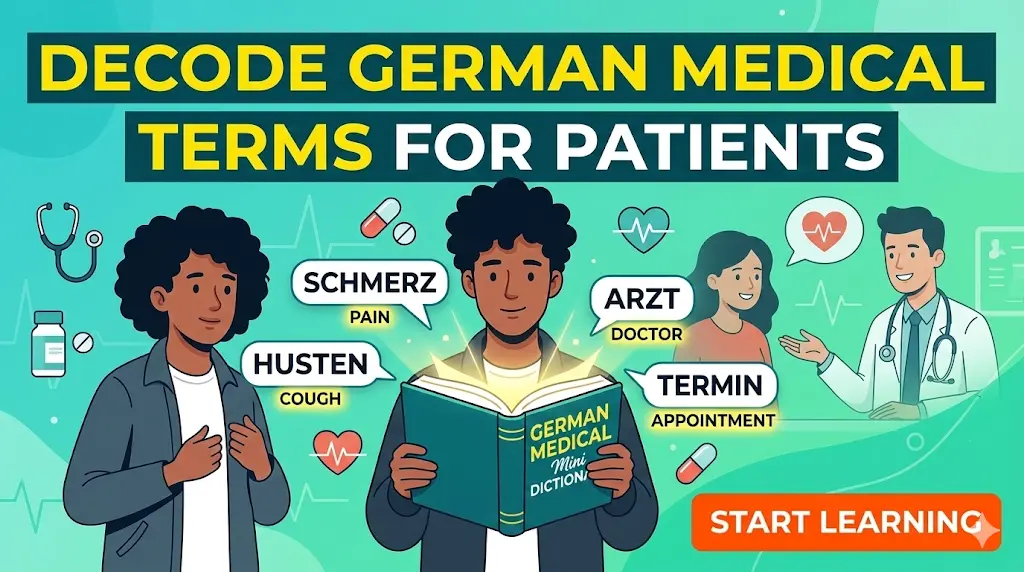
- Der Termin: The appointment. When you call, the standard phrase is “Ich brauche einen Termin” (I need an appointment).
- Die Sprechstunde: Consultation hours. This refers to the standard operating hours of the clinic when doctors see patients with scheduled appointments.
- Die Akutsprechstunde / Offene Sprechstunde: Acute or open consultation hours. By law, many clinics must offer specific blocks of time where patients without appointments can walk in for urgent, sudden illnesses.
- Das Wartezimmer: The waiting room. When you arrive, you will almost always be directed to take a seat here after handing over your insurance card.
Understanding how to establish this initial contact is the foundation of your healthcare journey in Germany. For a complete guide on how to register as a new patient, read Finding a Doctor in Germany: How to Choose a Hausarzt.
Understanding Clinic Roles and Titles
German clinics operate with a strict hierarchy, and addressing the staff correctly helps facilitate a smoother visit.
- Der Hausarzt / Die Hausärztin: The general practitioner (GP). This is your primary care doctor and your first point of contact for almost all non-emergency medical issues.
- Der Facharzt / Die Fachärztin: The specialist (e.g., cardiologist, dermatologist). In the public system, you typically need a referral from your Hausarzt to see a Facharzt.
- Die Medizinische Fachangestellte (MFA): The medical assistant. The MFA runs the reception desk, draws blood, and manages the doctor’s calendar. They are the gatekeepers of the clinic. Because their role is highly administrative, they may not always speak fluent English.
Describing Symptoms and Ailments
General Pain and Discomfort
When you actually sit down with the doctor, accurately describing your pain is vital for a correct diagnosis. Translating your symptoms into clear, concise German ensures the doctor understands the severity of your condition immediately.
- Der Schmerz: Pain. This is often combined with body parts, such as Kopfschmerzen (headache), Bauchschmerzen (stomach ache), or Rückenschmerzen (back pain).
- Die Übelkeit: Nausea.
- Der Schwindel: Dizziness or vertigo.
- Die Entzündung: Inflammation or infection.
German doctors will often ask you to describe the type of pain. Knowing a few specific adjectives is incredibly helpful. You can describe pain as stechend (stabbing), pochend (throbbing), dumpf (dull), or brennend (burning). If your pain is so severe that it prevents you from doing your job, the doctor will officially excuse you from work. You can learn exactly how this administrative process functions in Sick Leave in Germany: How to Get a Sick Note Krankmeldung and Your Rights.
Cold Flu and Respiratory Terms
The winter season in Germany brings a host of common respiratory illnesses. German doctors are notoriously conservative with antibiotics and prefer prescribing rest and natural remedies for standard viral infections.
- Die Erkältung: A common cold.
- Die Grippe: The flu (Influenza). Do not confuse a mild cold with a true Grippe, which implies a severe viral infection with a high fever.
- Das Fieber: Fever.
- Der Husten: Cough. The doctor or pharmacist will ask if it is a Reizhusten (dry, tickly cough) or a produktiver Husten (chesty cough with mucus).
- Der Schnupfen: A runny or blocked nose.
Because German clinical philosophy relies heavily on herbal teas and rest, expats often find the local pharmacies lacking in the strong, multi-symptom cold medicines they are accustomed to back home. To bridge this gap, many internationals utilize iHerb to bulk order their preferred global wellness brands, immune-boosting vitamins, and familiar cold remedies, ensuring their pantry is fully stocked before the winter weather sets in.
Reading Prescriptions and Pharmacy Instructions
Pharmacy specific Vocabulary
In Germany, you cannot buy actual medication at a standard grocery store. You must visit a licensed, clinical pharmacy. Understanding the vocabulary used in these retail spaces prevents confusion and saves you time.
- Die Apotheke: The pharmacy. Identifiable by a large, illuminated red “A” outside the building.
- Der Apotheker / Die Apothekerin: The licensed pharmacist.
- Rezeptpflichtig: Prescription-only. You cannot buy these medications without a doctor’s signature.
- Rezeptfrei: Over-the-counter (OTC). You can buy these without a prescription, but you still have to ask the pharmacist behind the counter for them.
To understand the strict regulatory divide between a clinical pharmacy and a standard drugstore selling shampoo and vitamins, review our deep dive on Pharmacies in Germany: Apotheke vs Drogerie Explained. While iHerb is a phenomenal resource for holistic supplements, active pharmaceutical ingredients must be purchased at the Apotheke.
Decoding the Beipackzettel
Every box of medicine in Germany contains a legally mandated, heavily detailed leaflet. If you do not speak German, this dense piece of paper can be highly intimidating.
- Das Rezept: The physical or electronic prescription slip given to you by the doctor.
- Der Beipackzettel: The patient information leaflet included inside the medicine box.
- Der Wirkstoff: The active ingredient (e.g., Ibuprofen, Paracetamol). Look for this term if you are trying to find the generic equivalent of a brand name from your home country.
- Die Nebenwirkungen: Side effects.
- Die Dosierung: The dosage instructions.
Mastering the dosage instructions is critical for your safety. To learn how to interpret the specific numeric shorthand German doctors use for daily dosages, carefully read Understanding German Medicine Dosages: Reading Labels and Instructions.
Insurance and Administrative Vocabulary
Public versus Private Insurance Terms
Your experience in a German clinic is fundamentally shaped by your place within the health insurance system. Knowing the correct terms ensures your billing is processed correctly.
- Die Krankenversicherung: Health insurance. This is mandatory for all residents in Germany.
- Die Gesetzliche Krankenversicherung (GKV): Statutory public health insurance. If you are in this system, you are gesetzlich versichert.
- Die Private Krankenversicherung (PKV): Private health insurance. If you hold a private policy, you are privat versichert.
- Die Gesundheitskarte (eGK): Your electronic health card. You must present this plastic card to the receptionist at every single doctor’s visit.
Navigating the bureaucratic differences between these two systems is one of the most complex tasks for new arrivals. Utilizing dedicated expat advisory services like Feather Insurance can help you seamlessly transition into the German system and ensure you possess the correct coverage.
Sick Notes and Billing
The administrative aftermath of a doctor’s visit involves highly specific paperwork, particularly if you need to excuse your absence from work or process a private medical payment.
- Die Krankschreibung / Die Arbeitsunfähigkeitsbescheinigung (AU / eAU): The official doctor’s sick note. The electronic version (eAU) is now automatically transmitted to public health insurers and employers.
- Die Überweisung: A referral slip. Public patients often need this paper from their Hausarzt to see a specialist.
- Die Rechnung: The medical invoice. Private patients, or tourists paying out of pocket, receive a Rechnung in the mail after their visit.
- Der Selbstzahler: A self-payer. If you choose to pay for a treatment entirely out of pocket without involving your insurance, you declare yourself a Selbstzahler.
- Die Notaufnahme: The hospital emergency room. Only to be used for genuine, life-threatening medical crises.
If you receive a Rechnung as a privately insured patient, you must pay the clinic directly and then submit the receipt to your insurer, such as Ottonova, for rapid reimbursement. If you are acting as a Selbstzahler and need to transfer funds from a foreign bank account to cover a high-value German medical invoice, utilizing a borderless financial platform like Wise ensures you convert your currency at the real mid-market exchange rate. Avoiding legacy bank fees with Wise protects your healthcare budget.
| German Term | English Translation | Context / Example Usage |
| Der Termin | Appointment | “Ich brauche einen Termin.” (I need an appointment.) |
| Die Schmerzen | Pain | “Ich habe starke Schmerzen.” (I have severe pain.) |
| Das Rezept | Prescription | The doctor issues this for the pharmacy. |
| Die Apotheke | Pharmacy | Where you buy medications. |
| Die Krankschreibung | Sick note | The document required by your employer. |
| Der Hausarzt | General Practitioner | Your primary care physician. |
| Die Überweisung | Referral | Required to see a specialist in the public system. |
| Die Notaufnahme | Emergency Room | For severe, life-threatening injuries only. |
| Die Gesundheitskarte | Health Insurance Card | Hand this to the receptionist upon arrival. |
| Rezeptfrei | Over-the-counter | Medication you can buy without a doctor’s signature. |
References
Primary sources (official)
- Bundesministerium für Gesundheit (Federal Ministry of Health): The official governmental health portal providing reliable, easily understandable information on medical conditions, the healthcare system structure, and digital health applications in Germany. https://gesund.bund.de/en/
- 116117.de (Der Patientenservice): The official portal operated by the National Association of Statutory Health Insurance Physicians (KBV), offering a centralized patient navigation tool and access to the medical on-call service. https://www.116117.de/de/patienten-navi.php
Other helpful sources
- Make it in Germany: The German government’s official portal for international professionals, detailing the practical steps for navigating healthcare bureaucracy, finding doctors, and understanding insurance as an expat. https://www.make-it-in-germany.com/en/living-in-germany/health-healthcare
Disclaimer
The information provided in this article is for general informational and educational purposes only and does not constitute professional medical, legal, or financial advice. Medical terminology, billing procedures, and the specific processes for securing referrals (Überweisungen) or sick notes (eAU) are subject to continuous legislative updates within the German healthcare system. Always consult directly with a qualified medical professional, a licensed pharmacist, or a certified insurance broker regarding your unique health needs and coverage options in Germany.