Stressed or Burned Out? Mental Health Days and Resources in Germany
Experiencing burnout or mental health struggles in Germany? This comprehensive guide explains how to secure a mental health sick note, access English-speaking therapy, navigate public and private insurance coverage, and utilize local emergency resources to prioritize your well-being.
Disclosure: This post may contain affiliate links. We may earn a commission at no extra cost to you if you make a purchase through these links. Read full disclosure.
Understanding Burnout and Mental Health Leave in Germany
The Concept of Krankschreibung for Mental Health
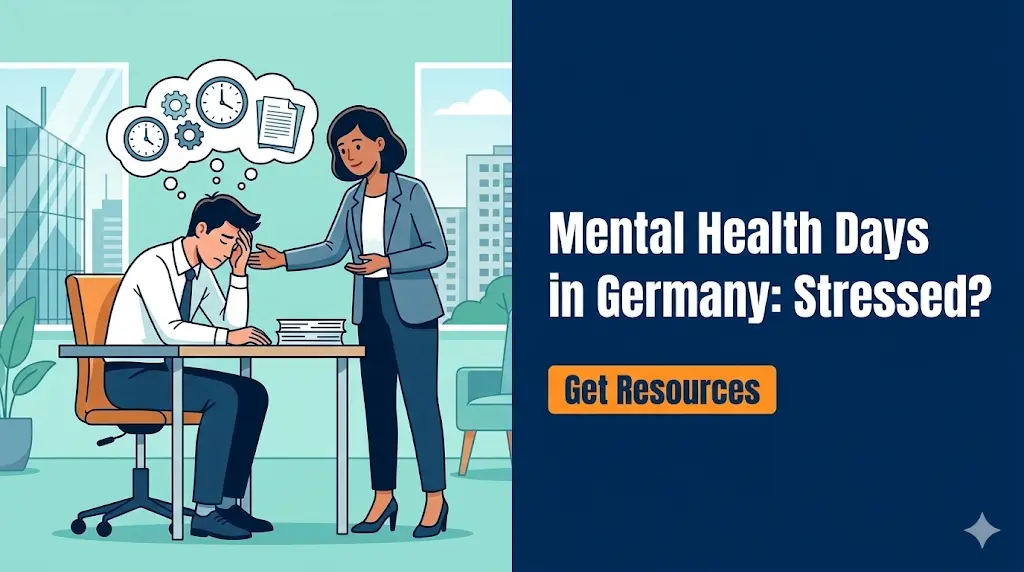
In Germany, mental exhaustion, severe stress, and burnout (Burn-out) are officially recognized as valid medical reasons to be declared unfit for work (arbeitsunfähig). The German healthcare and labor systems place a high priority on preventative rest. If you are struggling to function due to psychological strain, you are legally entitled to receive a sick note (Krankschreibung or eAU) to step away from your job and recover. Mental health support in Germany includes counseling services, sick leave for burnout, workplace assistance programs, and access to licensed therapists. To understand your specific labor rights and protections during this vulnerable period, refer to our detailed guide on Sick Leave in Germany: How to Get a Sick Note Krankmeldung and Your Rights.
How to Request a Mental Health Day
Unlike in the US or UK, where “mental health days” are often taken out of a limited pool of casual paid time off, in Germany, you take a formalized sick day. A crucial protection for employees is that you never need to tell your employer why you are sick. The diagnostic code on your official documentation is strictly confidential and is only shared with your health insurance provider. You simply inform your manager that you are unwell. Depending on your employment contract, you may need to provide the doctor’s sick note from the very first day of your absence, or after the third consecutive day.
Sick Pay Entgeltfortzahlung and Long Term Leave
Burnout recovery rarely happens over a single long weekend. If your doctor determines you need extended time away from the office, German labor law provides a massive financial safety net. Your employer is legally required to continue paying 100% of your gross salary for up to six continuous weeks of leave for the exact same illness (Entgeltfortzahlung).
If your recovery takes longer than six weeks, your health insurance seamlessly steps in to provide sick pay (Krankengeld). This statutory benefit covers roughly 70% of your gross salary for up to 78 weeks within a three-year period, allowing you to focus entirely on your therapy and recovery without the immediate threat of financial ruin.
How to Find Mental Health Support and Therapy
The Role of the Hausarzt
Your absolute first step in treating burnout should be visiting your general practitioner (Hausarzt). They are the gatekeepers of the German medical system. A Hausarzt can issue your initial sick note, run comprehensive blood panels to rule out physical causes of extreme exhaustion (such as thyroid disorders or severe vitamin deficiencies), and provide an official referral (Überweisung) for outpatient psychotherapy. Establishing this primary care relationship early is a critical foundation for your health, which we detail thoroughly in Finding a Doctor in Germany: How to Choose a Hausarzt.
Finding an English Speaking Therapist
Securing a psychotherapist (Psychotherapeut) in Germany requires significant patience, particularly if you require sessions in English. You can search for English-speaking providers using digital platforms like Doctolib or Jameda. Another powerful tool is the official patient service portal of the Association of Statutory Health Insurance Physicians (accessible via 116117.de), which allows you to filter licensed therapists by language proficiency.
If your Hausarzt determines your situation is highly urgent, they can affix a 12-digit urgency code (Dringlichkeitscode) to your referral. You can submit this code to the 116117 hotline to force the system to assign you an initial consultation within a few weeks. If you are currently without a registered doctor but need immediate guidance on navigating this system, our article What to Do When You’re Sick in Germany and Don’t Have a Doctor Yet offers actionable workarounds.
Acute Crisis Intervention and Emergency Resources
If your stress escalates into a severe mental health crisis, you do not have to wait for a therapy appointment. Immediate, compassionate help is always available. The German TelefonSeelsorge offers free, entirely anonymous, 24/7 crisis support (dial 0800 111 0 111 or 0800 111 0 222).
Additionally, every major German city operates psychiatric emergency rooms (Psychiatrische Notaufnahme) within their local hospital networks where you can walk in at any hour for acute psychological distress.
Health Insurance Coverage for Therapy
Navigating Public Health Insurance GKV
If you are enrolled in the statutory public health insurance system (Gesetzliche Krankenversicherung or GKV), outpatient psychotherapy is fully covered. However, the therapist must possess a specific public billing license (Kassensitz). Because demand for public therapists far outpaces supply, waitlists can frequently exceed six months.
If you can document that you contacted multiple public therapists and were rejected due to unmanageable waitlists, you can apply for a specialized workaround called the cost reimbursement procedure (Kostenerstattungsverfahren). This process legally compels your public insurer to cover the costs of a private therapist. For more on these baseline systemic benefits, read Public Health Insurance gesetzliche Krankenkasse: What It Covers and Costs. If you are an expat struggling with this dense, often entirely German-language bureaucracy, utilizing English-first advisory brokers like Feather Insurance can help ensure your public coverage is optimized to support your needs.
Benefits of Private Health Insurance PKV
Possessing private health insurance (Private Krankenversicherung or PKV) dramatically accelerates your access to mental healthcare. Private patients can bypass the heavily congested public waitlists entirely and book appointments with thousands of private-only therapists (Privatpraxen).
Premium, digital-first insurers like Ottonova frequently offer intuitive English apps where you can easily search for an English-speaking therapist, book a session, and rapidly upload the private invoice for reimbursement. If you are a high earner deciding whether the transition to private care makes sense for your mental health goals, exploring the comprehensive consultation options at Feather Insurance can provide unbiased clarity. You can review the exact financial thresholds required to make this switch in Private Health Insurance in Germany: Benefits, Costs, and Eligibility, and compare the overarching frameworks in Public vs Private Health Insurance: Which One Should You Choose?. With modern platforms like Ottonova, managing your ongoing therapy logistics becomes a seamless, stress-free process.
Self Paying and Alternative Wellness Options
Many expats choose to bypass the insurance system altogether and pay for therapy out of pocket (Selbstzahler). This guarantees complete privacy, keeps the psychiatric diagnosis off your official German health records, and grants you immediate access to care. Private therapy sessions typically cost between €100 and €150 per hour. If you are funding these private sessions using savings from your home country, transferring money via traditional banks will trigger terrible exchange rates. Utilizing a borderless financial platform like Wise allows you to pay your therapist at the real mid-market exchange rate. Using Wise ensures your wellness budget is spent purely on your recovery, rather than on hidden legacy banking fees.
| Therapy Route | Expected Wait Time | Insurance Coverage | Best Suited For |
| Public Therapist (Kassensitz) | Long (3-6+ months) | 100% Public (GKV) | Long-term care on a standard budget. |
| Reimbursement Procedure | Moderate (1-3 months) | 100% Public (GKV) | Those willing to navigate heavy paperwork. |
| Private Therapist | Short (1-3 weeks) | Private (PKV) depending on tariff | Fast access; expats with Private Insurance. |
| Self-Payer (Selbstzahler) | Immediate | None (Out of pocket) | Complete privacy and instant English access. |
Alongside professional therapy, prioritizing your daily baseline wellness is essential for true burnout recovery. While local German retail drugstores offer basic teas, expats frequently use iHerb to access a massive global catalog of stress-relief supplements that are otherwise difficult to source locally. Ordering your preferred international wellness products—such as high-absorption magnesium, ashwagandha, or specialized herbal tinctures—through iHerb ensures you can maintain a robust, holistic self-care routine while living abroad.
References
Primary sources (official)
- Federal Ministry of Health (BMG): Official guidelines on mental health support, sick leave rights, and the integration of psychotherapy within the statutory health insurance framework. https://www.bundesgesundheitsministerium.de/en/en.html
- TelefonSeelsorge Deutschland: The nationwide, state-supported crisis intervention hotline providing immediate, anonymous psychological support. https://www.telefonseelsorge.de/
- 116117.de (Patientenservice): The official portal operated by the Association of Statutory Health Insurance Physicians (KBV) for locating licensed therapists and utilizing the urgency code (Dringlichkeitscode). https://www.116117.de/
Other helpful sources
- Make it in Germany: The German government’s portal for international professionals, detailing labor protections, sick pay (Entgeltfortzahlung), and general healthcare access for expats. https://www.make-it-in-germany.com/en/
Disclaimer
The information provided in this article is for general informational and educational purposes only and does not constitute professional medical, psychiatric, legal, or financial advice. Burnout and severe depression are serious medical conditions that require intervention from a licensed healthcare professional. The regulations surrounding statutory sick pay (Krankengeld), the cost reimbursement procedure (Kostenerstattungsverfahren), and the specific mental health coverage terms of private plans from providers are highly complex and subject to continuous updates. Always consult directly with a qualified medical doctor or psychotherapist regarding your mental health, and dial 112 or visit a psychiatric emergency room in the event of an acute crisis.