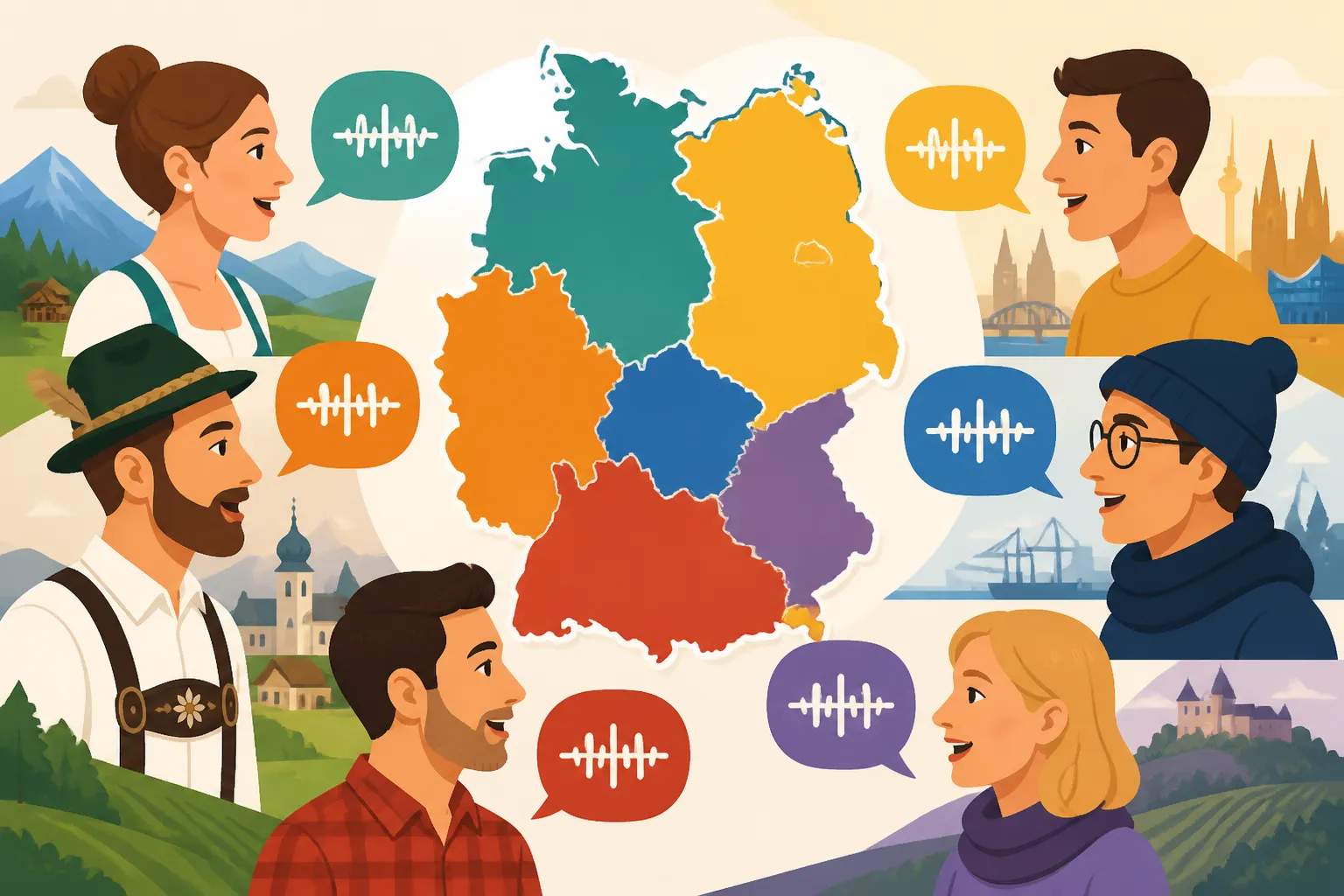
German Regional Dialects and Accents: What to Expect
Oh, the German language! You arrive here, perhaps having diligently studied Hochdeutsch (High German), feeling quite confident, only to step off the train in Bavaria and be met with what sounds like an entirely different tongue. Trust me, we’ve all been there – nodding politely while your brain frantically tries to decode what felt like a rapid-fire sequence of foreign sounds. This guide is here to unravel the wonderful, often perplexing, world of German regional dialects and accents, helping you understand what to expect and, more importantly, validating that no, it's not just you.
Disclosure: This post may contain affiliate links. We may earn a commission at no extra cost to you if you make a purchase through these links. Read full disclosure.
The German Language: More Than Just "Standard German"
When you learn German in school or through apps, you’re almost invariably learning Hochdeutsch, or Standard German. This is the official language used in media, education, and government, and it’s understood across the entire country. However, Germany is a nation with a rich, complex linguistic landscape, deeply rooted in its diverse historical regions. To truly understand the German language, you have to acknowledge the vibrant tapestry of dialects and regional accents that exist beneath the surface of Hochdeutsch. It’s like arriving in the UK having only learned 'BBC English' and then trying to decipher Glaswegian or Geordie – a real eye-opener!
High German vs. Low German: A Historical Divide
The terms "High German" (Hochdeutsch) and "Low German" (Plattdeutsch or Niederdeutsch) actually refer to two major historical language groups, not just the standard language. This division isn't about quality or prestige, but rather geographical elevation and a linguistic phenomenon known as the High German Consonant Shift. The "High" in High German refers to the higher, mountainous regions of Southern Germany, Austria, and Switzerland, where the shift occurred more completely. "Low" refers to the flatter, northern plains, where the shift did not take place, leaving their language closer to Old Saxon and the Germanic languages of Scandinavia and the Netherlands.
For instance, the word for "make" in Standard German is machen, which reflects the High German shift. In Low German, you'd find forms like maken, which feels much closer to the English "make" or Dutch "maken." This historical split means that if you travel to the northern reaches of Germany, particularly along the North Sea coast or in areas like Lower Saxony, you might hear older generations speaking a Low German dialect that is truly a distinct language. While Plattdeutsch speakers are fewer now and often bilingual, the influence of these older dialects still shapes the regional accents and even some vocabulary used in daily life in the north. Understanding this historical context helps put the modern dialect landscape into perspective and shows why these differences run so deep.
The Concept of "Dialect Continuum"
Germany doesn't have neat linguistic borders where one dialect abruptly ends and another begins. Instead, it's more of a "dialect continuum." Imagine a long chain of communities stretching across Germany; each community speaks a dialect that is very similar to its immediate neighbors, but as you move further along the chain, the dialects become less and less mutually intelligible. This means someone from Cologne might struggle a bit with a deep Bavarian dialect, but they'd likely understand a speaker from Düsseldorf, which is much closer. The same goes for understanding how a Low German dialect near the Dutch border gradually transitions into more Standard German-influenced speech as you move south towards the central regions.
This continuum is why the variations feel so fluid and complex. It's not just a few distinct dialects, but a spectrum of regional speech patterns, vocabulary, and grammar. This also means that many people speak a "Mundart" (a local dialect) or a "Regiolekt" (a regional variation of Standard German) that blends elements of their local dialect with Hochdeutsch, making it somewhat understandable to outsiders but still distinctly regional. It’s a beautiful reflection of local identity, but for an expat trying to master German Language and Everyday Communication for Visitors, it can certainly add an extra layer of challenge, especially outside the major metropolitan hubs.
Major German Dialect Families You'll Encounter
While the dialect continuum means no hard lines, linguists generally categorize German dialects into major families, each with its own quirks and characteristics. Knowing these broad categories can give you a better idea of what to expect as you travel across the country, whether you're planning a scenic train journey facilitated by services like Omio, or simply exploring a new city through a tour on GetYourGuide.
Southern German Dialects: Bavarian and Swabian
Ah, Southern Germany! This is where many expats first encounter significant linguistic differences. The dialects here, particularly Bavarian (Bairisch) and Swabian (Schwäbisch), are perhaps the most famous and, for many, the most challenging.
Bavarian (Bairisch): If you've spent any time in Bavaria, particularly around Munich, you'll know exactly what I mean. Bavarian isn't just an accent; it's a distinct dialect with its own grammar, vocabulary, and pronunciation rules. Think of it more as a close cousin to Standard German than just a regional variation. For example, "I am" in Standard German is Ich bin, but in Bavarian, it’s often I bin. The diminutive suffix -chen in Standard German (like Mädchen for girl) becomes -erl or -l in Bavarian (Madl). The famous greeting Grüß Gott is also a dead giveaway for Southern Germany. The pronunciation is often softer, with a tendency to aspirate sounds less forcefully, and vowels might sound longer or more open. The infamous Oktoberfest is a prime example of Bavarian culture, and while most people will speak Standard German to tourists, you'll hear the dialect buzzing all around. This rich linguistic heritage is part of what makes Living in Munich: Expat Guide to the Bavarian Capital such a unique experience.
Swabian (Schwäbisch): Moving slightly west, into Baden-Württemberg, you'll hit Swabian territory. Swabian shares some characteristics with Bavarian but has its own distinctive features. One of its most recognizable traits is the ending of many words with -le as a diminutive, such as Spätzle (small noodles) or Mädle. The "sch" sound is also very prevalent, and you might notice a more melodic, almost sing-songy intonation compared to the flatter tones of some northern accents. Vowels are often pronounced differently, and the "st" sound at the beginning of words, which is "sht" in Standard German, might just be a simple "st." It's definitely a distinct flavor of German that can take some getting used to.
Central German Dialects: Hessian, Thuringian, and Saxon
The dialects of Central Germany form a bridge between the south and the north, and they too have their own unique characteristics.
Hessian (Hessisch): Spoken around Frankfurt and the state of Hesse, Hessian is known for its softer consonants and sometimes a more relaxed pronunciation of vowels. The "ch" sound can often become a soft "sch," and the "pf" sound might simplify to "f." For example, Apfel (apple) might sound more like Affel. The "g" at the beginning of words can also sound like a "ch" or "j" sound, giving it a very distinctive flavor. While Frankfurt is a major international hub where you'll hear plenty of Standard German, venture into smaller towns in Hesse, and you'll quickly pick up on these regionalisms. It’s a good example of how even in bustling areas, local linguistic traits persist.
Thuringian (Thüringisch) and Saxon (Sächsisch): These dialects, found in the eastern states of Thuringia and Saxony (around Dresden and Leipzig), are often the subject of comedic portrayals in Germany due to their very distinct sound. Saxon, in particular, is famous for its softening of consonants, especially the "k" and "t" sounds. A "k" might become a softer "g," and a "t" can sound like a "d." The glottal stop that is common in Standard German (the small pause before a vowel at the start of a word) is often absent. This gives the speech a very smooth, flowing quality, but it can make it quite challenging for learners to pick out individual words. Thuringian shares some similarities but is often considered slightly less pronounced than Saxon. For newcomers to Germany, it's worth noting that while these dialects are distinct, most people in these regions are fluent in Standard German and will switch for clarity, especially with foreigners.
Northern German Dialects: Plattdeutsch and Frisian Influences
As you head north, the linguistic landscape shifts towards Low German. While pure Plattdeutsch speakers are rarer, its historical influence remains strong in the regional accents and vocabulary.
Low German (Plattdeutsch/Niederdeutsch): As mentioned earlier, Plattdeutsch is a distinct language family, not just a dialect of High German. Historically, it was the language of the Hanseatic League and a prominent language across Northern Europe. Today, it's considered a minority language, but efforts are made to preserve it. If you encounter older people in rural areas of states like Lower Saxony, Schleswig-Holstein, or Mecklenburg-Vorpommern, you might hear it. It sounds much closer to Dutch or English than to Standard German. For instance, "I am" might be Ik bün instead of Ich bin. The influence on accents in the north means that the "g" sound is often pronounced softer, almost like a "j" or "ch" sound, and the general intonation can be flatter and more direct than in the south.
Frisian Influences: Along the North Sea coast, particularly in Schleswig-Holstein and parts of Lower Saxony, you'll find areas with a Frisian minority. Frisian is another distinct Germanic language, even closer to English than Low German. While only a small percentage of the population speaks Frisian, its presence adds another layer to the linguistic tapestry of the far north. These influences are usually subtle in the regional accents of Standard German, but they contribute to the unique flavor of the northern regions, a distinct contrast to what you'd find in Living in Hamburg: A Guide to Germany’s Port City for Newcomers.
Understanding Accents: Regional Pronunciation of Standard German
Beyond the true dialects, which have their own grammatical structures and vocabulary, there are countless regional accents. An accent is primarily about pronunciation, intonation, and rhythm when speaking Standard German. This is where most expats will encounter the majority of their linguistic challenges and "aha!" moments.
The Nuances of Hochdeutsch Across Regions
While Hochdeutsch is the standard, no one speaks it like a robot. Just like in English, where a speaker from Texas and a speaker from New York both speak English but sound vastly different, the same applies to Germany. A speaker from Hannover is often cited as having the "purest" Hochdeutsch accent, meaning it's very close to the standard pronunciation rules. However, someone from Berlin will speak Hochdeutsch with a distinct "Berliner Schnauze" (Berlin snout/mouth), characterized by a slightly rougher tone and specific vowel shifts. Similarly, someone from Munich speaking Hochdeutsch will still retain a southern lilt, perhaps softer "ch" sounds and different vowel colorings, even if they aren't actively using Bavarian dialect words.
The key takeaway here is that you'll rarely hear truly neutral, textbook Hochdeutsch in everyday conversation. Everyone carries a regional inflection, a subtle flavor of their home. This is why when you start Learning German: Top Language Schools and Resources for Expats, you might learn perfect pronunciation, but real-world listening can still be a shock. These nuances are what make the language so alive and reflective of Germany's diverse geography and history.
Common Pronunciation Differences to Listen For
There are a few recurring pronunciation patterns that tend to differentiate regional accents:
- "r" sound: In Northern Germany, the "r" is often pronounced as a guttural sound from the back of the throat, similar to the French "r." In Southern Germany and parts of the Rhineland, it might be more of a rolled "r" (like in Spanish) or even a flap "r." This can significantly change how words sound.
- "ch" sound: The "ch" has two main pronunciations in Standard German: the soft "ich-Laut" (like in ich or Licht) and the hard "ach-Laut" (like in Bach or machen). Some accents, particularly in the south, tend to soften the "ach-Laut" to sound more like the "ich-Laut," or even blend it into a "sch" sound. Conversely, in other regions, the "ich-Laut" might become harsher.
- Vowel Sounds: Vowels are notoriously tricky. Some regions lengthen certain vowels, others shorten them. The "a" in Mann (man) might be pronounced differently in Berlin compared to Bavaria. The diphthongs "ei" and "au" can also have slight variations.
- "s" sound: The "s" before a vowel at the beginning of a word is usually pronounced as a "z" sound (like in sehen – to see). In many southern accents, however, it's often pronounced as a regular "s" sound, which can be confusing if you're not used to it.
- Intonation and Melody: Beyond individual sounds, the overall melody of speech varies greatly. Southern accents often have a more melodic, rising-and-falling tone, while northern accents can be flatter or more abrupt. This is a subtle but impactful difference that contributes heavily to the "sound" of an accent.
Here's a simplified table comparing some common accent characteristics:
| Feature / Region | Northern Accent Example (Hamburg) | Central Accent Example (Berlin) | Southern Accent Example (Munich) |
|---|---|---|---|
| "r" sound | Guttural (uvular fricative) | Guttural (uvular fricative) | Rolled (trilled) or tap/flap |
| "g" sound | Often softened (like 'ch' or 'j') | Clear 'g' (sometimes like 'j') | Clear 'g' (often hard) |
| Vowels | Flatter, sometimes shorter | Distinct "Berliner Schnauze" | Softer, sometimes longer |
| Intonation | Flatter, more direct | Often punchy, slightly rougher | More melodic, sing-songy |
| Word Endings | "en" often dropped (e.g., gehn) | "en" often pronounced | "en" often pronounced |
The Expat Experience: Navigating Dialects and Accents
This is where the rubber meets the road for us expats. The linguistic diversity of Germany can be one of the most significant initial culture shocks, leading to moments of genuine bewilderment and self-doubt. You're not alone in feeling this way!
Initial Frustrations and Why You're Not Alone
You’ve spent months, maybe even years, diligently learning Standard German. You ace your Goethe exam, feel confident ordering at a restaurant, and then you step into a local bakery in a small town in Bavaria or the Black Forest, and it's like your German lessons never happened. The bakery assistant speaks at lightning speed, words blur together, and you might catch one or two familiar sounds, but the overall message is lost. This can be incredibly frustrating and disheartening. You might think, "Is my German really that bad?" or "Did I learn the wrong language?"
The truth is, your German is probably just fine! The issue isn't your proficiency in Standard German, but the sheer breadth of regional variation. Germans themselves often struggle to understand strong dialects from other regions. I remember trying to order a simple coffee in a small village near the Austrian border, and despite my decent German, the waitress and I just stared at each other, mutually baffled. Eventually, a younger colleague had to translate her older dialect into more understandable Standard German for me. These experiences are part of the journey. Embrace them as a sign that you're truly immersing yourself in German life, and don't let them deter your motivation to keep practicing your Survival German for Travelers: Key Phrases to Learn First.
Tips for Understanding and Being Understood
So, how do you navigate this linguistic minefield? Here are some "been-there, done-that" tips:
- Don't Be Afraid to Ask for Clarification: Germans, especially younger generations, are generally aware of their dialect or accent and are usually happy to switch to Hochdeutsch or speak more slowly if they realize you're a foreigner. A simple "Können Sie das bitte wiederholen?" (Can you please repeat that?) or "Könnten Sie etwas langsamer sprechen?" (Could you speak a bit slower?) goes a long way. If you really don't understand, "Entschuldigung, ich spreche noch nicht so gut Deutsch. Können Sie bitte Hochdeutsch sprechen?" (Excuse me, I don't speak German so well yet. Can you please speak Standard German?) is perfectly acceptable.
- Focus on the Context: Even if you miss a few words, try to grasp the general meaning from the context, gestures, and situation. Are you in a shop? They're probably asking if you need help or what you'd like. This is where your overall German Etiquette and Social Life for Visitors knowledge comes in handy.
- Train Your Ear Gradually: The more you expose yourself to different accents, the better your ear will become. Watch regional TV shows or YouTube channels, listen to local radio stations (if you're brave!), and simply engage in conversations. Over time, you'll start to recognize patterns and key phrases.
- Learn a Few Local Phrases: While not necessary for survival, learning a couple of local dialect phrases or greetings can be a fantastic icebreaker and show respect for the local culture. Servus (Bavarian/Austrian greeting) or Moin (Northern German greeting) are great examples. People will appreciate the effort, even if your pronunciation isn't perfect.
- Be Patient with Yourself: Learning a language is a marathon, not a sprint. Dealing with dialects adds another layer of complexity. Celebrate your small victories, laugh off the misunderstandings, and remember that every interaction is a learning opportunity. Nobody expects you to understand every single dialect from day one. Services like Booking.com can help you find accommodations across different regions, allowing you to sample a wide array of local linguistic flavors during your travels.
Embracing the Linguistic Richness of Germany
Once you move past the initial shock and frustration, you might find a real appreciation for Germany's linguistic diversity. It's a key part of the country's cultural fabric and offers a deeper insight into regional identities.
Resources for Learning and Appreciating Dialects
While you shouldn't prioritize learning a dialect over Standard German, there are ways to engage with them:
- Online Dictionaries and Glossaries: Many dialects have their own online dictionaries or glossaries. A quick search for "Bairisch Wörterbuch" or "Schwäbisch online" can yield surprising results. These can be fun to browse and help you understand specific regional terms you might encounter.
- Regional Media: Local newspapers, radio stations, and TV channels sometimes feature segments or programs in dialect. This is an advanced listening exercise, but a rewarding one.
- Podcasts and YouTube: You can find podcasts or YouTube channels dedicated to specific dialects, often explaining their nuances or sharing humorous stories in the local tongue. Search for "Dialekt Podcast" or "[Region] Mundart."
- Cultural Events: Folk festivals, local theatre groups, and traditional music often incorporate dialect. Attending these events, perhaps found through platforms like GetYourGuide, is a great way to experience the dialect in its natural, cultural context.
- Local Interactions: The best way to appreciate a dialect is to hear it spoken by native speakers. Engage with shopkeepers, market vendors, and especially older residents. They often cherish their local language and are happy to share a phrase or two, even if they switch to Standard German for longer conversations.
How Dialects Connect You to Local Culture
Dialects are more than just different ways of speaking; they are deeply intertwined with regional identity, history, and culture. A strong dialect often signifies a strong sense of local belonging. When someone speaks in their dialect, they're not just communicating words; they're expressing a part of their heritage and community.
For expats, engaging with dialects, even just by listening and showing interest, can be a powerful way to connect with locals and bridge cultural gaps. It shows that you're not just passing through, but genuinely trying to understand and appreciate the nuances of their home. It's a way to move beyond merely being a tourist and become a more integrated member of the community. Understanding the linguistic landscape helps you better Coping with Culture Shock: Adjusting to Life in Germany, because you realize that some initial communication difficulties are simply part of the rich tapestry of German life. From the bustling streets of Living in Berlin: Expat Guide to Neighborhoods and Lifestyle, where a certain accent can instantly mark you as a local, to the quieter villages where centuries-old speech patterns persist, the diverse dialects and accents are a testament to Germany's incredible cultural depth. So, next time you hear a German word that sounds nothing like what your textbook taught you, remember it's not a mistake – it's just Germany, in all its wonderful, linguistic glory!
Disclaimer
The information provided in this guide is intended for general informational purposes only and does not constitute professional linguistic advice. While we strive for accuracy, regional dialects and accents are highly complex and constantly evolving, with variations even within small geographical areas. Always consult official linguistic resources for precise details.