From A1 to A2 With a Tutor: What to Cover in 20 Lessons
Ah, the infamous A1 plateau! I've been there, my friend, staring at my Wörterbuch (dictionary) and feeling like I was stuck in a linguistic mud pit, barely able to string a sentence together beyond "Ich heiße…" and "Ich komme aus…" It's a real struggle when you're trying to navigate daily life in Germany, and everyone around you seems to be zipping along in fluent German while you're still grappling with basic greetings. This guide is all about helping you break free from that A1 frustration and confidently leap to A2, using a structured approach with a dedicated tutor – especially focusing on how you can get there in just 20 focused lessons.
Disclosure: This post may contain affiliate links. We may earn a commission at no extra cost to you if you make a purchase through these links. Read full disclosure.
The A1 to A2 Bridge: More Than Just Words
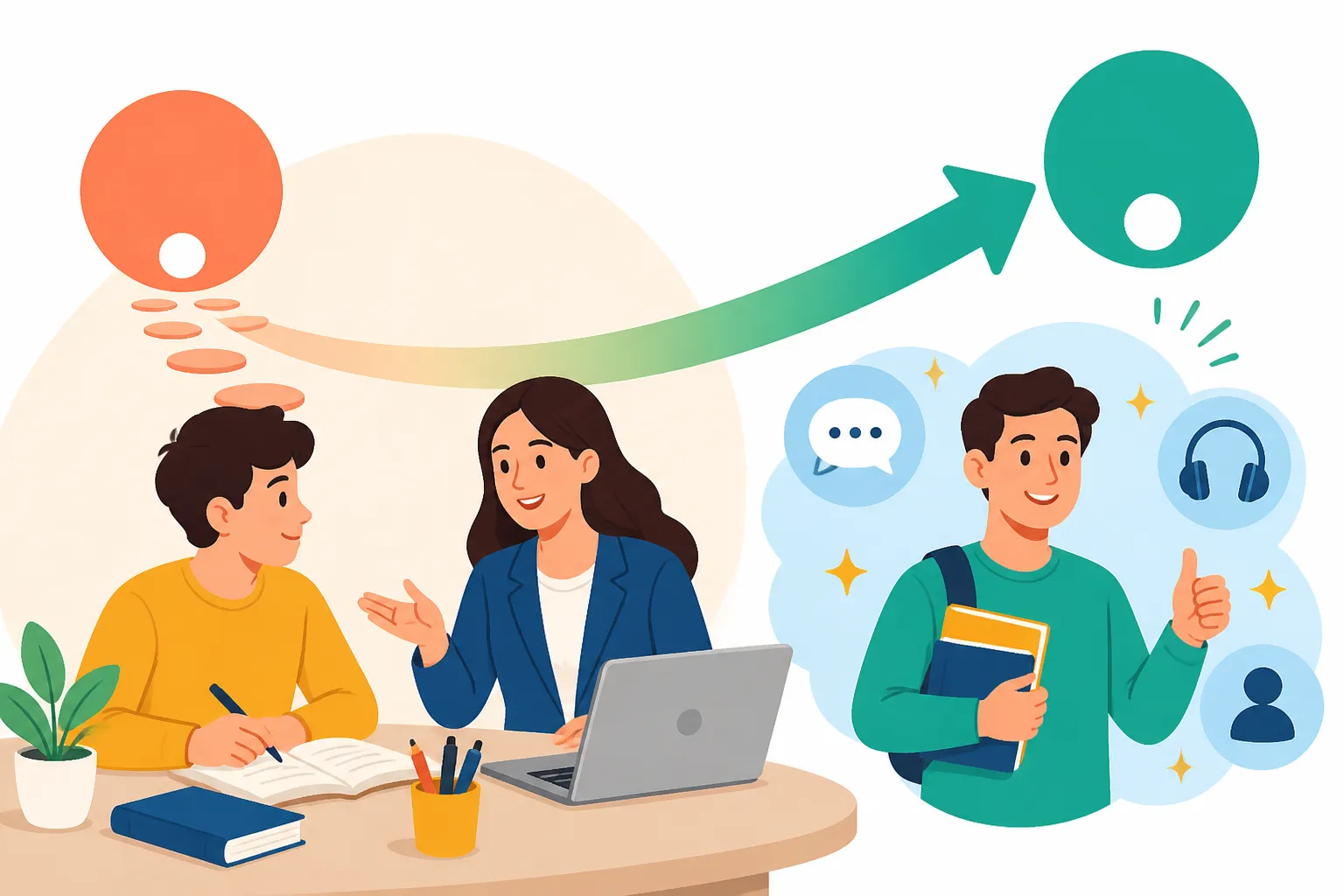
Moving from A1 to A2 isn't just about adding more vocabulary; it's about building bridges between those isolated words and basic phrases, allowing you to actually start communicating. A1 gives you the absolute fundamentals, like introducing yourself, asking simple questions, and understanding very basic instructions. But A2? That's when you start to feel like you can actually do things. You can talk about your past, make plans, express preferences, and handle more complex everyday situations without resorting to frantic hand gestures or pulling out your translation app every two minutes.
Understanding the A1 Baseline
At A1, you're essentially a linguistic newborn. You know isolated words, simple sentences, how to say hello, goodbye, please, and thank you. You can understand questions about yourself – where you live, what you do, your family – and give very short answers. Think of it like knowing how to identify individual bricks in a house. You can point to a brick, say "brick," but you can't build a wall yet, let alone a whole room. The German language, with its cases and verb conjugations, can feel overwhelming at this stage. Many expats get stuck here, finding it hard to move beyond the absolute basics, especially if their work or social circles are primarily English-speaking.
The challenge at A1 is often less about intelligence and more about exposure and structured practice. You might understand German, but speaking it often feels like trying to run with lead shoes. This is precisely why a dedicated tutor can be a game-changer; they can identify your specific weak points and tailor exercises to push you forward, rather than just repeating what you already know from an app.
Defining the A2 Destination
Reaching A2 means you can understand sentences and frequently used expressions related to areas of immediate relevance, like basic personal and family information, shopping, local geography, and employment. Crucially, you can communicate in simple and routine tasks requiring a direct exchange of information on familiar and routine matters. You can describe in simple terms aspects of your background, immediate environment, and matters in areas of immediate need. This means you can have a basic conversation with your Hausarzt (family doctor), understand the gist of a conversation at the Bürgeramt (citizen's office), or confidently order something at the Bäckerei (bakery) without panic.
The transition to A2 demands a significant shift in thinking. You'll move from simply identifying words to understanding the function of words within a sentence. You’ll start to grasp different tenses, prepositions, and more nuanced sentence structures. It's like moving from identifying individual bricks to understanding how to lay them, how mortar works, and how to create a solid corner. This is where many self-learners struggle because they lack the immediate feedback and personalized guidance a tutor, especially one from a platform like iTalki, can provide.
Crafting Your 20-Lesson Roadmap with a Tutor
The idea of tackling A2 in just 20 lessons might sound ambitious, but it’s absolutely achievable with a dedicated approach and the right tutor. The key is to be highly focused, practice consistently, and leverage your tutor's expertise to get personalized feedback. Think of these 20 lessons as 20 stepping stones, each designed to get you closer to your goal. This isn't about memorizing lists; it's about active application and building confidence.
Lesson Blocks: Thematic Learning for Daily Life
To maximize your 20 lessons, it's beneficial to break them down into thematic blocks. Instead of just working through a textbook chapter by chapter, focus on real-life scenarios you'll encounter in Germany. This makes the learning immediately relevant and builds practical communication skills. A platform like iTalki is perfect for this, as you can discuss your goals with your chosen tutor and build a custom curriculum based on your needs and interests.
You could structure your lessons into four blocks of five lessons each, focusing on a different aspect of German daily life. This allows for a deep dive into specific vocabulary and grammar that applies directly to those situations. For example, your first five lessons might focus on personal information and introductions, expanding on the A1 basics. The next five could be all about navigating your city and asking for directions, then perhaps shopping and ordering food, and finally, making plans and talking about your routine. This targeted approach with an iTalki tutor means you're learning what you need, when you need it, rather than slogging through irrelevant material.
Sample Lesson Plan Structure
Here's a hypothetical structure for your 20 lessons. Remember, this is a template, and a good iTalki tutor will adapt it to your learning style and specific needs.
| Lesson Block (5 Lessons) | Focus Area | Key Grammar Targets | Key Vocabulary Topics | iTalki Tutor Tip |
|---|---|---|---|---|
| Block 1: Getting Settled & Personal Story | Expanding introductions, talking about home, daily routines, past experiences. | Perfect Tense (Perfekt) with "haben" and "sein", Dative case (basic prepositions like in, an, auf), Separable Verbs (e.g., aufstehen). | Family members, household items, daily activities (arbeiten, schlafen, essen), hobbies, time expressions (gestern, morgen, letzte Woche). | Focus on role-plays describing your morning routine or a recent weekend. Ask your tutor to correct common errors in Perfekt usage. |
| Block 2: Navigating & Interacting | Asking for and giving directions, public transport, shopping for necessities, making appointments. | Accusative case (with prepositions like durch, für, um), modal verbs (können, wollen, müssen), polite requests. | Places in a city (Bahnhof, Apotheke, Supermarkt), directions (rechts, links, geradeaus), transport (Bus, Bahn, Ticket), common shopping phrases, making appointments (einen Termin vereinbaren). | Practice ordering food in a restaurant scenario. Your iTalki tutor can simulate a busy cashier at the Rewe or a helpful DB employee. How to Use the DB Navigator App in Germany is a great resource here. |
| Block 3: Opinions, Preferences & Future | Expressing likes/dislikes, making plans, talking about weather, simple future plans, health topics. | Imperative mood (commands), comparative/superlative, future tense (with "werden"), common conjunctions (und, aber, oder, weil). | Weather vocabulary, planning activities (verabreden, besuchen), food preferences, asking about health (Mir geht es gut/schlecht), basic symptoms. | Use your lessons to discuss your favorite German foods or plan a fictional trip to Berlin for First-Time Visitors. Work through Common German Medical Terms: A Mini Dictionary for Patients with your tutor. |
| Block 4: Problem Solving & Socializing | Dealing with minor issues, asking for help, social invitations, understanding cultural nuances. | Genitive case (basic possession), conditional clauses (with wenn), reported speech (simple forms), more complex sentence structures. | Explaining problems (Das Internet funktioniert nicht), apologies, invitations (möchtest du…?), saying yes/no politely, common German idioms. | Your iTalki tutor can role-play scenarios like calling customer service or inviting a new German friend for coffee. Discuss German Social Etiquette for Visitors: Greetings and Punctuality. |
With iTalki, you have the flexibility to schedule your lessons when it suits you, even if you have a busy work schedule. Many tutors offer shorter, more frequent lessons, which can be fantastic for consistent practice and retention.
Choosing the Right iTalki Tutor
Finding the right tutor is paramount to your success. With iTalki, you can browse through a diverse range of teachers, from community tutors to certified professionals. Don't be afraid to try a few different trial lessons. Look for someone who:
- Understands your goals: Make it clear you want to get from A1 to A2 in a set number of lessons, focusing on practical communication.
- Has a clear teaching methodology: Do they use a specific textbook? Do they provide their own materials? Do they focus on conversation, grammar, or a mix?
- Is empathetic and patient: You're going to make mistakes. A good tutor will encourage you and create a safe space for learning.
- Provides detailed feedback: Beyond just correcting errors, do they explain why something is wrong and offer ways to improve?
- Has good reviews: Other students' experiences can offer valuable insights.
Many iTalki tutors are native German speakers who also speak English, which can be helpful at the A1/A2 level when you need clarification without getting completely lost. They can provide cultural context and real-world usage examples that textbooks often miss.
Conquering Key Grammar and Vocabulary
The jump to A2 introduces some critical grammatical concepts that are essential for expressing more complex thoughts. While it might feel daunting at first, a tutor can break these down into manageable chunks.
Essential Grammar for A2 German
Forget rote memorization; with your iTalki tutor, you'll tackle these grammar points through conversation and practical exercises.
The Perfect Tense (Perfekt)
This is a big one. At A1, you might have touched on it, but at A2, you need to use it consistently to talk about the past. Germans often use the Perfekt in spoken language, rather than the simple past (Präteritum) for many verbs. You'll learn which verbs take "haben" and which take "sein" as auxiliary verbs, and how to form the Partizip II. Your tutor on iTalki can drill you on this through "What did you do yesterday?" or "Tell me about your weekend" exercises. It's a fundamental part of German Language and Everyday Communication for Visitors.
Dative and Accusative Cases with Prepositions
You've probably encountered the accusative case (direct object) and perhaps simple dative (indirect object) at A1. But at A2, you'll delve deeper into prepositions that always take the dative (e.g., mit, nach, von, zu) and those that always take the accusative (e.g., durch, für, gegen, ohne, um). The trickiest part comes with "two-way" prepositions (an, auf, hinter, in, neben, über, unter, vor, zwischen) which can take either dative (for location, "where?") or accusative (for direction, "where to?"). This is where personalized practice with your iTalki tutor is invaluable, as they can create tailored sentences and corrections to solidify your understanding.
Modal Verbs and Their Uses
You'll expand beyond "können" (can) to include "wollen" (want to), "müssen" (must), "sollen" (should), "dürfen" (may/be allowed to), and "mögen" (to like). These verbs change the meaning of the main verb and are crucial for expressing desires, obligations, and permissions. For example, "Ich muss zum Arzt gehen" (I must go to the doctor) or "Ich möchte einen Kaffee bestellen" (I would like to order a coffee). Your iTalki tutor can help you integrate these naturally into conversation, for instance, by discussing plans or explaining responsibilities.
Basic Subordinate Clauses (e.g., with "weil," "dass")
While full mastery of complex sentence structures comes later, A2 introduces you to simple subordinate clauses. "Weil" (because) is a lifesaver for explaining things ("Ich lerne Deutsch, weil ich in Deutschland lebe" – I learn German because I live in Germany). "Dass" (that) allows you to report what someone said or thought ("Ich weiß, dass er kommt" – I know that he is coming). These clauses are vital for connecting ideas and giving more detailed responses. Your iTalki tutor can gently introduce these structures and give you opportunities to use them in context.
Essential Vocabulary for A2 German
Expanding your vocabulary is crucial. Focus on words and phrases that will allow you to describe common situations and express yourself more precisely.
- Daily life and routines: Words related to work, home, morning/evening routines, chores, free time activities. For instance, Understanding Your German Payslip: Gross vs Net Salary Explained can become a vocabulary exercise.
- Shopping and services: Prices, types of shops, asking for specific items, understanding sales, paying for things. Think about your trips to the Apotheke (pharmacy) and how to navigate The German Apotheke Experience: Why Pharmacies Are More Than Just Medicine.
- Directions and transportation: Names of places in a city, directions (left, right, straight), public transport terms, asking for a ticket.
- Health and well-being: Basic body parts, common ailments (cold, headache), asking for help at the doctor or pharmacy. This is where topics like What to Do When You’re Sick in Germany and Don’t Have a Doctor Yet become less intimidating if you have some basic vocabulary.
- Food and drink: Ordering at a restaurant, talking about preferences, understanding menu items. Your iTalki tutor can help you practice How to Ask for the Bill in a German Restaurant.
- Making plans and social interactions: Inviting people, accepting/declining, suggesting activities, expressing opinions.
- Descriptive adjectives: Expanding beyond basic colors and sizes to describe feelings, qualities, and conditions.
Your iTalki tutor can provide targeted vocabulary lists, flashcards, or interactive exercises tailored to your needs. They can also introduce you to Common German Acronyms in Daily Life (BVG, GEZ, DHL, etc.) Explained to help you understand everyday German.
Beyond the Lesson: Practical Application and Confidence
Twenty lessons will give you a solid foundation, but true progress comes from applying what you've learned in the real world. Your iTalki tutor will arm you with the tools, but you have to use them!
Active Practice Beyond the Tutor Session
Don't let your learning stop when your iTalki session ends. Integrate German into your daily life as much as possible.
Speak, Speak, Speak
This is non-negotiable. Try to use German whenever you get a chance. Order your coffee in German, ask for directions, chat with your neighbors. Don't worry about perfection; focus on communication. Your iTalki tutor is your safe space for making mistakes and getting corrections, so when you're out in the wild, you'll feel more prepared. Even simple tasks like Understanding German Addresses: How to Read and Write Your Address Correctly become opportunities to practice numbers and prepositions.
Immerse Yourself (Even a Little Bit)
Even if you're not fluent, try to expose yourself to German media. Watch German TV shows with German subtitles, listen to German music, or try reading simple German news articles. Don't aim to understand everything; just get used to the sounds and rhythms of the language. This passive immersion complements your active lessons on iTalki, building your receptive skills. Check out resources like Learning German: Top Language Schools and Resources for Expats to find local groups or events.
Flashcards and Spaced Repetition
Use apps like Anki or Quizlet to create flashcards for new vocabulary and grammar rules. Consistent, spaced repetition is incredibly effective for long-term retention. Your iTalki tutor can suggest specific vocabulary sets or methods that work for their other students.
Overcoming the Fear of Making Mistakes
The biggest hurdle for many expats trying to learn German is the fear of sounding foolish or making mistakes. I've been there, frozen in fear, trying to conjure the perfect sentence before saying anything at all. But here's the truth: Germans appreciate the effort. They know their language is tough, and they respect you for trying.
Your iTalki tutor will create a supportive environment where making mistakes is part of the learning process. They're there to correct you gently, explain why, and give you strategies to avoid those errors in the future. Embrace the "fail forward" mentality. Every mistake is a learning opportunity.
Setting Realistic Expectations
While 20 lessons can take you from A1 to a confident A2, it's not a magic bullet. You'll still have moments of frustration, and there will be times when you feel like you're not progressing. That's completely normal. The key is consistency and perseverance. Celebrate the small victories: understanding a full sentence at the grocery store, successfully asking for the price of something, or even just completing a full thought in German with your iTalki tutor.
Think about how much you've already achieved by moving to Germany and starting this language journey. Each iTalki lesson is an investment in your integration and your comfort here. With dedicated effort, a great tutor from iTalki, and a commitment to practice, you'll soon be speaking with more ease and confidence than you ever thought possible. You've got this!
Disclaimer
This article is for general informational purposes only and does not constitute professional advice. Laws, prices and regulations vary by location and change over time. Consult a qualified professional for guidance on your specific situation.