The Deutschlandticket: What It Covers, What It Doesn’t, and Who It Suits
Oh, the sheer joy (and sometimes utter bewilderment!) of navigating public transport in Germany. As an expat who's been here a while, I can tell you it often feels like you need a degree in German bureaucracy just to buy a simple train ticket. Different fare zones, a myriad of regional networks, and the constant fear of accidentally stepping into the wrong train type – it’s enough to make anyone want to just stay home. But then came the Deutschlandticket, promising a beacon of simplicity in this complex landscape. This comprehensive guide will peel back the layers of this much-lauded ticket, revealing what it truly covers, its sneaky limitations, and whether it’s the right fit for your German adventures, all while showing you how a tool like Omio can make planning your journeys a breeze.
Disclosure: This post may contain affiliate links. We may earn a commission at no extra cost to you if you make a purchase through these links. Read full disclosure.
What Exactly is the Deutschlandticket?
For years, expats and locals alike dreamed of a unified, affordable public transport solution in Germany. The local transport associations, or Verkehrsverbünde, with their intricate fare systems, were notorious for making cross-regional travel a headache. You'd buy a ticket for Berlin's BVG and find it utterly useless just a few kilometers outside the city limits. The temporary 9-Euro-Ticket in summer 2022 gave us a glimpse of what could be, and the overwhelming success of that initiative paved the way for the Deutschlandticket.
The Concept and Its Origins
The Deutschlandticket, often informally called the "49-Euro-Ticket," launched on May 1, 2023, as a direct response to the popularity of its short-lived predecessor. The core idea was simple: one monthly ticket, valid for unlimited travel on all local and regional public transport across the entire country. Imagine that! No more deciphering complex fare zones or buying multiple tickets for a journey that crosses state lines. It was designed to encourage more sustainable travel, ease the financial burden of commuting, and, frankly, make life a whole lot easier for anyone using public transport. It's meant to simplify the daily commute and encourage exploration of Germany's countless towns and regions without the constant worry of ticket validity.
However, like most things in Germany, this simplicity comes with its own set of German-style rules and nuances. It's a fantastic initiative, but understanding the fine print is crucial. It’s not a magic pass for all trains, as many initially hoped. It’s specifically for the Nahverkehr, which translates to local and regional transport. This distinction is where many new expats, eager to embrace the ease of the ticket, often stumble.
The Monthly Subscription Model
Unlike a one-off purchase, the Deutschlandticket operates on a monthly subscription model. This is a crucial detail for anyone considering it. When you buy it, you're essentially signing up for a recurring payment of €49 per month. This means if you buy it on the 10th of a month, you're still paying for the entire month, and it will automatically renew for the following month unless you actively cancel it. The cancellation policy generally requires you to cancel by the 10th of the preceding month to avoid being charged for the next month. So, if you only plan to use it for July, you'd need to cancel by June 10th. This is a classic German contract approach – convenient if you want it long-term, but it demands attention if your needs are seasonal or short-term.
The subscription aspect makes it wonderfully convenient for commuters and regular travelers who rely on public transport daily. You set it up once, and you're good to go. For tourists or short-term visitors, however, it might require a bit more strategic thinking. Is your stay long enough to justify at least one full month? Do your travel plans align with the cancellation deadline? These are the questions that often plague us as expats, trying to bend German systems to our less-than-long-term plans.
Who is the Deutschlandticket For?
The Deutschlandticket truly shines for specific groups of people in Germany. First and foremost, it's a godsend for daily commuters. If your daily journey involves hopping on a bus, a tram, the U-Bahn, or an S-Bahn within your city, and perhaps even a regional train to a neighboring town, this ticket is likely to save you a significant amount of money compared to individual monthly passes. Public transport costs can easily soar past €49 a month for even short distances in some cities.
Secondly, students and young people who love to explore on weekends benefit immensely. Imagine being able to spontaneously decide to visit a friend in a different state, or simply explore a new town a few hours away, without worrying about the train ticket price. Many universities and student bodies have even integrated the Deutschlandticket into their semester fees, making it even more accessible and affordable for students. This can be a huge boon for international students trying to make the most of their time and budget here.
Finally, expats who frequently travel regionally or want to discover more of Germany without relying on a car will find it incredibly valuable. It opens up opportunities for day trips and weekend getaways without breaking the bank on individual tickets. Instead of thinking "How much will that train ticket cost?" for a trip to a nearby city, you can simply think "Can I get there on regional transport?" This freedom to explore can greatly enhance your experience of living in Germany. For those trips that demand speed or cross-border travel, don't forget that platforms like Omio are brilliant for comparing and booking all your transport options in one go, including those faster long-distance trains not covered by the Deutschlandticket.
What the Deutschlandticket Really Covers: The Nitty-Gritty of Local and Regional Transport
Alright, let's get into the specifics. This is where many expats initially get confused, so pay close attention. The Deutschlandticket is all about Nahverkehr, or local and regional transport. But what does that actually entail in practice?
Understanding 'Nahverkehr' Local and Regional Public Transport
Nahverkehr is the backbone of daily life in Germany. It encompasses all public transport services designed for shorter to medium distances, typically within a city, a metropolitan area, or between neighboring towns and regions. Think of it as anything that isn't a high-speed, long-distance express service. This is why you'll see it referred to as the "regional train ticket".
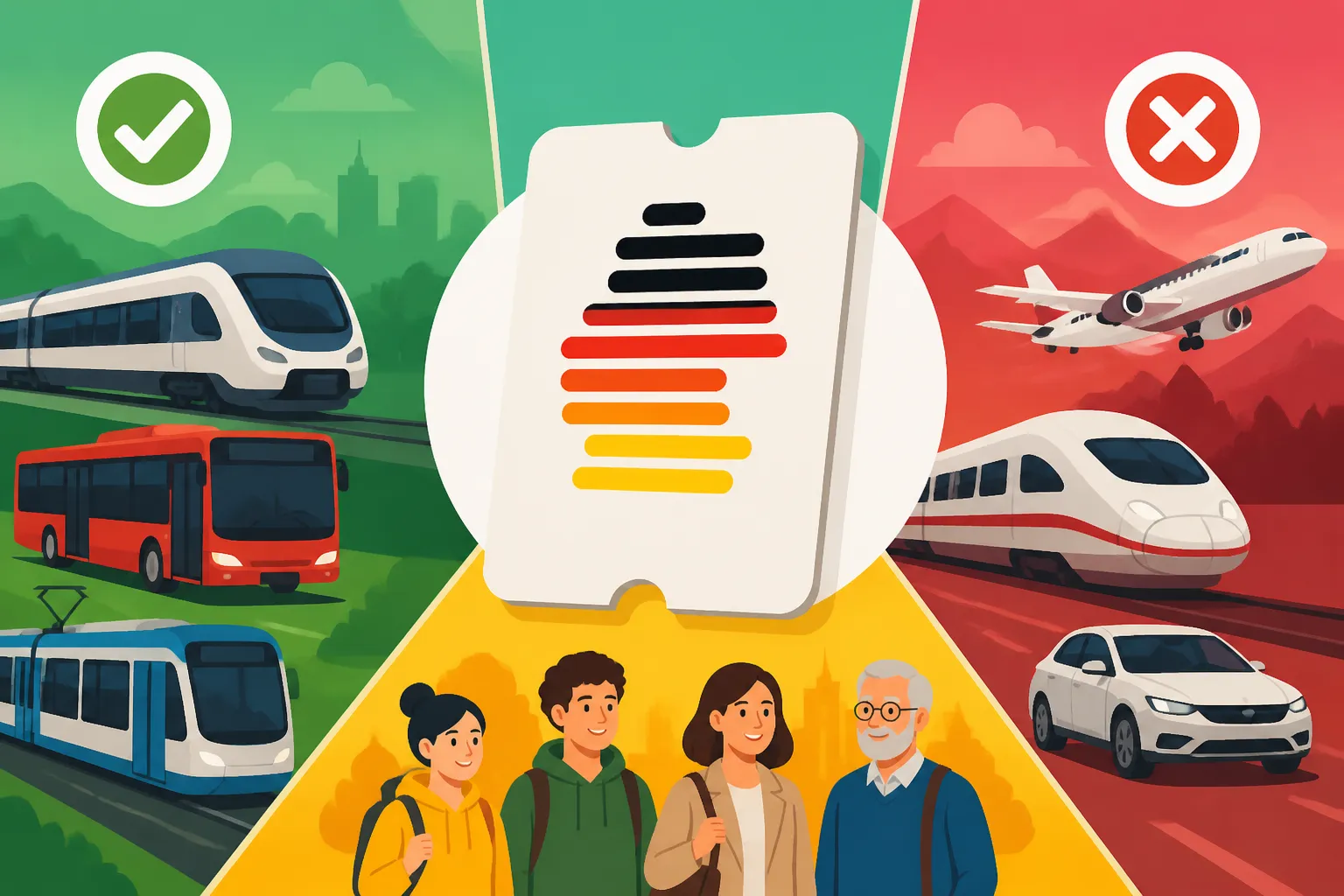
When you're travelling with the Deutschlandticket, you're generally looking for trains marked RE (Regional-Express), RB (Regionalbahn), and S-Bahn (local commuter trains). These trains make more frequent stops and are designed to connect smaller towns and cities within a state or across a few states. They're slower than their long-distance counterparts but offer excellent coverage. It also includes all the local city transport like buses, trams (Strassenbahn), and U-Bahns (subways). This expansive network is what makes the Deutschlandticket so powerful for local exploration and commuting.
The beauty of it is the sheer geographical reach. You could theoretically travel from Flensburg in the very north to Garmisch-Partenkirchen in the south, using only regional trains, buses, and trams, all on one ticket. It might take you ages and involve numerous changes, but it's possible. This ability to travel across various Verkehrsverbünde without ever buying a new ticket is the true game-changer, breaking down the old, restrictive fare borders. Just remember, for seamless long-distance planning or when regional routes are just too slow, checking options on Omio can save you a lot of time and hassle, as it integrates various transport modes and speeds.
Modes of Transport Included Buses, Trams, U-Bahn, S-Bahn, RE, RB
Let's list them out clearly so there's no confusion. With your Deutschlandticket, you can hop on:
- Buses (Bus): All city and regional bus lines, from the local school bus to inter-town services.
- Trams (Strassenbahn/Tram): Those beloved streetcars that crisscross German cities.
- U-Bahn (Untergrundbahn/Subway): The underground metro systems in major cities like Berlin, Munich, Hamburg, and Frankfurt.
- S-Bahn (Stadtschnellbahn/City Rail): The urban and suburban commuter rail networks that connect cities with their surrounding areas, often running above ground.
- Regional-Express (RE): Faster regional trains that connect larger towns and cities within a region, making fewer stops than the RB.
- Regionalbahn (RB): Slower regional trains that stop at most, if not all, stations along their route.
Essentially, if it's not explicitly labeled as an Intercity (IC), Eurocity (EC), or Intercity-Express (ICE) train, it's likely covered. This means for most day-to-day travel and spontaneous regional adventures, you're all set. The sheer coverage of the network is impressive, allowing you to immerse yourself in local culture, visit charming villages, or simply commute without thinking twice about fare zones.
Geographical Validity: All of Germany, But Not All Trains
As mentioned, the Deutschlandticket is valid across the entire federal territory of Germany. This is its biggest selling point! However, the crucial caveat is "all local and regional public transport." It explicitly excludes all long-distance trains operated by Deutsche Bahn (DB), specifically the high-speed ICE (Intercity-Express), IC (Intercity), and EC (Eurocity) trains. You also cannot use it on private long-distance train operators like Flixtrain.
This distinction is vital for planning any significant journey. If you need to travel from Berlin to Munich, the Deutschlandticket will get you there, but it will involve a series of regional trains, possibly taking 8-10 hours with multiple changes, instead of a direct 4-hour ICE ride. This is where you have to weigh time versus cost. For someone on a budget or with time to spare, it’s a fantastic way to see more of the countryside. For those in a hurry, it’s a non-starter for long distances.
A few limited exceptions exist, usually for specific stretches of ICE trains that are integrated into local transport schemes for very short distances, but these are rare and should not be relied upon without checking very carefully for your specific route. For clarity and to ensure you’re choosing the right ticket for your journey, whether it’s a quick regional hop or a long-distance sprint, platforms like Omio are indispensable. Omio clearly shows you different transport options, including ICE trains and regional connections, allowing you to see the fastest routes and compare costs, making your decision much simpler.
When Omio Comes in Handy for Regional Travel
While the Deutschlandticket is fantastic for covering regional travel once you have it, planning those intricate regional journeys can still be a bit… well, German. You might wonder which specific RE train connects to which RB train, or if there's a bus that takes you directly to that obscure castle you want to visit. This is where Omio truly shines, even for regional trips.
Omio aggregates various transport options – regional trains, buses, and even local city transport if integrated – and presents them in a clear, easy-to-understand format. You can input your starting point and destination, and Omio will show you the most efficient routes using Nahverkehr, detailing the connections and estimated travel times. It helps you visualize your journey across different Verkehrsverbünde, something that can be incredibly complex using individual transport apps. This is especially helpful if you're trying to figure out if a certain regional connection is feasible for a day trip or if the travel time makes it impractical for the Deutschlandticket alone.
For instance, if you're planning a trip from Cologne to, say, a smaller town in the Eifel region, Omio will help you map out the entire journey using only RE and RB trains, showing you exactly where you need to change. It takes the guesswork out of navigating the sprawling German regional network. Even if you're not buying a specific ticket (because you have your Deutschlandticket), Omio acts as a powerful journey planner, ensuring you pick the best regional routes and understand your connections without a hitch. It’s an expat's secret weapon against travel uncertainty, making the most of your Deutschlandticket.
Where the Deutschlandticket Falls Short: Limitations Expats Need to Know
While the Deutschlandticket is a game-changer, it's crucial to understand its limitations. Nothing is perfect, especially in a system as layered as Germany's public transport. These shortcomings often trip up unsuspecting expats.
Exclusions: No ICE, IC, EC, or D-Trains Intercity and Long-Distance
This is arguably the most significant limitation and the one that causes the most confusion. The Deutschlandticket is not a golden ticket for all trains. It explicitly excludes:
- ICE (Intercity-Express): Germany's high-speed flagship trains, which are the fastest way to travel between major cities.
- IC (Intercity): Long-distance express trains that connect major cities but are generally slower than ICEs.
- EC (Eurocity): International long-distance trains that connect Germany with other European countries.
- D-Trains (D-Zug): Older, less common long-distance trains.
If you accidentally board an ICE, IC, or EC train with only your Deutschlandticket, you will be considered a fare dodger (Schwarzfahrer). This means you'll face a hefty fine of €60, plus the cost of a new ticket for your journey. It’s a really easy mistake to make, especially when train stations can be bustling and signage sometimes confusing. Always double-check the train type before you board. If in doubt, look for the 'RE' or 'RB' on the train itself or on the platform display.
For expats planning to travel significant distances across Germany or beyond its borders, these exclusions mean you’ll still need to purchase separate tickets. This is where Omio becomes an indispensable tool. When you search for a route on Omio, it clearly displays all available options, including ICE, IC, and regional connections. You can see the price difference, travel time, and decide if paying extra for speed is worth it. Omio allows you to seamlessly purchase these long-distance tickets, saving you the stress of finding the right platform or booking system.
First Class, Special Buses, and Tourist Lines Not Included
Beyond the major long-distance trains, there are a few other subtle exclusions that can catch you off guard:
- First Class: The Deutschlandticket is a second-class ticket only. If you decide to upgrade to first class on a regional train, you'll need to purchase a separate first-class supplement for that specific journey. Trying to sit in first class with just your Deutschlandticket is another quick way to get fined.
- Special Buses/Night Buses/On-Demand Services: While most standard city and regional buses are covered, some specific "on-demand" services, certain night bus lines with special surcharges, or purely tourist-oriented buses (like city sightseeing tours) might not be included. Always check with the local transport provider if you're unsure about a very niche bus service.
- Cable Cars/Ferries (Exceptions Apply): The ticket generally doesn't cover cable cars, historical trams, or specific tourist ferries unless they are explicitly integrated into the local public transport network. For example, some city ferries, like those in Hamburg's harbour, are indeed covered as they are part of the HVV transport network, but don't assume every scenic boat ride is included.
These exclusions highlight the importance of understanding the intent of the Deutschlandticket: it's for utilitarian public transport, not luxury or premium travel experiences. It's about getting from A to B efficiently within the regional framework.
Inter-city Travel Gaps and Planning Alternatives
While the Deutschlandticket covers all local and regional transport, there's a practical "gap" when it comes to efficient inter-city travel over longer distances. As I mentioned, you can travel from Berlin to Munich, but it will be a long, winding journey through countless regional stops. This is often impractical for business travel, weekend trips with limited time, or simply when you value your sanity.
This is where planning alternatives become critical. If your destination is more than a couple of regional train hops away, you should seriously consider options beyond the Deutschlandticket. This is another prime scenario for using Omio. You can easily compare the regional train route (covered by your Deutschlandticket) with direct ICE connections, or even long-distance buses like FlixBus, which can sometimes be surprisingly fast and economical.
Example Scenario:
Let's say you're in Stuttgart and want to visit Hamburg for a weekend.
- Deutschlandticket Route: You'd be looking at 8-10 hours, multiple changes, likely through Mannheim, Hanover, or similar hubs. It's cheap (effectively "free" if you have the D-Ticket), but it eats up most of your day.
- ICE Route (via Omio): A direct ICE can get you there in about 5.5 to 6 hours. You pay extra for this ticket, but you gain back precious hours of your weekend. Omio lets you see these options side-by-side, helping you make an informed decision based on your priorities.
By using Omio, you're not just buying tickets; you're gaining transparency into Germany's entire transport ecosystem, allowing you to bridge those inter-city travel gaps effectively and confidently.
The 'No Bike, No Dog' Rule (Usually)
For many expats, bringing their furry friends or their bicycles along on public transport is a common occurrence. Unfortunately, the Deutschlandticket generally does not include the transport of bicycles or dogs (beyond small ones in carriers). This is a frequent point of frustration.
- Bicycles: You usually need to purchase a separate bicycle ticket (Fahrradkarte) for regional trains and sometimes even for local transport, depending on the city. These rules vary by Verkehrsverbund, making it notoriously difficult to navigate. For example, in some cities, bikes are allowed free of charge on the S-Bahn during off-peak hours, but not during peak times, and never on buses. On regional trains (RE/RB), you almost always need a Fahrradkarte.
- Dogs: Small dogs in carriers typically travel free, but larger dogs not in a carrier usually require their own child's ticket (Kinderfahrkarte). Again, this can vary regionally.
This limitation means that if you're planning a cycling trip or traveling with a medium to large dog, your Deutschlandticket won't cover their ride. You'll need to factor in these additional costs and be prepared to purchase separate tickets for them. This is one of those pesky details that highlights the need for local research, or simply asking a friendly German at the station – because the rules are rarely universally clear!
Buying, Managing, and Cancelling Your Deutschlandticket: The Practicalities
So, you're convinced the Deutschlandticket might be for you. Great! But how do you actually get your hands on it, and what's the deal with this subscription business? It's not always as straightforward as walking up to a ticket machine.
Where and How to Purchase
The Deutschlandticket is primarily sold as a digital ticket, usually through various regional transport apps and websites, or directly from Deutsche Bahn. You won't find it at a typical ticket machine as a one-off purchase. Here are the common ways:
- Regional Transport Apps: Most major cities and regions have their own transport apps (e.g., BVG Fahrinfo in Berlin, MVV-App in Munich, HVV App in Hamburg, VVS Mobile in Stuttgart). You can usually purchase and manage your Deutschlandticket directly through these apps. This is often the most convenient route for daily commuters.
- Deutsche Bahn (DB Navigator App/Website): Deutsche Bahn also sells the Deutschlandticket through their widespread DB Navigator app and their website. This is a popular choice for those who travel across different regions and don't want to commit to one local app.
- Local Transport Provider Websites: Many individual transport companies (like S-Bahn Berlin, or local bus operators) also offer the Deutschlandticket for purchase directly on their websites.
- Customer Centers: In some cases, you can also purchase it physically from a transport provider's customer service center, where they might issue you a chip card (Chipkarte) instead of a purely digital ticket.
When purchasing, you'll need to provide your personal details and set up a direct debit payment (Lastschrift) from your German bank account. For expats who might still be setting up their financial life, this can be a minor hurdle. Make sure you have a German bank account ready to go.
The Subscription Trap: Auto-Renewal and Cancellation
This is probably the biggest "gotcha" for many new users. The Deutschlandticket is a subscription. It's not a ticket you buy for one month and then forget about. It automatically renews each month unless you actively cancel it. And here's the kicker: you typically need to cancel by the 10th day of the preceding month for it to not renew for the next month.
Let's illustrate with an example:
- You buy the ticket on June 15th. It's valid for all of June.
- It will automatically renew for July, and you'll be charged for July.
- If you only want it for June and July, you must cancel by July 10th. If you forget and cancel on July 11th, you'll be charged for August too, and it will be valid until August 31st.
This cancellation deadline is non-negotiable and strictly enforced by most providers. It's designed to lock in consistent users, but it can feel like a "subscription trap" if you're not aware or if your travel plans are fluid. Always mark your calendar with the cancellation deadline if you're not planning to keep it long-term. Look for the "Kündigung" (cancellation) section in the app or on the website where you purchased your ticket.
Digital Ticket Management
The Deutschlandticket is overwhelmingly a digital product. Once purchased, it will typically appear as a QR code or barcode within the app you bought it from. This digital format is usually linked to your name and date of birth, and you'll often be asked to show a valid ID (passport or Personalausweis) during inspections to prove you are the ticket holder.
Some transport providers, particularly if you've purchased it from a physical customer center or if you requested it, might issue you a physical Chipkarte (a plastic card with an embedded chip) instead. Even with a chip card, your identity is linked to it, and you'll still need to carry ID.
The convenience of a digital ticket means no more fumbling with paper tickets, but it also means keeping your phone charged! If your phone dies and you can't present your valid digital ticket, it's effectively the same as not having a ticket, leading to a €60 fine. This is a common expat mishap, so invest in a power bank if you rely on your phone for ticketing.
Using Omio to compare and purchase other tickets when D-Ticket won't do
As awesome as the Deutschlandticket is, it simply doesn't cover every travel need. There will be times when you need to travel faster, further (internationally), or with those excluded services like ICE trains. This is precisely where Omio steps in as your travel planning superpower.
Instead of navigating the complex Deutsche Bahn website or figuring out international train connections, Omio aggregates all options. You can put in your desired route, say, Berlin to Paris, or Cologne to Vienna, and Omio will present you with train, bus, and even flight options, often showing you the best prices across various providers like Deutsche Bahn, FlixBus, and various airlines. This means you don't have to keep jumping between different platforms to find the best deal or fastest route.
Even for internal German travel, if your Deutschlandticket won't suffice for a particular trip due to its speed limitations, Omio provides a clear comparison of long-distance trains (like ICEs) versus regional connections. You can easily see the time saved by taking a faster train and the associated cost. It simplifies the decision-making process: "Do I take the long, scenic route with my Deutschlandticket, or do I spring for a faster ICE ticket, which I can buy instantly through Omio?" This makes Omio an invaluable companion for any expat in Germany, ensuring you're always choosing the most suitable transport for your specific journey, covering the gaps left by the Deutschlandticket.
Is the Deutschlandticket Right for You? Pros and Cons for Expats
Deciding if the Deutschlandticket is a good fit involves weighing your travel habits against its benefits and limitations. For expats, who often have varying travel needs, this assessment is particularly important.
Advantages: Cost Savings and Simplicity
The advantages of the Deutschlandticket are truly significant, especially if your lifestyle aligns with them:
- Unbeatable Cost Savings: For many, the €49 monthly fee is a steal. If you commute daily via public transport, even within a single city, you're likely paying more than €49 for a monthly pass. For example, a monthly pass in Berlin can easily be €80-90. The D-Ticket immediately cuts that cost almost in half. The savings become even more pronounced if you regularly travel between different cities or regions for work or leisure, as you no longer need separate tickets for each Verkehrsverbund.
- Ultimate Simplicity: Once you have it, you literally don't have to think about tickets again for regional travel. No more fumbling for change, trying to understand ticket machines in German, or worrying about fare zones. Just tap and go. This reduces a huge amount of mental load, which is a blessing when navigating a new country. It truly demystifies German public transport for the everyday user.
- Freedom to Explore: This is perhaps the most exciting benefit for expats. With the D-Ticket, you gain incredible freedom to explore Germany's vast regional network. Want to take a spontaneous day trip to a charming small town? Just check the regional train schedule and hop on. It encourages discovering hidden gems and getting out of your immediate city bubble without the added financial stress of individual tickets. This sense of spontaneous adventure is something many expats crave.
- Environmentally Friendly: By making public transport more accessible and affordable, the Deutschlandticket encourages people to leave their cars at home, contributing to a greener Germany. This aligns well with the values of many expats who move to a country known for its environmental consciousness.
These advantages collectively make the Deutschlandticket a compelling option, particularly for those whose primary travel needs are within Germany's regional network.
Disadvantages: Flexibility Limitations and the Subscription Model
However, the picture isn't entirely rosy. There are notable drawbacks that might make it less suitable for some:
- Lack of Flexibility (Subscription): As highlighted, the mandatory subscription model and the 10th-of-the-month cancellation deadline can be a major pain point. If your plans change suddenly, or if you only need the ticket for a few weeks in a month, you might end up paying for a full month you don't fully utilize. This can be especially frustrating for short-term visitors or those with irregular travel patterns.
- No Long-Distance or International Travel: The exclusion of ICE/IC/EC trains means it's not a solution for fast, inter-city travel or any journey beyond Germany's borders. If you frequently need to travel quickly between major German cities or venture into neighboring countries, you'll still need to purchase separate, often expensive, tickets. This necessitates a hybrid approach to travel planning.
- Slower Journeys: Relying solely on regional trains for longer distances, while possible, is significantly slower. A journey that takes 4 hours on an ICE might take 8-10 hours on regional trains, eating up valuable time. For many expats with busy schedules or limited vacation days, this trade-off is often not worth the savings.
- Limited Ancillary Benefits: As noted, it generally doesn't cover bike transport or larger dogs, which can be an inconvenience for specific travel needs. You'll need to purchase additional tickets for these, adding complexity.
For expats, it means you can't simply rely on the Deutschlandticket for all your transport needs. You need to be discerning about when to use it and when to opt for other solutions, like booking faster trains or international connections through platforms like Omio.
Hypothetical Scenarios: Who Benefits Most
Let's look at some real-world expat scenarios to help you decide:
- Scenario 1: The City Commuter
- Expat Profile: Lives in Berlin, works in Potsdam, uses S-Bahn/regional train daily. Also enjoys weekend trips within Brandenburg.
- Verdict: Absolute must-have. Their monthly commute alone would cost more. The D-Ticket saves them money and allows for spontaneous regional exploration.
- Scenario 2: The Frequent Business Traveler
- Expat Profile: Lives in Frankfurt, frequently travels to Munich, Hamburg, and Cologne for work meetings, often needing to be there quickly.
- Verdict: Not ideal as a standalone solution. They'll mostly rely on ICE trains for speed. However, for getting around within Frankfurt and for local commutes to the station, it's still useful. They'd use Omio to book their ICE tickets, perhaps supplementing with the D-Ticket for city travel.
- Scenario 3: The Student Explorer
- Expat Profile: Studies in Leipzig, loves hiking in Saxony, and visiting friends in Dresden and Berlin on weekends, often on a budget.
- Verdict: Perfect fit. The D-Ticket allows unlimited regional travel to all their favorite spots, making weekend adventures affordable and easy. They don't mind longer travel times.
- Scenario 4: The Part-Time Remote Worker with Family
- Expat Profile: Lives in a smaller town outside Stuttgart, works remotely mostly, occasionally goes into Stuttgart, takes kids to activities locally. Family visits from abroad mean occasional airport runs.
- Verdict: Depends. If their local travel for errands, school runs, and occasional city trips sums up to more than €49, it's a win. For airport runs (if remote), or when family comes to visit and wants to see other major cities, they'll be booking separate tickets. Here, Omio would be crucial for planning family trips that might involve a mix of regional and long-distance travel, ensuring everyone is on the right ticket.
How Omio Helps in Deciding/Planning a Mixed Travel Approach
For expats, a "mixed travel approach" is often the most realistic scenario. You might have your Deutschlandticket for daily commutes and regional jaunts, but for that urgent trip to Hamburg or a weekend getaway to Austria, you'll need something else. This is precisely where Omio becomes an indispensable part of your toolkit.
Omio isn't just a booking platform; it's a comprehensive travel planner that understands the nuances of multi-modal travel. You can easily:
- Compare Travel Times & Costs: See at a glance how long a journey takes by regional train (covered by your D-Ticket) versus an ICE (requires a separate ticket). Omio helps you quantify the trade-off between time and money.
- Integrate Different Transport Modes: If you decide to take an ICE for the long stretch, Omio helps you find and book that ticket. It can also help you plan the connecting regional leg of your journey (which your Deutschlandticket covers), so you're not left guessing.
- Plan International Trips: The Deutschlandticket is Germany-only. For those weekend trips to Amsterdam, Prague, or even just across the border to Strasbourg, Omio makes finding and booking international train or bus tickets simple, taking the headache out of cross-border planning.
Think of Omio as the smart assistant that complements your Deutschlandticket. It enables you to maximize the value of your monthly pass for regional travel, while seamlessly handling all your other travel needs without the usual German transport confusion. It's the ultimate tool for tailoring your transport choices to your actual expat life.
Combining the Deutschlandticket with Other Travel Options
The Deutschlandticket truly shines when you learn to integrate it smartly with other transport options. It’s not meant to be your only travel solution, but a powerful foundation.
Integrating with Long-Distance Travel ICE, IC
As we've firmly established, the Deutschlandticket won't get you on an ICE, IC, or EC train. However, it's brilliant for getting you to and from the long-distance train stations.
Example: You need to travel from a smaller town, say, Marburg, to Berlin. You've booked an ICE ticket from Frankfurt Hauptbahnhof to Berlin Hauptbahnhof. Your Deutschlandticket allows you to take the regional train from Marburg to Frankfurt Hauptbahnhof, and then, once you arrive in Berlin, take the S-Bahn or U-Bahn from Berlin Hauptbahnhof to your final destination in Berlin, all covered by your D-Ticket. You only pay for the Frankfurt-Berlin ICE segment.
This approach means you don't need to buy separate regional tickets for the "first mile" or "last mile" of your journey, which can add up. It’s a very cost-effective way to combine speed with affordability. Just be mindful of your connection times. Regional trains can sometimes be delayed, so always build in a comfortable buffer when connecting to an expensive, non-refundable ICE ticket. This strategic planning is simplified when you use tools like Omio, which can help you see these connections clearly and allow you to buy all your tickets, including the ICE, in one place.
Planning Trips with Multiple Transport Types
Germany's transport network is dense and varied. For many journeys, especially those to more rural or off-the-beaten-path locations, you might find yourself using a combination of regional trains, buses, and maybe even a local ferry. The Deutschlandticket simplifies this greatly.
Imagine a trip to a charming village in the Black Forest. You might take an RE train to a larger town like Offenburg, then an RB train to a smaller town, and finally a local bus service that winds its way through the valleys to your ultimate destination. All of these segments would be covered by your Deutschlandticket. You simply focus on the schedule and connections, not the individual ticket purchases for each leg. This multi-modal approach unlocks so much more of Germany for exploration.
Again, Omio becomes an invaluable companion here. When you input your destination, Omio provides comprehensive route options, often showing you the intricate dance between regional trains and buses required for such a journey. It streamlines the planning process, allowing you to quickly determine if a destination is reachable with your D-Ticket and what connections are needed. This prevents you from getting bogged down in multiple local transport websites.
Day Trips and Border Regions: What to Watch Out For
The Deutschlandticket is excellent for day trips within Germany. You can hop on regional trains and buses to explore nearby cities, national parks, or historical sites without worrying about ticket costs. It encourages spontaneity and adventure. Consider a trip to a beautiful lake in Bavaria or a medieval castle in Saxony; with the D-Ticket, the journey itself is covered.
However, a crucial point of caution arises when you are near Germany's borders. The Deutschlandticket is generally only valid within German territory. There are very few, highly specific exceptions where it might be valid for a short stretch into a neighboring country (e.g., certain bus lines just across the Austrian or Dutch border that are integrated into a German Verkehrsverbund). Do not assume validity across borders. If you intend to cross into France, Switzerland, Austria, Poland, Czech Republic, Denmark, Luxembourg, Belgium, or the Netherlands, you will almost certainly need a separate ticket for the cross-border portion of your journey.
When planning such trips, especially to places like Salzburg (Austria) from Munich, or Strasbourg (France) from Offenburg, it's vital to check the exact validity and purchase an additional ticket for the segment outside Germany. Using Omio is highly recommended for these cross-border routes, as it will show you clear international connections and allow you to purchase the appropriate tickets, ensuring you don't face an unexpected fine from an international ticket inspector.
| Feature / Service | Deutschlandticket Coverage | When to Use Omio / Other Tickets |
|---|---|---|
| Price | €49/month (subscription) | For faster travel or when D-Ticket is not suitable. Omio shows comparative prices. |
| Train Types | RE, RB, S-Bahn | ICE, IC, EC (long-distance trains). Omio helps book these tickets. |
| Local Transport | U-Bahn, Trams, Buses (all standard lines) | Special tourist buses, specific on-demand services (check local provider). |
| Geographical Area | All of Germany (regional transport only) | Cross-border travel into neighboring countries (few exceptions). Omio for international train/bus tickets. |
| First Class | No (2nd class only) | If you desire First Class, purchase a separate supplement for your journey. |
| Bicycles | No (usually requires separate Fahrradkarte) | Always plan to buy a Fahrradkarte for regional trains. Check local rules for S-Bahn/U-Bahn. |
| Dogs | Small dogs in carriers: yes. Larger dogs: no (needs child's ticket) | For larger dogs, purchase a child's ticket. |
| Payment Method | Monthly direct debit (German bank account) | For one-off tickets (ICE, international), various payment methods often available via Omio. |
| Cancellation | By 10th of prior month to avoid renewal | N/A (this is a fixed D-Ticket rule, but Omio helps find alternatives if you decide to cancel and still need to travel). |
| Digital/Physical | Mostly digital (app QR code) / sometimes Chipkarte | N/A |
| Journey Planning | Good for single-mode regional travel | Multi-modal journeys (regional + long-distance), complex connections, international routes. Omio excels here. |
| Speed | Slower (regional trains make more stops) | For fast, direct inter-city travel. Omio shows fastest routes and booking options. |
Common Questions and Troubleshooting for Deutschlandticket Holders
Even with all the information, a few common questions and unexpected hiccups often arise for expats using the Deutschlandticket. Let's tackle them.
What if I Forget My Ticket? Digital vs. Physical
This is a scenario every expat in Germany eventually faces: the ticket check. What happens if you genuinely have a Deutschlandticket but can't present it?
- Digital Ticket: If your phone's battery dies, or the app glitches, and you can't show the valid QR code, it's generally treated as traveling without a valid ticket. This means a €60 fine (Erhöhtes Beförderungsentgelt). While some inspectors might be lenient and give you a chance to present it later (with an administrative fee), this is not guaranteed and varies widely. Always ensure your phone is charged and your ticket is easily accessible.
- Physical Chipkarte: If you have a physical Chipkarte and forget it at home, you also face the €60 fine. In some cases, if you can prove you had a valid ticket later (e.g., by visiting a customer service center within a few days), the fine might be reduced to an administrative fee (typically around €7-10). However, this again depends on the transport provider and their specific policies.
The best advice here is always to have your ticket ready. Whether digital or physical, it needs to be with you and presentable when requested. A small power bank for your phone can be a lifesaver. This is a common point of frustration for expats, who might be used to more lenient systems in their home countries.
Changing My Subscription Details or Payment Method
Life happens. You might get a new bank account, or need to update your address. Since the Deutschlandticket is a subscription, you'll need to manage these details.
- Payment Method: If your bank account changes, it's crucial to update your payment information with the provider you purchased your Deutschlandticket from (e.g., in their app, on their website, or at a customer center). Failure to do so can lead to failed payments, which can result in warnings, additional fees, and eventually, the cancellation of your ticket. It’s always best to be proactive.
- Personal Details (Address/Name): While less critical for ongoing use (as your ticket is linked to your ID), it's good practice to keep your details updated, especially your address. Most providers allow you to do this directly through your online account or via their customer service.
Remember that German bureaucracy loves things to be correct and up-to-date. Don't leave these things until the last minute!
Dealing with Ticket Inspections and Fines
Ticket inspectors in Germany are generally polite but firm. They usually wear uniforms or visibly display their identification. When asked, you must present your valid ticket and often your ID.
- Showing Your Ticket: For digital tickets, open the app, navigate to your ticket, and display the QR code/barcode. For physical cards, simply present it. Always be ready to show your official photo ID (passport or Personalausweis) upon request.
- What if I'm Fined? If you are caught without a valid ticket, the inspector will issue you a document detailing the €60 fine. You'll need to provide your name, address, and date of birth. It's best to cooperate and provide accurate information. Ignoring the fine or providing false information can lead to more serious legal consequences. You'll typically have a deadline (usually 14 days) to pay the fine. If you believe there was a mistake (e.g., you did have a valid ticket but couldn't show it at the time), you might be able to appeal or present your valid ticket at a customer service center, which could reduce the fine to an administrative fee. But this is not guaranteed, and you'll need proof.
The key is to understand that the system is strict. Don't try to argue your way out of it or claim ignorance. A valid ticket and ID are your best defense.
Navigating German Public Transport with Confidence (Beyond the Deutschlandticket)
Even with the Deutschlandticket in your pocket, mastering German public transport is an ongoing journey for any expat. It’s about more than just tickets; it’s about understanding the network, the culture, and knowing where to turn for help.
Understanding Local Transport Apps and Websites
Each major city and region in Germany has its own transport association and corresponding app or website. While the Deutschlandticket covers all of them for regional travel, these local apps are still crucial for real-time information:
- Real-Time Updates: Local apps provide live departure times, delay notifications, platform changes, and information on any disruptions. This is invaluable, especially during adverse weather or unexpected events.
- Route Planning: They offer detailed route planning, often including walking distances to stops, which specific bus or tram to take, and estimated journey times.
- Specific Local Information: You can find details about local rules (e.g., bike transport hours, night bus schedules, specific tourist line info).
Some popular local apps include:
- DB Navigator: While also for long-distance, it's excellent for regional connections throughout Germany and real-time updates.
- BVG Fahrinfo (Berlin)
- MVV-App (Munich)
- HVV App (Hamburg)
- RMV-App (Frankfurt/Rhein-Main)
Familiarize yourself with the app for your specific city. They are truly your daily companions for getting around effectively.
The Power of Planning: How Omio Simplifies the Complex Network
Even with your local apps and Deutschlandticket in hand, planning complex or multi-modal journeys can still feel like solving a puzzle. This is where Omio truly shines as a unifying force. Think of it as your multilingual, multi-platform travel translator.
- Integrated Search: Instead of checking a regional app for an S-Bahn, then the DB Navigator for an ICE, then FlixBus for a cheaper alternative, Omio pulls all this information into one intuitive search. You input your A to B, and it shows you all available options – train, bus, and flight – with their respective travel times and prices.
- Seamless Booking: Once you've chosen your preferred option (perhaps an ICE if your Deutschlandticket won't suffice, or an international bus), Omio allows you to book directly within the platform. No more creating accounts on multiple German websites!
- Clarity for Expats: For newcomers, the sheer volume of German transport operators and tariffs can be overwhelming. Omio cuts through this noise, presenting clear, comparable options that empower you to make informed decisions without needing perfect German or intimate knowledge of every Verkehrsverbund. It's particularly fantastic for Getting Around Germany: Trains, Buses, Flights, and Car Hire. For those occasions when you need to purchase a ticket not covered by the Deutschlandticket, Omio offers a user-friendly interface to buy them without fuss.
General Tips for Stress-Free Travel in Germany
To round off your expat journey through German public transport, here are a few general tips for making your travels as stress-free as possible:
- Be Punctual: Germans value punctuality, and trains/buses are generally on time. Aim to be at the platform or stop a few minutes early. Missing a connection due to your own tardiness can be annoying, and German connections are often tight.
- Mind the Ruhezeit (Quiet Hours): Especially on regional trains, avoid loud phone calls or excessive noise, particularly in the mornings and evenings. Germans appreciate quiet in public spaces. This is part of German Etiquette and Social Life for Visitors.
- Validate Your Tickets (if applicable): While the Deutschlandticket is digital or pre-validated, for single paper tickets, always remember to stamp them in the small machines at the platform entrance or on the bus/tram. Failure to validate means your ticket is invalid, even if purchased.
- Keep Your ID Handy: As mentioned, carry your passport or Personalausweis with your Deutschlandticket.
- Understand Pfand (Deposit System): If you buy a drink in a reusable bottle at the station, you'll pay a Pfand (deposit) that you get back when you return the bottle to a store. It's a key part of German Recycling System Explained: How to Sort Trash and Recycle Properly.
- Utilize Information Boards: At stations, look for the yellow departure boards (Abfahrt) and white arrival boards (Ankunft) for up-to-date information on train times and platforms.
- Learn Basic German Phrases: Even a few words like "Entschuldigung" (excuse me), "Sprechen Sie Englisch?" (Do you speak English?), and "Vielen Dank" (thank you very much) can go a long way in getting help or clarifying information, especially in smaller towns. Our guide on German Language and Everyday Communication for Visitors can help here.
- Consider Travel Insurance: For longer trips or if you're traveling with valuable luggage, always consider Travel Insurance for Trips to and Within Germany to cover unforeseen circumstances.
- Stay Connected: A German SIM card or eSIM will ensure you have mobile data for your apps and Omio. For more details, check out Mobile Data and eSIMs for Travel in Germany.
With the Deutschlandticket as your reliable regional companion and Omio as your smart overarching travel planner, you'll be navigating Germany's intricate transport network like a seasoned local in no time. Happy travels!
Disclaimer
The information provided in this guide is for general informational purposes only and does not constitute professional advice. While we strive to keep the information up-to-date and accurate, details regarding the Deutschlandticket, including its terms, coverage, pricing, and cancellation policies, are subject to change by the operating transport authorities in Germany. It is always recommended to consult the official websites of Deutsche Bahn or your specific regional transport provider for the most current and authoritative information. Travel rules and regulations can vary, and individual circumstances may differ. We strongly advise checking the latest conditions before making any travel or purchasing decisions.