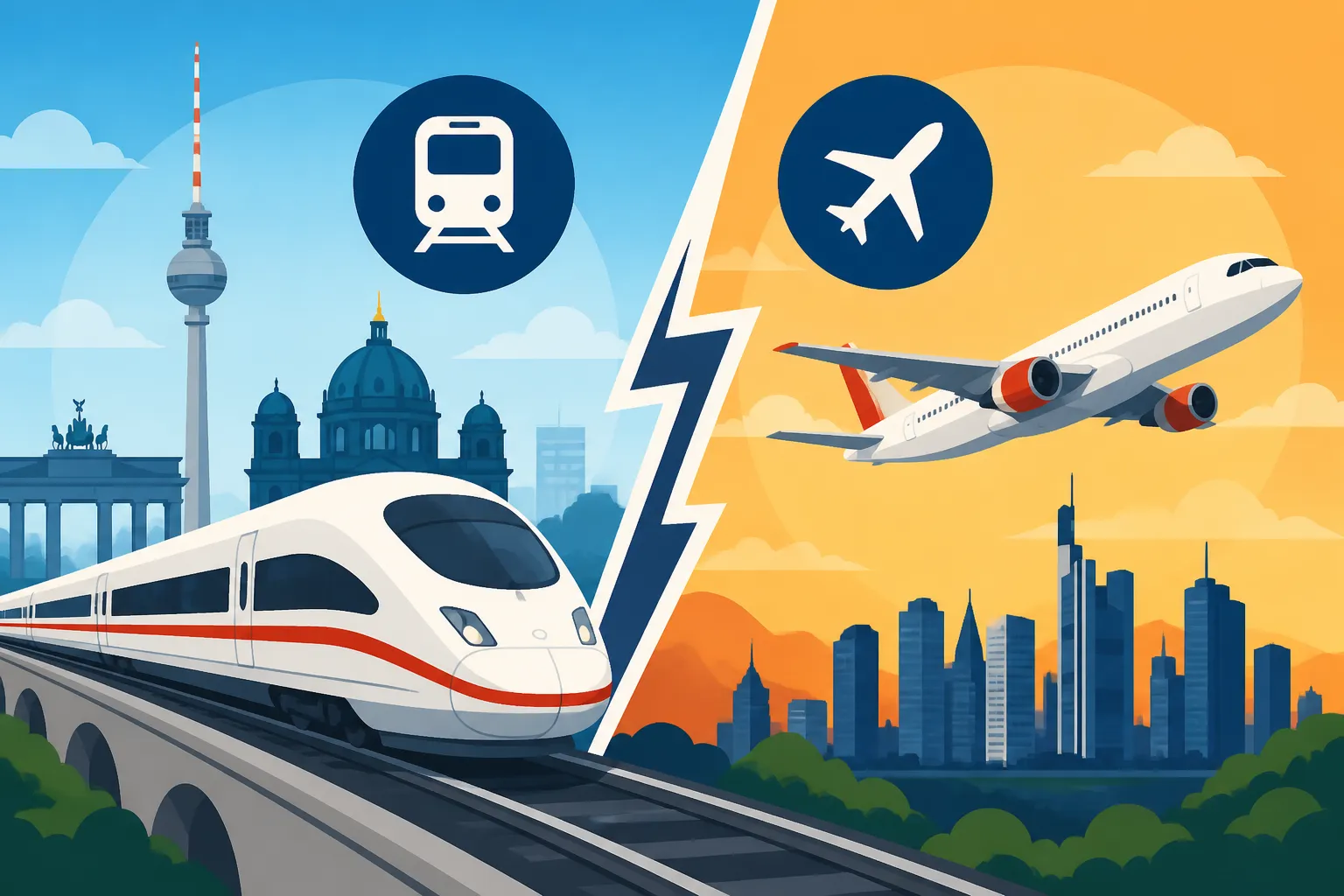
Berlin to Frankfurt: ICE Options and When Flying Makes Sense
Alright, my fellow wanderers and German enthusiasts, let's talk about a classic German journey: getting from the vibrant, bustling heart of Berlin to the financial powerhouse and international gateway that is Frankfurt. Navigating this route can feel like a labyrinth of options, from lightning-fast trains to budget-friendly buses and even taking to the skies. But fear not, because this guide will break down every single option, helping you decide whether the speed of the ICE, the economy of a bus, or the convenience of a flight makes the most sense for your next adventure or important meeting, and how tools like Omio can simplify the entire process.
Disclosure: This post may contain affiliate links. We may earn a commission at no extra cost to you if you make a purchase through these links. Read full disclosure.
The Classic German Way: High-Speed Train (ICE)
When you mention intercity travel in Germany, the first thing most people think of is the Deutsche Bahn's Intercity-Express, or ICE. This isn't just a train; it's an institution, a symbol of German efficiency, and often, the most sensible way to traverse the country. For the Berlin to Frankfurt route, the ICE is a formidable contender, offering a blend of speed, comfort, and convenience that's hard to beat.
Why the ICE is Often Your Best Bet
For many expats and seasoned travelers, the ICE is the undisputed champion for journeys like Berlin to Frankfurt. Imagine this: you step onto a sleek, modern train in the heart of Berlin, settle into a comfortable seat, and within minutes, you're gliding through picturesque German landscapes. There's no frantic rush to the airport hours ahead of time, no endless security queues, and no tedious baggage claim. You simply arrive at Berlin Hauptbahnhof, find your platform, and board. The direct connection from Berlin Hbf straight to Frankfurt Hbf means you disembark right in the city center, often just a short walk or quick U-Bahn ride from your final destination.
The comfort level on an ICE train is generally excellent. Most trains offer two classes: first class, which provides more spacious seating, complimentary newspapers, and often at-seat service, and second class, which is still very comfortable with ample legroom. Onboard amenities usually include free Wi-Fi (though signal quality can vary, especially through tunnels), power outlets at every seat, and a Bordbistro or Bordrestaurant for snacks, meals, and drinks. For those who need to work or just prefer quiet, designated "Ruhebereiche" (quiet zones) are a godsend. For a deeper dive into the German rail network, check out our guide on High-Speed Trains in Germany ICE Deutsche Bahn Routes and Savings.
Understanding Ticket Types and Pricing for ICE Trains
Booking an ICE ticket can sometimes feel like a game of chance if you're not familiar with the system, but platforms like Omio make it much more transparent. Deutsche Bahn primarily offers three types of fares:
- Flexpreis: This is the most expensive but also the most flexible option. It allows you to use any train on your chosen route on your travel day, and you can change or cancel your ticket without a fee up to the day of travel. Perfect if your plans are still a bit fluid.
- Sparpreis (Saver Fare): This is where most people find their sweet spot. Sparpreis tickets are significantly cheaper but are tied to a specific train and time. You can often cancel or change these, but usually for a fee and up to a certain point before travel.
- Super Sparpreis (Super Saver Fare): The cheapest option, ideal for budget-conscious travelers with fixed plans. These tickets are non-refundable and non-exchangeable, so you better be sure about your travel date and time.
The golden rule for getting the best prices is to book as far in advance as possible. Deutsche Bahn usually releases tickets around six months ahead of time, and the cheapest "Super Sparpreis" tickets sell out quickly. So, if you know your travel dates, don't procrastinate! While seat reservations are optional for second-class tickets, they are highly recommended, especially on popular routes like Berlin to Frankfurt or during peak travel times. No one wants to stand for four hours, trust me!
The Journey: Stations, Travel Time, and Connections
The primary departure point in Berlin is the majestic Berlin Hauptbahnhof (Hbf), a hub connecting national and international routes. In Frankfurt, you'll arrive at Frankfurt Hauptbahnhof (Hbf), another impressive central station. Most ICE services between these two cities are direct, meaning no changes, which is a huge bonus.
The average travel time for a direct ICE connection from Berlin to Frankfurt ranges from approximately 3 hours and 50 minutes to 4 hours and 30 minutes, depending on the specific route and intermediate stops. The journey itself is generally smooth and allows you to either catch up on work, read a book, or simply enjoy the passing scenery. Arriving directly in the city center saves valuable time and eliminates the stress of airport transfers, making it a truly city-to-city experience. If you're looking for more general information on how to navigate German transit, our guide on Getting Around German Cities U-Bahn S-Bahn Trams and Buses might come in handy for your arrival in Frankfurt.
Taking to the Skies: When Flying Makes Sense
While trains dominate domestic travel discussions in Germany, flying from Berlin to Frankfurt does have its niche, especially for certain travelers or specific situations. It might seem counter-intuitive for a relatively short distance, but let's break down when a flight could genuinely be the smarter choice.
Airlines and Routes from Berlin to Frankfurt
The main player for flights between Berlin Brandenburg Airport (BER) and Frankfurt Airport (FRA) is undoubtedly Lufthansa. As Germany's flag carrier, Lufthansa operates multiple daily flights on this busy route, catering largely to business travelers and those connecting to international long-haul flights from Frankfurt, which is one of Europe's largest aviation hubs. While other airlines might occasionally offer connecting flights, direct service is almost exclusively dominated by Lufthansa.
It's worth noting that Berlin's BER airport is relatively new and well-connected to the city center by regional trains and S-Bahn, but it still requires time to get there. Frankfurt Airport, being a massive international hub, is also well-integrated into the public transport network, with direct train connections to Frankfurt Hbf and regional services.
The True Cost and Time of Flying
Here's where flying often deceives us. On paper, the flight time itself from Berlin to Frankfurt is a mere one hour and five minutes. Sounds fast, right? But that's just the tip of the iceberg. You need to factor in:
- Travel to the airport: Allow at least 45 minutes to an hour from central Berlin to BER. Similar for FRA to central Frankfurt.
- Airport arrival time: For domestic flights, most airlines recommend arriving 60-90 minutes before departure. Add another 30 minutes if you're checking a bag.
- Security and boarding: This can be unpredictable.
- De-boarding and baggage claim: Once you land, it takes time to get off the plane, wait for your luggage, and then make your way out of the airport.
When you add all this up, the total door-to-door travel time for flying often clocks in at 4 to 5 hours, easily comparable to a direct ICE train. In terms of cost, while you might find cheap flight deals, be wary of "hidden" costs. Baggage fees, seat selection fees, and airport transfer costs can quickly inflate your initial budget airline ticket price. This is where Omio really shines, allowing you to see flight options and compare them side-by-side with train and bus, often including these extra costs in a clearer way.
So, when does flying actually make sense? Primarily if:
- You're connecting to a long-haul flight: If Frankfurt is your gateway to an international destination, flying from Berlin directly to FRA and connecting makes perfect sense.
- Your departure/arrival points are close to the airports: If you live or need to be very close to BER and FRA, the ground travel time is minimized.
- Time is absolutely critical (and money isn't): If you can afford business class and fast-track security, flying can shave off some minutes.
Airport Experience and Logistics
Navigating German airports, particularly the sprawling Frankfurt Airport, can be an experience in itself. Berlin Brandenburg (BER) is more compact but still requires careful planning. Both airports offer a wide array of shops, restaurants, and services. Transfer options include the S-Bahn, regional trains, and long-distance trains directly from the airport's train stations. For example, Frankfurt Airport has two train stations: a regional one and a long-distance one, making onward travel surprisingly easy. However, the sheer size of FRA means you might need to walk considerable distances between terminals or to your train platform. Security checks, while generally efficient in Germany, can still lead to queues during peak hours, reminding you that flexibility is key when traveling. For general advice on travel logistics, our Travel Logistics in Germany Money Safety and Connectivity article has some good pointers.
Budget-Friendly (But Longer) Alternatives: Bus Travel
Sometimes, speed isn't the priority, or perhaps you're just looking for the absolute cheapest way to get from A to B. This is where long-distance buses step in, offering a no-frills, often surprisingly comfortable, and always budget-friendly option.
The Rise of Long-Distance Buses
The landscape of long-distance bus travel in Germany has been revolutionized over the past decade, largely by companies like FlixBus. What used to be a patchwork of smaller regional lines has consolidated into an efficient, wide-ranging network that connects almost every major city and many smaller towns. For the Berlin to Frankfurt route, FlixBus is the dominant and often the sole operator.
The primary advantage of taking a bus is, without a doubt, the price. Tickets can often be found for a fraction of the cost of a train or plane ticket, especially if booked in advance. This makes it an incredibly attractive option for students, backpackers, or anyone keeping a close eye on their finances.
What to Expect from a Bus Journey
A bus journey from Berlin to Frankfurt is an experience in itself. While train travel typically takes around 4 hours, a bus trip will usually last anywhere from 6 to 8 hours, and sometimes even longer if traffic is particularly bad on the Autobahn. So, patience is definitely a virtue here!
Most modern FlixBus coaches are equipped with comfortable seating, free Wi-Fi (again, signal strength can vary), power outlets at seats, and a toilet onboard. There are usually designated stops along the way for quick breaks. You'll typically depart from major bus stations like Berlin ZOB (Zentraler Omnibusbahnhof), which is well-connected by local public transport. In Frankfurt, buses often arrive at the main bus station near Frankfurt Hbf, or sometimes at Frankfurt Südbahnhof, offering convenient connections to the city's U-Bahn and S-Bahn networks.
It's important to set your expectations: this isn't first-class train travel. The ride can be bumpier, and you're more susceptible to traffic delays, especially during rush hour or public holidays. However, for a deep dive into the bus network, you might want to check out Long-Distance Buses in Germany FlixBus and Networks.
Is It Worth the Savings?
This question really boils down to your priorities. If you're on a tight budget and have plenty of time, then absolutely. The savings can be substantial, leaving you more euros for that delicious Apfelwein in Frankfurt or a fancy dinner in Berlin. However, if you're pressed for time, prone to motion sickness, or simply value efficiency and comfort above all else, the longer travel time and potential for delays might outweigh the financial benefits.
For families traveling with young children, the longer duration and restricted movement could also be a challenge. But for solo travelers, flexible groups, or those who enjoy watching the world go by (and perhaps getting some work done with patchy Wi-Fi), it's a solid, reliable choice. Remember, Omio includes bus options in its search results, making it easy to see if a bus journey fits your schedule and budget.
Driving Yourself: Freedom and Flexibility (with German Road Rules)
Ah, the open road! For some, there's nothing quite like the freedom of having your own wheels, especially in a country renowned for its Autobahn. Driving from Berlin to Frankfurt offers a unique perspective on the German landscape and the ultimate flexibility.
Renting a Car and the Autobahn Experience
Renting a car in Germany is straightforward, with international companies like Sixt, Europcar, Hertz, and Avis widely available at airports and major city locations. Just make sure you have your valid driver's license (an International Driving Permit is recommended for non-EU citizens) and a credit card.
The journey from Berlin to Frankfurt primarily involves cruising along the Autobahn. The notorious "no speed limit" myth is partially true, as there are indeed sections where you can legally put the pedal to the metal. However, large portions, especially near cities or in construction zones, have strictly enforced speed limits. You'll want to pay close attention to the signage. German drivers are generally disciplined and efficient, keeping the left lane clear for faster traffic. It's a fantastic experience, but also one that demands your full attention. The estimated driving time without significant stops is usually around 5 to 6 hours, depending on traffic. For more specifics on driving here, our article on Renting a Car and Driving on the Autobahn is a must-read.
Costs and Considerations for Driving
While the freedom is appealing, driving does come with its own set of costs. Beyond the rental fees (which can vary wildly based on car type, duration, and insurance), you'll need to factor in:
- Fuel costs: Gasoline (Benzin) and diesel are expensive in Germany compared to many other countries.
- Parking: Finding and paying for parking in both Berlin and Frankfurt city centers can be a challenge and an added expense.
- Environmental zones (Umweltzonen): Many German cities, including Berlin and Frankfurt, have designated environmental zones that require vehicles to have a specific sticker (Umweltplakette) to enter. Rental cars typically come with these, but it's always good to double-check, as fines for non-compliance are hefty.
- Tolls: While major Autobahns are generally free for passenger cars, some specific tunnels or private roads might have tolls.
The main draw of driving is the ability to stop whenever and wherever you please. Fancy a detour through a charming medieval town? Want to visit a specific castle or nature park off the main route? Driving gives you that spontaneous flexibility that public transport simply can't.
When a Car Makes Sense
Driving is an excellent option if:
- You're traveling with a group or family: Splitting the costs and having space for luggage makes it economical.
- You have a lot of luggage: No more struggling with suitcases on public transport.
- You want to explore beyond the main cities: If your final destination is not directly in the city center of Frankfurt, or if you plan to visit smaller towns or scenic routes between Berlin and Frankfurt, a car is invaluable.
- You value flexibility above all else: Changing your departure time or route on a whim is priceless for some.
However, if you're primarily moving from one city center to another and don't plan on extensive detours, the stress of city driving, parking, and traffic might negate the benefits.
Comparing Your Options: The Berlin to Frankfurt Travel Matrix
Now that we've laid out all the ways to get from Berlin to Frankfurt, let's put it all together in a clear comparison. This will help you weigh the pros and cons and make an informed decision based on your personal needs.
Time vs. Cost vs. Comfort
Deciding on the best mode of transport often comes down to balancing these three crucial factors. Sometimes you need speed, other times saving a few euros is the priority, and then there are days when comfort reigns supreme.
Here's a handy table to summarize the general characteristics of each travel method:
| Mode of Transport | Avg. Duration (Door-to-Door) | Avg. Cost (Range) | Comfort Level | Best For |
|---|---|---|---|---|
| ICE Train | 4.5 – 5.5 hours | €40 – €150+ | High | Business travelers, those prioritizing efficiency, city-center to city-center convenience, comfortable travel. |
| Flight | 4 – 5 hours | €50 – €200+ | Medium-High | Travelers connecting to international flights from FRA, those living very close to airports, absolute speed (flight time only). |
| Long-Distance Bus | 6.5 – 9 hours | €15 – €50 | Medium-Low | Budget travelers, students, those with flexible schedules and plenty of time, scenic but longer journey. |
| Car (Driving) | 5 – 7 hours | €60 – €150+ | Medium-High | Groups/families, those with heavy luggage, wanting flexibility, exploring off-the-beaten-path destinations, spontaneous stops. |
Note: Costs are approximate and can fluctuate greatly based on booking time, demand, and specific amenities (e.g., first class train, baggage fees for flights, fuel prices for cars).
This table clearly illustrates the trade-offs. If you want a quick, comfortable, and relatively stress-free city-to-city journey, the ICE is usually your best bet. If you're connecting internationally or have very specific airport-adjacent needs, flying might edge out. For the truly budget-conscious, the bus is a solid pick. And for those who love a road trip and the freedom it entails, driving is the way to go. No matter which option you lean towards, remember that Omio allows you to compare all these modes of transport on one platform, showing you the real-time prices and journey durations, helping you find the perfect balance for your trip. This comprehensive comparison can save you a lot of time and hassle, especially when planning complex itineraries.
Factors to Consider Beyond the Obvious
Beyond the basic triumvirate of time, cost, and comfort, there are other considerations that might influence your decision:
- Environmental Impact: If you're eco-conscious, trains generally have a lower carbon footprint per passenger compared to flights or individual car travel.
- Luggage Allowance: Trains and buses are often more generous with luggage than budget airlines, which can quickly add exorbitant fees for extra bags. If you're moving a lot of stuff, this is a serious consideration.
- Pet Travel: Traveling with pets can be tricky. Small pets are usually allowed on trains in carriers, sometimes for a fee. Buses generally restrict pets (except service animals). Flying has strict rules and often significant costs for pet transport.
- Accessibility: Both trains and modern airports generally offer good accessibility for people with disabilities, but it's always wise to check with the specific provider in advance. Buses can be more challenging for mobility-impaired passengers.
- The Scenic Route vs. Fastest Route: While a flight offers aerial views, the train journey allows you to truly see the German countryside, from rolling hills to charming villages. Driving offers the most control over your scenic detours.
- Connectivity on the Go: While many trains and buses offer Wi-Fi, it's often not as reliable as a good mobile data plan. Having a local SIM or eSIM can be a lifesaver for navigation, entertainment, or work, especially during longer journeys. You can find more about staying connected in our Mobile Data and eSIMs for Travel in Germany guide.
- Overall Experience: What kind of journey do you want? A relaxing one where you can read or work? An adventurous one where you explore? Or simply getting from point A to B as efficiently as possible? Your personal preference for the travel experience should play a big role in your final choice.
- Cultural Nuances: Even simple things like understanding local etiquette, whether it's on a train or in an airport, can make your trip smoother. Our article on German Etiquette and Social Life for Visitors can help you navigate these subtle cultural differences.
Ultimately, whether you're hopping on an ICE, soaring through the skies, catching a bus, or embarking on a road trip, Germany offers excellent infrastructure for intercity travel. The key is to weigh your priorities, do your research, and leverage tools like Omio to find the best option for your specific Berlin to Frankfurt journey. Happy travels, my friends!
Disclaimer
Please remember that travel information, especially regarding schedules, prices, and regulations, can change. Always check the most current details with service providers like Deutsche Bahn, airlines, or bus companies, and refer to official governmental sources for visa and travel requirements before making your plans. This guide offers general advice based on common experiences and aims to provide a comprehensive overview.