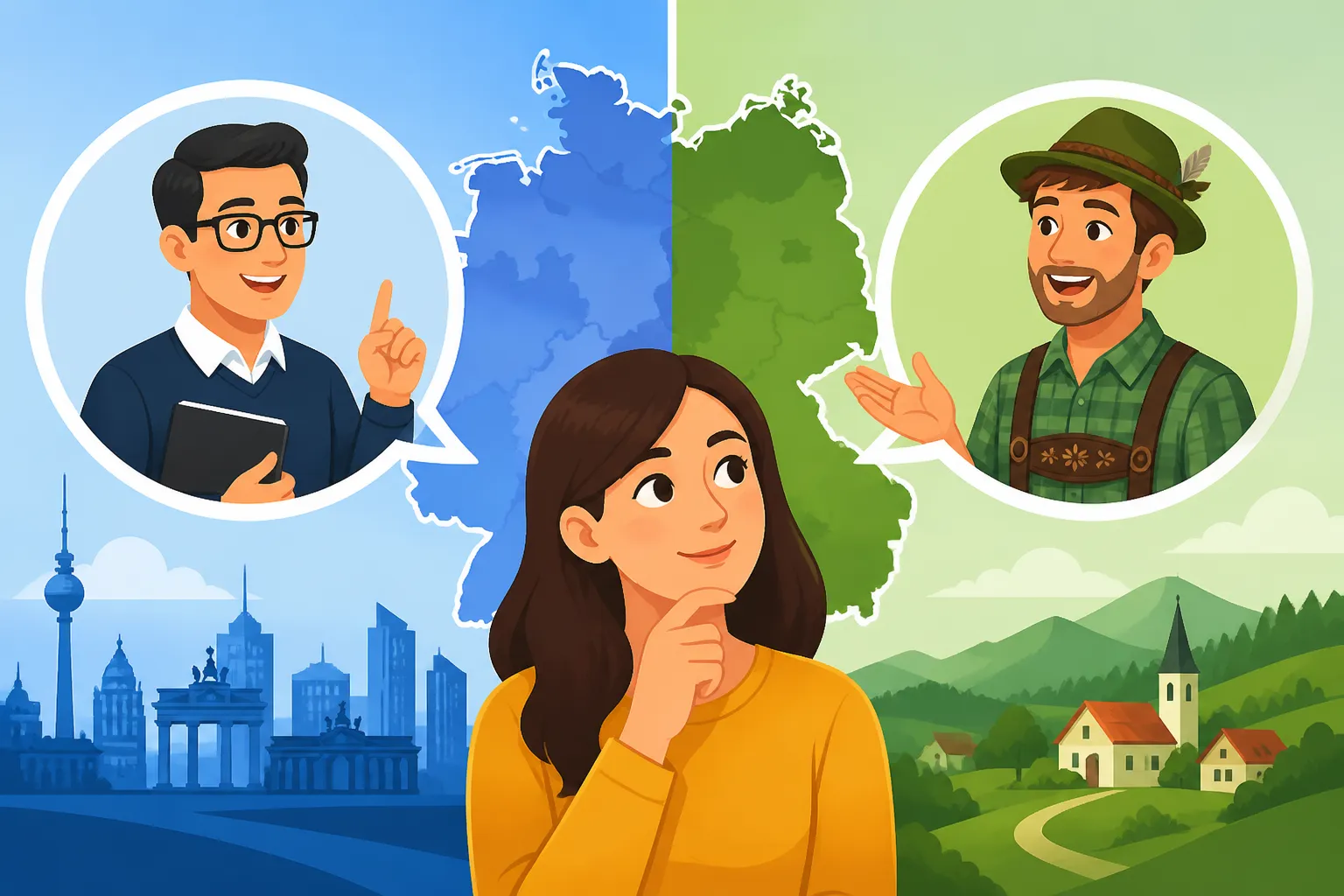
Hochdeutsch vs Regional Accents: Choosing a Tutor for Where You’ll Live
One of the biggest head-scratchers when you first decide to seriously tackle German isn't just how to learn it, but what kind of German to learn. You hear whispers of "Hochdeutsch" and then a cacophony of regional accents when you arrive, leaving you wondering if you're learning the "right" German for where you'll actually live. This guide will help you untangle the linguistic spaghetti, understand the nuances between Standard German and regional accents, and crucially, guide you in choosing a tutor who can prepare you best for your life in Germany.
Disclosure: This post may contain affiliate links. We may earn a commission at no extra cost to you if you make a purchase through these links. Read full disclosure.
The German Language Landscape: More Than Just "German"
When you tell people back home you're learning German, they often picture a single, unified language. Oh, bless their innocent hearts! The reality on the ground here in Germany is a vibrant, sometimes baffling, tapestry of spoken language that goes far beyond what you might learn from a textbook or a single online course. It’s like arriving in the UK expecting everyone to speak with BBC English, only to find yourself in Glasgow or rural Cornwall. The initial shock can be real, and it’s important to understand what you’re up against.
What is Hochdeutsch (Standard German) Really?
Think of Hochdeutsch, or High German, as the official, codified version of the German language. It's what you'll find in newspapers, hear on national news broadcasts, read in literary works, and what’s generally taught to foreigners in language schools across the globe. It's the lingua franca that allows a Berliner to understand a Münchner, despite their vastly different regional speech patterns. But here's the kicker: very few Germans actually speak pure Hochdeutsch in their daily lives.
It's more of a benchmark, a standardized form that everyone understands, rather than a living, breathing dialect. When Germans speak among themselves, especially in informal settings or with family and friends, their regional roots often shine through. They might soften their "ch" sounds, drop endings, or use entirely different vocabulary. Learning Hochdeutsch is absolutely essential – it’s your foundation, your key to understanding official communications, job interviews, and generally being understood by anyone, anywhere in the country. It’s the common ground. But expecting to hear it constantly, or to sound exactly like a news anchor, might lead to some unrealistic expectations.
A Whirlwind Tour of Germany's Major Regional Accents
Germany is a land of many tribes, and each tribe often comes with its own distinct way of speaking. These aren't just subtle intonations; they can be deeply ingrained dialects (Dialekte) that sometimes feel like entirely different languages, or strong regional accents (Regionale Akzente) that modify Standard German significantly. For an expat, this can be incredibly frustrating. Just when you think you've mastered "Guten Tag," someone greets you with "Grüß Gott" or "Moin!"
In the south, particularly Bavaria and Swabia, you'll encounter some of the most distinct dialects. Bavarian (Bairisch) can sound incredibly thick, with unique vocabulary and grammar that can throw even native German speakers from other regions for a loop. Swabian (Schwäbisch) is another robust one, often characterized by diminutive endings and a sing-song intonation. Venture west to the Rhineland, and you'll find Rhenish accents (Rheinisch) which often sound softer, more lilting, and perhaps a bit friendlier to some ears. Head north, and while the accents are generally closer to Hochdeutsch, you'll still find strong influences of Low German (Plattdeutsch) in the vocabulary and pronunciation in some areas, especially along the coast. Even within a single state like Saxony, the Saxon dialect (Sächsisch) can be quite pronounced, often the butt of friendly jokes for its unique vowels and soft consonants. Don't worry, you don't need to learn them all, but being aware that they exist, and that your ears will need to adjust, is half the battle. This linguistic diversity is part of the rich cultural fabric of Germany, but it certainly adds a layer of complexity for us newcomers.
Why Your Chosen Location in Germany Matters for Language Learning
You might be thinking, "German is German, right?" Not exactly. The specific region you plan to live in can significantly influence your language learning journey, from the prevalence of accents you'll hear daily to the type of vocabulary that will be most immediately useful. Ignoring this geographical factor can leave you feeling perpetually out of sync with your local community, no matter how diligently you study your textbook.
The North vs. The South Divide: Pronunciation and Vocabulary Differences
This is perhaps the most famous and, for learners, impactful linguistic divide in Germany. Generally speaking, people in northern Germany (think Hamburg, Bremen, Hanover) are often perceived to speak a German that is much closer to Hochdeutsch. Their pronunciation tends to be clearer, their vowels crisper, and their vocabulary more aligned with what you'd learn in a standard language course. This isn't to say they don't have any regionalisms, but they are often less pronounced and easier for a learner to decipher. If you're heading to the north, a focus on pure Hochdeutsch will likely serve you very well from day one.
In contrast, southern Germany, particularly Bavaria, Baden-Württemberg, and even parts of Hesse and Rhineland-Palatinate, is a completely different linguistic beast. Here, strong dialects like Bavarian (Bairisch) and Swabian (Schwäbisch) reign supreme. These aren't just accents; they often have different grammatical structures, unique words for common objects (e.g., 'Grüß Gott' instead of 'Guten Tag'; 'Semmel' instead of 'Brötchen'), and heavily modified pronunciations. A "Pfannkuchen" in Berlin is a pancake, but in Bavaria, it's a Berliner (jelly doughnut), which is a completely different item! If you're moving to Munich or Stuttgart, while people will understand your Hochdeutsch, you'll constantly be exposed to local dialects, and learning some key phrases or at least recognizing common dialect words can be incredibly helpful for social integration. Understanding this north-south dynamic is crucial when you're choosing a tutor, because a tutor from Rostock might teach you a very different 'spoken German' than one from Regensburg.
Urban Centers vs. Rural Areas: Exposure to Dialect vs. Standard
The urban-rural divide also plays a significant role in the German language experience. In major metropolitan hubs like Berlin, Hamburg, and Frankfurt, you'll find a much more international atmosphere. Here, even many Germans often tone down their regional accents or switch to a more neutral Hochdeutsch, especially when interacting with foreigners or in professional settings. English is also more widely spoken and accepted as a fallback. This means that while you'll still hear a variety of accents, your primary exposure will often be to a more standardized form of German, alongside a significant amount of English. These are good places to practice your textbook German without feeling completely overwhelmed by localisms.
However, venture out into smaller towns or rural areas, and the linguistic landscape shifts dramatically. In a quaint Bavarian village or a Swabian hamlet, the local dialect isn't just spoken; it's often the primary language of daily life. The butcher, the baker, your neighbors, and even your colleagues might communicate almost exclusively in their local dialect. While they will switch to Hochdeutsch if they realize you don't understand, the sheer immersion in a dialect can be intense. For someone moving to a rural area, incorporating an understanding (if not speaking ability) of the local dialect can be a huge boon for connecting with the community. This is where a tutor who understands these local nuances and can offer guidance on specific regional quirks becomes invaluable. It's all about equipping yourself for the specific environment you'll be navigating daily.
Navigating the Tutor Selection Process: Accent Awareness
Okay, so you've grasped that "German" isn't a monolith, and your target region matters. Now comes the exciting part: finding someone to guide you through this linguistic maze! This is where platforms like iTalki shine, offering an incredible array of tutors from all corners of Germany, allowing you to be incredibly precise about your learning journey. The days of being stuck with whatever local teacher your school assigned are long gone, and it’s a massive advantage for us expats.
Identifying Your Learning Goals and Target Region
Before you even start browsing tutor profiles, take a moment for some self-reflection. What are your primary goals for learning German? Are you aiming for a corporate job in an international city like Frankfurt, where clear, formal Hochdeutsch will be paramount? Or are you moving to a charming village in the Black Forest, where social integration might benefit from understanding local idioms, even if you don't plan to speak in dialect yourself? Knowing your target city or region is the absolute first step.
If you're unsure where you'll end up, or if your job involves moving around, then prioritizing pure Hochdeutsch (Standard German) is probably your safest bet. It's the universally understood form. However, if you know you'll be living in, say, Cologne, then finding a tutor who can at least explain the subtle Rhenish influences you'll encounter can be incredibly helpful. This is where iTalki's detailed tutor profiles become your best friend. You can see where a tutor is from, often what their accent sounds like in their intro video, and even ask them directly about their experience with regional variations during a trial lesson. It empowers you to make an informed choice that aligns with your future life here.
The Pros and Cons of Learning from a Regional Speaker
Choosing a tutor from a specific region or one with a discernible accent can be a double-edged sword, offering both unique advantages and potential pitfalls. It's not about avoiding regional speakers entirely, but rather about making a conscious choice.
On the "pro" side, learning from someone who hails from your target region offers unparalleled authenticity. They can introduce you to local vocabulary, explain common phrases, and help you tune your ear to the rhythms and intonations you'll hear every day. This kind of nuanced cultural and linguistic insight is something a textbook simply can't provide. A tutor from Stuttgart, for example, could teach you the formal Hochdeutsch, but also casually drop in a "Grüß Gott" and explain its usage, or even tell you how to order a "Viertele" (a quarter-liter of wine) like a true local. This can significantly speed up your social integration and make you feel less like an outsider. It's also an excellent way to practice understanding, which is often the harder part for us expats!
However, there are "cons" to consider. If you're a beginner, learning from someone with a strong accent might initially confuse you. You might inadvertently pick up non-standard pronunciations or vocabulary, which could hinder your ability to be universally understood. While Germans appreciate the effort, if your goal is primarily professional communication or passing official language exams (which are based on Hochdeutsch), then a tutor who can meticulously stick to the standard is crucial. The key is balance. A truly good tutor, whether from Berlin or Bavaria, will be able to clearly differentiate between Hochdeutsch and their regional quirks. They can teach you the standard and then, crucially, prepare you for the variations you'll encounter. With a platform like iTalki, you have the flexibility to choose, experiment with trial lessons, and switch if a particular accent isn't working for your current learning stage.
Making the Most of Your Language Learning Journey with iTalki
Once you understand the nuances of German accents and your own goals, it's time to leverage the power of a platform designed for personalized language learning. iTalki, for many expats, has become an indispensable tool precisely because it offers the flexibility and choice needed to navigate this complex linguistic landscape. It's not just another language app; it's a gateway to real human connection and tailored instruction.
Finding the Perfect Tutor for Your Regional Needs on iTalki
This is where iTalki truly shines as your core solution. Their comprehensive search filters allow you to pinpoint tutors based on incredibly specific criteria, which is exactly what you need when you're focusing on regional accents or ensuring a pure Hochdeutsch foundation. First, you can filter by "Native Speaker" and then specify "Germany" as the country. This ensures you're learning from someone who grew up speaking German.
Now for the magic: Many tutors on iTalki will indicate their specific region or even city of origin in their profile descriptions or introduction videos. You can actively look for tutors who mention they are from Berlin, Hamburg, Munich, or the Rhineland. If your goal is to speak perfectly neutral Hochdeutsch, seek out tutors who explicitly state they specialize in teaching "Standard German" or "Hochdeutsch." They often take pride in their ability to teach a clear, accent-free German. If you're moving to Cologne, for instance, you can try to find a tutor from that region to help you attune your ear to the local sounds, while still ensuring they teach you proper grammar.
The trial lesson feature on iTalki is invaluable for this purpose. Don't be shy! Book a few trial lessons with tutors from different regions, or with those who emphasize their Hochdeutsch expertise. During these introductory sessions, you can openly discuss your planned move to Germany and your desire to understand (or avoid) specific regional accents. Ask them directly about their own accent, and how they would approach teaching you based on your target location. This direct communication ensures you find someone whose teaching style and linguistic background align perfectly with your needs.
| Tutor Profile Element | How It Helps with Accent Awareness |
|---|---|
| Intro Video | Listen to their natural speaking voice and accent. |
| "From" Location | See their city/region of origin in Germany. |
| Specializations | Look for "Hochdeutsch," "Standard German," "Conversational German," or specific regional dialects. |
| Student Reviews | Other students might comment on the tutor's clarity or regional focus. |
| Trial Lesson | Directly ask about their accent and how they'd help with your target region's specifics. |
Balancing Hochdeutsch and Regional Flavor
So, you've found an amazing iTalki tutor, perhaps one from Northern Germany for crystal-clear Hochdeutsch, or maybe a delightful teacher from Bavaria who can give you the lowdown on local slang. Now, how do you manage both? The key is strategic integration.
Initially, especially if you're a beginner, it's always best to focus on building a strong foundation in pure Hochdeutsch. This gives you the core grammar, vocabulary, and pronunciation rules that are universally understood. Your iTalki tutor can drill you on this, ensuring you don't pick up too many regional quirks too early. This solid base is crucial for official matters, job applications, and general comprehension. How to Improve Your German for the Workplace is a great resource that highlights this professional need.
Once you have a comfortable grasp of the fundamentals, you can then start to strategically introduce "regional flavor" with your tutor's guidance. If you're moving to Hamburg, ask your iTalki tutor, "How would a local say 'hello' or 'goodbye' in an informal setting?" (Spoiler: it's often "Moin!"). If you're heading to Munich, inquire about common phrases or food items that have different names. Your tutor can explain these differences, giving you context without necessarily teaching you to speak in a full dialect. They can help you understand why some Germans sound different, and how to recognize those differences without adopting them yourself unless that's your explicit goal. This hybrid approach, nurtured through personalized lessons on iTalki, allows you to become proficient in Standard German while also preparing your ears and mind for the linguistic diversity you'll truly encounter.
Practical Tips for Expats: Beyond the Classroom
Learning German isn't just about what happens in your iTalki lessons; it's about what you do in between. As an expat, every interaction is a learning opportunity, and embracing the linguistic diversity of Germany will make your experience richer, if sometimes a little bewildering. You'll make mistakes, you'll be misunderstood, and you'll definitely encounter accents that make you question everything you thought you knew. That's all part of the journey!
Immersion Strategies and Real-World Practice
Your iTalki lessons will give you the tools, but real-world immersion is where you hone them. Once you're on the ground, actively seek out opportunities to practice and expose yourself to the language – and its regional variations. Don't let fear of making mistakes hold you back; Germans generally appreciate the effort.
First, dive into local media. If you're in Bavaria, try listening to a local Bavarian radio station, or watching a regional news program. You might not understand everything, but your ear will start to pick up the rhythms and common phrases. German podcasts, TV shows, and even YouTube channels can be fantastic resources. Look for content creators from your specific region if you want to dial in on local speech patterns. Secondly, seek out social interactions. Join local clubs or groups related to your hobbies – a sports club, a choir, a hiking group. These are prime environments for natural, informal language exchange. Look for local Stammtische (regular meet-ups at a pub or cafe) or language tandem partners. Platforms like Meetup or even university notice boards are great places to find these. When you're out and about, don't be afraid to ask people to repeat themselves ("Können Sie das bitte wiederholen?") or speak slower ("Können Sie bitte langsamer sprechen?"). Most Germans will be happy to oblige. And remember that embracing German social customs will often involve engaging in German conversation; German Etiquette: Do’s and Don’ts in Social and Professional Settings offers great insights here.
Embracing the Linguistic Diversity
The most important "extra" tip I can give you is to embrace the linguistic diversity of Germany rather than fighting it. You don't need to master every single dialect or accent. That's an impossible task even for many Germans! The goal isn't to become a perfect native speaker of every regional variant; it's to develop the flexibility to understand and navigate the different ways German is spoken.
Think of it as developing a broader linguistic awareness. When you hear a strong accent, instead of freezing up, you'll start to recognize, "Ah, that sounds a bit Bavarian," or "That's probably someone from the Rhineland." This recognition alone helps manage expectations and reduces the cognitive load. Your iTalki tutor can arm you with the knowledge to understand what makes a certain accent sound different, even if you can't mimic it. This understanding is crucial for cultural integration and simply making sense of your daily interactions. It allows you to appreciate the richness of the German language rather than being frustrated by its variations. Ultimately, the ability to communicate effectively in Living in Germany Without Speaking German (Yet): Tips to Get By is a journey, and acknowledging and adapting to Germany's diverse linguistic landscape is a huge step in feeling truly at home.
Disclaimer
This article is for general informational purposes only and does not constitute professional advice. Laws, prices and regulations vary by location and change over time. Consult a qualified professional for guidance on your specific situation.