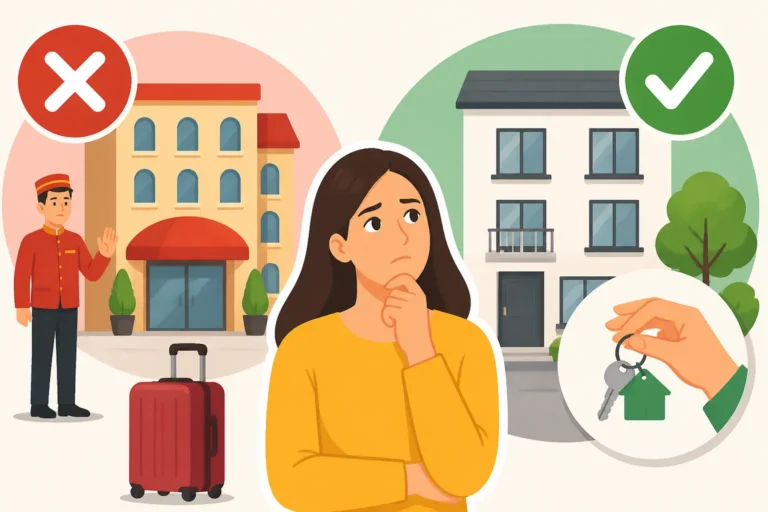
DIY Van Move vs Professional Movers to Germany: Real Cost Comparison
You have a new lease starting in Munich, a flat full of furniture in Manchester, and two options. A rental van looks cheap. A removal firm’s quote looks terrifying. Most people choose badly because they compare the van’s daily rate with the mover’s total price. This guide breaks down every real cost of a DIY van move and of professional movers to Germany, so you can compare like with like.
Disclosure: This post may contain affiliate links. We may earn a commission at no extra cost to you if you make a purchase through these links. Read full disclosure.
What a DIY Van Move to Germany Really Costs
I did my first move into Germany the DIY way. I drove a rented van from Rotterdam to Cologne with a friend who agreed to help in exchange for dinner and a bed. On paper it was the obvious bargain. In practice I paid for things I had never put on my spreadsheet. The van’s headline rate is only the visible part of the bill, and the parts you don’t see are what make DIY moves to Germany expensive.
Rental Rates, One-Way Fees, and the Cross-Border Clause
The first surprise is that many rental companies either forbid international one-way rentals or charge a large surcharge for them. A van rented in Lyon is supposed to go back to Lyon. If you leave it in Frankfurt, someone has to drive it home, and you pay for that. Some branches won’t let the vehicle cross a border at all without written permission. Others allow it only into certain countries. Read the cross-border section of the rental terms before you book, not at the pickup counter while your boxes wait in the hallway.
If you can’t find a one-way deal, the alternative is a return trip. You drive the van to Germany, unload it, and drive it back. Now you’re paying for two days of rental, double the fuel, and a second long drive while exhausted. Then you need a flight or train back to Germany. I’ve met people who booked the “cheap” van for a Warsaw to Berlin move and found that the return logistics alone took a full extra day and cost more than they expected the whole move to cost.
Then there’s the size question. Vans that a standard car licence covers are limited by weight, and once you load a sofa, a bed frame, a washing machine and forty boxes of books, you get close to that limit faster than you’d think. If you need something bigger, you may need a different licence category, which many people from outside the EU don’t have. Exceeding the weight limit puts you at risk on the road, and it can also void your rental insurance.
Fuel, Tolls, Ferries, and the Road Home
A loaded van uses noticeably more fuel than an empty one, and much more than your car does. On a long route, say Madrid to Hamburg or Bucharest to Nuremberg, fuel becomes one of the biggest items on the DIY bill, and it rises with every kilometre. Don’t assume you can top up cheaply on arrival. Motorway service stations in Germany usually charge more than town petrol stations, and you won’t want to leave the Autobahn with a full load to save a little.
Tolls depend on your route. Germany’s motorway toll system mainly targets heavier goods vehicles, but the countries you drive through on the way may have their own rules. Austria and Switzerland, for example, require vignettes, and France and Italy charge distance-based tolls at booths. I explain how this works for German roads specifically in Do You Need a Vignette or Toll to Drive in Germany? It’s worth reading before you plan a route through the Alps. If you’re coming from the UK, Ireland or Scandinavia, add a ferry or Channel crossing, priced for a van rather than a car and often higher at short notice.
Last on this list is accommodation. A drive that a sat-nav calls “one long day” is rarely one day in a heavy van with a tired driver. Hotel nights on the way, meals at service stations, and secure parking for a van full of everything you own all add up. I know one couple who drove from Porto to Leipzig and spent two nights in roadside hotels. Both nights they slept badly because they kept checking that the van hadn’t been broken into.
Your Time, Your Back, and Your Helpers
DIY moves look cheap because they leave out the value of your time. Count the days honestly: packing, picking up the van, loading, driving, unloading, returning the van, and getting yourself back. For most international moves into Germany that adds up to several days, often taken as unpaid leave or as holiday you’d much rather use for something else. If you’re self-employed, those are days you aren’t invoicing.
Then there’s the physical work. Carrying a wardrobe down three floors in your old city and up four floors in a German Altbau without a lift is hard, slow and risky. Friends help, but friends cost something too: their travel, their food, your obligation to help them next time, and the awkwardness if someone drops your grandmother’s cabinet. Hiring local helpers by the hour at each end is possible, but now you’re paying for labour anyway, without the coordination and accountability of a removal company.
Injury and damage are the hidden costs nobody budgets for. Rental insurance usually covers the vehicle, not what’s inside it. Your home contents policy may not cover goods in transit, especially across a border. If your television cracks on a cobbled street in Freiburg, you probably pay for it yourself. Put a realistic value on that risk before you decide DIY is the cheaper option.
What Professional Movers to Germany Actually Charge For
When I moved from Cologne to Munich a few years later, I hired professionals. The quote looked shocking at first. Once I understood what was in it, I could see that most of those line items were things I had paid for myself on the van move, just spread across receipts I never added up. Professional pricing isn’t arbitrary. It follows a predictable logic, and once you understand that logic, comparing quotes is much easier.
Volume, Distance, and Labour
The core of any removal quote is how much you’re moving, measured in cubic metres, and how far it’s going. Volume decides the size of vehicle and how much space you take up in it. Distance decides fuel, driver hours and possibly overnight stays for the crew. Labour covers the people who carry, load, unload and place everything. These three factors make up the base of the price, and any reputable mover will explain how they reached their volume estimate.
Volume is also the factor you control most. Every item you sell, donate or give away before the move comes straight off the quote. German flats are often smaller than people expect, and kitchens and wardrobes don’t always fit the way they did back home. Before you ask movers to price an oversized sectional sofa, check Will Your Furniture Fit a German Flat? Room Sizes, Doorways, and Ceiling Heights. Sometimes the cheapest cubic metre is the one you never ship.
Timing affects labour costs too. End-of-month dates, summer weekends and the weeks around university semester starts are busy for movers across Europe. A firm with spare capacity mid-week in a quiet month can often offer a better price than one squeezing you into a Saturday at the end of June. If your lease dates allow any flexibility, ask movers whether shifting a few days would change the quote.
Packing, Disassembly, and Access Fees
Most removal firms offer a range of service levels. At the basic end, you pack every box yourself and the crew only loads and transports. In the middle, they supply materials and pack fragile items like glassware, art and electronics. At the full-service end, they pack the whole home, take apart and reassemble furniture, and sometimes unpack at the destination. Each level adds labour and materials to the quote, and each one removes work and risk from you.
Access fees are where quotes can get confusing. Movers price in the reality of your buildings: how many floors, whether there’s a lift, how far the truck can park from the door, and whether the stairwell is narrow enough that furniture has to come in through a window with an external furniture lift. In Germany, where many city flats are in older buildings with steep, winding staircases, these details matter. If a quote looks low, check whether it assumes ground-floor access at both ends.
Disassembly and reassembly deserve a closer look. Flat-pack furniture that has been built and taken apart several times can lose its structural integrity, and some movers will only take it apart with a liability waiver. Fitted items, such as a kitchen you’re bringing with you, may need specialist work. Make sure every quote lists which items the crew will dismantle and rebuild, so you aren’t left on arrival with a flat full of bed parts and no Allen key.
Insurance and Liability
This is the area where DIY and professional moves differ most, and where most people misunderstand what they’re buying. A professional mover carries statutory liability for your goods while they’re in its care. In Germany that liability is limited by a formula based on volume, not on the actual value of what you own. For a home full of ordinary furniture it may be enough. For a small, valuable item such as a laptop, a painting or a designer lamp, it may be far below what the item is worth.
That’s why most removal firms offer additional transit insurance, priced as a share of the value you declare. You list your goods, assign values, and pay a premium to have them covered properly. It costs extra, but it’s also the cover that DIY movers simply don’t have. When you compare a van against a professional quote, the honest comparison is between a professional quote with insurance and a DIY move where you carry all the risk yourself.
Claims processes vary from firm to firm. The firm will expect you to note damage on the delivery receipt, take photos and report within a set window. If you don’t, your claim may be weakened even if the damage is real. I explain how to choose a valuation, what policies exclude and how to document damage in Moving Insurance for Shipments to Germany: Coverage, Valuation, and Claims. Read it before you sign any mover’s contract.
Side-by-Side Cost Comparison for a Move to Germany
Now let’s put everything side by side. I won’t quote figures that will be wrong by the time you read this, because rental rates, fuel prices and movers’ rates change constantly and differ between countries. What doesn’t change is the structure: who pays for what, and how each cost grows as the move gets bigger or longer.
Line-Item Breakdown
The table below lists the real cost items in a move into Germany. Use it as a checklist when you build your own budget. If an item on the DIY side applies to you, it belongs in your sum, even if no single invoice for it ever arrives.
| Cost item | DIY van move | Professional movers |
|---|---|---|
| Vehicle | Daily rental rate, plus one-way or cross-border surcharge if allowed | Included in quote |
| Fuel | You pay, and it rises steeply with load and distance | Included in quote |
| Tolls, vignettes, ferries | You pay for each transit country and crossing | Included in quote |
| Return trip | Second drive or a flight or train back for the driver | Not your concern |
| Overnight stays | Hotels and meals on long routes | Crew costs included in quote |
| Labour | Your time, unpaid leave, friends or hourly helpers | Included, scaled to volume and access |
| Packing materials | Bought separately, often more than expected | Supplied on most service levels |
| Furniture disassembly | Your tools, your time, your risk | Available as a listed service |
| Parking permit at destination | You arrange it with the local authority | Often arranged by the mover, sometimes as a separate item |
| Goods-in-transit insurance | Usually none; vehicle cover only | Statutory liability plus optional full-value cover |
| Damage and injury risk | Entirely yours | Shared with the mover under contract |
| Customs paperwork for non-EU origins | You handle declarations at the border | Usually handled or guided by the mover |
When you go through this table honestly, the gap between the two options narrows. On short routes with small loads, DIY often still wins. On long routes, with full homes, or with any border crossing that involves customs, the professional quote usually turns out much more competitive than it first looked.
Where DIY and Professional Costs Meet
The break-even point depends on three things: volume, distance and complexity. A small load over a short distance, such as a student’s room from Strasbourg to Karlsruhe, is cheap to move by van because there’s little to carry, little fuel to burn and no return logistics to speak of. As volume grows, you need a bigger van, more helpers and more trips up the stairs. As distance grows, fuel, nights on the road and the return journey take over.
Complexity speeds this up. A border crossing from a non-EU country such as Switzerland or the UK adds customs. A destination flat on the fifth floor without a lift adds labour and risk. A tight move-in date with an old lease ending the same day adds pressure that DIY handles badly. Each of these factors moves the break-even point towards the professionals.
The most useful exercise I know is simple. Fill in every DIY line from the table with honest estimates, including a value for your own days. Then request several professional quotes for the same move. Only when you put the two totals side by side, with the same scope and the same level of insurance, do you get a real cost comparison.
Three Real-World Scenarios
Scenario one is Marta, a student moving from Kraków to Leipzig with a single room’s worth of belongings. She has a car licence, a friend with free time and no fragile valuables. For her, a small van and a weekend is probably the right answer. The distance is manageable, there’s no customs border inside the EU, and the volume is small. She should still check the rental company’s cross-border rules and book a parking permit for her new street, but DIY makes sense here.
Scenario two is a family of four moving from Manchester to Munich: a three-bedroom house, two children’s rooms, a garage of bikes and tools. DIY would mean a ferry, a long drive through several countries, customs declarations for goods entering the EU from the UK, a return trip, and several days off work for both parents. Once every line is added up, a professional move with proper insurance is very likely cheaper, and certainly less risky. Comparing several quotes is the obvious next step.
Scenario three is in between: a couple moving a one-bedroom flat from Amsterdam to Düsseldorf. The distance is short, there’s no customs, but they have a heavy oak dining table, a piano and a fourth-floor destination. They could do a hybrid. They pack everything themselves to keep labour costs down, and hire professionals for the piano and the heavy carrying. This is often where the best value is, and it only shows up when you ask movers to price exactly the services you need.
The German Arrival Problems That Change the Calculation
Moving to Germany has some local quirks that catch newcomers out. Most guides treat the destination as just the place where the van stops. In German cities, the last hundred metres of your move can be the most complicated part, and they affect DIY and professional moves in very different ways.
Parking Permits and the Halteverbotszone
In most German cities you can’t just double-park a van outside your new building for four hours. Streets are narrow, parking is scarce, and the Ordnungsamt takes it seriously. The proper solution is a temporary no-parking zone, called a Halteverbotszone, for which you apply to the local authority in advance. Official signs must go up several days before the move so that residents can move their cars. If you set it up late or wrongly, you have no legal space and you risk fines.
DIY movers have to do all of this themselves: find the right office, submit the application, often in German, arrange the signs and deal with any car that ignores them. Many professional removal firms arrange the Halteverbotszone as part of their service, or through a local partner. Some include it in the quote and others list it separately, which is why you need to read quotes line by line. I’ve covered this at length in Hidden Costs in German Moving Quotes: Halteverbotszone Permits and Access Fees, including how to tell which quotes have quietly left it out.
The permit also matters at the origin if you’re leaving a city with similar rules, such as Vienna, Paris or Amsterdam. Two permits in two countries, in two languages, on two schedules, is exactly the kind of admin that makes a DIY move feel endless. A good mover has handled this hundreds of times.
Stairs, Narrow Stairwells, and Quiet Hours
The German Altbau is beautiful, with high ceilings, stucco and wooden floors, but it often comes with a narrow, winding staircase and no lift. Carrying a double mattress up five flights around tight landings is a two-person job at the very least, and some items simply won’t fit. Professional crews deal with this using straps, protective padding and, when needed, external furniture lifts that bring large pieces in through a window. A DIY team usually finds out the problem halfway up the stairs.
Your neighbours are part of moving day too. Most German residential buildings have house rules, and many communities observe quiet hours in the evenings, on Sundays and on public holidays. A move that runs late into the evening, with banging and drilling while you put up your bed, can get you off to a bad start with the people you’ll be living beside. For how quiet hours work in practice, see Neighborhood Noise Rules: Understanding Ruhezeit (Quiet Hours) in Germany.
A practical point that affects both options: protect the stairwell. In many buildings the shared stairs belong to the owners’ association, and damage to walls or banisters can end up on your bill. Professional movers bring padding and floor protection as standard. DIY movers should buy blankets and corner guards, which is yet another line on the DIY budget. For a full picture of what to expect when the truck arrives, read Delivery Day in a German Building: Stairs, Lifts, and Street Permits.
Customs for Non-EU Origins
If you’re moving from within the EU, your household goods cross into Germany without customs formalities. Moving from the UK, Switzerland, Norway or anywhere outside the EU is a different situation. Your belongings are imports, and they need the right declaration to enter without duty. Germany offers relief for household goods of people moving their residence there, but it comes with conditions about ownership, use and timing, and it requires paperwork.
For a DIY mover, this means stopping at a customs office at the border or inland with an inventory, proof of residence and identity documents, then waiting while it’s processed. If something is missing, you may have a van full of furniture parked at a customs yard while you sort it out. Professional international movers handle these declarations routinely and know what customs officers expect. The rules are explained in Ubersiedlungsgut: Germany’s Duty Exemption for Household Goods Explained, and why EU and non-EU origins are treated so differently is covered in EU vs Non-EU Moves to Germany: Why Customs Treats Them Completely Differently.
Customs alone is often enough to push UK and Swiss movers towards professionals. The price of a quote may look high, but the cost of a failed border crossing, with lost days, storage fees and stress, is much higher.
How to Get Honest Professional Quotes With Sirelo
By now you probably suspect that the professional option deserves a closer look than you first gave it. The problem is that requesting quotes one firm at a time is slow and frustrating. You fill in the same form again and again, explain your inventory on the phone repeatedly, and still don’t know whether the prices you’re getting are fair. This is the point where Sirelo becomes the most useful tool you have.
Why Comparing Quotes Beats Calling One Firm
Removal prices for the same move can vary widely between firms. One company might have a truck returning empty from your region and price aggressively to fill it. Another might be fully booked and quote high because it doesn’t really need the job. If you only ask one firm, you have no idea which of these situations you’re in. Comparison is the only reliable way to find the real market price.
Sirelo is a comparison platform built specifically for removals across Europe, including international moves into Germany. You describe your move once, with origin, destination, rough volume, and the services you need, and Sirelo passes your request to removal companies that cover your route. Instead of several separate enquiries, you get several quotes in your inbox, which you can compare on equal terms. Requesting quotes doesn’t commit you to anything. For details of how the service works, check Sirelo’s own pages.
The other advantage is transparency about the firms themselves. Sirelo shows mover profiles and reviews from previous customers, so you can see how a company handled other people’s damaged items, delays and difficult staircases before you trust it with yours. In an industry where an unreliable operator can disappear with your deposit, that background check is worth a lot. When the quotes arrive, read them with Comparing International Removal Quotes for Germany: Line Items That Hide Costs open beside you. It will show you which “cheap” quotes are cheap only because they’ve left things out.
Step-by-Step: Getting Quotes Through Sirelo
Here’s the process I recommend to anyone planning a move to Germany. It takes a single evening and saves days of phone calls.
- Make a room-by-room inventory of what you’re bringing. Include large items individually and estimate the number of boxes. Be honest. Underestimating volume leads to quotes that rise on moving day.
- Decide what you are not bringing. Sell, donate or give away anything that won’t fit your German flat or isn’t worth the cost of shipping. Every item you remove lowers every quote.
- Note the access details for both addresses: floor number, whether there’s a lift, how far a truck can park from the door, and any narrow staircases or tight corners.
- Choose the service level you want from each mover, from loading only to full packing, and list any specialist items such as a piano, artwork or fitted furniture.
- Submit your move details through Sirelo’s quote request form, adding your inventory and access notes so the movers can price accurately.
- As the quotes come in, put them into a simple comparison sheet: base price, packing, disassembly, parking permit, access fees, insurance options and payment terms.
- Check the reviews and profile of every firm on your shortlist, and ask follow-up questions about anything unclear before you accept.
- Ask your preferred mover for written confirmation of the agreed scope, the date, and the insurance cover you’ve chosen, and only then confirm the booking.
If your move is still months away, fit these steps into a broader timeline. An International Move to Germany: The 12-Week Planning Calendar shows when to request quotes, when to apply for parking permits and when to start packing, so nothing gets left until the last week.
Hybrid Options: Groupage, Part Loads, and Self-Packing
Professional doesn’t have to mean premium. If your load is small, you don’t need a whole truck. Groupage, also called part-load or shared-load service, puts your goods on a vehicle with other customers’ shipments heading the same way, so the vehicle cost is shared. The trade-off is flexibility: delivery windows are wider because the truck has several stops. For many single people and couples, groupage costs far less than a dedicated move. For how the numbers compare by volume, see Full Load vs Groupage to Germany: Cost Break-Even by Cubic Metre.
Self-packing is the other big lever. If you pack your own boxes carefully, using proper materials and labelling every one, the mover’s labour bill falls significantly. Keep professional packing for the items that really need it, such as glass, electronics and art, and do the rest yourself in the evenings before the move. When you submit your request through Sirelo, say clearly that you want a self-pack quote, so every mover prices the same scope.
You can also combine DIY and professional elements more creatively. Some people drive their fragile valuables and essentials themselves in their own car, and send furniture with a groupage mover. Others hire professionals only for the heavy carrying at the destination flat, where the stairs are worst. Ask for exactly what you need and nothing more. Using Sirelo, you can describe an unusual setup like this in a single request and see which firms are willing to price it, instead of calling around and hoping someone says yes.
Whichever route you choose, base the decision on full costs rather than headline rates. Write down every DIY line honestly, collect several professional quotes for the same scope, and compare them side by side. If you’re still unsure which way your own move tips, the quickest way to find out is to request quotes through Sirelo and see the real prices for your route. It costs you an evening, and it may save you a very long weekend in a rented van.
Disclaimer
This article is for general informational purposes only and does not constitute professional advice. Laws, prices and regulations vary by location and change over time. Consult a qualified professional for guidance on your specific situation.