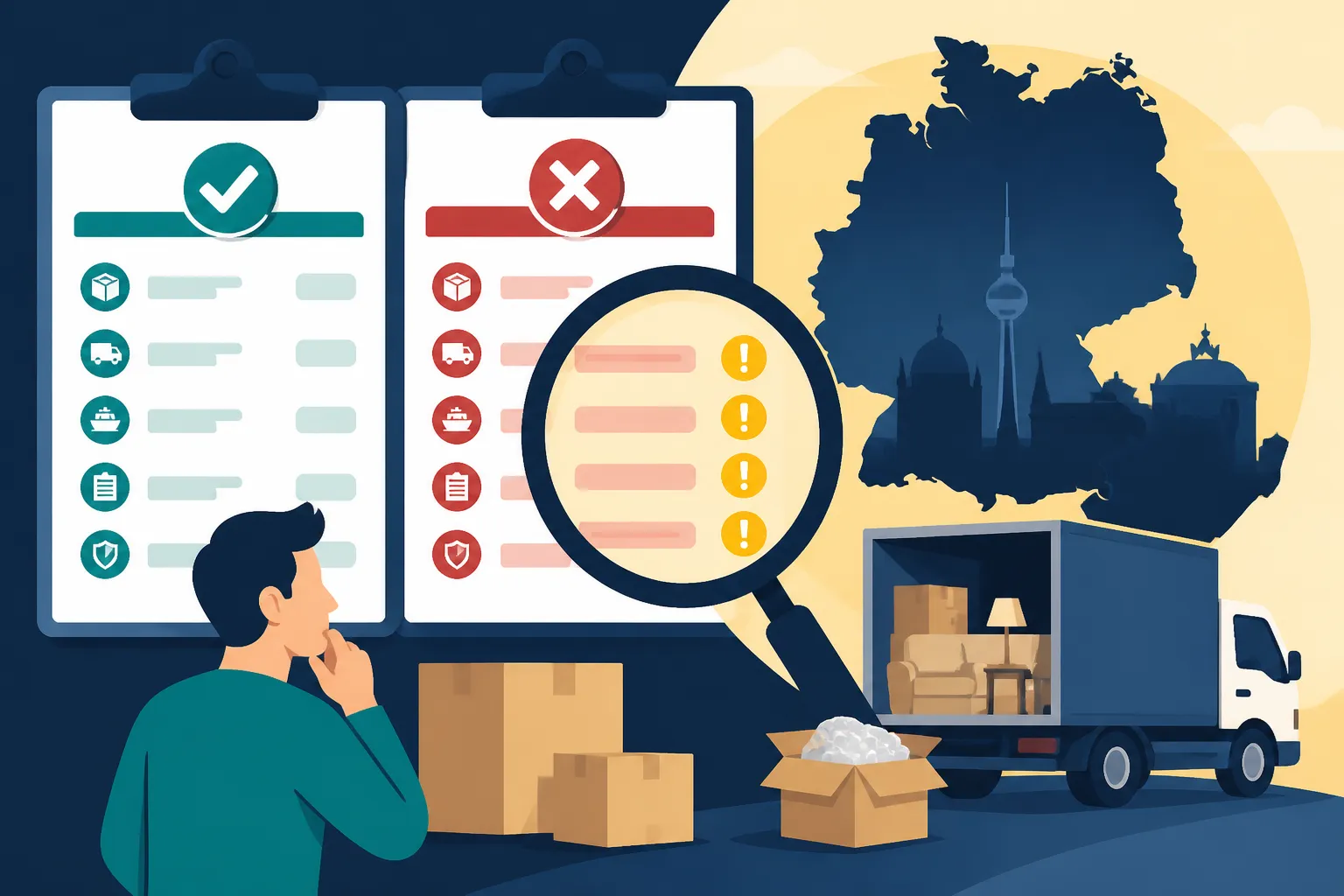
Comparing International Removal Quotes for Germany: Line Items That Hide Costs
Three removal quotes for your move to Germany can differ wildly, and the cheapest one is often the one that charges you later. Extras appear at the destination: a parking permit fee, a long-carry surcharge, port handling, or an insurance shortfall you only find after something breaks. This guide shows which quote line items hide costs, how liability works under German law, and how to compare offers line by line before you sign.
Disclosure: This post may contain affiliate links. We may earn a commission at no extra cost to you if you make a purchase through these links. Read full disclosure.
Why International Removal Quotes for Germany Are So Hard to Compare
I have moved household goods into Germany twice. The first time I chose the lowest quote, and it ended up costing more than the most expensive one I turned down. Nobody lied to me. The quote was simply built differently. It assumed things about my move that turned out to be false, and every false assumption became an invoice line on delivery day.
International removal quotes are not standard documents. No template forces every mover to list the same services in the same order. One company bundles packing, materials, a parking permit and destination handling into one figure. Another lists only the transport and a few optional extras. A third quotes “door-to-door” but means something narrower than you think. If you lay these side by side and compare only the bottom line, you are comparing three different moves.
The Headline Price Is a Marketing Number
The total at the bottom of a quote shows the cost of the move the mover imagines. Some movers keep that number low on purpose. They leave out services they know you will probably need, because a low number wins the first conversation. Once you have booked, paid a deposit and planned your life around a pickup date, changing companies is painful. Extras added at that point rarely get challenged.
Picture two quotes for a three-bedroom flat moving from Manchester to Düsseldorf. Quote one looks noticeably cheaper. Read it closely and it covers loading at origin, road transport and unloading “at kerbside.” Quote two costs more but includes carrying everything up to a fourth-floor flat, reassembling beds and wardrobes, and arranging a no-parking zone outside the building. If your Düsseldorf flat is a fourth-floor Altbau with no lift, quote one is not actually cheaper.
The fix is to stop reading the total first. Read the scope of services first, then the exclusions, then the assumptions, and only then the price. It feels backwards, but it is the only way to see what you are paying for.
Volume Is the Variable Everything Else Hangs On
Almost every international removal quote is built on volume, measured in cubic metres. The truck space or container space your goods take up drives the transport cost. It also drives packing time, labour hours and, as you will see later, the basic liability ceiling. If the volume estimate is wrong, everything built on it is wrong too.
Volume estimates come from three places. The mover can do a physical survey in your home. They can do a video survey, walking through your rooms with a camera. Or you fill in an online inventory yourself. Self-declared inventories are where the trouble starts. Most people underestimate. They forget the loft, the cellar, the garden furniture, the bikes in the shed and the forty boxes of books. A quote based on your own optimistic list will look cheap until the crew arrives and finds a fuller house than described.
Many movers write in a clause allowing them to recalculate the price if the actual volume exceeds the estimate. That is reasonable. What matters is the rate they will charge for the extra volume, and whether it is stated in writing. Some quotes say nothing about it. That leaves the mover free to set the rate on the day, when you have no leverage.
Why Comparing Through Sirelo Changes the Starting Point
Collecting quotes yourself usually means describing your move again and again, a little differently each time. One mover hears “about a two-bedroom flat,” another gets a detailed room list, a third gets a rushed phone call. You then get quotes built on different briefs, which makes them hard to compare.
Sirelo is a removal comparison platform. You describe your move once and receive quotes from several international removal companies working on the same information. That single brief is the real advantage. When every mover starts from the same volume, the same addresses and the same access notes, the remaining differences between quotes show up in pricing and scope, which is what you want to compare. Sirelo also lists removal companies alongside customer reviews. That helps you weed out movers with a pattern of surprise invoices before you even request a quote.
The Line Items That Most Often Hide Costs
The costs that hurt the most are rarely hidden in fine print. Usually they are simply missing, or they appear only as “on request” or “if required.” Germany has some local quirks that make certain extras almost certain for many moves, and foreign movers who rarely deliver here sometimes leave them out of their first offer.
Access Charges at the German End
German cities are full of beautiful old buildings with narrow stairwells, no lifts and inner courtyards reached through an archway, the Hinterhof. Neighbourhoods like Prenzlauer Berg in Berlin, Schwabing in Munich or the Belgisches Viertel in Cologne look charming and are hard for removal crews. Several access-related charges can show up here.
The first is the no-parking zone, the Halteverbotszone. In most German cities, a removal truck cannot just stop on the street and unload for hours. The mover or the tenant applies to the local authority for a temporary no-parking permit, and signs go up in advance. Some quotes include organising the permit, some include the permit fee itself, and some include neither. For the full mechanics, see Hidden Costs in German Moving Quotes: Halteverbotszone Permits and Access Fees.
The second is the long-carry or distance charge. If the truck has to park some distance from your front door, every item has to be carried further. Movers often price this in metres beyond a certain threshold. The third is the floor charge, applied per storey when there is no lift or when the lift is too small for furniture. The fourth, and often the most expensive, is the shuttle service. When a large truck cannot get into your street at all, goods are moved into a smaller vehicle and driven to your door in several trips. If a quote does not mention any of these, ask. Tell the mover your exact floor, whether there is a lift and how it is sized, and how close a truck can get. Our guide Delivery Day in a German Building: Stairs, Lifts, and Street Permits walks through what to measure.
Packing, Materials, and Assembly
Packing is the second big area where quotes drift apart. “Full packing service” can mean that the crew packs everything, including the contents of kitchen drawers and bookshelves. It can also mean they pack only fragile items while you handle the rest. Packing materials such as cartons, wardrobe boxes, bubble wrap and mattress covers may be included, charged per piece, or charged as a lump sum. You need to know which version you are being offered.
Disassembly and reassembly of furniture is another line that often goes missing. Wardrobes, bed frames, large desks and modular shelving may need to come apart to leave your old home and go back together in the new one. Some quotes include taking things apart but not putting them back together. Some leave out both. Others have a cap on the number of items covered. If you are moving into a German flat where you will also need to fit an empty kitchen, check whether the mover offers kitchen installation. Most do not, and you will need a separate tradesperson.
Specialist items deserve their own line. Pianos, large artwork, antique mirrors, marble tabletops and gym equipment often need custom wooden crates or extra handling. A quote that lumps them into the general volume figure may be underpricing them. More importantly, it may be underprotecting them. It is also worth checking that your furniture will physically fit. Our guide Will Your Furniture Fit a German Flat? Room Sizes, Doorways, and Ceiling Heights can save you from shipping a sofa that never makes it through the door.
Destination Charges, Port Fees, and Customs Handling
For moves by sea, the gap between “door-to-door” and “port-to-port” quotes is where the largest surprises live. A port-to-port quote covers shipping your container between two ports and stops there. Everything after the vessel docks becomes your problem. That includes unloading at the terminal, handling charges, customs clearance, delivery from the port to your home, and unpacking. The cost for all of it can arrive as a separate invoice from a destination agent you have never heard of. Our guide Door-to-Door vs Port-to-Port Moves to Germany: What Each Quote Includes breaks this down in detail.
Even quotes labelled door-to-door sometimes exclude destination terminal handling charges, customs inspection fees or port storage. Terminal handling charges at the destination are a classic. Quotes often show them as “DTHC excluded” or “destination charges payable by consignee,” in small print near the bottom. If your container goes through Hamburg, Bremerhaven or Rotterdam, find out exactly who pays these and how they will be billed. For more on port choice, see Hamburg, Bremerhaven, or Rotterdam? Choosing a Port of Entry for Germany.
Customs is the other destination trap. Moving from outside the EU, you can usually import your household goods duty-free as a new resident, provided you meet the conditions and file the right paperwork. If the paperwork is late, incomplete or filed in the wrong order, goods can sit in port storage, and those charges add up daily. Ask every mover whether customs clearance is included, what documents they need from you, and what happens if an inspection is ordered. Our guide Ubersiedlungsgut: Germany’s Duty Exemption for Household Goods Explained covers the relief itself.
The table below summarises the line items I have seen cause the most trouble, how they usually appear in a quote, and what to ask.
| Line item | How it usually appears | What to ask the mover |
|---|---|---|
| Volume estimate | A single cubic metre figure, sometimes from a self-filled inventory | Was this from a survey? What rate applies if actual volume is higher? |
| Halteverbotszone permit | “Parking permit on request” or not mentioned | Do you apply for it, and is the authority fee included? |
| Long carry | “Standard access assumed” | What distance from truck to door is included, and what is the rate beyond it? |
| Floor or stair charge | “Ground floor or lift access” | Is my exact floor and lift size priced in? |
| Shuttle service | Rarely shown unless asked | If the truck cannot enter my street, what does the shuttle cost? |
| Packing materials | “Materials extra” or a lump sum | Is it per carton or flat, and is unused material credited back? |
| Disassembly and reassembly | “Basic disassembly included” | Is reassembly included, and is there an item limit? |
| Crating for fragile items | “Specialist items quoted separately” | Which of my items need crates, and are they priced now? |
| Destination terminal handling | “DTHC excluded” | Who pays it, how is it billed, and can you estimate it? |
| Customs clearance | “Customs formalities by client” | Do you clear goods, and what are inspection and storage fees? |
| Storage in transit | “Storage available” | What is the daily or weekly rate if my keys are delayed? |
| Insurance beyond basic liability | “Insurance optional” | What does extra cover cost, what is excluded, and how are claims settled? |
Liability and Insurance: How the Cubic Metre Rule Works
Insurance is the line item people think about least and regret most. Most expats assume that if a professional mover breaks something, the mover pays for it in full. The reality is more limited, and it is worth knowing exactly how the limit works.
What Basic Liability Actually Covers
Under German law, section 451e of the German Commercial Code, s.451e HGB, a removal company’s basic liability for loss or damage is capped at EUR 620 per cubic metre of loading space needed for the move. This basic liability comes free. You do not pay extra for it, and it applies to removal contracts governed by German law. If your contract is governed by another country’s law, which can happen when you book a foreign mover, check which liability rules the contract names. The basic cover may work quite differently.
The key point is that the cap depends on volume, not weight. It is calculated from the loading space your move needs. Take a move that needs 30 cubic metres of loading space. The basic liability ceiling is 30 multiplied by EUR 620, which comes to EUR 18,600 for the whole shipment. That figure is the most the mover is liable for under basic cover across everything in the truck. It is not a guaranteed payout, and it is not an amount per box.
This is also why an accurate volume estimate matters twice. A quote built on an underestimated volume undercharges you at first. It also implies a lower liability ceiling, and in a serious loss the mover may argue about how much space was really needed. Both problems start with the same wrong number.
How the Ceiling Applies to the Whole Shipment
The cap applies to the shipment as a whole. It sets a ceiling on the mover’s total liability. It does not set a value for any individual item.
When something is damaged, what you can claim depends on the actual loss you can prove, within that overall ceiling and subject to the terms of the contract. Movers may contest claims on several grounds. Common ones are boxes you packed yourself, damage they say existed before the move, and claims filed after the deadline. Notice deadlines for visible damage are usually short, so check every item at delivery and note damage on the delivery receipt before you sign.
The practical danger is not a small payout for one broken item. The danger shows up with a valuable household. Suppose your goods are worth far more than the volume-based ceiling. Then a total loss, such as a truck fire, a theft or a container lost at sea, could leave a large gap between what you owned and what basic liability will pay. A family with original art, a good piano, designer furniture and a lot of electronics can easily cross that ceiling, even in a modest-sized load.
When to Buy Additional Cover
Most international movers offer extra transport insurance, often called Transportversicherung. It may be on an all-risks basis or on a named-perils basis. This is a separate product from basic liability and it is usually charged on top. It is calculated on the declared value of your goods, so your first job is an honest valuation. Make a room-by-room inventory and put a realistic replacement value next to the significant items. Undervaluing to save on cover defeats the purpose.
When comparing insurance offers in quotes, look at four things. First, whether cover is all-risks or limited to named perils. Second, whether self-packed boxes are covered or excluded. Third, whether there is an excess, the Selbstbeteiligung, that you pay on every claim. Fourth, who actually settles claims: the mover, or a third-party insurer with its own procedures. Some movers also cap payouts on single high-value items unless you list them separately. For a fuller walkthrough of valuation and claims, see Moving Insurance for Shipments to Germany: Coverage, Valuation, and Claims.
Also check your own policies. A German Hausratversicherung, the household contents insurance, may or may not cover goods in transit, depending on the policy and the timing of your move. Insurance from your home country often stops covering once goods leave your old address. Do not assume one of them covers the move. Get it in writing.
Binding Prices, Estimates, and the Fine Print
Two quotes that list the same services can still behave very differently once something unexpected happens. Fixed or estimated pricing, payment terms and what happens when dates slip all decide your real cost. They rarely get the attention they deserve.
Fixed Price Versus Estimate
German movers commonly distinguish between a Festpreis, or fixed price, and a Kostenvoranschlag, an estimate. A fixed price means the mover commits to the stated total for the defined scope. If the job takes longer or needs more labour than expected, that is generally their risk, provided you described the move accurately. An estimate is a calculation of likely cost. The final invoice can move up or down depending on what actually happens.
Neither is automatically better. A fixed price gives you certainty. But it is only as good as the scope it describes. If the scope says “volume as per client inventory” and your inventory was light, the fixed price can still be recalculated. An estimate based on a thorough home survey can be more reliable in practice than a fixed price based on a guess. What you want is a binding price, clearly defined scope, a survey-based volume, and stated rates for anything outside that scope.
Watch for quotes that use the word “fixed” in the headline but include a long list of “subject to” conditions further down. Subject to access as described. Subject to volume confirmation. Subject to no waiting time. Subject to fuel price adjustment. Each condition is a door through which the price can change.
Payment Terms, Validity, and Cancellation
Every quote has a validity period, and international removal prices can shift with fuel costs, shipping rates and capacity. A quote that was attractive when you got it may no longer apply if you take too long to accept. Note the validity date on each quote and line them up against your decision timeline. For planning, our guide An International Move to Germany: The 12-Week Planning Calendar shows when quotes should be in hand.
Payment structure matters too. Some movers ask for a deposit at booking and the balance before delivery. Others ask for full payment before loading, and some request payment at the destination. Paying everything upfront to a company you have never dealt with is a real risk. Paying nothing until delivery is often unrealistic for international jobs. A deposit with the balance due on or before delivery is a common middle ground. Whatever the structure, make sure the quote says which currency you are paying in and whether currency conversion is your responsibility.
Cancellation and rescheduling terms are the last piece. Rental handovers in Germany do not always go to plan. A landlord delays the Übergabe, a renovation runs over, or your visa appointment moves. Read what happens if you need to change the pickup or delivery date. Some movers allow a change with notice, others charge a fee, and some keep the deposit.
Storage, Delays, and Waiting Time
Many expats arrive in Germany before their long-term flat is available. That makes storage in transit a real possibility. If your goods arrive before your keys, they go somewhere, and someone charges you for it. Quotes often mention that storage is “available” without stating the rate, the minimum period, or the handling charges for moving goods into and out of the warehouse. Each handling event can cost as much as several weeks of storage. Our guide Storage While You Relocate: Home-Country Units vs German Lagerraum compares the options.
Waiting time is the quieter cousin of storage. If the crew arrives at your Munich address and cannot unload because the parking zone is blocked, the lift is out, or the previous tenant is still moving out, the clock keeps running. Many quotes include a waiting time clause charged per hour after a grace period. Ask what the grace period is and what the hourly rate is. Also ask what happens if the delay forces a second delivery attempt on another day.
A Step-by-Step Method for Comparing Quotes Side by Side
Once you know where costs hide, comparing quotes becomes a process instead of a guessing game. This is the method I use now, and it has saved me from repeating my first mistake.
Standardise the Brief Before You Request Anything
The most important step happens before you contact a single mover. Write one clear, complete description of your move and use it for every request. This is exactly where Sirelo helps. You enter the move details once and those same details reach multiple removal companies. You are not retelling the story slightly differently each time.
Use this numbered checklist to build your brief:
- List both full addresses, including the floor number, whether there is a lift, and the lift’s approximate internal dimensions.
- Describe access at both ends: street width, parking situation, distance from the likely truck position to the front door, and any courtyards or archways.
- Create a room-by-room inventory, including the loft, cellar, garage, garden and storage units, and flag any specialist items such as pianos, artwork or safes.
- State your preferred pickup window and your earliest possible delivery date in Germany, and say whether storage might be needed.
- Decide which services you want: full packing, fragile-only packing, or self-packing, plus disassembly and reassembly.
- Note whether you are moving from inside or outside the EU, because this changes the customs work involved.
- Ask every mover for a home survey or video survey rather than relying on your own volume guess.
A brief this detailed tells movers you know what you are doing. In my experience, that alone reduces the number of “optional extras” that appear later. Movers quote more carefully when they can see the customer will check.
Build Your Own Comparison Table
When the quotes arrive, do not compare the PDFs directly. Copy every quote into a simple comparison table you build yourself, with one row per line item and one column per mover. Mark each cell as included, excluded, or priced separately. Below is a template using three hypothetical quotes for a move into a city flat.
| Line item | Mover A | Mover B | Mover C |
|---|---|---|---|
| Volume basis | Video survey | Self-declared inventory | Home survey |
| Price type | Fixed price | Estimate | Fixed price |
| Halteverbotszone permit | Included | Not mentioned | Organised, fee extra |
| Long carry and floors | Included as described | Ground floor assumed | Included as described |
| Shuttle if needed | Rate stated | Not mentioned | Rate stated |
| Full packing and materials | Included | Materials per carton | Included |
| Reassembly | Included | Disassembly only | Included |
| Destination port and handling | Included | Excluded | Included |
| Customs clearance | Included | Client’s responsibility | Included |
| Basic liability | s.451e HGB, EUR 620 per cubic metre | Not specified | s.451e HGB, EUR 620 per cubic metre |
| Additional insurance | Offered, all-risks | Not offered | Offered, named perils |
| Storage rate | Stated | On request | Stated |
In this example, Mover B would almost certainly show the lowest headline price. But it relies on a self-declared volume, assumes ground-floor access and excludes destination handling and customs. It says nothing about the permit, the shuttle or liability. Each blank cell is a cost that will come back to you. Mover A and Mover C are now comparable on substance. The decision between them comes down to price, insurance terms and reviews, which is where it should be.
When you request quotes through Sirelo, you will typically find the offers far easier to line up this way, because they all started from the same brief. Any gaps that remain are real differences in what each company offers, not artefacts of how you described the move.
Questions to Ask Every Mover Before You Sign
Even a good comparison table leaves questions. Before you sign, put these to each shortlisted mover in writing, so the answers become part of the record:
- Is this price binding for the scope described, and under what exact conditions can it change?
- What rate applies per additional cubic metre if the actual volume exceeds the estimate?
- Which law governs the contract, and what basic liability applies?
- Who handles the move at the German end: your own crew or a local partner agent, and does the partner bill me directly for anything?
- What happens, and what does it cost, if delivery cannot take place on the agreed day?
- What is the deadline for reporting damage, and how is a claim filed?
- Which documents do you need from me for customs, and by when?
Pay attention to how each mover answers, not just what they say. A company that replies clearly and quickly before you have paid is more likely to behave the same way when something goes wrong. Vague answers at this stage are a warning sign. Cross-checking the mover’s reviews on Sirelo adds another layer. Patterns in other customers’ experiences, especially around final invoices and damage claims, often tell you more than any sales conversation.
Real-World Scenarios
Principles are easier to apply when you see them play out. Here are two composite scenarios drawn from moves I have watched friends and readers go through. They show how the same hidden line items show up in very different relocations.
London to a Munich Altstadt Flat
Priya and her partner were moving from a two-bedroom house in south London to a third-floor flat near the Viktualienmarkt in central Munich. They collected three quotes by phone and email. The cheapest was clearly lower than the other two, and they nearly booked it on the spot.
When they lined up the quotes by line item, the picture changed. The cheapest quote assumed kerbside delivery and said nothing about a no-parking permit. Central Munich streets are narrow and heavily regulated, so a permit was essential, and a shuttle was likely if the full-size truck could not reach the building. The quote also listed reassembly as “on request.” Their wardrobes and bed frame were flat-pack pieces that would need full reassembly. Once they asked the cheapest mover to price the permit, a probable shuttle, three flights of stairs and reassembly, the total ended up higher than the most expensive original quote.
There was a customs angle too. Since the UK is outside the EU, their household goods needed proper import documentation to qualify for duty relief. The more expensive movers included customs clearance as standard. The cheapest one listed it as the client’s responsibility. They chose a mid-priced mover that had done a video survey, offered a fixed price for a clearly defined scope, and stated the basic liability terms in writing. They also bought additional transport insurance, because their combined possessions were worth more than the volume-based ceiling would cover.
A Container from the US East Coast to Hamburg
Daniel was relocating from New Jersey to Hamburg for a job, shipping the contents of a four-bedroom home by sea. He received two door-to-door quotes and a much lower port-to-port quote, and he wondered whether managing the German end himself was worth the saving.
It was not, at least not for him. The port-to-port quote ended when the container arrived at the terminal. After that, he would need a destination agent for terminal handling, customs clearance, delivery to his flat in Eimsbüttel, unloading and unpacking. He would have to source that agent himself, from abroad, in a language he did not yet speak. Any delay in customs paperwork would trigger port storage charges until clearance was complete. And his employer’s relocation package only reimbursed costs backed by a single mover’s invoice. If you are weighing container sizes for a move like this, see 20ft vs 40ft Container to Germany: Which Load Size Fits Your Home.
He also learned something that surprised him. Even one of his door-to-door quotes originally listed destination terminal handling as excluded. He asked the mover to restate the quote with every destination charge included. The revised version was higher, but it was now an honest comparison against the second door-to-door quote he had received. In the end he chose the mover whose quote was complete from the start, on the reasoning that a company transparent upfront was less likely to surprise him later. He also sequenced his address registration and customs paperwork so the documents were ready before the vessel docked. Our guide Sequencing Anmeldung and Customs Clearance Before Your Container Lands explains that timing.
Getting Started With Sirelo
Both scenarios share the same lesson. The cheapest quote is only cheap if it describes the move you are actually making. The work of comparing removal quotes for Germany is mostly about getting complete, comparable quotes in the first place. After that, reading the line items carefully is straightforward.
That is why I recommend starting with Sirelo. Describe your move once, in detail, and receive quotes from several international removal companies working from the same brief. Then use the comparison table method above to put each offer through the same checks: volume basis, access charges, packing scope, destination handling, customs, liability and insurance. Read the reviews on Sirelo for any mover you shortlist, and put your final questions in writing before you sign. Check the provider’s own pages for current terms, because details change.
If you are just starting to plan, also look at Full Load vs Groupage to Germany: Cost Break-Even by Cubic Metre. If your volume is modest, a shared load may change which quotes are worth requesting at all. Then request your quotes through Sirelo, build your table, and give yourself enough time to choose carefully.
Disclaimer
This article is for general informational purposes only and does not constitute professional advice. Laws, prices and regulations vary by location and change over time. Consult a qualified professional for guidance on your specific situation.