Tethering and Hotspot Limits on eSIM Plans in Germany
You've just landed in Germany, perhaps fresh off the plane at Frankfurt or Berlin, and one of the first thoughts that crosses your mind (after figuring out the train, of course!) is how you're going to stay connected. More specifically, you're wondering if that shiny new eSIM you're considering will let you share your precious data with your laptop, tablet, or even a travel buddy. The bureaucracy here can be a maze, and navigating mobile data rules, especially when it comes to tethering and hotspots, can feel like another one of those uniquely German challenges. This guide is here to untangle the knot, clarify how tethering works with eSIM plans in Germany, and show you why a solution like Airalo can be your digital lifeline.
Disclosure: This post may contain affiliate links. We may earn a commission at no extra cost to you if you make a purchase through these links. Read full disclosure.
The Basics of Tethering and Hotspot in Germany
Let's get down to brass tacks: what exactly are we talking about when we say "tethering" or "hotspot"? For many of us, especially those used to abundant and flexible data plans back home, this is second nature. But in Germany, where digital infrastructure sometimes feels a decade behind its Western counterparts, it's worth a closer look.
What Exactly is Mobile Tethering?
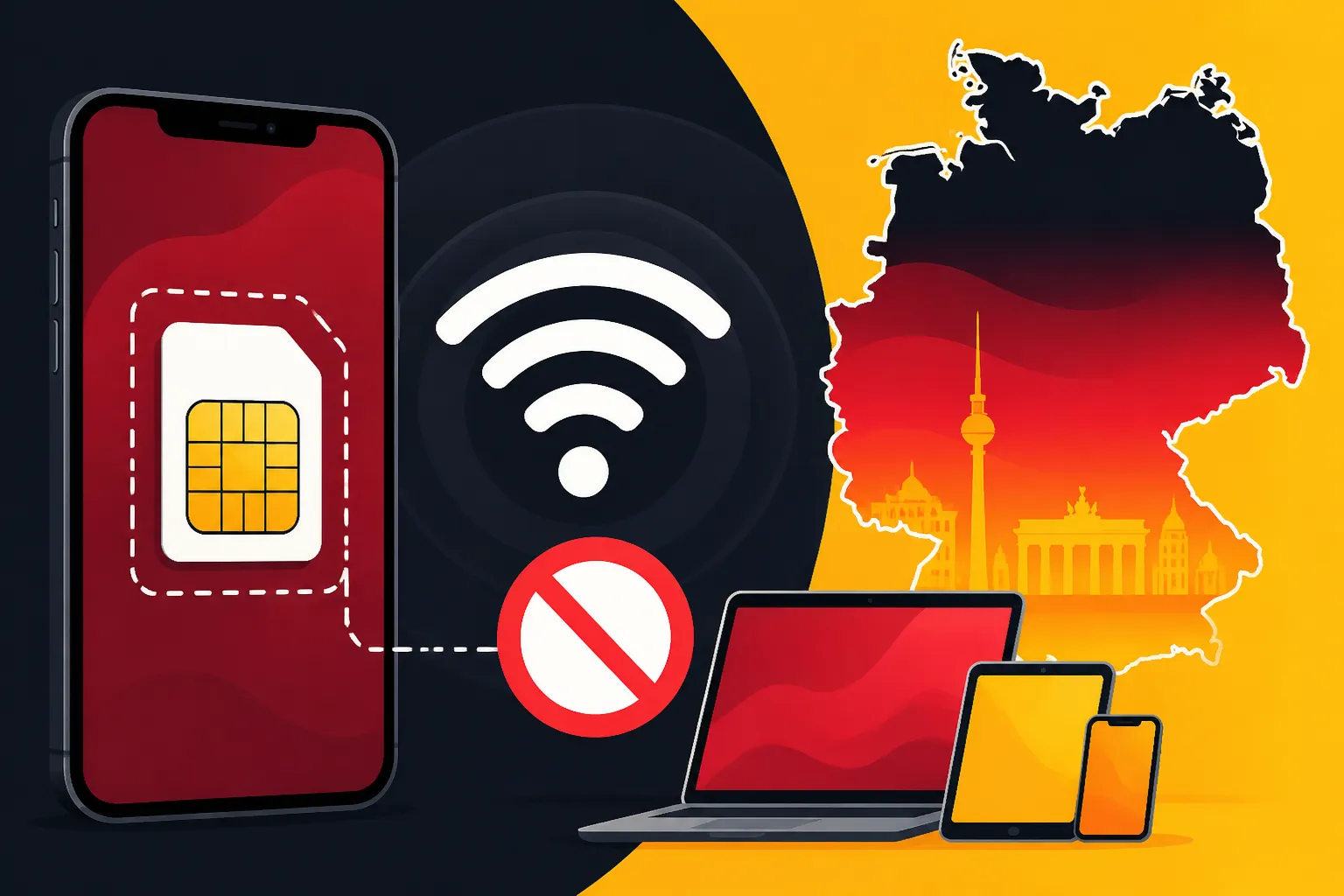
Mobile tethering, often referred to as setting up a "personal hotspot," is simply the act of using your smartphone's cellular data connection to provide internet access to other devices. Think of your phone as a mini Wi-Fi router, broadcasting its internet signal for your laptop, tablet, another smartphone, or even a smart device to connect to. This can be an absolute lifesaver when you're out and about, away from reliable Wi-Fi.
Imagine you're trying to send an urgent work email from a café in Munich, but their Wi-Fi is spotty, or worse, non-existent. Or maybe you're on a long ICE train journey, and the Deutsche Bahn Wi-Fi is buffering more than streaming. In these moments, being able to flip on your phone's hotspot and connect your laptop is not just convenient, it's essential for staying productive and sane. For tourists relying on maps and translation apps on a secondary device, or expats who constantly need their laptop for administrative tasks, tethering ensures you’re never truly offline, even if public Wi-Fi is playing hard to get. It’s about maintaining that crucial bridge between your primary data source and all your other digital tools.
General Rules and Provider Policies
In general, most German mobile network providers, whether you have a physical SIM from Telekom, Vodafone, or O2, or an eSIM from a local provider, allow tethering. It's usually not a feature that's explicitly blocked. The key, however, lies in your data allowance. If you have a plan with a finite amount of data – say, 10GB or 20GB – then tethering will simply consume that data just like any other activity on your phone. There are no additional fees for the act of tethering itself, but you're still using up your allowance.
Where things get a little murkier is with "unlimited" or heavily bundled plans. While genuine "unlimited" plans in Germany are less common for everyday consumers and often come with a hefty price tag, some plans might offer large data volumes. Here, providers might implement a Fair Usage Policy (FUP). This means that while they might say tethering is allowed, if you're constantly using your phone to power multiple devices for heavy streaming or downloads, they could throttle your speeds after you hit a certain data threshold within a billing cycle. It's a subtle distinction, but one that can seriously impact your experience. Always check the fine print, because "unlimited" sometimes comes with unspoken caveats, especially when you're pushing a lot of data through a hotspot. For more on staying connected in Germany, check out our guide on Internet and Mobile Phone Plans in Germany: Getting Connected Fast.
Tethering on eSIM Plans in Germany: What You Need to Know
Now, let's talk about the world of eSIMs. Many expats and tourists are turning to eSIMs for their sheer convenience – no physical SIM cards to swap, easy activation, and often more flexible plans for short-term stays or multi-country travel. But does this digital convenience come with hidden restrictions when it comes to sharing your data?
Are There Specific Restrictions for eSIMs?
This is a common concern, and thankfully, it's mostly a myth! For the vast majority of reputable travel eSIM providers, the restriction isn't eSIM-specific but rather plan-specific. What do I mean by that? It means that if you purchase an eSIM data package that explicitly states tethering or hotspot is allowed, then your phone will generally allow you to use it, just as it would with a physical SIM. The eSIM technology itself doesn't inherently block tethering.
The important thing is to choose an eSIM provider that understands the needs of international users. This is where a service like Airalo shines. Airalo, for example, is widely known for allowing personal hotspot usage on most of its data plans, provided your device supports it. You're simply consuming the data you've paid for, no different than if you were browsing Instagram on your phone. This transparency and reliability are a huge relief for anyone who depends on consistent connectivity. Before purchasing any eSIM, especially for a crucial need like work, always double-check the plan details or the provider's FAQ section. Rest assured, many eSIM providers cater directly to the need for flexible, shareable data.
Understanding Data Limits and Fair Usage Policies
Even if an eSIM plan permits tethering, you still need to be acutely aware of your data limits and any associated fair usage policies (FUPs). Tethering is a data guzzler, pure and simple. What might seem like a generous 5GB or 10GB data bundle can vanish remarkably quickly when you're powering a laptop, which often has background apps, updates, and higher-resolution content loading.
Let's put it into perspective:
- Checking emails and light browsing: Minimal data usage, but can still add up.
- Video calls (Zoom, Teams): 1-3 GB per hour, easily. If you're working remotely, those daily stand-ups and client meetings will eat through your allowance.
- Streaming video (Netflix, YouTube): High definition streaming can consume 3GB per hour or more.
- Software updates: A single Windows or macOS update can easily be several gigabytes.
Many "unlimited" or very high data volume local German SIM plans do come with FUPs. For instance, a provider might offer "unlimited" data but then slow you down significantly after you've used 50GB in a month. While this might be sufficient for personal phone use, adding tethered devices can push you over that hidden threshold much faster. Travel eSIMs, like those offered by Airalo, typically offer fixed data bundles (e.g., 5GB, 10GB, 20GB for a set number of days). With these, the limit is clear: once you've used your purchased gigabytes, you'll need to top up. There's usually no hidden FUP beyond the explicit data cap, which offers a certain peace of mind. You know exactly what you're getting and how much you have left. This predictability is often preferred over a vague "unlimited" promise that turns into a crawl just when you need it most.
The Hidden Costs and Performance Realities
While the concept of tethering is straightforward, the execution, especially for expats and tourists in Germany, can sometimes throw a few curveballs related to hidden costs and performance.
Firstly, "roaming charges" are a big one to watch out for. If you're using an eSIM that's primarily designed for another region and you're in Germany, or if you've mistakenly activated a plan without German coverage, you could incur exorbitant roaming fees. Always ensure your eSIM plan explicitly covers Germany and, ideally, other EU countries if you plan to travel. Many providers, including Airalo, offer specific Germany-only plans or regional EU plans that make this clear. If you find yourself needing to jump between countries, consider an eSIM that offers wider coverage rather than risking unexpected charges. For advice on managing travel health insurance while on the move, consider our guide on European Health Insurance Card EHIC: Using It in Germany and Abroad.
Secondly, let's talk about speed. Mobile network speeds in Germany can vary wildly depending on your location, the time of day, and the specific network (Telekom generally has the best coverage and speeds, followed by Vodafone, then O2). When you tether, you're splitting that available bandwidth across multiple devices. If you're already on a slower connection, or in a rural area with limited signal, tethering can make things even slower. Even in cities, attaching a laptop with multiple tabs open and background processes running can drastically reduce the effective speed for each connected device. It's a shared resource, after all. To optimize performance, try to connect only essential devices, close unnecessary apps on the tethered devices, and position your phone in an area with the best possible signal. Remember, an eSIM from a provider like Airalo will leverage the local networks, so the underlying speed will depend on the strength of the specific German network it connects to.
Choosing the Right eSIM for Your Tethering Needs in Germany
When you're trying to figure out which eSIM to get for your time in Germany, especially if you're counting on being able to tether, it can feel like a daunting task. There are so many options out there, each with its own little quirks. But as a seasoned expat, I've seen enough to know what truly works, and what often leads to frustration.
Why Airalo is a Top Pick for Expats and Travelers in Germany
Let me tell you, when it comes to travel eSIMs, Airalo has truly been a game-changer for so many people I know, myself included. It takes so much of the stress out of getting connected, and critically for this discussion, it handles tethering beautifully. Why is it a top pick for Germany?
First off, its sheer accessibility is fantastic. You can browse, purchase, and activate an Airalo eSIM from anywhere in the world before you even land in Germany. This means you step off the plane with connectivity already sorted – no scrambling for local SIM cards, no dealing with language barriers at phone shops, and no complicated registration processes. You can literally be online within minutes of touching down, which is invaluable for getting your initial bearings, finding your way to your accommodation, or letting loved ones know you've arrived safely.
Secondly, Airalo's broad coverage across Germany is excellent, as it partners with major local networks like Telekom or Vodafone, giving you access to reliable 4G/5G speeds wherever available. This is crucial for tethering, as a strong base connection means a better hotspot experience. They offer diverse data packages, ranging from smaller bundles perfect for a weekend trip (e.g., 1GB for 7 days) to larger ones that cater to longer stays or heavier data users (e.g., 20GB for 30 days). The flexibility to top up data directly from their app means you're never truly cut off, even if you burn through your initial allowance faster than expected. This convenience and reliability make Airalo not just a good option, but often the go-to for hassle-free connectivity in Germany, especially when you need to share that connection with other devices.
| Airalo Plan Type | Data Allowance | Validity | Ideal For | Tethering Capability |
|---|---|---|---|---|
| Germany Local eSIM | 1 GB | 7 Days | Light travel, quick stopovers, emergencies. | Yes |
| Germany Local eSIM | 5 GB | 30 Days | Standard tourist, moderate browsing, occasional video calls. | Yes |
| Germany Local eSIM | 10 GB | 30 Days | Remote workers, heavy social media, regular streaming, multiple tethered devices. | Yes |
| Germany Local eSIM | 20 GB | 30 Days | Extended stays, very heavy data users, frequent tethering. | Yes |
| Eurolink Regional | Varies (e.g., 10GB) | 30 Days | Multi-country EU travel, broad coverage across Europe, including Germany. | Yes |
Note: Specific plans and pricing can vary, always check the Airalo app or website for the most current offers.
Practical Tips for Maximizing Your Hotspot Experience
Alright, you've got your Airalo eSIM, and you're ready to tether. But let's be realistic; even the best plans can be misused. Here are a few veteran tips to make sure your hotspot experience in Germany is as smooth as freshly brewed German coffee.
First, battery drain is real. Running a personal hotspot turns your phone into a mini beacon, constantly sending and receiving data for multiple devices. This eats through battery life faster than a Berliner eats a Currywurst. Always have a power bank or access to a charger if you plan on extended tethering. There's nothing worse than your phone dying in the middle of an important video call because you forgot it was fueling your laptop.
Second, monitor your data usage religiously. While Airalo makes it easy to track your remaining data directly in their app, it’s also a good habit to keep an eye on your phone's built-in data usage monitor (found in settings on both iOS and Android). Many operating systems allow you to see how much data is being used by your hotspot, which apps are consuming the most data, and even set warnings or limits. This helps you avoid unexpected top-ups. Remember, once that data is gone, it's gone. For general budgeting in Germany, our guide on Cost of Living in Germany: Budgeting Guide for Expats can offer broader financial insights.
Third, secure your hotspot. Always use a strong, unique password for your personal hotspot. Public Wi-Fi networks in Germany can sometimes be less secure, and you don't want to inadvertently become an open access point for anyone to jump on and siphon your data (or worse, access your devices). A good password protects both your data allowance and your privacy. Lastly, while tethering is fantastic, it's not always the most efficient. If you're doing really heavy data tasks, like uploading large files or downloading big software updates, try to wait until you have access to a stable, unlimited fixed-line internet connection. Tethering should be your flexible, on-the-go solution, not your primary internet source for power-user tasks.
Activating and Managing Your Airalo eSIM for Tethering
Getting your Airalo eSIM up and running for tethering is surprisingly straightforward, especially if you follow the steps. It’s definitely less complicated than some of the other bureaucratic hurdles you might face in Germany!
First, purchasing and installation: You'll start by downloading the Airalo app. From there, you can browse available eSIMs for Germany or a wider European region. Once you've chosen and purchased a plan (for instance, the 10GB Germany-specific eSIM for 30 days), the app will guide you through the installation process. This usually involves scanning a QR code or manually entering details into your phone's settings. It’s intuitive, but make sure you’re connected to Wi-Fi during installation. This initial setup is critical to ensure a smooth transition when you arrive.
Next, activation and connectivity: Once installed, your eSIM needs to be activated. For most Airalo plans, this simply means turning on the eSIM line in your phone settings and ensuring data roaming is enabled for that line. Airalo’s instructions are always clear on this, often specifying to activate only when you arrive in the country to maximize your validity period. Your phone will then connect to a local German network. You’ll see the network name (like "Telekom.de" or "Vodafone.de") pop up, indicating you're connected.
Finally, enabling the hotspot: With your Airalo eSIM active and providing data, enabling tethering is just like you would with any other SIM.
- For iOS (iPhone): Go to Settings > Personal Hotspot, and toggle it on. You might need to set a Wi-Fi password if you haven't already.
- For Android: The path can vary slightly by phone model, but usually it’s Settings > Network & Internet > Hotspot & tethering > Wi-Fi hotspot, and then toggle it on. You can also configure the network name (SSID) and password here.
Once activated, your other devices can simply search for your phone's Wi-Fi network and connect using the password you've set. It's truly that simple. Always remember to turn off the hotspot when you don't need it to conserve both data and battery. By following these easy steps, you can confidently rely on Airalo to keep all your devices connected throughout your stay in Germany. If you're pondering other aspects of digital life, you might find our guide on Using Wise, TransferWise and Revolut: Fintech Solutions for Expats useful for managing money.
Disclaimer
Please note that while I strive to provide accurate and up-to-date information based on my experience and available data, mobile network policies, eSIM plan details, and specific terms and conditions can change. Always verify the current details directly with Airalo or your chosen eSIM provider before making a purchase. This guide is for informational purposes only and does not constitute official advice.