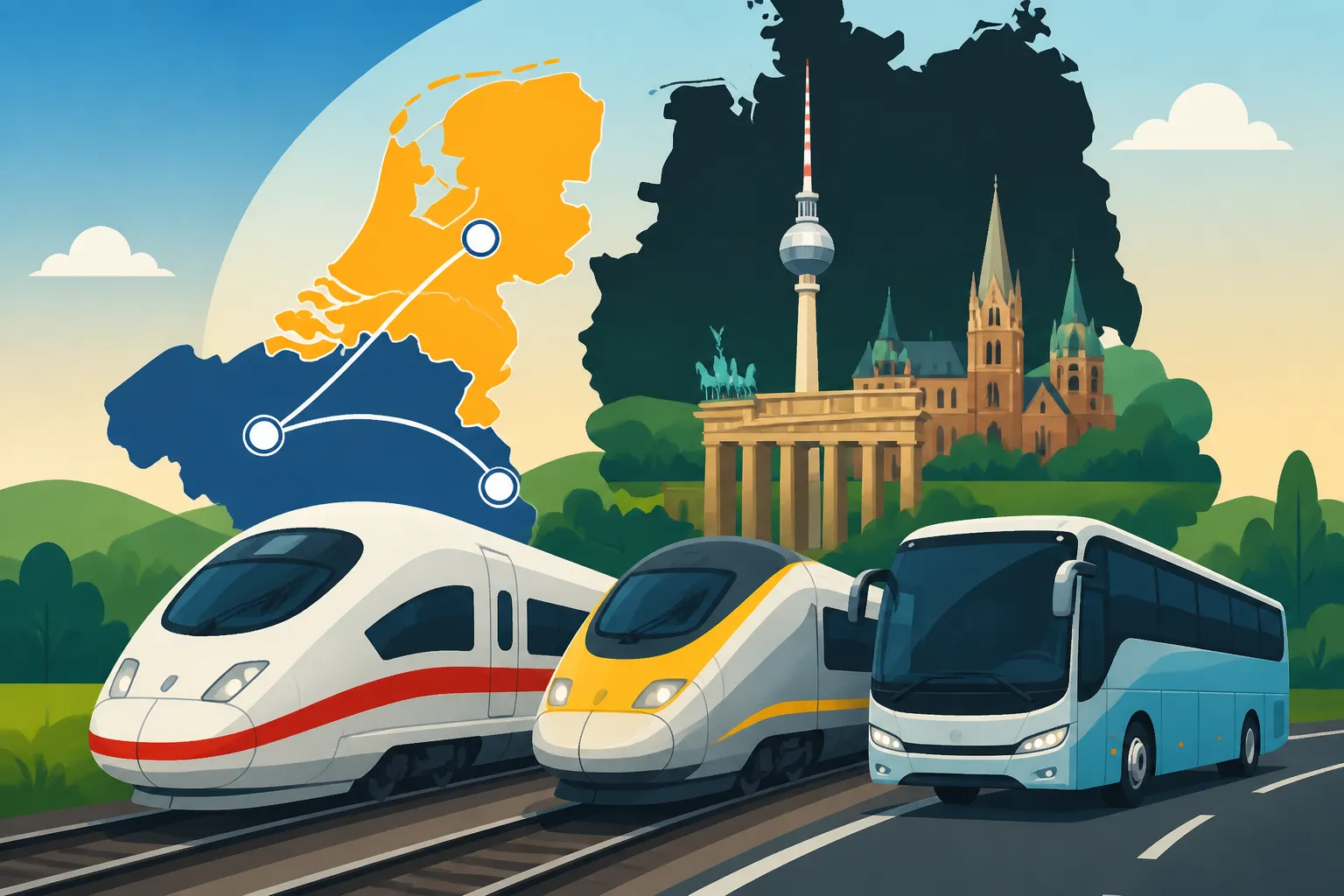
Germany to the Netherlands and Belgium: ICE, Eurostar, and Bus Options
Ah, the siren call of nearby adventures! You've settled into Germany, perhaps mastered the art of Anmeldung and deciphered your Nebenkostenabrechnung, but now you're itching to explore beyond the German borders. It's a natural craving, isn't it? Germany is fantastic, but sometimes you just want a different vibe, a fresh plate of frites in Brussels or a canal cruise in Amsterdam. The good news is, getting from Germany to the Netherlands and Belgium is surprisingly straightforward, and with a tool like Omio, planning your escape can be as easy as pie. This guide is all about demystifying those cross-border trips, showing you how to navigate the options, and highlighting why a single platform like Omio can be your best friend in coordinating your journey.
Disclosure: This post may contain affiliate links. We may earn a commission at no extra cost to you if you make a purchase through these links. Read full disclosure.
Planning Your Cross-Border Journey: Why Travel to the Netherlands and Belgium?
When you’re an expat in Germany, the proximity to so many diverse countries is one of the biggest perks. You could hop on a train or bus and be in a completely different cultural landscape within hours. The Netherlands and Belgium, in particular, offer a wonderful blend of rich history, vibrant cities, and distinct culinary delights, all within easy reach. They're perfect for a quick weekend getaway or a longer exploration, and honestly, sometimes you just need to get out of your routine and experience something new!
The Allure of Amsterdam and Brussels
Let's be real, Amsterdam and Brussels are often the first cities that spring to mind when you think of these two countries. Amsterdam, with its iconic canals, charming gabled houses, world-class museums like the Rijksmuseum and the Anne Frank House, and a buzzing nightlife, is a perennial favorite. It's a city designed for walking and cycling, offering a relaxed yet vibrant atmosphere that feels quite different from many German cities. The Dutch directness, too, can be a refreshing change!
Then there's Brussels, the capital of Belgium and, famously, the de facto capital of the European Union. While it might sound all serious and bureaucratic, Brussels is a city of stunning architecture, from the opulent Grand Place to the quirky Atomium. It's also a paradise for foodies, renowned for its delectable chocolates, crispy frites, and an incredible array of beers. Picture yourself wandering through the historic streets, perhaps stumbling upon a Tintin mural, and then settling down for a hearty Belgian stew. These cities, and countless others in both countries, offer experiences that complement your life in Germany beautifully.
Practicalities of Cross-Border Travel from Germany
Traveling within the Schengen Area is one of the great privileges of living in Germany as an expat. No constant passport checks, no endless visa applications for short trips – it's truly a dream compared to many other parts of the world. For most residents in Germany, whether you're an EU citizen or hold a German residence permit, crossing the internal borders into the Netherlands and Belgium is usually seamless. You simply hop on your chosen transport, and off you go. However, it's always wise to carry your passport or national ID card, as random checks can occur, and it's your primary form of identification if needed.
Beyond identification, you'll want to think about currency (both countries use the Euro, just like Germany, so no worries there!), and communication. While English is widely spoken in tourist areas, especially in the Netherlands, a few basic phrases in Dutch or French can go a long way in Belgium. Don't forget to consider your mobile data – while EU roaming largely means you won't incur extra charges, it's good to double-check your plan or consider an Mobile Data and eSIMs for Travel in Germany solution for seamless connectivity.
Understanding Your Transport Options: Train, Bus, or Car?
When it comes to getting from Germany to its western neighbors, you've got a few solid options, each with its own set of pros and cons. The choice often comes down to your budget, time constraints, comfort preferences, and how much luggage you're hauling. From the lightning-fast efficiency of German trains to the wallet-friendly charm of bus travel, or the ultimate freedom of your own set of wheels, there's a mode of transport for every kind of traveler. And let me tell you, having a platform like Omio to compare all these modes in one go is a real game-changer. It takes the headache out of sifting through countless websites and helps you make the best decision for your trip.
The Comfort and Speed of Rail Travel: ICE and Eurostar
Train travel is often my personal go-to for cross-border trips from Germany, and for good reason. It’s generally the fastest and most comfortable option, especially for city-center to city-center journeys.
- ICE (Intercity-Express): Germany's flagship high-speed train, operated by Deutsche Bahn, offers excellent connections directly from major German cities like Cologne, Düsseldorf, Frankfurt, and Berlin to cities in the Netherlands, primarily Amsterdam and Utrecht. The journey from Cologne to Amsterdam, for instance, can be as quick as 2 hours 45 minutes, a blink of an eye considering the distance. The ICE trains are modern, offer comfortable seating, Wi-Fi, and often a Bordrestaurant or bistro car where you can grab a coffee or a meal. For deeper dives into saving money on tickets, check out my guide on How to Buy Deutsche Bahn Tickets and Save Money.
- Eurostar (formerly Thalys): For travel into Belgium, especially Brussels, the Eurostar (which has recently taken over Thalys routes) is your star player. These high-speed trains connect Cologne directly to Brussels and beyond, sometimes even to Paris. The journey to Brussels from Cologne can be as fast as 1 hour 45 minutes. The Eurostar trains are known for their comfort and speed, making them ideal for business travelers or anyone who values a quick, smooth ride. What I love about using Omio for these routes is that it pulls up both ICE and Eurostar options, showing you the fastest and cheapest combinations, even when it involves switching between operators – something that used to require a lot of manual searching.
Train travel allows you to relax, read a book, or simply watch the European landscape whiz by. You arrive right in the heart of the city, ready to explore without the added stress of parking or navigating busy roads.
Budget-Friendly Bus Alternatives
If you're traveling on a shoestring budget, or if your destination isn't directly served by a high-speed train, buses are an excellent alternative. They might take a bit longer, but the cost savings can be significant, especially if you book in advance.
- FlixBus: This is probably the most well-known and widely available long-distance bus operator in Germany and across Europe. FlixBus offers extensive connections from numerous German cities to practically every major city and many smaller towns in the Netherlands and Belgium. You can catch a FlixBus from Berlin to Amsterdam, Frankfurt to Brussels, or even smaller German cities to regional Dutch or Belgian hubs. The buses are generally comfortable, offering Wi-Fi, power outlets, and a restroom. For more details on this option, read up on Long-Distance Buses in Germany: FlixBus and Networks.
- Cost vs. Time: The main trade-off with bus travel is time. A journey that might take three hours by train could easily be five or six by bus, depending on the route and traffic. However, for those who value saving money or need flexibility with departure times, buses are a fantastic choice. Again, this is where Omio truly shines because it lets you easily compare train and bus prices and journey times side-by-side, helping you weigh the options efficiently without having to jump between the FlixBus app and the Deutsche Bahn website.
Driving Yourself: Freedom vs. Hassle
For some, the open road calls. Driving offers unparalleled flexibility, allowing you to explore off-the-beaten-path destinations and travel at your own pace.
- Pros: You can pack as much luggage as your car allows (within reason, of course), make spontaneous stops, and reach remote areas not accessible by public transport. This is particularly appealing if you're planning to visit multiple smaller towns or scenic countryside regions in either country. For tips on driving, you might find my guide on Renting a Car and Driving on the Autobahn helpful, even if you're using your own vehicle.
- Cons: The freedom of driving comes with its own set of challenges. Fuel costs can add up, especially with current prices. Then there's parking, which can be notoriously expensive and hard to find in popular city centers in Amsterdam or Brussels. You also have to contend with traffic, potential tolls, and differing road rules. While both countries drive on the right like Germany, parking regulations and city access rules can vary. For example, some cities have low-emission zones (Umweltzonen) that require special permits or restrict certain vehicles. Make sure your Travel Insurance for Trips to and Within Germany covers you for driving abroad, just in case.
Ultimately, driving is best if you value maximum independence and are planning a multi-stop itinerary that ventures beyond major urban centers. For quick city breaks, public transport often wins on convenience.
The Power of Omio: Simplifying Your Travel Bookings
Let's talk about the unsung hero of expat travel: platforms that bring all your options together. Trying to plan a trip from Germany to the Netherlands or Belgium can quickly become a maze of tabs and conflicting information. Do you check Deutsche Bahn? Or Thalys (now Eurostar)? Or FlixBus? What about local connections? This is where Omio steps in and completely changes the game. As an expat who’s spent years wrangling with German bureaucracy and logistical puzzles, I can tell you that any tool that simplifies things is a godsend. Omio isn't just a booking site; it's a travel planning superpower that aggregates all your choices into one user-friendly interface.
How Omio Streamlines Your Search and Booking
Imagine this: you want to go from Berlin to Amsterdam. You could open separate tabs for Deutsche Bahn, FlixBus, perhaps even look up flights, and then try to compare prices, departure times, and journey durations. It’s tedious, time-consuming, and frankly, a bit of a pain. This is precisely the problem Omio solves.
When you enter your origin and destination on Omio, it doesn't just show you one mode of transport. It instantly pulls data from major train operators like Deutsche Bahn and Eurostar (formerly Thalys), bus companies like FlixBus, and even some flight options. You get a comprehensive overview on a single screen. This means you can see:
- Train options: High-speed ICE, regional trains, and direct international services.
- Bus options: Various routes and times offered by companies like FlixBus.
- Sometimes even flights: For longer distances or when a budget airline makes sense.
This aggregation is fantastic because it eliminates the guesswork and allows for true "apples-to-apples" comparison. No more juggling tabs, no more trying to remember which website had the cheapest fare for that 7 AM train. Omio puts it all right there, making your travel planning efficient and, dare I say, enjoyable. It's truly built for the modern traveler who expects convenience and clarity, which, let's be honest, is not always what we get with traditional booking methods in Europe.
Comparing Routes and Prices with Ease
Once Omio presents you with all the available options, the real magic of comparison begins. Each result clearly displays:
- Departure and arrival times: So you can pick a schedule that fits your plans.
- Journey duration: Crucial for balancing cost and speed.
- Prices: Transparently shown, often with different fare classes (e.g., economy, flexible).
- Number of changes: Whether it's a direct journey or requires a transfer.
- Operator: Clearly stating if it's a Deutsche Bahn ICE, a FlixBus, or an Eurostar.
This clear presentation allows you to quickly filter and sort. Are you looking for the absolute cheapest ticket, even if it means a longer bus ride? Omio can sort by price. Do you need to get there as fast as humanly possible, even if it costs a bit more? Sort by shortest duration. Want to avoid transfers? Filter for direct routes.
For example, if you're heading from Cologne to Brussels, Omio will show you multiple Eurostar options which are super fast but might be pricier, alongside FlixBus options that are significantly cheaper but take longer. It helps you make an informed decision based on your priorities for that specific trip, not just a general idea of which mode is "best." This level of detail and flexibility is precisely why Omio has become such a valuable tool for expats exploring Germany and its neighbors.
Seamless Ticketing and Mobile Access
Beyond just finding the best route, Omio makes the booking process incredibly smooth. Once you’ve selected your preferred option, you can purchase your tickets directly through their platform. This means you don't get redirected to another website, potentially losing your chosen fare or starting the search process all over again. It’s all contained within Omio.
And in today’s digital age, mobile access is non-negotiable. Omio provides mobile tickets for most routes, which you can easily access on your smartphone. No need to print out tickets, fumble with paper, or worry about losing them. Just show your phone to the conductor or driver, and you're good to go. This is a huge convenience, especially when you're rushing to catch a connection or simply prefer to travel light.
The platform also keeps all your travel details organized in one place, making it easy to review your upcoming trips. It's an end-to-end solution that takes the stress out of planning and executing cross-border European adventures, allowing you to focus on the fun part: exploring new places. This convenience and consolidation are invaluable, which is why Omio is my recommended choice for anyone traveling from Germany to the Netherlands and Belgium.
Deep Dive into Train Travel: ICE and Eurostar Connections
Train travel across Europe is a truly enchanting experience, a far cry from the often dreary airport rituals. The journey itself becomes part of the adventure, offering glimpses into the changing landscapes and cultures as you speed along. When you're making your way from Germany to the Netherlands or Belgium, the high-speed rail networks, primarily the ICE and the Eurostar, are your best bet for a comfortable and efficient trip.
Riding the ICE to the Netherlands
The ICE, Germany's pride and joy of rail travel, provides fantastic direct connections to many Dutch cities. From major German hubs like Cologne (Köln Hauptbahnhof), Düsseldorf, or Frankfurt, you can often find direct ICE services straight into the heart of Amsterdam Centraal, Utrecht Centraal, or other key locations.
- Key Routes & Travel Times:
- Cologne to Amsterdam: This is one of the most popular routes. An ICE train can whisk you from Cologne Hbf to Amsterdam Centraal in about 2 hours 45 minutes. It’s incredibly efficient and usually quite punctual.
- Düsseldorf to Amsterdam: Even quicker, often under 2 hours 30 minutes.
- Frankfurt to Amsterdam: A bit longer, usually around 4 hours, sometimes with a quick change in Cologne.
- Berlin to Amsterdam: This is a longer haul, typically around 6 hours 20 minutes with a direct ICE.
- Onboard Experience: The ICE trains are designed for comfort. You'll find spacious seating, usually with ample legroom, and a quiet atmosphere in the first-class carriages, perfect for getting some work done or simply relaxing. Second class is also very comfortable. Most ICE trains offer free Wi-Fi, though sometimes it can be spotty, especially in tunnels or rural areas. There's almost always a Bordrestaurant (restaurant car) or a Bordbistro (bistro car) where you can purchase hot meals, snacks, and drinks, from a coffee to a full lunch.
- Booking Tips: For the best prices, always try to book your ICE tickets as far in advance as possible, especially if your travel dates are fixed. Deutsche Bahn's "Sparpreis" (saver fare) tickets can offer significant discounts, but they are often non-refundable and non-changeable. Using Omio to compare these fares across different departure times and even against bus options helps ensure you're getting the best deal for your specific needs. It's like having a super-powered travel agent in your pocket.
The Eurostar Experience to Brussels and Beyond
For journeys into Belgium, particularly to the capital Brussels, the Eurostar (which took over Thalys services in late 2023) is your premier high-speed rail option. These distinctive red trains connect Germany directly to Belgium and beyond, offering a fast and stylish way to travel.
- Key Routes & Travel Times:
- Cologne to Brussels: The primary route. A Eurostar train can get you from Cologne Hbf to Brussels-Midi/Zuid in approximately 1 hour 45 minutes. It's a fantastic, swift connection.
- Düsseldorf to Brussels: Roughly 2 hours 30 minutes, often with a change in Cologne.
- Essen to Brussels: Similar to Düsseldorf, around 2 hours 45 minutes.
- Frankfurt to Brussels: Usually around 3 hours 30 minutes, often direct or with one change.
- Onboard Experience: Eurostar trains are known for their modern design and amenities. They offer three classes of service: Standard, Comfort, and Premium. Even in Standard, the seats are comfortable, and there's often free Wi-Fi. Comfort and Premium classes offer more spacious seating, complimentary meals, and other perks, making them ideal for a splurge or a business trip. There's also a Bar Car where you can grab refreshments. The seamless journey through the scenic German and Belgian countryside is a definite highlight.
- Connecting Beyond Brussels: Brussels-Midi/Zuid is a major European rail hub. From here, you can easily connect to other Belgian cities like Bruges, Ghent, or Antwerp via frequent Belgian domestic trains, or even further afield to Paris or London (via the Eurostar to St Pancras International). Again, Omio will show you these onward connections, sometimes even integrating them into a single booking for simplicity. For general info on public transport, you can also look into Getting Around Germany: Trains, Buses, Flights, and Car Hire, as many principles apply.
Essential Tips for Train Travel in Europe
- Book in Advance: I cannot stress this enough, especially for high-speed international routes. Prices for ICE and Eurostar tickets tend to increase significantly as the departure date approaches, particularly for popular times. Booking a few weeks or even months ahead can save you a pretty penny.
- Flexibility: If your schedule allows, being flexible with your travel times can lead to cheaper fares. Mid-week travel (Tuesdays, Wednesdays, Thursdays) and off-peak hours (early morning or late evening) are often less expensive than peak morning commutes or Friday/Sunday evenings.
- Seat Reservations: While not always mandatory, especially in second class on some ICE routes, a seat reservation is highly recommended, particularly for longer journeys or during busy periods. On Eurostar, seat reservations are typically included in your ticket. You don't want to be standing for three hours with your luggage, trust me.
- Luggage: Trains are quite generous with luggage compared to airlines. You can generally bring two large bags and a carry-on item, as long as you can manage them yourself and they fit in the overhead racks or designated luggage areas.
- Arrival at the Station: Aim to arrive at the station at least 15-20 minutes before your train's departure, especially in larger stations like Köln Hbf or Berlin Hbf. This gives you enough time to find your platform, maybe grab a coffee, and settle onto the train without feeling rushed.
- Connectivity: While Wi-Fi is often available, don't rely on it entirely for critical work. Download any movies, books, or documents you might need beforehand.
Comparing the different routes and prices for both ICE and Eurostar options is incredibly simple with Omio, making it an indispensable tool for any expat planning a train journey from Germany to its charming western neighbors.
Exploring Bus Travel: FlixBus and Other Operators
While trains are fantastic for speed and comfort, sometimes your wallet has the final say, or your destination isn't on a direct high-speed rail line. That's where bus travel comes in, offering a reliable and significantly more budget-friendly alternative for cross-border journeys from Germany to the Netherlands and Belgium.
FlixBus: Your Go-To for Budget Bus Routes
When it comes to intercity and international bus travel in Germany and across Europe, FlixBus is the undisputed champion. You've probably seen their distinctive green buses everywhere, from bustling city centers to quiet suburban stops.
- Extensive Network: FlixBus boasts an incredibly vast network, connecting hundreds of cities and towns in Germany with destinations throughout the Netherlands and Belgium. This means you can find direct routes from major German cities like Berlin, Munich, Frankfurt, Cologne, and Hamburg to popular Dutch cities like Amsterdam, Rotterdam, The Hague, and Utrecht, as well as Belgian hubs like Brussels, Antwerp, Ghent, and Bruges. They even serve smaller, more regional destinations that might be harder to reach by train without multiple transfers.
- Affordability: This is the main draw. FlixBus tickets are often substantially cheaper than train tickets, especially if you book well in advance. I've personally snagged tickets for less than €10 for cross-border trips, which is almost unheard of for train travel. This makes it an ideal option for students, budget-conscious travelers, or anyone who simply prefers to save their money for experiences at their destination.
- Comfort & Amenities: Don't let the low prices fool you into thinking it's a rough ride. FlixBus vehicles are generally modern and comfortable. You'll typically find reclining seats, air conditioning, free Wi-Fi (again, sometimes spotty, so plan accordingly!), power outlets at most seats, and an onboard restroom. While it's not the same as first-class train travel, it's perfectly adequate for a few hours on the road.
- Booking Simplicity: The FlixBus app and website are very user-friendly, but honestly, I find it even easier to just use Omio. Since Omio partners directly with FlixBus, you get access to all their routes and prices without leaving the Omio platform.
What to Expect from Cross-Border Bus Journeys
While bus travel is a fantastic budget option, it does come with a few characteristics that differentiate it from train travel.
- Longer Travel Times: Buses take longer than high-speed trains. This is simply a fact of road travel compared to dedicated rail lines. Traffic, especially around major cities like Amsterdam or Brussels, can add significant delays. A journey that's 3 hours by train might be 5-6 hours by bus. Factor this into your planning, especially if you have tight connections or appointments.
- Departure/Arrival Points: Bus stations are sometimes located a bit further from the absolute city center compared to train stations. While many FlixBus stops are at major train stations or well-connected bus terminals, it's always worth checking the exact departure and arrival point on your ticket and planning your local transport accordingly. For instance, in Amsterdam, many FlixBus services arrive at Sloterdijk station, which is well-connected to Centraal Station by local trains, but it's not directly Centraal Station itself. My guide on Public Transport Tickets and Passes: Navigating German Transit Systems might offer some general insights into city transport, which you might need for your onward journey once you arrive.
- Customs/Passport Checks: While rare for most EU/Schengen passport holders, buses sometimes undergo more frequent, albeit brief, passport checks at borders. Always have your valid passport or national ID card handy, even if you don't expect to use it.
- Flexibility with Delays: Due to traffic, buses can sometimes run late. Build in a buffer if you have a crucial appointment or a connecting flight. Unlike trains, buses aren't on dedicated tracks, so they're more susceptible to road conditions.
Booking Bus Tickets with Omio
Here’s another example of where Omio really shines as a core solution. When you search for routes from Germany to the Netherlands or Belgium, Omio doesn't just show you train options; it seamlessly integrates all the available bus journeys as well.
- Side-by-Side Comparison: You can instantly see the price difference, the time difference, and the number of transfers (if any) between a train and a bus for the exact same route. This allows for an incredibly efficient comparison. Maybe you see a train ticket for €60 that takes 3 hours, but a bus ticket for €25 that takes 5 hours. Depending on your priorities for that day, you can make an informed decision within seconds.
- Direct Booking: Once you've chosen your bus option, you can book and pay for your FlixBus ticket directly through Omio. No need to leave the site and re-enter your details on another platform. It's a unified experience.
- Mobile Ticketing: Just like with train tickets, Omio provides mobile tickets for bus journeys, too. Store it on your phone, and present it to the driver when you board. Easy-peasy.
For expats like us, dealing with enough paperwork and logistical puzzles in Germany, a straightforward booking process is a true luxury. Omio helps you find and book the most economical or convenient bus journey without the usual hassle, making it a highly recommended tool for your cross-border adventures.
Navigating Practicalities and Border Crossings
So you've chosen your mode of transport, booked your tickets through Omio, and your bags are packed. But before you set off, it's wise to consider a few practical aspects of cross-border travel that can make your journey even smoother. Even within the Schengen Area, a little preparation goes a long way to avoid any last-minute stress.
Passport Control and Customs Considerations
As I mentioned earlier, one of the huge benefits of living in Germany and traveling within the Schengen Area is the largely open borders. For EU citizens and those with a valid German residence permit, formal passport control is usually non-existent when crossing between Germany, the Netherlands, and Belgium. However, it’s not always a completely free pass.
- Always Carry ID: Despite the lack of systematic checks, border police or transport officials are legally entitled to conduct random checks. Always, and I mean always, carry your valid passport or national ID card. If you're a non-EU citizen, make sure you have your residence permit (Aufenthaltstitel) with you. These documents are your proof of identity and your right to be in the Schengen Area. Not having them could lead to inconvenient delays, even if you're fully compliant with immigration laws.
- Customs (Rare but Good to Know): For personal travel, customs checks between these EU countries are extremely rare. You're generally free to move goods for personal use. However, there are limits on certain items like tobacco and alcohol if you're bringing them in commercial quantities. Unless you're trying to set up a small shop in your suitcase, you generally don't need to worry about this.
- Schengen Visa Holders: If you are traveling on a short-stay Schengen visa, ensure your visa is valid for the duration of your trip and covers all the countries you intend to visit. While internal border checks are minimal, your visa documentation is crucial if you encounter any official queries. You can refer to our general guide on Schengen Visa for Germany: Short-Stay Visa Requirements and Tips for broader information on this.
Luggage, Food, and Comfort on Your Journey
Regardless of whether you choose train or bus, thinking about your comfort and packing smart can greatly enhance your travel experience.
- Luggage Allowance:
- Trains (ICE, Eurostar): Generally generous. You can bring two large pieces of luggage plus a carry-on, provided you can handle them yourself and they fit in the overhead racks or designated luggage areas. There aren't typically strict weight limits like on flights, but be reasonable.
- Buses (FlixBus): Usually allows one piece of checked luggage (up to 20kg or 23kg, depending on the route and booking) and one piece of carry-on luggage. Always double-check your specific ticket details on Omio or the operator's website, as excess luggage can incur extra fees.
- Food and Drink:
- Trains: Most high-speed trains like ICE and Eurostar have a Bordrestaurant or Bar Car where you can buy food and drinks. However, prices can be higher than at a supermarket. I often pack my own snacks, a sandwich, and a refillable water bottle to save money and ensure I have exactly what I want.
- Buses: While some buses might offer snacks for purchase, it's not as common or extensive as on trains. It’s definitely best to bring your own provisions for bus journeys.
- Comfort Essentials:
- Entertainment: Load up your tablet or phone with movies, e-books, or podcasts. While Wi-Fi is often available, it can be unreliable, especially on the move.
- Chargers: A portable power bank is a lifesaver, especially on older buses or trains where outlets might be scarce or non-functional.
- Neck Pillow/Eye Mask: For longer journeys, these can be invaluable for catching some Z's.
- Layers: Temperatures can fluctuate, so dressing in layers is always a good idea.
- Headphones: Essential for listening to your entertainment without disturbing others, and for some peace and quiet.
- Connectivity: Having a reliable way to stay online is a huge relief when traveling internationally. Make sure your phone plan has decent EU roaming or consider an eSIM for seamless data access. You don't want to get lost or struggle to find information because you're offline.
Accommodation and Local Transport on Arrival
Once you arrive at your destination, whether it's Amsterdam or Brussels, you'll need to think about getting to your accommodation and navigating the city.
- Booking Accommodation: Always book your accommodation in advance, especially in popular cities. Websites like Booking.com or Airbnb are widely used. Make sure you know how to get from the train or bus station to your hotel or apartment.
- Local Transport: Both Dutch and Belgian cities have excellent public transport networks – trams, metros, buses, and local trains.
- Netherlands: The OV-chipkaart (public transport chip card) is widely used, or you can often tap your credit/debit card for single journeys. Google Maps is great for planning routes.
- Belgium: Brussels also has an extensive metro, tram, and bus system. You can buy single tickets or multi-day passes.
- Walking/Cycling: Many European cities are very walkable, and cycling is king in the Netherlands! Consider renting a bike in Amsterdam for the full experience.
- Omio's Wider Usefulness: While Omio is primarily for long-distance travel, the convenience of having all your bookings in one app means you can quickly check your arrival details and immediately switch to a local mapping app to find your way. It streamlines the whole journey experience, not just the intercity part. For more general travel logistics, don't forget to review Travel Logistics in Germany: Money, Safety, and Connectivity.
By paying attention to these small but important details, your cross-border adventure from Germany to the Netherlands or Belgium will be much more relaxed and enjoyable.
Comparison Table: Train, Bus, and Car Travel
To help you visualize the trade-offs, here’s a quick overview comparing the different modes of transport for a typical journey from Germany to the Netherlands or Belgium. Remember, these are general estimations and can vary based on specific routes, booking times, and personal circumstances. This is where a tool like Omio is invaluable, as it provides real-time, specific comparisons for your exact journey.
| Feature | Train (ICE/Eurostar) | Bus (FlixBus) | Car (Personal/Rental) |
|---|---|---|---|
| Speed | Fast to very fast (e.g., Cologne to Amsterdam ~2h45) | Slower (e.g., Cologne to Amsterdam ~4-5h) | Variable, depends on traffic and stops (can be fastest door-to-door) |
| Comfort | High (spacious seats, amenities, smooth ride) | Medium (reclining seats, basic amenities, can be bumpy) | High (personal space, control over environment) |
| Cost | Medium to High (cheaper if booked far in advance) | Low to Medium (very affordable, especially with early booking) | Medium to High (fuel, tolls, parking, rental costs) |
| Convenience | High (city-center to city-center, no parking stress) | Medium (bus stations can be further out) | High (door-to-door, flexible stops), but parking can be an issue |
| Luggage | Generous allowance, easy storage | Limited allowance (1 checked, 1 carry-on), extra fees | Very generous (depends on car size) |
| Flexibility | Fixed schedule (but many departures) | Fixed schedule (but many departures) | Very High (go anywhere, anytime) |
| Onboard Services | Restaurant/bistro car, Wi-Fi, power outlets | Wi-Fi, power outlets, restroom | Personal amenities, snacks, music |
| Environmental Impact | Low per passenger (efficient) | Low per passenger (efficient for mass transport) | Higher per passenger (emissions) |
| Recommended For | Speed, comfort, direct city travel, business trips | Budget travel, flexible schedules, direct regional routes | Exploring rural areas, multiple stops, group travel, heavy luggage |
This table clearly illustrates why using Omio is so beneficial. It gives you this kind of comparative information instantaneously for your actual route, making the decision-making process incredibly easy. It's the essential tool for balancing your budget, time, and comfort desires for any European adventure from Germany.
Conclusion: Embrace the European Adventure with Omio
Venturing from Germany to explore the charming canals of the Netherlands or the historic streets of Belgium is an absolute joy, one of the greatest perks of expat life here. The proximity and excellent transport links mean that diverse cultural experiences are just a short journey away. Whether you're craving the fast pace of high-speed rail or the budget-friendly convenience of a bus, the choices are plentiful.
The biggest takeaway here, and something I genuinely believe in from years of personal experience, is that a tool like Omio transforms what could be a convoluted planning process into something straightforward and stress-free. It literally puts all your options – trains like ICE and Eurostar, buses like FlixBus, and even occasional flight connections – right at your fingertips, allowing you to compare prices, times, and comfort levels in one go. No more jumping between websites, no more second-guessing if you found the best deal. Omio streamlines your booking from start to finish, providing mobile tickets and keeping all your travel details neatly organized.
So, if you're feeling that familiar itch to discover a new European city, don't let the logistics intimidate you. Embrace the adventure, plan smart with Omio, and enjoy every moment of your journey from Germany to the Netherlands and Belgium. Gute Reise!
Disclaimer
Please note that travel information, including schedules, prices, and entry requirements, can change rapidly. While every effort has been made to provide accurate and up-to-date information, it is always recommended to verify details with the respective transport providers and official government sources before making any travel arrangements. This guide is for informational purposes only and does not constitute professional advice.