German Citizenship Test and Interview: How to Prepare and Pass
Staring blankly at a multiple-choice question about the 1949 German constitution while your entire European future hangs in the balance is uniquely terrifying. I remember my hands physically shaking during my citizenship interview, convinced one wrong answer meant deportation. This guide breaks down exactly how to prepare for and pass the German citizenship test and interview process.
Disclosure: This post may contain affiliate links. We may earn a commission at no extra cost to you if you make a purchase through these links. Read full disclosure.
Decoding the Einbuergerungstest Reality
When you finally accumulate enough years of paying taxes and navigating bureaucracy in Germany, the ultimate finish line is naturalization. But the German state demands proof that you genuinely understand the society you are asking to permanently join. This proof comes in the form of the official citizenship test.
What the Citizenship Test Actually Measures
There is a massive misconception among the expat community that the Einbürgerungstest (citizenship test) is designed to trick you or filter out applicants with obscure trivia questions. Having taken it myself, I can validate that this is not the case. The test is a standardized assessment of your fundamental civic knowledge. It measures your grasp of the German democratic system, basic legal rights, major historical milestones, and general living conditions.
The authorities are not looking for constitutional scholars. They want to ensure that you know the voting age, understand the separation of powers, and recognize the dark chapters of 20th-century German history. Because the exam is administered entirely in German, it also acts as a secondary proxy to verify that you possess the basic reading comprehension required to function in society. If you are currently studying the language to meet your baseline visa requirements, the vocabulary in this test will overlap heavily with your coursework, a dynamic detailed in Language Course Visa for Germany: Learning German on a D-Visa.
Furthermore, passing this test is an absolute, non-negotiable prerequisite for the vast majority of applicants. Without the physical certificate proving you passed, your naturalization application will be permanently stalled. Understanding how this fits into the broader timeline is critical; you should familiarize yourself with the full procedural roadmap in German Citizenship by Naturalization: Eligibility and Application Steps.
The Thirty Three Questions Format Explained
The mechanics of the test are incredibly straightforward. You will sit in an examination room and receive a paper booklet. The test consists of exactly 33 multiple-choice questions. For every question, there are four possible answers, and only one is correct. There are no essay questions, no fill-in-the-blanks, and no trick “all of the above” options.
These 33 questions are not generated randomly on the spot. They are pulled directly from a publicly available, fixed catalog of 310 total questions. Thirty of the questions on your exam will be general knowledge applicable to the entire Federal Republic of Germany. The remaining three questions will be specifically tailored to the federal state (Bundesland) where you are currently registered as living—for example, specific questions about the Bavarian state parliament or the coat of arms of Berlin.
You are given 60 minutes to complete the test. In my experience, and the experience of almost every veteran expat I have spoken to, if you have prepared properly, you will finish the exam in under 15 minutes. To pass and receive your certificate, you only need to answer 17 out of the 33 questions correctly. Scoring 17 is treated exactly the same as scoring a perfect 33; there is no bonus for perfection.
Who is Legally Exempt from Testing
Not everyone has to endure the stress of the Einbürgerungstest. German law provides several logical exemptions for individuals who have already proven their integration through other institutional means.
If you hold a German school-leaving certificate (such as the Abitur or Realschulabschluss), the state considers your civic education complete, and you are exempt. More relevant to expats is the higher education exemption. If you successfully graduated from a recognized German university with a degree in law, social sciences, political science, or public administration, you are legally exempt from taking the test. However, graduating with an engineering or IT degree does not grant you this exemption.
There are also humanitarian exemptions. If you cannot take the test due to a severe physical or mental illness, or due to a disability or age-related cognitive decline, the requirement can be waived. You must provide extensive medical documentation from a recognized German physician to prove this hardship. Navigating these specific medical waivers can be incredibly complex; if you are dealing with chronic conditions in the German system, review Accessible Healthcare: Services for People with Disabilities in Germany.
Preparation Strategies for the Citizenship Test
The beauty of the German citizenship test is its absolute transparency. Because the entire question pool is public, failure is almost entirely a result of poor preparation rather than a lack of intelligence.
Utilizing Official BAMF Resources and Simulators
You absolutely do not need to spend money on expensive test preparation books, tutoring services, or premium courses to pass this exam. The Federal Office for Migration and Refugees (BAMF) publishes the entire 310-question catalog online for free.
The most efficient way to study is by using digital simulators. There are dozens of free smartphone apps that replicate the test environment perfectly. These apps track your progress, highlighting the specific questions you consistently get wrong. The vocabulary can be dense—words like Gewaltenteilung (separation of powers) or Weimarer Republik might be new to you—so utilizing flashcards alongside the simulator is highly recommended.
The strategy that worked best for my cohort was rote memorization through daily repetition. If you dedicate 15 minutes during your daily commute to run through a simulated 33-question test on your phone, you will have memorized the correct answers to the entire 310-question catalog within a month. You do not necessarily need to deeply understand the political nuances of every question; you just need to recognize the correct answer pattern.
Memorizing Regional State Questions
The three regional questions trip up many applicants simply because they forget to study them. When you download a test simulator app, you must configure it to your specific Bundesland. If you live in Hesse, studying the geographical borders of Saxony is a waste of time.
These regional questions typically ask you to identify the state’s coat of arms from a lineup of four images, name the state capital, identify the current Minister-President, or point out your state on a blank map of Germany.
A critical administrative trap to avoid is moving states right before your test. If you are registered in Hamburg, take the Hamburg-specific test, but then move to Frankfurt before your citizenship application is processed, the naturalization office in Frankfurt might force you to retake the test for Hesse. Always align your test location with your permanent residency plans.
Integration Courses versus Self Study
Many expats arrive in Germany and are mandated to take an Integration Course (Integrationskurs). The final module of this massive language course is the Orientierungskurs (orientation course), which covers politics, history, and society.
The Orientierungskurs culminates in a final exam called “Leben in Deutschland” (Life in Germany). It is vital to know that passing the “Leben in Deutschland” test with at least 17 points is legally accepted as exactly equivalent to passing the Einbürgerungstest. You do not have to take both.
If you are a highly skilled worker arriving on an EU Blue Card, you are likely not mandated to take an integration course. In this case, skipping the classroom and simply registering for the standalone Einbürgerungstest at your local Volkshochschule (adult education center) is the fastest, most pragmatic route. Sitting through weeks of evening classes to learn basic civic facts that you can memorize on a train commute is an inefficient use of a full-time professional’s time.
| Feature | Einbürgerungstest (Citizenship Test) | Leben in Deutschland (LiD) Test |
| Primary Audience | Independent applicants, Blue Card holders | Integration Course participants |
| Preparation Method | Self-study via apps and BAMF catalog | Mandatory 100-hour classroom course |
| Test Structure | 33 Questions (30 general, 3 regional) | 33 Questions (30 general, 3 regional) |
| Passing Score | 17 points | 15 points (Course pass) / 17 points (Citizenship) |
| Validity for Passport | Yes | Yes (Must score 17+) |
The New Ideological and Democratic Requirements
Germany has recently undergone a massive overhaul of its nationality laws. While the timelines were shortened, the ideological gatekeeping was significantly tightened. The naturalization interview and testing process now feature a much heavier emphasis on your personal values.
The Anti Semitism and Loyalty Declarations
In 2024, responding to shifting political climates, the German government updated the Nationality Act to explicitly exclude anyone harboring antisemitic, racist, or inhumane ideologies from acquiring citizenship. The state wants absolute assurance that new citizens align with the core democratic values enshrined in the Basic Law (Grundgesetz).
To enforce this, the test catalog was updated with new questions specifically addressing Germany’s historical responsibility toward Jewish life, the State of Israel, and the absolute prohibition of discrimination. During your application process, you will be required to sign a formal, legally binding declaration of loyalty to these democratic principles.
If the background checks—which are conducted in deep coordination with local police and federal intelligence agencies—reveal that you have participated in extremist activities, shared illegal hate speech online, or committed crimes rooted in prejudice, your application will be instantly rejected. The state is making it abundantly clear that naturalization is a privilege reserved for those who share its humanitarian values.
Navigating Cultural Integration Scrutiny
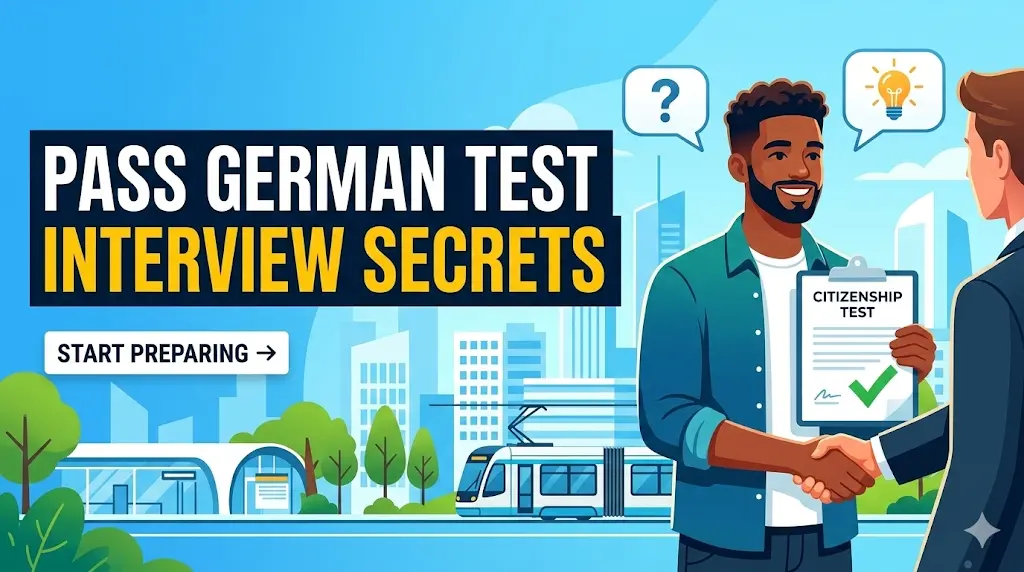
The term “Citizenship Interview” often terrifies expats, conjuring images of intense, adversarial interrogations seen in US Green Card processes. In Germany, the reality is usually much more bureaucratic and administrative. The “interview” is typically a series of face-to-face appointments (Beratungsgespräch or application submission meetings) with your assigned caseworker at the Einbürgerungsbehörde.
However, these meetings are absolutely assessments of your cultural integration. The caseworker is observing your demeanor, your respect for the process, and your commitment to living in Germany. It is entirely normal to feel frustrated by the invasive nature of the paperwork—they will scrutinize your divorce decrees, your rental contracts, and your entire employment history.
Validating this frustration is important: it feels incredibly cold. But the key to surviving these interactions is maintaining strict professionalism. Dress appropriately, organize your documents flawlessly in a binder, maintain eye contact, and always remain polite, even when the caseworker is being stereotypically blunt. Giving them the impression that you are an integrated, respectful resident makes the subjective parts of their evaluation move much smoother.
Tackling the Citizenship Interview Process
Securing a German passport is a marathon of paperwork. The face-to-face interactions you have with the authorities dictate the speed and success of your application.
Booking the Initial Consultation Appointment
In major expat hubs like Berlin, Munich, or Stuttgart, simply getting your foot in the door is a monumental challenge. The very first step is booking an initial consultation appointment. Because hundreds of thousands of expats rushed to apply after the 2024 dual-citizenship law passed, these appointment slots are fiercely guarded.
You will likely spend weeks refreshing digital booking portals at 6:00 AM hoping to catch a cancellation. During this initial meeting, the caseworker will perform a rapid triage of your profile. They will ask how long you have lived here, verify your pension contributions, and ask about your criminal record. If you meet the baseline criteria, they will hand you the official application packet. This meeting is where you must prove your foundational eligibility.
The Verbal Language Assessment Component
Here is the unspoken trap of the German citizenship process: your formal language certificate is not always enough to save you. Officially, you must submit a B1 (or C1 for fast-track) certificate from a recognized testing center. However, the caseworker has the legal authority to assess your language skills informally during your in-person meetings.
If you hand over a pristine B1 Goethe certificate but cannot understand the caseworker when they ask you a basic question like “Why do you want to become a German citizen?” or “Can you explain your current employment contract?”, they can flag your file. They have the right to doubt the authenticity of your certificate if your spoken German is incomprehensible.
You must prepare a personal narrative before you walk into that office. Practice explaining your job, describing your living situation, and articulating your desire to vote and participate in German society.
Overcoming Bureaucratic Delays and Backlogs
The most agonizing part of the citizenship process is the silence. After you pass your test and submit your flawless application, you will enter a waiting period that currently averages 12 to 24 months in major cities.
During this excruciating wait, you must actively manage your current legal status. Do not let your EU Blue Card or standard work visa expire under the assumption that your citizenship will be approved in time. You must continue to renew your temporary permits. If you fall into an illegal overstay while your citizenship is pending, your application will be destroyed.
If your application has been sitting untouched for over a year and the office refuses to reply to your emails, there is a severe but effective legal tool known as the Untätigkeitsklage (failure to act lawsuit). You can hire an immigration lawyer to sue the specific government office for inaction. The moment the lawsuit is filed, the office magically finds your file and processes it within weeks to avoid court fines. It is a nuclear option, but veteran expats use it frequently to break through administrative paralysis.
Document Translation and Final Administration
The final boss of the German naturalization process is not the test; it is the absolute perfection demanded of your foreign documentation. A single missing stamp can derail a two-year process.
Sorting Sworn Translations for Foreign Documents
The naturalization office will demand your original birth certificate, your marriage certificate, and potentially your divorce decrees. Because the German government operates strictly in German, any civil document issued in English, Hindi, Spanish, or Arabic must be officially translated.
You cannot translate these yourself, nor can you use a standard local notary from your home country. The state mandates the use of court-approved sworn translators (vereidigter Übersetzer). Hunting down local sworn translators who have the capacity to take on new clients is infuriating. To bypass this massive headache, smart expats use Lingoking.
You simply upload high-resolution scans of your legalized foreign documents to the Lingoking platform. They assign the files to a certified German sworn translator. The legally binding, officially stamped translations are then physically mailed to your doorstep. Submitting flawless, certified translations generated through Lingoking guarantees that the caseworker cannot reject your file on administrative technicalities. This level of preparation is the secret to surviving German bureaucracy.
Consolidating Financial and Insurance Proofs
Finally, you must prove to the caseworker that you have been a self-sufficient, responsible resident for your entire stay. This means providing a gapless history of your financial stability and health insurance coverage.
If you transitioned between public and private health insurance over the last five years, any administrative gap where you were uninsured is fatal to your application. To prevent this, expats utilize digital brokers like Feather Insurance. If you manage your policies through Feather Insurance, their English-speaking support team can instantly generate the comprehensive, visa-compliant coverage records required by the naturalization office. Handing the caseworker a pristine insurance timeline from Feather Insurance stops any interrogations about your healthcare compliance. For a deep dive into how these insurance transitions work, read Public vs Private Health Insurance: Which One Should You Choose?.
Furthermore, you must establish a documented timeline of your financial independence. The caseworkers look favorably upon applicants who have always followed the rules. If you utilized a recognized provider like Expatrio to block your funds when you first arrived as a student or job seeker, and can now show current, high-earning payslips, you prove a trajectory of success. Showing that you graduated from an Expatrio blocked account to a fully taxable German salary demonstrates exactly the kind of integration the state desires.
Passing the German citizenship test and surviving the interview is a marathon of memorization and administrative patience. But by utilizing digital test simulators, securing flawless translations with Lingoking, and keeping your insurance perfectly documented with Feather Insurance, you can confidently claim your permanent place in Europe.
References
Primary sources official
- Federal Office for Migration and Refugees (BAMF): The official government portal detailing the exact structure of the Einbürgerungstest, exemptions, and access to the free, complete catalog of the 310 test questions.https://www.bamf.de/EN/Themen/Integration/ZugewanderteTeilnehmende/Einbuergerung/einbuergerung-node.html
- Federal Ministry of the Interior and Community (BMI): The authoritative source on the modernizations to the Nationality Act, including the updated democratic loyalty requirements and the fast-track naturalization timelines.https://www.bmi.bund.de/EN/topics/migration/law-on-foreigners/nationality-act/nationality-act-node.html
Other helpful sources
- Make it in Germany: The federal government’s official portal for skilled workers, providing practical guides on how to book naturalization appointments and the documentation required for your local Einbürgerungsbehörde.https://www.make-it-in-germany.com/en/visa-residence/living-permanently/naturalisation
Disclaimer
The information provided in this article is for general informational and educational purposes only and does not constitute professional legal, financial, or immigration advice. German citizenship laws, the exemption rules for the Einbürgerungstest, health insurance enrollment rules managed by brokers, financial deposit requirements via platforms, and sworn translation regulations for services are highly complex and subject to continuous legislative updates. Always consult directly with the local Ausländerbehörde (Foreigners Office), the Standesamt (Civil Registry), or a certified immigration lawyer (Fachanwalt für Migrationsrecht) regarding your specific family situation and visa status in Germany.