EU Long-Term Residence Permit vs German Permanent Residency: Differences Explained
Choosing between two permanent residency permits that sound identical but offer vastly different European mobility rights is a bureaucratic nightmare. I spent weeks translating German legalese just to figure out which card would legally let me work in Spain later on. This guide breaks down the exact differences between the German permanent residence permit and the EU long-term residence permit so you can secure your future.
Disclosure: This post may contain affiliate links. We may earn a commission at no extra cost to you if you make a purchase through these links. Read full disclosure.
The Fundamentals of Permanent Residency in Germany
When you finally approach the end of your temporary visa cycle, the immigration office (Ausländerbehörde) presents you with a choice that will dictate the rest of your life in Europe. Both permits grant you the right to stay in Germany forever, but they are governed by entirely different legal frameworks. The EU Long-Term Residence Permit allows easier mobility across EU countries, while Germany’s permanent residency mainly grants indefinite stay and work rights within Germany but limited movement benefits elsewhere.
The EU Long-Term Residence Permit and German Permanent Residency both offer stable living rights but differ in scope. Eligibility criteria are similar, including income stability, language skills, and integration. However, the EU permit requires stricter proof of long-term security. Choosing between them depends on whether you plan to stay in Germany or move within the EU.
What is the Niederlassungserlaubnis?
The Niederlassungserlaubnis is the standard German permanent settlement permit. It is governed purely by German national law (Section 9 of the Residence Act). When most expats talk about getting “permanent residency” or “PR” in Germany, this is the card they are referring to. It untethers your right to live in the country from your specific job, university, or spouse.
Once you hold this permit, you have unrestricted access to the German labor market. You can quit your corporate job to become a freelancer, start a business, or simply take a sabbatical without the looming threat of your visa expiring. It is the ultimate goal for anyone planning to make Germany their forever home, buy property, and eventually apply for citizenship. However, its privileges stop squarely at the German border.
What is the Erlaubnis zum Daueraufenthalt-EU?
The Erlaubnis zum Daueraufenthalt-EU (EU Long-Term Residence Permit) is an entirely different beast. While it functions almost identically to the Niederlassungserlaubnis while you are physically standing inside Germany, it is governed by European Union Directive 2003/109/EC. This means it is an integrated European status, designed for third-country nationals (non-EU citizens) who have put down deep roots in a member state.
This permit is built for mobility. It grants you enhanced rights to move to, live in, and eventually work in other participating European Union countries under facilitated conditions. If your long-term career trajectory involves transferring to an office in Paris or Amsterdam, or if you simply dream of retiring on the Mediterranean coast, this is the permit you want in your wallet. It is significantly harder to obtain than the German national permit, but the geographical freedom it offers is unmatched.
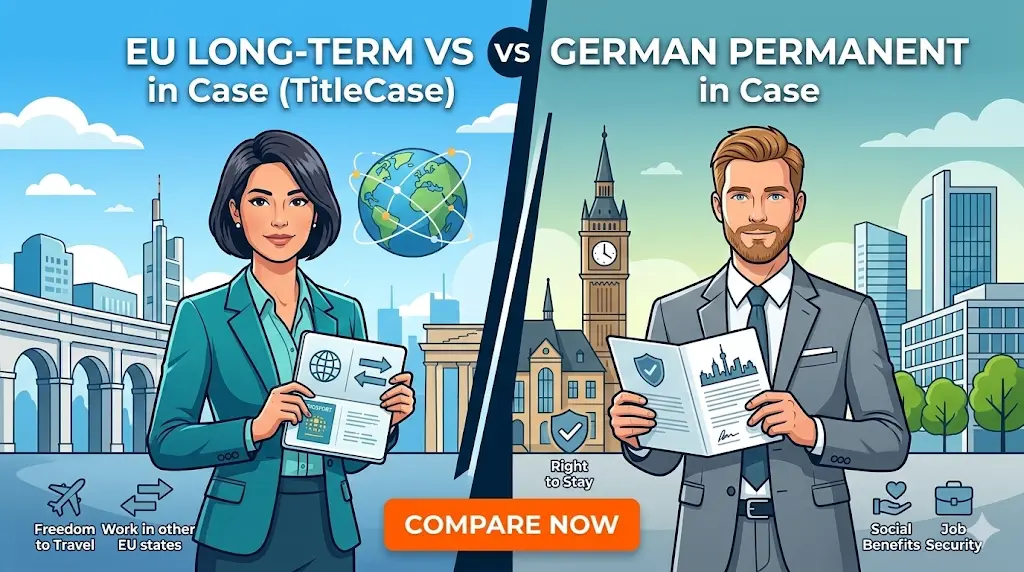
Timeline and Eligibility Criteria Compared
The single biggest source of frustration for expats applying for permanent residency is the sheer confusion surrounding the timelines. The two permits have vastly different countdown clocks, and understanding how your past years in Germany are calculated is critical.
The Strict Five-Year Rule for the EU Permit
To qualify for the Daueraufenthalt-EU, there are absolutely no shortcuts. You must have lived in Germany legally and continuously for exactly five years (60 months). Furthermore, you must have paid into the statutory German pension system (Rentenversicherung) for 60 months. The EU directive is incredibly rigid on this timeline.
The calculation of these 60 months is where many former students face heartbreak. If you spent years in Germany on a student visa, the Ausländerbehörde only counts that time at 50% value toward the EU permit. This means four years of studying only counts as two years of residency. You must make up the rest with full-time employment. If you are a fresh graduate trying to map out your timeline, reading Extending Your Stay: From Student Visa to Job Seeker Visa After Graduation will help you understand when your “full value” residency clock actually starts.
Fast-Track Options for the Niederlassungserlaubnis
The German Niederlassungserlaubnis is vastly superior when it comes to speed. While the baseline requirement is also five years, German national law offers massive fast-track exemptions for highly qualified expats. The German government desperately wants to retain talent, so they allow certain groups to bypass the 60-month waiting period entirely.
If you hold an EU Blue Card, you can secure the German permanent residence permit in just 27 months with basic A1 German, or a staggering 21 months if you possess B1 German skills. If you graduated from a German university, you only need 24 months of qualified employment. Standard skilled workers can apply after 36 months. None of these fast-tracks apply to the EU permit. If you want the deepest breakdown of how to qualify for these accelerated timelines, bookmark Permanent Residence Permit Niederlassungserlaubnis: How to Qualify in Germany.
Calculating Pension Contributions and Income
For both permits, proving your financial stability is paramount. The state demands absolute certainty that you will not rely on social welfare (Bürgergeld). You must present employment contracts, tax assessments, and a history of gapless pension contributions.
If you are applying for the Niederlassungserlaubnis via a fast-track, you only need to prove pension contributions for that shortened period (e.g., 21 months for an advanced Blue Card holder). However, if you are applying for the Daueraufenthalt-EU, you must prove the full 60 months of contributions. If you spent your early years here working marginal part-time jobs while studying, you might be missing critical pension months. To understand exactly how these contributions are withheld from your salary, take a look at Understanding Your German Payslip: Gross vs Net Salary Explained.
European Mobility and Expiration Rules
The true value of these permits becomes apparent the moment you pack a suitcase. Understanding the legal limitations of leaving Germany is the most vital factor in choosing between the two.
Leaving Germany: The Six-Month Expiration Trap
Many expats falsely believe that “permanent” means unconditional. It does not. If you hold the German Niederlassungserlaubnis and you leave Germany for more than six consecutive months, your permanent residency automatically expires and becomes invalid by operation of law.
There are minor exceptions to this rule—for example, if you are over 60 years old and have lived in Germany for 15 years, or if you apply for a special pre-approval from the Ausländerbehörde before you leave for an extended sabbatical. However, generally speaking, the German national permit chains your primary life center to Germany. If you take a one-year assignment in London or a nine-month trip back to your home country to care for a sick parent, your hard-earned German permanent residency vanishes.
The Superior Travel Rights of the Daueraufenthalt-EU
This is where the Daueraufenthalt-EU proves its worth. Because it is an integrated European permit, it offers vastly superior geographical flexibility. If you hold this permit, you can leave Germany and reside in a non-EU country (like the US, UK, or India) for up to 12 consecutive months without losing your status.
Even better, you can move to another participating European Union country (like France, Italy, or Spain) and live there for up to six years before your German permanent residency expires. This means you can essentially trial a life in another European country, knowing that your permanent safety net in Germany remains entirely intact for over half a decade.
| Feature | Niederlassungserlaubnis (German PR) | Daueraufenthalt-EU (EU PR) |
| Fast-Track Eligibility | Yes (21, 24, 27, or 36 months) | No (Strictly 60 months required) |
| Time Allowed Outside EU | Max 6 Months | Max 12 Months |
| Time Allowed in Other EU State | Max 6 Months | Up to 6 Years |
| Mobility/Work in Other EU States | Standard tourist rules (90 days) | Facilitated residency & work permits |
| Language Requirement | B1 (A1 for some Blue Card holders) | B1 |
Working in Other EU Member States
Another massive misconception is that the Daueraufenthalt-EU acts as a borderless work permit for the entire European Union. It does not mean you can simply drive to Amsterdam, rent an apartment, and start a new job on Monday morning without any paperwork.
However, it gives you highly preferential treatment. If you hold the Daueraufenthalt-EU from Germany and want to move to Austria, the Austrian government is bound by the EU directive to facilitate your local residence and work permit. You do not have to jump through the agonizing hoops of proving a local labor shortage; the path is smoothed out for you. The German Niederlassungserlaubnis offers none of this. To another EU country, holding a German national permit just makes you a standard third-country national tourist.
Navigating the Bureaucratic Application Process
Whether you choose the national or the European route, the documentation required by the immigration office is virtually identical and equally unforgiving. German bureaucracy demands perfection.
Gathering Financial Proofs and Housing Contracts
The caseworker will ruthlessly scrutinize your financial history. They want to see a trajectory of total self-sufficiency. If you can show that you successfully evolved from a student who relied on a Expatrio blocked account to a high-earning professional, you establish exactly the narrative they want to see. Demonstrating that you have always respected the financial boundaries set by the state—historically proven by managing your funds via Expatrio during your temporary visa years—goes a long way in establishing trust.
You must also prove that your living situation is stable. You will need a formal, indefinite rental contract and a recent letter from your landlord confirming you still live there. The state requires sufficient square footage for every member of your family, so squeezing into a tiny studio will trigger an immediate rejection. To prepare for the realistic costs of maintaining an appropriate apartment over these five years, refer to Cost of Living in Germany: Budgeting for Your First Year as an Expat.
Translating Foreign Documents and Vital Records
You cannot secure permanent residency without providing your birth certificate, and if applicable, your marriage certificate and the birth certificates of your children. Because the Ausländerbehörde operates strictly in German, any document issued in English, Spanish, Hindi, or Arabic must be officially translated.
The German government does not accept translations from casual online services or foreign notaries. You must provide translations executed by an officially sworn, court-approved translator (vereidigter Übersetzer). Hunting down a certified translator locally is an unnecessary headache. Veteran expats use digital platforms like Lingoking to bypass this bottleneck. You just upload high-quality scans of your vital records, and Lingoking assigns them to a certified German sworn translator. The legally binding, stamped translations are mailed directly to your door, guaranteeing they will pass the immigration office’s strict standards. Utilizing Lingoking ensures a missing official stamp doesn’t derail your five-year journey.
Securing Bulletproof Health Insurance Records
The immigration office will demand proof of continuous, gapless health insurance coverage for your entire stay in Germany. A single month of being uninsured can lead to a rejection of your permanent residency application.
If you transitioned between the public and private health insurance systems over the last five years, pulling these historical records can be terrifying. This is exactly where managing your policies through an English-first digital broker like Feather Insurance becomes a lifesaver. The support team at Feather Insurance can instantly generate the exact comprehensive, visa-compliant coverage timelines the immigration office demands. Handing the caseworker a pristine insurance history provided by Feather Insurance immediately shuts down any interrogations about your healthcare compliance. If you are still debating which insurance system serves your long-term goals best, review Public vs Private Health Insurance: Which One Should You Choose?.
Which Permit Should You Choose?
Deciding between the Niederlassungserlaubnis and the Daueraufenthalt-EU comes down to your personal timeline and your long-term European ambitions.
When to Pick the German Niederlassungserlaubnis
If you are a highly skilled worker, a Blue Card holder, or a recent graduate of a German university, the Niederlassungserlaubnis is almost always the smarter initial play. The ability to lock down permanent residency in two or three years—freeing you from employer dependency and temporary visa anxiety—is too valuable to pass up.
You should take the fast-track German permanent residency the moment you are eligible. It provides immediate security, makes it infinitely easier to get a mortgage, and allows you to switch jobs freely. Once you have it, you can simply live your life and wait until you hit the 60-month mark, at which point you can always apply for the EU permit as an upgrade.
When the Daueraufenthalt-EU is the Smarter Play
If you have already lived in Germany for five years on a standard work visa, or if you are a freelancer who finally reached the 60-month mark of pension contributions, you should apply directly for the Daueraufenthalt-EU.
Because you have already met the grueling time requirement, there is almost no reason to apply for the geographically restricted German national permit. The Daueraufenthalt-EU gives you the exact same rights inside Germany, but adds the massive benefit of European mobility and extended travel allowances. It is the ultimate insurance policy for a transnational life. If you dream of one day taking a year off to travel the world or eventually moving your career to another EU capital, this is the permit that safeguards your right to always return to Germany.
Securing permanent residency is an exhausting administrative marathon. But by strategically choosing the right permit, securing flawless translations with Lingoking, maintaining bulletproof insurance records via Feather Insurance, and proving your historical financial stability managed by platforms like Expatrio, you can permanently break the cycle of temporary visas and claim your home in Europe.
References
Primary sources (official)
- Make it in Germany: The federal government’s official portal detailing the exact legal differences, mobility rights, and requirements between the Settlement Permit and the EU Long-Term Residence Permit.https://www.make-it-in-germany.com/en/visa-residence/living-permanently/eu-long-term-residence-permit
- Federal Office for Migration and Refugees (BAMF): Official immigration directives clarifying the EU Directive 2003/109/EC and how the 60 months of residency and pension contributions are calculated.https://www.bamf.de/EN/Themen/MigrationAufenthalt/ZuwandererDrittstaaten/Migrathek/Niederlassungserlaubnis/niederlassungserlaubnis-node.html
Other helpful sources
- European Commission – Immigration Portal: Broad overview of the rights granted to non-EU citizens who acquire long-term resident status across participating member states.https://immigration-portal.ec.europa.eu/general-information/long-term-residents_en
- Federal Ministry of the Interior and Community (BMI): Documentation on the specific expiration rules for residence titles when a foreign national leaves the Federal Republic of Germany.https://www.bmi.bund.de/EN/topics/migration/law-on-foreigners/law-on-foreigners-node.html
Disclaimer
The information provided in this article is for general informational and educational purposes only and does not constitute professional legal, financial, or immigration advice. German citizenship laws, the specific visa eligibility criteria for Elterngeld, health insurance enrollment rules managed by brokers, financial deposit requirements via platforms, and sworn translation regulations for services are highly complex and subject to continuous legislative updates. Always consult directly with the local Ausländerbehörde (Foreigners Office), the Standesamt (Civil Registry), or a certified immigration lawyer (Fachanwalt für Migrationsrecht) regarding your specific family situation and visa status in Germany.