Legalizing and Translating Documents for German Visa Applications
Getting a visa rejected simply because an official birth certificate lacked a specific rubber stamp is a devastating, uniquely German rite of passage. I once had a major work permit delayed for three months over a single untranslated signature. This guide decodes the excruciating process of legalizing, authenticating, and translating your foreign documents so the embassy actually accepts them.
Disclosure: This post may contain affiliate links. We may earn a commission at no extra cost to you if you make a purchase through these links. Read full disclosure.
The German Bureaucratic Mindset: Why Your Originals Aren’t Enough
Before you begin gathering your paperwork, you must fundamentally understand how the German administrative state views foreign documents. If you hand a German consular officer a pristine, beautifully embossed university degree from a foreign country, they do not see a valid credential. They see an unverified piece of paper that could easily have been printed in a basement.
The Fundamental Distrust of Foreign Paperwork
The German immigration system operates on a doctrine of absolute, verifiable proof. They do not assume positive intent, and they do not operate on the honor system. The burden of proof rests entirely on your shoulders to demonstrate that a foreign document—whether it is a marriage certificate, a university diploma, or a police clearance check—was genuinely issued by a competent, legal authority in your home country.
This inherent skepticism frustrates thousands of expats annually. You know your birth certificate is real because you have had it your entire life. The German official, however, requires a documented chain of custody that connects the signature on your birth certificate directly to an international legal treaty. Until that chain of trust is established, your document holds absolutely zero legal weight in the Federal Republic of Germany. Understanding this rigid philosophy is the absolute first step in mastering the Documents Required for German Visa Applications: Complete Guide.
The Three Tiers of Document Verification
To establish this chain of trust, Germany places all foreign documents into one of three distinct tiers, depending entirely on the country that issued the document. Your relocation timeline depends completely on which tier your home country falls into.
The first tier is the easiest: documents issued within the European Union or the European Economic Area (EEA). Due to sweeping EU regulations, civil status documents like birth and marriage certificates issued in other EU member states are generally exempt from any form of legalization in Germany. They are accepted as genuine on their face.
The second tier involves countries that are members of the Hague Apostille Convention. For these nations, a streamlined, single-stamp authentication process is required. The third and final tier applies to countries outside of this international treaty. If your document originates from a tier-three country, you are subjected to Consular Legalization, which is arguably the most agonizing, time-consuming administrative hurdle in the entire German immigration process. To map out how these tiers affect your overall timeline, you should heavily review our Germany Immigration Checklist: 10 Steps to Moving Legally.
Demystifying the Apostille Process
If you are fortunate enough to hold documents from a country that participates in the Hague Convention—such as the United States, the United Kingdom, Australia, India, or South Africa—your authentication process is governed by a single, internationally recognized certificate known as an Apostille.
What is the Hague Apostille Convention?
The Hague Convention Abolishing the Requirement of Legalisation for Foreign Public Documents of 1961 was created specifically to end the nightmare of multi-step diplomatic authentications. An Apostille is a standardized certificate, usually glued or stapled to the back of your original public document, which legally authenticates the origin of the underlying document.
Crucially, an Apostille does not certify that the content of the document is accurate or true. It merely certifies the authenticity of the signature on the document, the capacity in which the person signing the document acted, and the identity of the seal or stamp it bears. When a German official sees a valid Apostille from a partner nation, international law dictates that they must accept the signature on your document as genuine without requiring any further verification from the German embassy.
It is vital to note that Apostilles are strictly for “public documents.” This includes civil registry documents (birth, marriage, and death certificates), court rulings (like divorce decrees), and notarized documents. It generally does not cover purely private contracts or administrative documents related directly to commercial or customs operations.
How to Obtain an Apostille in Your Home Country
The German government cannot issue an Apostille for a foreign document. You must obtain the Apostille from the designated competent authority in the exact country where the document was originally issued.
The process varies wildly depending on your homeland. In the United States, for example, vital records like birth certificates are issued at the state level. Therefore, you must mail your original birth certificate to the Secretary of State in the specific state where you were born to receive the Apostille. If you have a federally issued document, such as an FBI background check, you must send it to the US Department of State in Washington, D.C. In the UK, the Foreign, Commonwealth & Development Office (FCDO) handles all Apostilles centrally.
Because you must often mail original documents to government offices, the Apostille process can take anywhere from two weeks to three months. If you are currently living in Germany and suddenly realize your foreign marriage certificate lacks an Apostille, you will be forced to courier your original documents back across the globe, halting your visa application. This is a common, terrifying reality for spouses attempting to navigate Family Reunification in Germany: Ultimate Guide for Bringing Your Loved Ones. You must secure all necessary Apostilles before you board your flight to Europe.
Surviving Consular Legalization The Hard Path
If your document was issued in a country that is not a member of the Hague Apostille Convention—or if Germany has formally objected to that country’s accession to the treaty—the streamlined Apostille process is legally blocked. You must instead navigate the brutal gauntlet of Consular Legalization.
Navigating Non-Hague Member States
Consular Legalization is the traditional, agonizingly slow method of international document authentication. Unlike the Apostille, which relies on a single stamp from your home government, Legalization requires the German diplomatic mission (the local German embassy or consulate) in the issuing country to physically verify the document themselves.
The German embassy cannot simply look at a random local birth certificate and know if the local clerk’s signature is genuine. Therefore, they require a meticulous chain of domestic authentications before they will even touch the paper. This process typically originates in nations with complex or historically less secure civil registries, and it demands intense patience and logistical planning from the expat.
If you attempt to bring an unlegalized document from one of these countries directly to the local immigration office in Germany, the clerk will reject it instantly. They will instruct you to send it back to your home country to begin the legalization chain, effectively pausing your life and jeopardizing your job offer. If you are terrified of facing this rejection at a municipal desk, you must study the behavioral strategies outlined in Navigating the Ausländerbehörde: Tips for Dealing with German Immigration Offices.
The Embassy Chain of Authentication
The Legalization chain is a strict, multi-step process that must be followed in exact chronological order. First, your original document must usually be certified by a local notary public or the issuing municipal authority in your home country.
Second, that notarized document must be taken to your home country’s Ministry of Foreign Affairs (or equivalent domestic ministry). The Ministry will review the local notary’s signature, confirm it is valid, and attach their own official government seal to the document. They are essentially telling the world, “Our national government verifies that this local official is legitimate.”
Finally, you must take the document—now bearing your Ministry’s seal—to the German embassy or consulate in that country. The German consular officers keep a registry of signatures from your Ministry of Foreign Affairs. They will match the Ministry’s signature on your document to their internal registry. Once verified, the German embassy affixes the final Legalization stamp. Only then is the document legally valid for use inside the Federal Republic of Germany. This chain can take months to complete and often requires hiring local legal agents in your home country if you have already moved abroad.
| Authentication Type | Applicable Countries | Authority Issuing the Final Stamp | Average Complexity | Processing Time |
| No Authentication | EU / EEA Member States | None required | Very Low | Immediate |
| Apostille | Hague Convention Members (e.g., US, UK, Australia) | Designated domestic authority (e.g., Secretary of State) | Moderate | Weeks |
| Legalization | Non-Hague Members (e.g., UAE, Nigeria, previously Canada) | German Embassy/Consulate in the issuing country | Extremely High | Months |
Translating Your Documents for German Authorities
Authentication proves a document is real, but translation proves what it actually says. The German administrative state operates exclusively in the German language. While some progressive embassy officers might occasionally accept English-language bank statements, relying on that leniency for vital legal documents is a recipe for visa denial.
The Myth of the Bilingual Friend
One of the most devastating financial traps expats fall into is attempting to save money by having a bilingual friend translate their documents, or by hiring a cheap, generic online translation agency. The German immigration office will flatly reject these translations.
In Germany, legal translation is a highly regulated profession. The authorities do not care if a translation is technically accurate; they care if the translator is legally accountable for that accuracy. A standard translation agency has no legal standing in a German court. If you submit a commercial translation of your university degree, the caseworker will hand your entire file back to you and instruct you to start over.
Why Sworn Translators Are Non-Negotiable
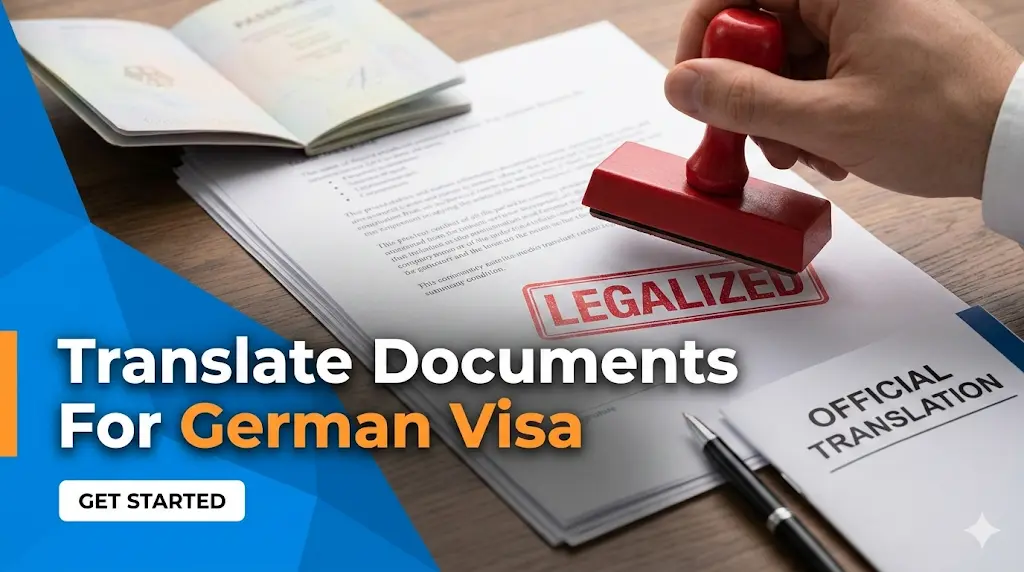
To satisfy the German authorities, your foreign documents must be translated by a vereidigter Übersetzer—a Sworn Translator. These are elite linguists who have taken a formal oath before a German regional court. They possess a specific, legally binding rubber stamp. When a sworn translator stamps your document, they are assuming legal liability under German law for the absolute accuracy of the translation.
The immigration office trusts the sworn translator’s stamp, completely removing the burden of language verification from the caseworker. However, finding a sworn translator who specializes in your specific dialect or obscure native language can be incredibly difficult, especially if you are applying from abroad.
This is where utilizing a dedicated platform like Lingoking becomes an absolute lifesaver. Instead of desperately searching German municipal directories, Lingoking connects you instantly with an entire network of court-certified sworn translators. You upload your authenticated documents, and they return a physical, stamped translation that the German embassy is guaranteed to accept. Do not risk your relocation on a cheap translation; the peace of mind provided by a legally binding service is worth every cent.
Managing the Translation Timeline and Costs
Translations must be the absolute final step in your document preparation journey. This is a crucial chronological rule that countless expats violate. You must never translate a document before it has received its Apostille or Consular Legalization.
Why? Because the German authorities require the Apostille or the Legalization stamps themselves to be translated into German. The stamps and seals attached by your home government contain vital legal text, and the German caseworker must be able to read that text. If you translate your birth certificate, and then get an Apostille attached to it later, your translation is incomplete and will be rejected.
You must first obtain the original document, successfully navigate the Apostille or Legalization process, and then submit the fully stamped, finalized packet to your sworn translator via Lingoking. The translator will physically attach their certified German translation to copies of your authenticated originals, folding the corners and stamping them together with specialized rivets or seals to prove the translation belongs to that specific authenticated document.
Integrating Authenticated Documents into Your Visa Portfolio
Understanding the theory of legalization and translation is useless if you cannot strategically deploy these documents during your visa interview. Different visas require different levels of intense documentary proof, and failing to authenticate the correct papers will derail your specific pathway.
Academic Verification for Students and Professionals
If you are moving to Germany to pursue higher education or to take up a highly skilled corporate role, the authentication of your academic history is the absolute center of gravity for your application.
The German embassy will rigorously verify these degrees against the Anabin database. While the database proves the university is recognized, your physical diploma and your academic transcripts must still be properly authenticated and translated by a sworn translator to prove they genuinely belong to you.
Similarly, international students must present flawless academic records to secure their university admission letters. Alongside these academic documents, students and job seekers must provide massive financial proofs to the embassy, showing they will not rely on German welfare. Fortunately, the documents proving your financial solvency—specifically the confirmation PDFs generated by opening a Blocked Account—are already issued in compliant German and English. Utilizing a certified provider like Expatrio to secure your funds means the resulting financial documents bypass the translation and legalization nightmare entirely. You simply print the Expatrio confirmation and hand it to the consular officer, saving you weeks of administrative stress.
Vital Records for Family Reunification and Beyond
The most intense scrutiny applied by the German immigration system is reserved for civil status documents. If you are attempting to bring your spouse or your children to Germany, your marriage certificates and birth certificates will be examined under a microscope.
Because marriage fraud and child trafficking are severe international concerns, the German embassy demands absolute, verified proof of your familial relationships. A marriage certificate from a non-EU country must almost universally bear an Apostille or Consular Legalization. Furthermore, any previous divorce decrees or child custody court orders must also be fully authenticated and translated by a sworn translator. A single missing Apostille on a custody document will completely freeze a family reunification application.
Amidst this mountain of translated vital records, you must also provide proof of comprehensive health insurance for every family member. Trying to translate foreign insurance policies to prove they meet German standards is a losing battle. The embassy frequently rejects them. To bypass this, you must secure German-compliant coverage before your appointment. Using an English-first, specialized expat broker like Feather Insurance allows you to instantly generate policy documents that are already formatted precisely for the German immigration office. Handing the caseworker a pristine, compliant certificate from Feather Insurance instantly satisfies the medical requirement without needing a single sworn translation.
The German bureaucratic system is intimidating, rigid, and deeply frustrating. However, it operates on a highly logical set of international rules. By respecting the sequence of authentication, securing your Apostilles, investing in sworn translations, and presenting a flawless portfolio, you will conquer the administrative anxiety and successfully secure your right to live in Germany.
References
Primary sources (official)
- Federal Foreign Office – International Recognition / Legalization of Documents: https://www.auswaertiges-amt.de/en/visa-service/konsularisches/urkundenverkehrallgemeines-node
- Federal Foreign Office – Foreign public documents for use in Germany: https://www.auswaertiges-amt.de/en/visa-service/konsularisches/urkundenverkehrallgemeines-node/urkundenverkehrteilb-node
Other helpful sources
- Hague Conference on Private International Law (HCCH) – Apostille Section: https://www.hcch.net/en/instruments/conventions/specialised-sections/apostille
Disclaimer
This guide is provided for informational purposes only and does not constitute formal legal or immigration advice. German embassy protocols, Hague Convention member statuses, and requirements for Consular Legalization change frequently and vary heavily depending on the issuing country of your documents. Always consult the official website of the German embassy in your home country or seek professional counsel from a certified German immigration lawyer before paying for document authentications, sworn translations, or submitting formal visa applications.