Cost of Utilities in Germany: Average Prices for Electricity, Gas, Water
Opening an unexpected 500-euro back-payment letter for heating is a terrifying expat initiation rite that destroys your monthly budget. I once received a massive gas bill simply because I didn’t understand how German estimated payments worked. This guide breaks down the true cost of utilities in Germany, explaining electricity, gas, and water prices so you avoid nasty financial surprises.
Disclosure: This post may contain affiliate links. We may earn a commission at no extra cost to you if you make a purchase through these links. Read full disclosure.
The Difference Between Warmmiete and Kaltmiete
Decoding the Ancillary Costs
When you first start browsing German apartment listings, you will immediately encounter two distinct rental prices: the Kaltmiete (cold rent) and the Warmmiete (warm rent). The Kaltmiete is exactly what it sounds like—the baseline price for the empty, cold physical space. It does not include a single utility or service. The additional costs layered on top of the cold rent are officially known as the Nebenkosten (ancillary costs).
Understanding what exactly is legally classified as Nebenkosten is crucial. These fees cover building-wide operational expenses, including property taxes, elevator maintenance, stairwell cleaning, street sweeping, garbage collection, and building insurance. For an in-depth look at how these complex terms dictate your tenancy and liabilities, review Understanding German Rental Contracts: Key Terms and Conditions.
What is Actually Included in Your Warm Rent
The Warmmiete is calculated by adding the Kaltmiete and the estimated monthly Nebenkosten together. However, a massive shock for many expats is that “Warm” does not necessarily mean “all-inclusive.” In the vast majority of traditional, unfurnished German apartments, the Warmmiete only includes water, centralized heating, and the aforementioned building fees.
Electricity is almost never included in the standard Warmmiete. You are entirely responsible for finding your own electricity provider, signing a contract, and paying a separate monthly bill directly to the power company. Furthermore, if your apartment has a gas boiler inside the individual unit rather than a centralized building heating system, you will also have to set up your own private gas contract. Accurately anticipating this rigid separation of costs is vital for your financial planning, which you can map out using Cost of Living in Germany: A Realistic Budget for Expats.
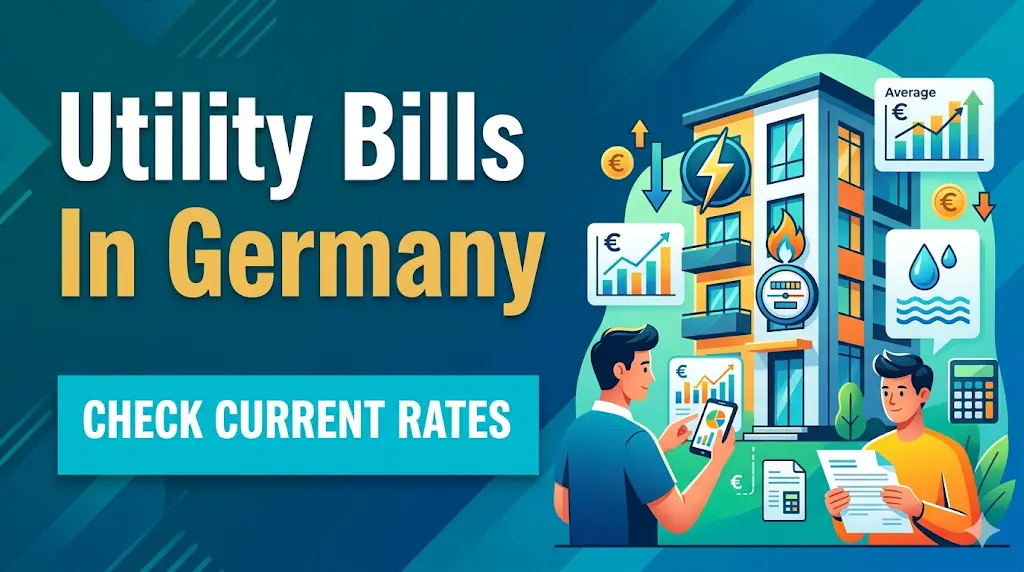
Breaking Down the Average Prices for Utilities
Electricity Costs and the Default Provider Trap
Germany consistently has some of the highest electricity prices in Europe, driven by taxes, grid fees, and the transition to renewable energy. As of recent Eurostat and Destatis reporting, the average household electricity price hovers around 38 to 40 cents per Kilowatt-hour (kWh). For a single person living in a standard apartment, this typically translates to an electricity bill of €50 to €70 per month. For a couple or a family working from home, it can easily exceed €100.
When you move into a new apartment, the electricity works immediately. This is because you are automatically enrolled in the Grundversorgung (basic supply) provided by the local municipal utility company. However, the Grundversorgung is notoriously the most expensive tariff available on the market. You must actively compare providers online and switch to a private, fixed-term contract to lock in a cheaper rate per kWh. For a step-by-step walkthrough on executing this switch safely, consult A Guide to German Utilities: Setting Up Electricity Gas and Water.
Gas and Heating Expenses
Heating costs in Germany vary wildly depending on the energy efficiency of the building you rent. An older, historic building with high ceilings and poor insulation will cost significantly more to heat than a modern, heavily insulated new build. Average gas prices have stabilized after recent global spikes, generally costing around 10 to 14 cents per kWh.
If heating is included in your Nebenkosten, you will pay a fixed monthly estimate to your landlord. If you set up your own gas contract, you will pay the provider directly. A single person might pay €60 to €90 a month for gas heating, while larger families in older homes can easily face monthly heating costs exceeding €150 during the harsh winter months.
Water and Waste Management Fees
Water and sewage costs are almost universally rolled into the building’s Nebenkosten and paid directly to the landlord. Cold water is relatively inexpensive, usually costing around €2 to €3 per cubic meter depending on your municipality. However, the cost of the energy required to heat that water is what drives the bill up.
Waste management fees are also included in your warm rent. The size of the building’s designated trash bins and the frequency of municipal pickup dictate the exact cost, which is then mathematically split among the tenants based on the square footage of their apartments.
| Utility Type | Average Monthly Cost (1 Person) | Average Monthly Cost (2-3 People) | How it is Paid |
| Electricity | €50 – €70 | €80 – €120 | Separate private contract |
| Heating / Gas | €60 – €90 | €100 – €160 | Usually in Nebenkosten (or private gas contract) |
| Water | €15 – €25 | €30 – €50 | Included in Nebenkosten |
| Broadcasting Tax | €18.36 | €18.36 (Per household) | Separate direct payment to the state |
Remember, you must also independently register and pay the mandatory public broadcasting tax, regardless of whether you actually own a television or consume German media. Read Understanding the Rundfunkbeitrag Fee: Why You’re Charged €18 Every Month to ensure you avoid massive state fines.
The Infamous End of Year Reconciliation
Why You Might Owe Thousands in Back Payments
Utility billing in Germany operates on an estimation model known as the Abschlag. Your monthly utility payment—whether paid to the landlord or directly to the electricity provider—is merely a pre-calculated estimate based on the previous tenant’s consumption or the average square footage of the apartment.
Once a year, the physical utility meters in your basement or hallway are read by a technician. The landlord or provider then issues the dreaded Nebenkostenabrechnung (utility cost reconciliation). They calculate exactly how much energy and water you actually consumed over the last twelve months. If you used less than your monthly estimates covered, you receive a joyful refund. However, if you blasted the heating all winter, you will receive a Nachzahlung—a lump sum invoice demanding the difference within 30 days.
It is incredibly common for unaware expats to receive back-payment demands of €500 to €1,000. Navigating these aggressive, formal letters is a primary reason you must master the local paperwork, a skill explored in Bureaucracy Basics: Understanding Bescheinigung Anträge and Other Paperwork.
Strategies to Lower Your Monthly Consumption
Because the cost of energy is so high, adopting German conservation habits is a strict financial necessity. The absolute most effective strategy is shock ventilation. Instead of leaving a window tilted open all day—which lets out all your expensive heating—Germans turn off the radiators completely, open all windows wide for five minutes to circulate fresh air, and then close them tightly to trap the warmth.
Technology is also your best defense against the end-of-year reconciliation bill. Replacing outdated analog radiator dials with programmable smart thermostats is highly recommended. You can easily order affordable smart thermostats on Amazon Germany and install them without any complex tools. Furthermore, checking for window drafts and buying simple draft excluders from Amazon Germany will significantly trap the heat inside your flat. Finally, swapping out every old incandescent bulb in your apartment for highly energy-efficient LED bulbs sourced from Amazon Germany will immediately drive down your monthly electricity consumption.
Managing Utilities During Your Expat Transition
Setting Up Contracts Without German Skills
If you move into an unfurnished apartment, setting up your electricity, internet, and gas contracts requires intense administrative stamina. The online application portals and the dense legal terms and conditions are strictly in German. Furthermore, securing these contracts often requires you to have already completed your civil registration and opened a local bank account. If you are lacking these documents, utility providers might flag your application or demand hefty security deposits.
To ensure you have the foundational paperwork required to sign utility contracts, you must review the Registering Your Address Anmeldung Step by Step Guide. Setting up a Wi-Fi connection is notoriously the slowest part of this entire process, often requiring weeks of waiting for a technician to activate the line. You can minimize this stress by preparing early and consulting How to Set Up Internet in Germany Without German Skills English Friendly Providers.
Why Furnished Apartments Eliminate the Headache
During the vulnerable first year in a new country, managing the anxiety of the yearly reconciliation bill and setting up monolingual utility contracts is incredibly demoralizing. This is exactly why so many expats rely entirely on furnished housing platforms during their transition period.
When you secure an apartment through Wunderflats, the utility structure changes dramatically. In most cases, booking a flat on Wunderflats means you are paying a flat-rate warm rent that genuinely includes all utilities: electricity, heating, water, and active high-speed internet.
Living in a Wunderflats apartment shields you from the volatile energy market. You do not have to negotiate with the local providers in broken German, and you do not have to live in fear of a €1,000 back-payment invoice arriving in the mail in December. A Wunderflats landlord manages the meter readings and the provider contracts, granting you total financial predictability. This predictable cost structure gives you the mental bandwidth to focus on your new job and the broader administrative hurdles detailed in Anmeldung Address Registration vs Visa Why Both Are Needed in Germany.
References
Primary sources (official)
- Eurostat – Electricity price statistics: https://ec.europa.eu/eurostat/statistics-explained/index.php?title=Electricity_price_statistics
- Federal Statistical Office (Destatis) – Consumer Price Index and Energy: https://www.destatis.de/EN/Themes/Economy/Prices/Consumer-Price-Index/energy.html
- Make it in Germany – Employment and Earnings (Cost of Living): https://www.make-it-in-germany.com/en/living-in-germany/discover-germany/employment-earnings
Other helpful sources
- BDEW (Federal Association of Energy and Water Management) – Electricity Price Analysis: https://www.bdew.de/service/daten-und-grafiken/strompreis-fuer-haushalte/
- Expatica – Setting up utilities in Germany: https://www.expatica.com/de/housing/utilities/utilities-in-germany-106764/
Disclaimer
The information provided in this guide is for general informational purposes only and is based on the real-world experiences of expats navigating the German utility and housing markets. Average utility prices, the legal parameters of the Nebenkostenabrechnung, and energy taxes are subject to frequent fluctuations based on global energy markets and federal German policy. This article does not constitute legal, financial, or tax advice. Always carefully review your rental contract and specific utility tariffs, ideally with the help of a local tenants’ association (Mieterverein), to fully understand your personal financial liabilities.