Du or Sie? Navigating Formal and Informal German Address
I once enthusiastically addressed a notoriously strict Munich police officer with a casual “Du,” and the resulting icy glare and immediate passport check instantly taught me the gravity of German pronouns. For English speakers, navigating the formal and informal “you” is an absolute social minefield. This guide decodes the rigid rules of German address so you can communicate with cultural confidence.
Disclosure: This post may contain affiliate links. We may earn a commission at no extra cost to you if you make a purchase through these links. Read full disclosure.
The Cultural Weight of German Pronouns
Why the Distinction Matters So Deeply
To truly understand why the choice between Du and Sie causes so much anxiety, you must first understand the German cultural psyche. If you originate from an English-speaking country, you are accustomed to a language that democratized its pronouns centuries ago. The English “you” is universally applicable; it serves perfectly whether you are yelling at a reckless driver in traffic, sweet-talking your romantic partner, or formally addressing a supreme court judge. Because “you” carries no inherent hierarchical weight, English speakers naturally assume that translated pronouns function the same way. This is a massive, culturally dangerous assumption.
In Germany, pronouns are load-bearing pillars of the social structure. They immediately establish the nature of the relationship, the level of respect, and the exact distance between two individuals. Using the formal Sie is not merely a linguistic quirk; it is a physical and psychological boundary line drawn in the sand. It tells the other person, “I respect your autonomy, I recognize our professional distance, and I am not assuming an intimacy we have not yet earned.”
Conversely, using the informal Du when it has not been officially permitted is perceived as a violent crossing of that boundary line. To a German, an uninvited Du from a stranger or a junior colleague feels incredibly invasive, patronizing, and disrespectful. It triggers the same internal alarm bells that an American might feel if a complete stranger walked up and hugged them without warning.
The Fundamental Linguistic Divide
The difference between Du and Sie is not just a matter of swapping out a single word; it forces you to alter the entire grammatical structure of your sentence. The formal Sie (always written with a capitalized ‘S’) grammatically acts like the third-person plural (“they”). The informal du acts as the second-person singular. If you want to ask someone where they live, you must mentally calculate the social relationship before you even open your mouth to conjugate the verb. It is either the formal “Wo wohnen Sie?” or the informal “Wo wohnst du?”
Furthermore, the pronoun choice dictates how you use the person’s name. The formal Sie is strictly paired with the person’s title and last name (e.g., “Guten Morgen, Herr Müller”). You never, under any circumstances, use the formal Sie combined with just a first name unless you are explicitly invited into a very specific, rare social gray area. The informal du is paired exclusively with the first name (e.g., “Hallo, Thomas”).
For adult expats trying to learn the language from scratch, this mental gymnastics slows down conversational fluency immensely. You will frequently find yourself pausing mid-sentence, terrified of conjugating the verb incorrectly and offending your conversational partner. To build the necessary muscle memory, it is highly recommended to purchase a comprehensive, localized grammar workbook directly from Amazon Germany, allowing you to drill these specific conjugations daily until they become second nature.
The Psychological Boundary of ‘Sie’
Many expats initially view the formal Sie as cold, elitist, or needlessly rigid. They long to break down the barrier and reach the casual, friendly du stage as quickly as possible. However, seasoned expats eventually realize that the Sie is actually a highly protective psychological tool. It is the linguistic equivalent of the famous German “Coconut” cultural model: a hard, protective outer shell that guards the soft, private interior.
The Sie protects you from the emotional labor of false intimacy. When a cashier or a bank teller addresses you as Sie, they are maintaining a sterile, highly efficient transactional environment. You do not have to pretend to be their friend, and they do not have to pretend to be yours. This clear delineation allows Germans to compartmentalize their lives effectively.
When you encounter conflict, the Sie becomes a brilliant armor. If you are disputing a deeply frustrating utility charge, maintaining the Sie keeps the argument strictly professional and objective. It prevents the conflict from becoming a personal, emotional attack. You are fighting the issue, not the person.
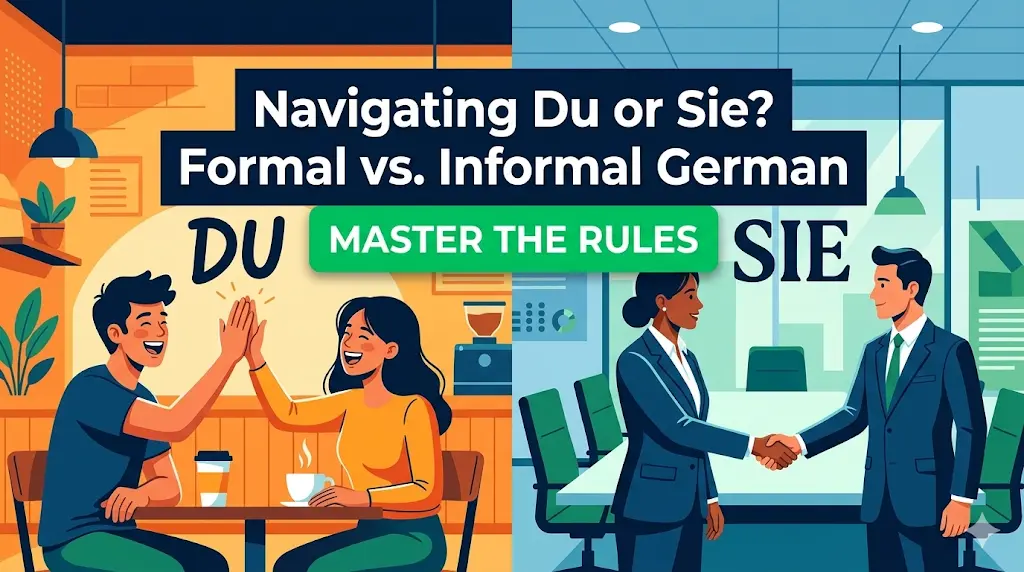
Decoding the German Workplace Hierarchy
Traditional Corporate Environments and the Mittelstand
If you secure a job in a traditional German industry—such as banking in Frankfurt, automotive manufacturing in Stuttgart, or a classic mid-sized family company (Mittelstand)—the rules regarding Sie are absolute, uncompromising, and highly hierarchical. From the moment you walk through the corporate lobby on your first day, everyone is Sie. You will use Sie when speaking to the CEO, your direct manager, the accounting department, and the front desk receptionist.
In these traditional environments, the Sie protects the chain of command. It ensures that professional feedback, no matter how blunt, is received as objective data rather than a personal insult. If a manager uses Sie to critique your project, it reinforces that the critique is about the company’s output, not your personal worth. Attempting to force the informal du in this setting to appear “friendly” or “approachable” will severely backfire, marking you as unprofessional or naive to the established corporate culture.
You must also extend this formality to written communication. Internal emails, memos, and Slack messages in traditional companies adhere strictly to the formal address unless your department has a specific exception.
Startup Culture and the Rise of the English Bubble
In stark contrast to the Mittelstand, the tech startups and international agencies located in Berlin, Munich, and Hamburg operate in an entirely different linguistic universe. These companies often declare English as their official corporate language. However, when the staff does speak German, there is an immediate, company-wide policy of using the informal du.
In a modern startup, everyone from the 22-year-old junior intern to the 50-year-old founder uses du with each other from day one. This flat hierarchy is designed to foster rapid innovation, open communication, and a sense of “team family.” For expats landing in these environments, it feels incredibly familiar and comfortable, mirroring the casual tech culture of Silicon Valley or London.
However, this startup environment is a dangerous linguistic trap. It creates an “English Bubble.” Expats can spend five years working in a Berlin tech hub using only the casual du and high-fives, failing to ever learn the rigid rules of the formal Sie. When they eventually leave the startup world to interact with the traditional German infrastructure—such as buying a house or dealing with the tax office—they are completely paralyzed.
Handling Clients and External Partners
Even if you work in the most hyper-casual, bean-bag-chair-filled startup where the CEO is your best friend, the rules instantly snap back to traditional conservatism the moment an external client or business partner enters the room. Business-to-Business (B2B) communication in Germany is strictly Sie territory until the client explicitly dictates otherwise.
If your casual tech agency is pitching a software solution to a traditional Bavarian insurance company, your entire presentation must be conducted using the formal Sie. Addressing the 60-year-old purchasing director of an insurance firm with an informal du will likely cost you the contract on the spot. It conveys a shocking lack of respect and suggests that your company lacks the maturity to handle a serious account.
This requires the mental agility to code-switch rapidly. You might turn to your colleague and whisper, “Kannst du mir die Mappe geben?” (Can you give me the folder?), and then instantly turn to the client and say, “Hier sind Ihre Unterlagen, Herr Schmidt” (Here are your documents, Mr. Schmidt). Mastering this rapid transition is essential for advancing into client-facing roles. To ensure you look the part when making these formal transitions, investing in a high-quality, professional leather portfolio from Amazon Germany is a subtle but highly effective way to project competence.
Navigating Social Scenarios and Daily Life
Meeting New Acquaintances and Friends of Friends
Moving outside the office, the social rules of the pronoun become slightly more fluid, heavily dependent on the context of the gathering and the age of the participants. As a general rule of thumb among younger generations (under 40), social settings like house parties, bars, or casual sports clubs are designated du zones.
If you attend a barbecue hosted by a colleague, and they introduce you to their university friends, you can safely assume the informal du right away. “Hallo, ich bin Sarah, woher kommst du?” is perfectly acceptable here. Using the formal Sie at a casual house party full of thirty-somethings would make you seem incredibly stiff, awkward, and socially inept. The shared connection of the host automatically fast-tracks the intimacy level.
However, age differences still command respect. If you are 25 and you are introduced to your friend’s 65-year-old parents at a gathering, you absolutely must use the formal Sie (“Freut mich, Sie kennenzulernen, Frau Weber”). You must maintain this formality until the parents explicitly invite you to use du. Navigating these nuanced private settings is a core component of integrating and Making Friends in Germany: Social Tips for Expats.
Interacting with Neighbors and Landlords
One of the most frequent and severe mistakes newly arrived expats make involves their living situation. In Germany, your landlord (Vermieter) and your neighbors (Nachbarn) are strictly Sie until proven otherwise. The relationship with a landlord is a legal, financial transaction governed by complex tenancy laws. It is not a friendship. Always address your landlord as “Herr/Frau [Last Name]” and use Sie in all emails, phone calls, and hallway encounters.
Similarly, when you move into a new apartment building, you must formally introduce yourself to the neighbors using Sie. “Guten Tag, ich bin der neue Nachbar, mein Name ist Smith.” This sets a polite but firm boundary. If the neighbor is roughly your age and you hit it off, they might quickly offer the du, but you must let them initiate it.
The intense pressure of dealing directly with strict private landlords is a primary reason why many expats choose to secure their initial housing through platforms like Wunderflats. By booking a fully furnished apartment through a managed, digital platform, you bypass the immediate, stressful necessity of drafting perfectly formal German emails to grumpy landlords. The expectations are clear, and the communication is mediated. Once you are settled and ready to brave the traditional market, referencing Finding an Apartment in Germany: Best Websites and Tips for Expats will prepare you for the intense formalities of the long-term rental hunt.
Retail, Hospitality, and Strangers on the Street
In the realm of retail and public life, the formal Sie reigns supreme. When you speak to a cashier at the supermarket, a teller at the bank, or a stranger you are asking for directions on the street, you must use Sie. “Können Sie mir helfen?” (Can you help me?) is the standard, polite approach. Using du with a stranger on the U-Bahn is highly aggressive and usually reserved for children or animals.
There is one notable exception to this rule: the hipster hospitality sector. If you walk into a trendy third-wave coffee shop in a young neighborhood like Berlin-Kreuzberg or Leipzig-Connewitz, the heavily tattooed barista will almost certainly address you with a casual “Was möchtest du trinken?” (What would you like to drink?). In this specific subculture, the du is used to project an aura of anti-corporate authenticity and casual coolness.
In these specific cafes and trendy bars, you are expected to return the du. Replying to the hipster barista with a stiff, formal Sie will mark you as a total outsider. Learning to read the room and identify when you are in a traditional retail space versus a trendy, casual bubble is a subtle art that takes time to master.
The Ritual of the Transition (Das Du anbieten)
The Unwritten Rules of Who Offers the Switch
Transitioning from the formal Sie to the friendly du is not a casual accident; it is a highly structured cultural ritual known as das Du anbieten (offering the ‘du’). You cannot simply wake up one morning and decide you are going to start calling your older colleague “du” because you feel you have known them long enough. The transition must be explicitly offered, and the rules governing who is allowed to make that offer are rigidly defined by hierarchy and age.
In the business world, the unwritten rule is absolute: the higher-ranking person must offer the du to the lower-ranking person, regardless of their respective ages or genders. A 30-year-old manager must offer the du to a 55-year-old junior employee. The junior employee can never initiate the switch. In the private sphere, outside of work hierarchies, age dictates the rule. The older person must offer the du to the younger person.
Historically, there was a third rule stating that a woman must offer the du to a man, but in modern, egalitarian Germany, this rule has largely been discarded in favor of professional rank and age. As an expat, the safest and most vital rule to memorize is this: unless you are the boss or the significantly older person, never initiate the transition. Wait patiently for it to be offered to you. Understanding these underlying rules of respect is also crucial when navigating Understanding German Punctuality and Directness: Adapting to Cultural Norms.
How to Execute the Ritual and Accept
When a German finally decides to break the coconut shell and let you into their inner circle, the offer is usually made in a specific, slightly ceremonial manner. It often happens outside of standard working hours—perhaps at a company Christmas party, during an after-work beer (Feierabendbier), or after successfully concluding a massive, stressful project together.
The person will typically raise their glass, look you directly in the eye, and say a specific phrase, such as “Wir können gerne ‘du’ sagen” (We can gladly say ‘du’) or “Lass uns beim ‘Du’ bleiben” (Let’s stick with the ‘du’). They will then introduce themselves using only their first name, holding out their hand or raising their glass for a toast: “Ich bin der Thomas.”
Your response must be immediate and reciprocal. You accept the offer, clink glasses (maintaining unbroken eye contact, which is vital for German etiquette), and respond with your first name: “Gerne, ich bin der John.” From that exact second forward, the relationship is permanently altered. You cannot go back to using Sie the next morning in the office just because you feel awkward. Once the du is established, it is a lifelong contract of familiarity.
The Awkwardness of the Hamburger Sie
As if the binary choice between Du and Sie wasn’t complicated enough, the German language features a highly specific, notoriously awkward gray area known as the Hamburger Sie. This linguistic compromise involves addressing a person by their first name, but continuing to conjugate the verbs and use the pronoun of the formal Sie. For example: “Thomas, können Sie mir bitte die Datei schicken?” (Thomas, can you [formal] please send me the file?).
The Hamburger Sie is often used in retail environments where a company wants its employees to sound modern and approachable to customers, but still maintain a respectful professional distance. It is also occasionally used in modern offices as a stepping stone between complete formality and total casualness.
Conversely, there is also the Münchner Du (or Kassierer-Du), which flips the formula: you use the person’s last name but the informal du pronoun. “Müller, mach das mal!” (Müller, do that!). This is heavily outdated, slightly aggressive, and traditionally used in military or highly blue-collar settings to denote a tough, hierarchical camaraderie. As an expat, you should never attempt to initiate either the Hamburger Sie or the Münchner Du. Stick to the standard binary until a German explicitly leads you into the gray area.
Digital Communication and Written Etiquette
Drafting Official Letters and Bureaucratic Emails
The stakes for getting your pronouns correct are arguably highest when you are communicating in writing, particularly with the state bureaucracy. When you are writing an email to the Bürgeramt (registration office), the Ausländerbehörde (immigration office), or your health insurance provider, the communication must be flawlessly formal. The Sie is absolutely non-negotiable here.
You must open official letters with the highly formal “Sehr geehrte(r) Herr/Frau [Last Name]” and close with “Mit freundlichen Grüßen.” Throughout the body of the email, ensure that every instance of Sie, Ihr (your), and Ihnen (to you) is capitalized. Failing to capitalize the formal pronoun in a letter is a glaring grammatical error that instantly reveals your lack of German proficiency and can make your request seem sloppy or disrespectful.
Typing these formal letters on an English QWERTY keyboard is often a massive headache for expats, as you constantly have to use alt-codes for umlauts (ä, ö, ü) and the sharp S (ß). Sending an official letter with misspelled words because you didn’t want to find the umlaut key damages your professional presentation. Purchasing a set of high-quality, German QWERTZ keyboard overlay stickers from Amazon Germany is a cheap, brilliant life-hack that allows you to type proper, formal German bureaucracy emails swiftly and accurately.
WhatsApp Groups and Social Media Nuances
The rules of address blur significantly in the digital realm of social media and instant messaging. If you are added to a neighborhood WhatsApp group to coordinate taking out the trash bins, the standard etiquette generally defaults to a polite, plural ihr (you all, informal) or the singular du, simply because the medium of WhatsApp inherently implies a casual, rapid-fire communication style. However, if you are messaging your landlord directly on WhatsApp about a broken heater, you must maintain the formal Sie.
On professional networking sites like LinkedIn or XING (the German equivalent), the environment is currently undergoing a massive cultural shift. Traditionally, direct messages to recruiters or potential business partners on these platforms required the strict Sie. Today, heavily influenced by international tech culture, many younger recruiters will approach candidates using the du.
The golden rule for digital communication is mirroring. Look closely at how the other person addresses you in their initial message. If the recruiter opens with “Hallo Thomas, hast du Interesse…” you reply with the informal du. If they open with “Sehr geehrter Herr Smith, haben Sie Interesse…” you must absolutely reply with the formal Sie.
Quick Reference Guide: When to use Du vs. Sie
To help you survive your first few months, use this rapid-reference table to determine your default pronoun in common daily scenarios.
| Social Scenario | Default Pronoun | Notes and Exceptions |
| Police, Civil Servants, Bureaucrats | Sie | Absolutely non-negotiable. Do not risk the du. |
| Doctors and Medical Staff | Sie | Maintains professional distance and respect. |
| Landlords and Property Managers | Sie | It is a legal relationship, not a friendship. |
| Traditional Corporate Boss/Colleagues | Sie | Wait for the higher-ranking person to offer the du. |
| Tech Startup / Creative Agency | Du | Generally flat hierarchy, first-name basis from day one. |
| Cashiers, Waiters, Strangers on the Street | Sie | Exception: Trendy hipster cafes/bars where du is standard. |
| Friends of Friends at a Party | Du | Assuming you are in the same general age demographic. |
| Children and Teenagers (under 16) | Du | Adults always address children with the informal du. |
| Animals and Pets | Du | You do not need to formally respect a German Shepherd. |
References
Primary sources (official)
- Make it in Germany (Official Federal Government Portal) – Business Culture: https://www.make-it-in-germany.com/en/working-in-germany/working-environment/business-culture
- Deutschland.de – A Guide to German Etiquette: https://www.deutschland.de/en/topic/life/a-guide-to-german-etiquette
Other helpful sources
- Goethe-Institut – Deutsch lernen (Grammar and Phrases Guide): https://lernen.goethe.de/deutschonline/A1/PDF/EN/deutschonline_phrases_grammar_1.pdf
- Deutschland.de – Dos and Don’ts in Germany: https://www.deutschland.de/en/topic/life/dos-and-donts-in-germany-just-make-sure-you-avoid-these-mistakes
Disclaimer
The linguistic rules, workplace hierarchies, and social etiquette detailed in this guide reflect standard, generalized German cultural norms. However, language is constantly evolving. Younger generations, international corporate environments, and specific regional dialects may employ much more relaxed rules regarding the transition from Sie to Du. Always observe the specific environment you are entering, listen closely to how locals address each other, and when in absolute doubt, default to the formal Sie until corrected, as it is always better to be overly polite than accidentally offensive.