Freelancer vs Employee: Financial Pros and Cons in Germany
Choosing between freelancing and traditional employment in Germany fundamentally impacts your financial trajectory. This comprehensive guide breaks down the critical financial pros and cons, comparing tax liabilities, social security burdens, and administrative costs to help expats make an informed career decision.
Disclosure: This post may contain affiliate links. We may earn a commission at no extra cost to you if you make a purchase through these links. Read full disclosure.
The Core Financial Differences Between Employment Types
Income Stability and Predictability
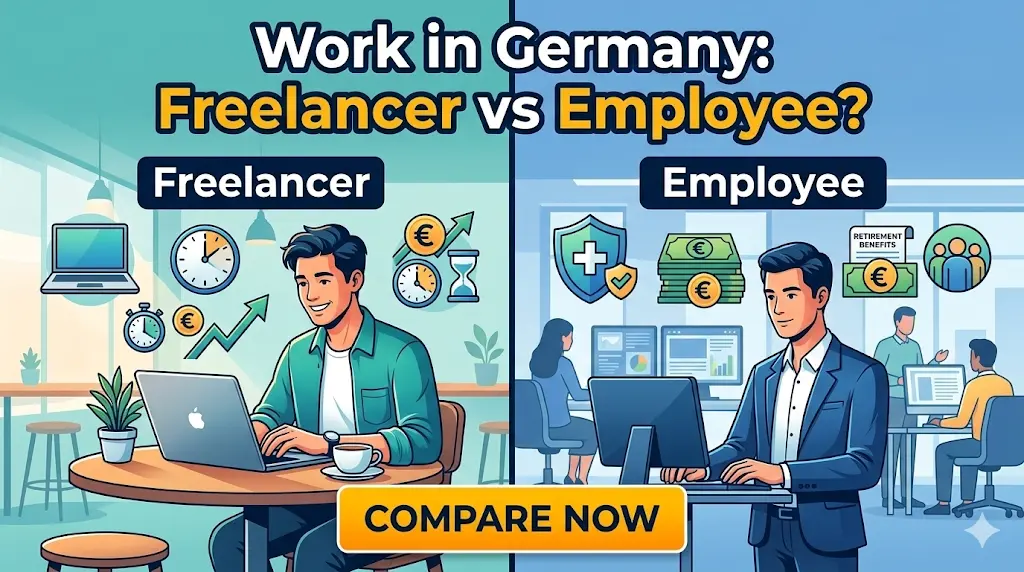
The most immediate financial distinction between a standard employee (Angestellter) and a freelancer (Freiberufler or Gewerbetreibende) is the predictability of cash flow. As an employee in Germany, you are guaranteed a fixed gross salary (Bruttogehalt) at the end of every single month. This stability is protected by rigorous German labor laws, which mandate strict notice periods and make it exceptionally difficult for an employer to terminate a contract without severe cause. This financial predictability makes long-term personal budgeting, securing an apartment lease, and getting approved for a mortgage significantly easier.
For a freelancer, income is inherently volatile. Your monthly revenue depends entirely on your ability to secure client contracts, complete deliverables, and collect payments. It is completely normal for a freelancer to earn €10,000 one month and €1,500 the next. Furthermore, freelancers in Germany frequently deal with delayed invoice payments, meaning the work you complete in March might not translate into liquid cash until May.
This feast-or-famine cycle requires freelancers to maintain a much larger emergency fund compared to traditional employees. While an employee might comfortably survive with three months of expenses saved, a freelancer in Germany should ideally hold six to twelve months of living costs in a highly liquid account. To understand the baseline costs you need to cover during lean months, reviewing our comprehensive guide on the Cost of Living in Germany: Budgeting for Rent, Food, and Transport is an essential first step.
The Burden of Social Security Contributions
The German social security system (Sozialversicherung) is famously robust, but it is also incredibly expensive. For a traditional employee, the financial burden of this system is shared equally. The total cost of mandatory health, pension, unemployment, and long-term care insurance equates to roughly 40% of your gross salary. However, the law mandates a strict 50/50 split. You pay approximately 20% out of your paycheck, and your employer matches that contribution out of their own pocket. This employer match is a massive, invisible financial benefit.
Freelancers do not have an employer to share this burden. In the vast majority of cases, self-employed individuals must cover 100% of their social security and insurance costs themselves. If a freelancer chooses to remain in the public health insurance system, they must pay both the employer and employee portions, heavily cutting into their net profits. Additionally, freelancers are generally entirely responsible for funding their own retirement, as they do not receive the 9.3% employer pension match.
There is one major exception to this rule: the Künstlersozialkasse (KSK). The KSK is a special social security fund designed for freelance artists, writers, journalists, and musicians. If you qualify for the KSK, the German government steps in and acts as your “employer,” covering 50% of your health, pension, and nursing care insurance costs. For creative expats, gaining admission to the KSK is a financial game-changer that makes freelancing vastly more sustainable. To understand the deeper mechanics of these shared costs, read Social Security Contributions: What Are You Paying For in Germany?.
Tax Liability and Deductions
Taxation mechanics differ wildly depending on your employment status. For an employee, the income tax (Lohnsteuer) is calculated and withheld automatically by the employer’s payroll department every month. You rarely have to worry about setting aside money for a massive surprise tax bill. Employees benefit from a standard flat-rate deduction (Arbeitnehmer-Pauschbetrag) of €1,230 per year for work-related expenses, but beyond commuting costs and basic home office days, their ability to deduct expenses is relatively limited.
Freelancers, however, pay income tax (Einkommensteuer) in quarterly prepayments (Vorauszahlungen) directly to the Finanzamt (tax office). They are legally responsible for calculating their expected profit and setting aside the appropriate amount of tax. Failing to meticulously save for these quarterly tax bills is the number one reason expat freelancers face financial ruin in their second or third year of operation.
The major financial advantage of freelancing lies in tax deductions. Freelancers can write off a massive array of business expenses against their revenue, significantly lowering their taxable profit. This includes the proportional cost of their home office rent, internet bills, laptops, specialized software, business travel, client dinners, and professional development courses.
Navigating Health Insurance and Social Safety Nets
Public versus Private Health Insurance Costs
Health insurance is compulsory for every resident in Germany, but your employment status heavily influences your available options and ultimate costs. Standard employees earning under the compulsory insurance threshold (roughly €77,400 in 2026) are legally required to be enrolled in the statutory public health insurance system (Gesetzliche Krankenversicherung or GKV). The premium is a flat percentage of their salary, capped at a maximum ceiling, and subsidized by the employer.
Freelancers, regardless of their income level, immediately have the freedom to choose between voluntarily remaining in the public system or switching to private health insurance (Private Krankenversicherung or PKV). Because public insurance premiums for freelancers are assessed based on their total business profit—and because the freelancer must pay the full 100% premium themselves—highly successful freelancers often find the public system exorbitantly expensive.
Consequently, many young, healthy expats transition to private insurance when they begin freelancing. Private premiums are calculated based on age and medical history rather than income, frequently making them much cheaper for a 30-year-old freelancer. However, private premiums increase aggressively as you age, and returning to the public system later in life is legally incredibly difficult. Exploring these complex long-term implications is thoroughly detailed in Health Insurance for Freelancers and Self-Employed: Navigating the System.
Statutory Pension Schemes and Retirement Planning
Employees in Germany are mandatorily enrolled in the statutory public pension scheme (Deutsche Rentenversicherung). Every month, 18.6% of their gross salary is deposited into the federal system (split between employee and employer). This guarantees a steady, albeit modest, monthly payout upon reaching the legal retirement age. While the system is under demographic strain, it provides a highly secure, baseline safety net that requires zero administrative effort from the worker.
Most freelancers are explicitly exempt from this mandatory public pension system. While a few specific professions (like independent teachers, midwives, and artisans) must contribute, standard freelance IT consultants, graphic designers, and marketing experts are not required to pay into the federal scheme. This provides a massive boost to their immediate monthly cash flow, allowing them to keep nearly 20% more of their earnings compared to an employee.
However, this freedom comes with severe long-term risk. Freelancers must possess the absolute discipline to build their own retirement portfolios. Without proactive investing, they face severe poverty in old age. Savvy expat freelancers utilize low-cost global brokerages like Interactive Brokers to consistently funnel their untaxed surplus income into diversified ETF portfolios, building a private retirement engine that outpaces the state system. For a masterclass in structuring these assets, consult Pension System in Germany: What Expats Should Know About Retirement Contributions.
Unemployment Benefits and Sick Pay
The German safety net is highly tailored to protect traditional employees. If an employee falls ill, the employer is legally mandated to continue paying 100% of their salary for six weeks. If the illness persists, the public health insurance steps in with Krankengeld (sick pay) for up to 78 weeks. If an employee is terminated, they are entitled to Arbeitslosengeld I (ALG I), an unemployment benefit that pays roughly 60% of their previous net salary for up to a year while they search for new work.
Freelancers naturally have zero access to paid sick leave from an employer. If you do not work, you do not bill, and you do not earn money. If a freelancer in the public system wants sick pay, they must explicitly opt-in and pay a slightly higher premium. Freelancers using private health insurance must actively purchase a dedicated sick pay rider (Krankentagegeldversicherung) to avoid total financial collapse during a severe medical crisis.
Similarly, freelancers do not automatically qualify for standard unemployment benefits if their business fails. They can apply for a voluntary unemployment insurance scheme within their first three months of starting their business, but the rules are incredibly rigid.
Bureaucracy and Administrative Costs
Tax Status and Business Registration
The administrative burden placed on a traditional employee is virtually non-existent. Once you sign your contract and provide your tax ID, HR handles the rest. For a freelancer, initiating your business is a bureaucratic hurdle. You must first determine if you qualify as a Freiberufler (a liberal professional, such as a doctor, artist, IT expert, or lawyer) or a Gewerbetreibende (a commercial trader).
This distinction is massive financially. If the Finanzamt classifies you as a Gewerbe (trade), you are subject to the Gewerbesteuer (trade tax) once your profits exceed €24,500 per year. You must also formally register your business with the local trade office (Gewerbeamt) and pay membership fees to the local Chamber of Commerce (IHK). Freiberufler, on the other hand, are entirely exempt from the trade tax and corporate chamber memberships, saving them thousands of euros annually.
To ensure you are properly classified and to obtain the necessary tax numbers to legally issue your very first invoice, you must meticulously fill out the Fragebogen zur steuerlichen Erfassung (tax registration questionnaire).
Invoicing VAT and Accounting Tools
Employees never touch Value Added Tax (VAT). Freelancers, however, essentially become unpaid tax collectors for the German state. Unless you operate under the Kleinunternehmerregelung (small business regulation)—which exempts you from charging VAT if your prior year’s revenue was under €22,000 and the current year is projected under €50,000—you must add 19% or 7% Umsatzsteuer to every invoice you issue to a domestic client.
Collecting VAT means you must submit regular advance VAT returns (Umsatzsteuervoranmeldungen), usually on a monthly or quarterly basis via the ELSTER tax portal. You must carefully track the VAT you collected from clients and subtract the VAT you paid on your own business expenses, remitting the difference to the Finanzamt. This requires flawless bookkeeping and highly organized receipt management.
While the administrative weight is heavy, being VAT-registered allows freelancers to claim back the 19% tax on expensive business purchases like laptops, standing desks, and software subscriptions, effectively granting them a massive 19% discount on all professional equipment.
The Hidden Costs of Professional Assistance
Because employee taxation is largely automated via payroll, many expats can manage their annual voluntary tax return using cheap, €30 English-language software applications. The financial cost of compliance is negligible. For a freelancer, navigating the labyrinth of quarterly prepayments, VAT returns, depreciation of assets, and the final Einnahmen-Überschuss-Rechnung (revenue surplus calculation) completely independently is highly dangerous.
Almost every successful freelancer in Germany retains the services of a certified Steuerberater (tax advisor). While an advisor protects you from severe auditing fines and optimizes your legal deductions, they are expensive. A freelancer should realistically budget between €1,000 and €2,500 annually for professional tax assistance, depending on their total revenue and the volume of their invoices.
When transmitting sensitive client invoices and banking statements to your accountant, digital hygiene is paramount. Expats frequently handle administration from coworking spaces or cafes. By utilizing a premium Virtual Private Network like NordVPN, you ensure that your highly sensitive financial documents and business data are heavily encrypted, preventing interception on unsecured public Wi-Fi networks.
| Financial Element | Standard Employee | Registered Freelancer / Self-Employed |
| Income Predictability | High (Fixed monthly salary) | Low (Fluctuates based on client payments) |
| Health Insurance | Employer pays 50% | Freelancer pays 100% (unless in KSK) |
| Public Pension | Mandatory (Employer pays 50%) | Exempt (100% personal responsibility) |
| Tax Deductions | Limited (Commuting, basic home office) | High (Rent proportion, equipment, travel) |
| Administrative Burden | Minimal (Handled by HR/Payroll) | High (VAT returns, quarterly prepayments) |
Strategies for Managing Expat Wealth and Cash Flow
Utilizing Digital Banking for Expense Tracking
Mixing personal and professional finances is a critical error that routinely destroys freelance businesses during a tax audit. Employees can comfortably operate their lives out of a single checking account. Freelancers must immediately open a dedicated business account to isolate their revenue, separate their VAT collections, and cleanly log their deductible expenses.
To manage this complex cash flow, transitioning away from clunky traditional branch banks to agile, digital-first platforms is highly recommended. Utilizing N26 allows freelancers to effortlessly track business expenses with automatic categorization and exportable CSV files designed explicitly for tax preparation. Furthermore, N26 offers integrated “Spaces” sub-accounts, allowing you to instantly sequester the 19% VAT you collected and roughly 30% of your net invoice for future income tax prepayments, ensuring you never accidentally spend the government’s money.
For employees, these digital platforms are equally valuable for managing their net salary and tracking personal spending against the high local cost of living.
Cross Border Transfers and International Clients
Freelancing offers expats the unique capability to maintain professional ties with their home countries. Many expat freelancers live in Berlin but bill clients located in the United States, the United Kingdom, or Australia. However, receiving a $5,000 USD invoice payment directly into a traditional German Euro bank account via the SWIFT network will result in exorbitant correspondent fees and terrible, hidden exchange rate markups that systematically erode your profit margins.
To protect your global revenue, integrating borderless financial technology is essential. Utilizing a platform like Wise allows freelancers to open local account details in dozens of different currencies. You can provide your American client with a standard US routing number, allowing them to pay you via local ACH transfer.
Once the USD lands in your Wise account, you can convert it to Euros at the real, mid-market exchange rate with a tiny, transparent upfront fee. This infrastructure completely bypasses traditional banking extortion, ensuring you retain the absolute maximum amount of your international earnings.
Investing Surplus Income for Long Term Security
Whether you are a highly paid employee utilizing the 50/50 employer pension match or a freelancer keeping 100% of your gross revenue, relying solely on cash savings in Germany is a fast track to financial stagnation. With inflation constantly eroding purchasing power, deploying your surplus income into the capital markets is mandatory for long-term wealth preservation.
Because freelancers do not have a company pension scheme (Betriebliche Altersvorsorge) quietly compounding in the background, they must be aggressively proactive. Utilizing a sophisticated, low-cost international brokerage like Interactive Brokers allows you to construct a globally diversified portfolio of ETFs and equities. Interactive Brokers offers unparalleled market access and extremely low execution fees, bypassing the high custody charges associated with local German retail banks.
For expats, the portability of these platforms is the ultimate advantage. If your freelance business or corporate career eventually requires you to leave Germany, an international brokerage account travels with you effortlessly across borders, preventing the forced liquidation of your assets.
Conclusion
The decision between embracing the stability of employment and the freedom of freelancing in Germany dictates your entire financial infrastructure. Employees enjoy profound security, heavily subsidized health and pension insurance, and near-zero administrative friction. Freelancers unlock massive tax deductions and unlimited earning potential, but they must fiercely manage their own safety net, handle complex VAT compliance, and shoulder 100% of their social security costs.
By establishing a rigid financial system—using N26 to segregate tax liabilities, Wise to capture international revenue without massive banking fees, and Interactive Brokers to independently fund your retirement—expats can mitigate the risks of self-employment. Regardless of the path you choose, protecting your sensitive digital administration with NordVPN and thoroughly understanding the German taxation landscape ensures you build a prosperous, sustainable career in the heart of Europe.
References
Primary sources (official)
- Federal Ministry of Finance (BMF): Official guidelines distinguishing between commercial trades (Gewerbe) and liberal professions (Freiberufler), as well as VAT regulations. https://www.bundesfinanzministerium.de/
- Deutsche Rentenversicherung: Detailed outlines on which self-employed professions are subject to mandatory statutory pension contributions. https://www.deutsche-rentenversicherung.de/DRV/EN/Home/home_node.html
Other helpful sources
- Make it in Germany: The official German government portal providing comprehensive, step-by-step guides for international professionals setting up a freelance business or standard employment. https://www.make-it-in-germany.com/en/working-in-germany/setting-up-business
- Finanztip: Germany’s premier independent consumer finance portal, offering rigorous comparisons on public versus private health insurance costs for the self-employed. https://www.finanztip.de/
Disclaimer
The information provided in this article is for general informational and educational purposes only and does not constitute professional financial, tax, or legal advice. German tax laws, VAT reporting requirements, social security classifications, and the legal distinction between Gewerbe and Freiberufler are highly complex and subject to continuous legislative updates. Always consult directly with a certified Steuerberater (tax advisor), an official corporate legal counsel, or the Finanzamt regarding your unique employment status, tax liabilities, and visa conditions before initiating any commercial activities in Germany.