German Business Meetings: Why Agendas and Minutes Matter
Walking into a German conference room without a printed agenda is a recipe for silent judgment and a truly awkward forty-five minutes. I remember my first time presenting in Berlin; I thought I could wing it with a "let’s just brainstorm" approach, only to be met with cold stares and a direct question about the missing Tagesordnung. This guide solves the mystery of German meeting culture by explaining exactly why agendas and minutes are the non-negotiable pillars of your professional life here.
Disclosure: This post may contain affiliate links. We may earn a commission at no extra cost to you if you make a purchase through these links. Read full disclosure.
The Cultural Foundations of the German Agenda
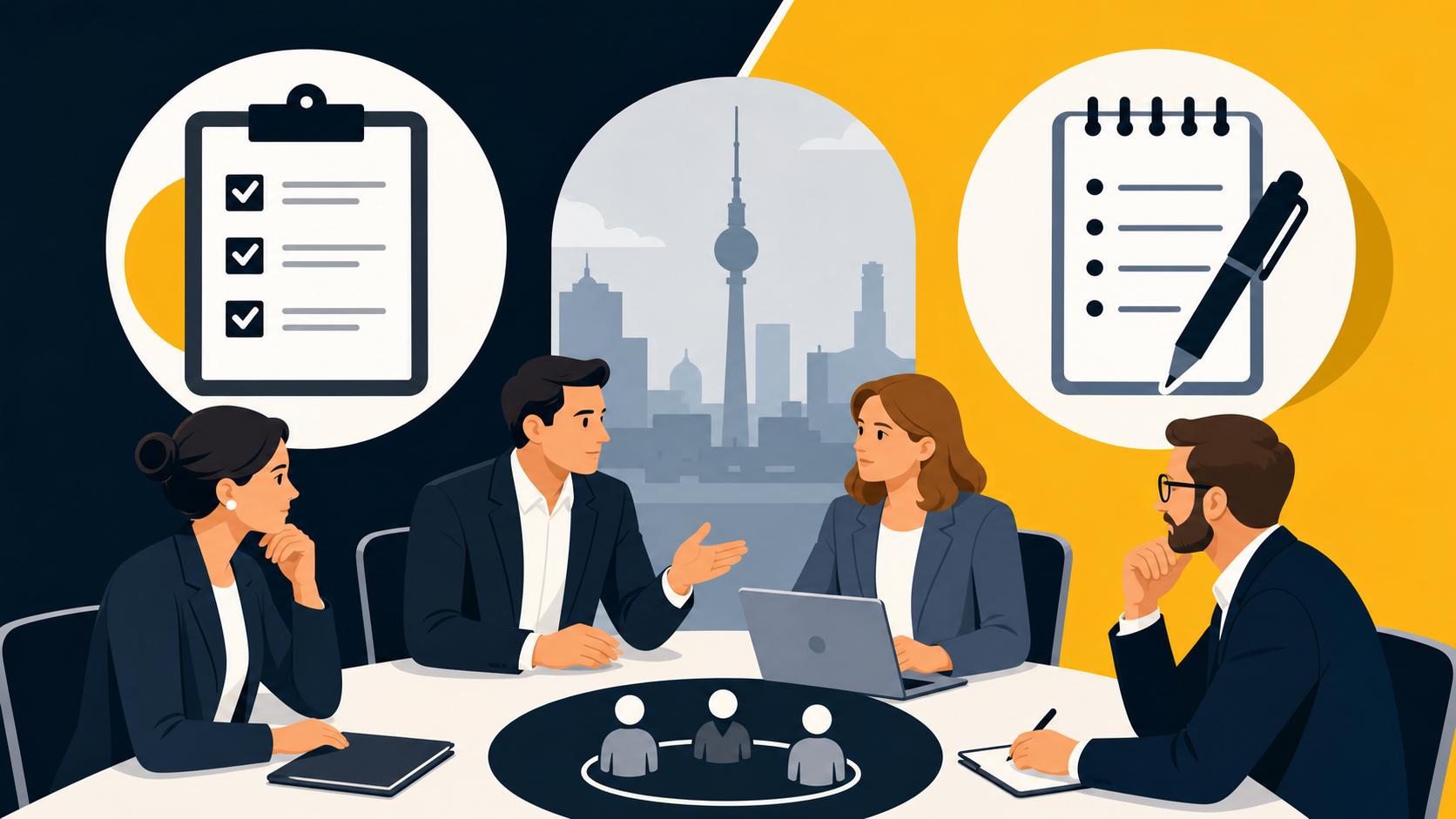
In the German workplace, time is not a fluid concept; it is a precious resource that must be allocated with surgical precision. When you receive an invitation for a meeting, the very first thing a German colleague looks for isn't the guest list—it is the "Tagesordnung" (TO), or the agenda. This isn't just a list of things to chat about; it is a contract of intent that dictates the boundaries of the discussion.
Predictability Over Spontaneity
Germans generally loathe the "meeting that could have been an email." To avoid this, a meeting is only considered valid if it has a clear, predefined structure. If you’ve spent any time studying Work Culture in Germany: Etiquette, Hierarchy, and Office Norms, you’ll know that predictability is a core value. An agenda allows participants to prepare their data, formulate their arguments, and come ready to make decisions. Walking into a meeting to "see where the conversation goes" is often viewed as a lack of respect for everyone else’s time. Spontaneity is for the "Feierabendbier" (after-work beer), not the conference room.
Efficient Time Management
Every "Tagesordnungspunkt" (TOP), or agenda item, usually has a specific time slot attached to it. If the agenda says "TOP 1: Quarterly Reports (10 minutes)," the room expects you to be done by minute eleven. This rigid adherence to time is something I struggled with initially. I once tried to expand on a point about team morale during a technical review, and the moderator politely but firmly told me that we would have to schedule a separate meeting because it wasn't on the TO. It felt harsh at first, but I soon realized this level of discipline is why German offices can be incredibly productive. If you are struggling with the specific terminology used in these documents, using resources like GermanPod101 can help you master the "Amtssprache" or official language often found in corporate templates.
Anatomy of a Professional German Meeting Agenda
If you are the one calling the meeting, the burden of the agenda falls squarely on your shoulders. This isn't a task to be scribbled out five minutes before the start time. A proper German agenda should be distributed at least 24 to 48 hours in advance—more if the topics are complex. This gives everyone a chance to look over the points and raise objections or additions before the clock starts ticking.
Structured Content and Clear Objectives
A well-crafted agenda starts with the basics: date, time, location, and a list of attendees. But the meat of the document lies in the TOPs. Each point should be clear and actionable. Instead of writing "Marketing," write "TOP 3: Decision on Q4 Social Media Budget." This level of detail ensures that by the end of the meeting, a decision has been reached. If you’re currently in the process of Writing a German-Style CV and Cover Letter: Tips for Success, demonstrating that you understand this level of detail in your written communication can set you apart from other international candidates who might take a more relaxed approach.
Pre-Meeting Preparation
The agenda serves as a signal for what materials need to be brought to the table. If an item is on the agenda, it is expected that the person responsible has the necessary "Unterlagen" (documents) ready. In my experience, there is nothing more embarrassing than having a TOP named after your project and then having to say, "I'll have to get back to you on that data." In the German context, you are expected to have the data because it was on the agenda. If your German isn't quite at the level where you can confidently draft these technical points, taking a business-focused course through Lingoda can provide the specific vocabulary needed for high-stakes corporate communication.
The Sacred Nature of the Protokoll
Once the meeting is over, the work is only half-done. In many cultures, "minutes" are a formality that sits in an inbox and is never read. In Germany, the "Protokoll" (minutes) is the definitive record of reality. If a decision was made but didn't make it into the Protokoll, it effectively didn't happen. This document is essential for navigating the complexities of German Business Etiquette: Meeting Protocol and Dress Code.
Documenting Accountability
The Protokoll serves several purposes, but the most important is "Festhalten"—pinning things down. It documents who said what, who agreed to which task, and most importantly, what the deadlines are. There are typically two types: the "Verlaufsprotokoll," which is a chronological account of the discussion, and the "Ergebnisprotokoll," which only lists the decisions and action items. Most modern German offices prefer the latter for its efficiency. I’ve learned that if you disagree with a decision made in a meeting, you must ensure your dissent is noted in the Protokoll before it is finalized, otherwise, you are professionally bound by the group’s consensus.
Legal and Administrative Significance
For those working under Understanding German Work Contracts: Probation, Notice Periods, and More, the Protokoll can even have legal implications. If a meeting involves changes to your responsibilities, salary discussions, or performance reviews, that document becomes a part of your professional record. It’s not uncommon for a Protokoll to be sent out within 24 hours of the meeting, and you are usually given a short window to suggest corrections. Always, always read it. I once missed a typo in a Protokoll that assigned me a task I wasn't qualified for, and it took weeks of administrative headache to rectify because the "official record" had already been filed.
Essential Etiquette for Navigating German Business Meetings
Understanding the paperwork is one thing, but surviving the social dynamics is another. German meetings are often characterized by "Sachlichkeit"—an objectivity that can feel cold or aggressive to newcomers. It isn't personal; it’s about the task at hand.
| Aspect | German Approach | Typical International Confusion |
|---|---|---|
| Small Talk | Minimal. 2-3 minutes max before starting the agenda. | Expecting 10-15 minutes of personal banter. |
| Directness | "Kritik" is common and expected for improvement. | Interpreting direct feedback as a personal insult. |
| Hierarchy | Respected, but expertise often trumps title in discussion. | Assuming the highest-ranking person should talk the most. |
| Decision Making | Based on data and consensus on the TOP. | Expecting decisions to be made on "gut feeling." |
| The End | Meeting ends exactly on time, often with a follow-up date. | Letting the meeting run over "just to finish up." |
Punctuality and Formality
Punctuality in Germany is not about being "on time"; it’s about being ready to work the second the clock strikes the hour. If a meeting starts at 9:00 AM, being "on time" means you are in your seat, your laptop is open, and you have your copy of the agenda ready at 8:58 AM. Walking in at 9:01 AM is technically late and is often met with a pointed look at the clock. This level of discipline extends to German Workplace Rights: Overtime, Breaks, and Vacation Days Explained, where meetings are rarely allowed to bleed into lunch breaks or the end of the workday.
The Art of Direct Communication
During the meeting, don't be surprised if a colleague tells you, "That idea is illogical" or "The data doesn't support your conclusion." In many cultures, this would be a "bridge-burning" moment. In Germany, it’s just Tuesday. They are critiquing the work, not you. If you are Learning German: Best Ways for Students to Improve Language Skills, pay attention to the use of "Man" (one) instead of "Du" (you) in critiques. "Man sollte das anders machen" (One should do that differently) is a common way to soften the blow while remaining incredibly direct. Even in English-Speaking Jobs in Germany: Finding Work When You Don’t Speak German, you will find that German colleagues maintain this level of bluntness in English.
Practical Tips for Leading and Participating in Meetings
To truly succeed, you need to be proactive. If you are an expat, you might feel like a spectator, but the German system rewards those who contribute to the "Ordnung" (order) of the office.
Follow-Up Strategies
After the Protokoll is sent, don't just archive it. Use it to create your own "To-Do" list. In the next meeting, the first item on the agenda is often "Status of the last minutes." If you haven't completed your assigned tasks, there is no place to hide because the document from the previous week is right there on the table. If you are still navigating the Job Interview Tips for Germany: What to Expect and How to Impress, asking about how the company handles meeting documentation is a "power move" that shows you already understand the local professional culture.
Continuous Learning
The vocabulary of German business is a beast of its own. Words like "Beschlussfähig" (having a quorum) or "Vertagung" (adjournment) are essential. I highly recommend spending time on platforms like Lingoda to specifically practice business-case scenarios or using GermanPod101 to build your "Meeting Survival Kit" of phrases. Being able to say, "Ich möchte diesen Punkt auf die nächste Tagesordnung setzen" (I would like to put this point on the next agenda) shows a level of integration that your colleagues will deeply respect. It proves you aren't just an expat working in Germany, but a professional who has mastered the German way of working.
Disclaimer
This guide is based on personal experience and general professional standards in Germany. Workplace cultures vary between industries and regions. For example, a tech startup in Berlin will have different norms than a traditional manufacturing firm in rural Bavaria. Always observe your specific company’s internal guidelines and adjust your approach accordingly.