German Business Etiquette: Meeting Protocol and Dress Code
Walking into a glass-walled conference room in Frankfurt’s Bankenviertel for the first time, I felt an icy wave of anxiety that my ironed shirt wasn't crisp enough and my watch was thirty seconds slow. I still remember the sharp, collective silence that greeted a colleague who arrived just two minutes late; it wasn't just a delay, it was a breach of contract in their eyes. This guide deconstructs the unwritten rules of German professional conduct to ensure you command respect rather than accidental resentment.
Disclosure: This post may contain affiliate links. We may earn a commission at no extra cost to you if you make a purchase through these links. Read full disclosure.
The Sacred Architecture of the German Meeting
In many cultures, a meeting is a collaborative brainstorming session where ideas flow freely and the clock is a mere suggestion. In Germany, a meeting is the final stage of a long, meticulously planned process. If you walk in expecting to "wing it" or "vibe" with your coworkers, you will likely find yourself sidelined. The German approach to business is built on the pillar of Sachlichkeit—a focus on facts, objectivity, and results over personal rapport.
The first thing you will encounter is the Tagesordnung, or the agenda. This isn't a loose list of talking points; it is the holy scripture of the hour. Straying from the agenda is seen as a lack of discipline. If you have a brilliant idea that isn't on the list, the correct protocol is usually to wait until the end or bring it up in a separate email. This rigid structure is part of the broader Work Culture in Germany: Etiquette, Hierarchy, and Office Norms that defines how business is done from Hamburg to Munich.
Preparation is your best defense. Germans value expertise and data above all else. If you make a claim, expect to be asked for the source, the methodology, and the projected ROI immediately. There is no "let me get back to you on that" without a slight loss of face. Before a major presentation, I often used resources like GermanPod101 to brush up on specific industry terminology, as using the correct technical term can significantly boost your perceived authority in the room.
Punctuality and the Concept of Time
There is a common saying in Germany: "Punctuality is the politeness of kings." In a business context, it is the absolute minimum requirement. If a meeting is set for 10:00, it means everyone is seated, their laptops are open, and the first item on the agenda is being read at 10:00:01. Arriving exactly at 10:00 is often viewed as being slightly late. I’ve learned the hard way to aim for the "five-minute buffer"—arriving at 09:55 allows you to settle in and perform the necessary social handshakes before the clock strikes.
This obsession with time extends to deadlines and project phases. Over-promising and under-delivering is the quickest way to ruin your reputation. If you suspect a project will take three weeks, tell them it will take four and deliver it in three. Reliability is a currency here. This mindset is deeply embedded in German Business Meetings: Why Agendas and Minutes Matter, where every decision is documented to ensure accountability.
Furthermore, do not expect meetings to run over. If a meeting is scheduled to end at 11:00, people will start packing their bags at 10:59. Germans value their Feierabend (the end of the working day) and their private time. Encroaching on someone's lunch break or stay-late time because you didn't manage the meeting time well is considered highly unprofessional. You can learn more about these boundaries in our guide on German Workplace Rights: Overtime, Breaks, and Vacation Days Explained.
Communication Styles and the Power of Titles
One of the biggest culture shocks for expats is the legendary German directness, often called Klartext. In an American or British office, criticism is often wrapped in a "compliment sandwich." In a German office, the sandwich is just the meat. If your report is bad, your boss will likely say, "This report is incomplete and the data in section three is wrong." They aren't trying to be mean; they are trying to be efficient. Taking this personally is a common mistake for newcomers.
Another layer of communication is the formal versus informal address. While startups in Berlin might be "Du" (informal) from day one, much of the German Mittelstand (small to medium-sized enterprises) still relies on "Sie" (formal). Always start with "Sie" and the person’s title and last name. For example, "Herr Dr. Müller." Never use a first name until you are explicitly invited to do so. This transition from "Sie" to "Du" is a significant social milestone. If you’re unsure how to navigate these linguistic traps, taking a few targeted lessons on Lingoda can help you practice the subtle shift in tone and grammar that accompanies formal business speech.
For a deeper dive into these linguistic nuances, I highly recommend reading about Du or Sie? Navigating Formal and Informal German Address. Understanding this distinction is vital not just for meetings, but for the entire Job Interview Tips for Germany: What to Expect and How to Impress process, where first impressions regarding respect and hierarchy are made.
| Industry Sector | Typical Dress Code | Tone of Communication |
|---|---|---|
| Banking & Finance | Formal (Suits, Ties) | Highly Formal (Always 'Sie') |
| Engineering & Manufacturing | Business Casual / Functional | Formal but Practical |
| Tech & Startups | Casual / Smart Casual | Informal ('Du' is common) |
| Creative Agencies | Trendy / Individualistic | Semi-Formal to Informal |
Dress Code Standards Across Industries
While the world is generally moving toward more casual attire, Germany remains a country that appreciates a well-pressed appearance. The specific "look" varies wildly depending on whether you are in a fintech hub like Frankfurt or a creative pocket of Berlin. However, the golden rule is: it is always better to be slightly overdressed than underdressed. Even in "casual" offices, "casual" rarely means gym clothes or flip-flops; it means high-quality dark denim and a crisp button-down shirt.
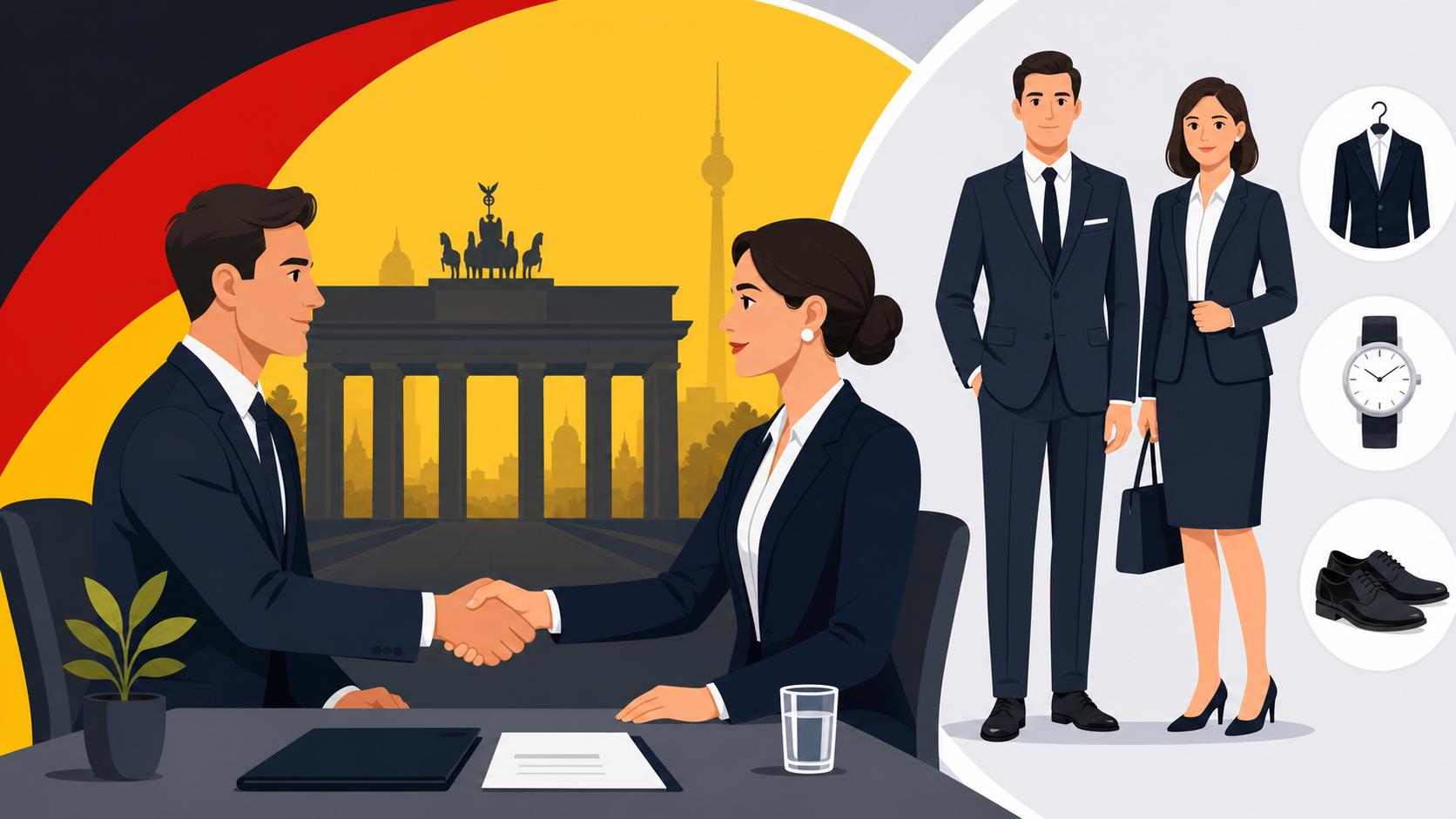
In cities like Frankfurt, the traditional suit is still king. If you are Living in Frankfurt: Navigating Life in Germany’s Finance Hub, you’ll notice the "Banker Uniform"—navy or charcoal suits, white or light blue shirts, and conservative ties. Accessories should be minimal and high-quality. A scuffed pair of shoes can be seen as a sign of a cluttered mind. Germans notice the details; they look at your watch, the leather of your briefcase, and the cleanliness of your coat.
Conversely, if you are Living in Berlin: Expat Guide to Neighborhoods and Lifestyle, especially working for a startup in Mitte or Kreuzberg, a full suit might actually make you look out of touch. In these environments, the "Smart Casual" look prevails. Think chinos, a premium sweater, or a blazer over a high-end T-shirt. However, even in the tech world, when meeting with investors or "old economy" partners, the "Sie" and a blazer usually make a comeback. For those still in the application phase, remember that your photo on the CV often dictates the expectation; see our tips on Writing a German-Style CV and Cover Letter: Tips for Success for more on visual presentation.
Meeting Etiquette and Social Protocols
The physical conduct within a meeting is just as important as the words spoken. The handshake is the standard greeting. It should be firm, brief, and accompanied by direct eye contact. Avoiding eye contact is often interpreted as having something to hide or a lack of confidence. If you are entering a room where people are already seated, it is polite to greet everyone collectively with a "Guten Tag" or "Hallo zusammen."
During the meeting, stay focused. Multi-tasking—checking your phone or answering emails on your laptop—is seen as incredibly rude and a sign that you do not value the speaker's time. If you must take a call, excuse yourself and leave the room. It is also worth noting that "small talk" is kept to a minimum. A few sentences about the weather or your journey are fine, but do not spend ten minutes talking about your weekend. The goal is to get to the Sacharbeit (actual work) as quickly as possible.
When it comes to digital meetings, the same rules apply. Camera on, background professional, and no eating. If you are Working in Tech in Germany: Opportunities for IT Professionals, you might find the culture slightly more relaxed, but the expectation of being present and prepared remains. Using tools like GermanPod101 to learn "meeting filler" phrases can help you sound more natural when you need a moment to think or want to interrupt politely.
Post-Meeting Follow-up and Documentation
In the German business world, if it isn't written down, it didn't happen. The Protokoll (minutes) of a meeting is a crucial document. Usually, one person is assigned to take notes, and these are circulated shortly after the meeting. Review these carefully. If there is a misunderstanding in the minutes, correct it immediately. Silence is often taken as agreement.
The follow-up should be as structured as the meeting itself. If you were assigned a task, send a brief confirmation email outlining your understanding of the task and the deadline. This level of thoroughness is what separates a successful expat from one who struggles with the bureaucracy. You’ll find that Understanding Job Ads in Germany: Decoding Abbreviations (m/w/d, etc.) often hints at the level of administrative precision required for a role, as the language used in the ads reflects the internal company culture.
Finally, remember that the office is for work. While after-work drinks (Feierabendbier) do happen, they are not the primary place for building business relationships. Trust in Germany is built through consistent, high-quality work over time, not through being "charming" at a bar. If you find yourself in a leadership position, Lingoda can provide business-specific coaching to help you manage these boundaries and lead your team with the right mix of authority and empathy.
Health and Safety Disclaimer
The information provided in this guide is for educational and informational purposes only. While every effort has been made to ensure the accuracy of these cultural and professional insights, business norms can vary significantly between companies and regions in Germany. Always observe the specific culture of your individual workplace. This guide does not constitute legal or career counseling advice. For specific legal issues regarding employment contracts or workplace rights, please consult a qualified legal professional in Germany.