Getting Your Tax ID (Steuer-ID) and Tax Class (Steuerklasse) in Germany
An essential step in establishing your new life abroad is navigating the bureaucratic foundations of the German financial system. This comprehensive guide explains how to obtain your personal tax identification number, decode the six tax classes, and strategically optimize your monthly net income through proper tax class management.
Disclosure: This post may contain affiliate links. We may earn a commission at no extra cost to you if you make a purchase through these links. Read full disclosure.
Understanding the German Tax ID Steuer Identifikationsnummer
What is the Steuer ID and Why Do You Need It
The German Tax Identification Number, officially known as the Steuer-Identifikationsnummer (often abbreviated as Steuer-ID, IdNr, or TIN), is a unique, 11-digit number assigned to every individual registered in Germany. Unlike other reference numbers that might change if you move to a different state or change your marital status, your Steuer-ID is permanent. It is assigned to you for your entire life and is used by the German tax authorities (Finanzamt) to uniquely identify you across all financial and administrative databases.
As an expat, you will find that your Steuer-ID is a mandatory requirement for almost every major financial milestone. Your employer must have this number to accurately run your payroll, calculate your income tax deductions, and remit your social security contributions. Furthermore, under modern banking regulations, German financial institutions are legally required to record your Steuer-ID. Whether you are opening a traditional savings account or setting up a modern digital checking account with agile providers like N26, you will typically be asked to provide your tax ID within the first 90 days of opening the account to ensure compliance with federal tax laws.
Without a valid Steuer-ID, you will quickly face administrative roadblocks. If your employer cannot process your payroll with your specific ID, they are legally obligated to place you in the highest possible tax bracket (Tax Class 6) until the number is provided. This will severely reduce your initial take-home pay. Therefore, securing and keeping track of this 11-digit number is just as important as securing your residence permit. To understand how this fits into your broader financial landscape, review our overarching guide on Understanding Taxes in Germany: An Expat’s Guide to the German Tax System.
How to Apply for Your First Tax ID
You do not actually need to fill out a specific application form to receive your first Steuer-ID; the process is entirely automated, though it requires a crucial first step on your part. The generation of your tax ID is triggered automatically the moment you successfully register your residential address in Germany. This registration process, known as the Anmeldung, takes place at your local citizens’ office (Bürgeramt). Once the local clerk enters your personal details into the municipal database, the system pings the Federal Central Tax Office (Bundeszentralamt für Steuern or BZSt).
After your Anmeldung is complete, the BZSt will generate your unique 11-digit Steuer-ID and mail it to your newly registered German address as a physical letter. This standard postal delivery typically takes between two to four weeks. Because this letter is sent via standard mail, it is absolutely critical that your name is clearly written on the physical mailbox at your apartment building. German postal workers will not deliver official government mail if the recipient’s name is missing from the letterbox, and the document will be returned to the sender.
For newly arrived expats eager to start working, waiting up to a month for this letter can be stressful. If you need your Steuer-ID urgently to avoid being placed in the emergency tax class by your HR department, you can sometimes expedite the discovery process. After waiting about five business days post-Anmeldung, you can visit your local Finanzamt in person with your passport and registration certificate.
What to Do If You Lose Your Tax ID
Because the Steuer-ID is a lifelong identifier, losing the original physical letter sent by the BZSt is a common occurrence. Fortunately, recovering your tax ID is a straightforward process, though it requires a bit of administrative patience. Before contacting the government, check the documents you already have. Your 11-digit Steuer-ID is permanently printed on every single monthly payslip (Lohnabrechnung) you receive from your employer. It can also be found on your annual income tax assessment (Einkommensteuerbescheid) or on letters regarding your health insurance.
If you have never worked in Germany and have lost the initial letter, you must request a replacement directly from the Federal Central Tax Office. You cannot request your tax ID over the phone or via email due to strict German data protection and privacy laws. Instead, you must navigate to the official BZSt website and fill out their specific online input form to request a renewed notification of your Steuer-ID.
Once the online request is submitted, the BZSt will retrieve your number from their database and mail it to your current registered address. This postal delivery can take up to four weeks, so it is highly advised to request it long before you actually need it for a new job or to open an investment portfolio with platforms like Interactive Brokers. Keeping a secure digital scan of this document alongside your passport and visa copies is a highly recommended administrative habit for all expats.
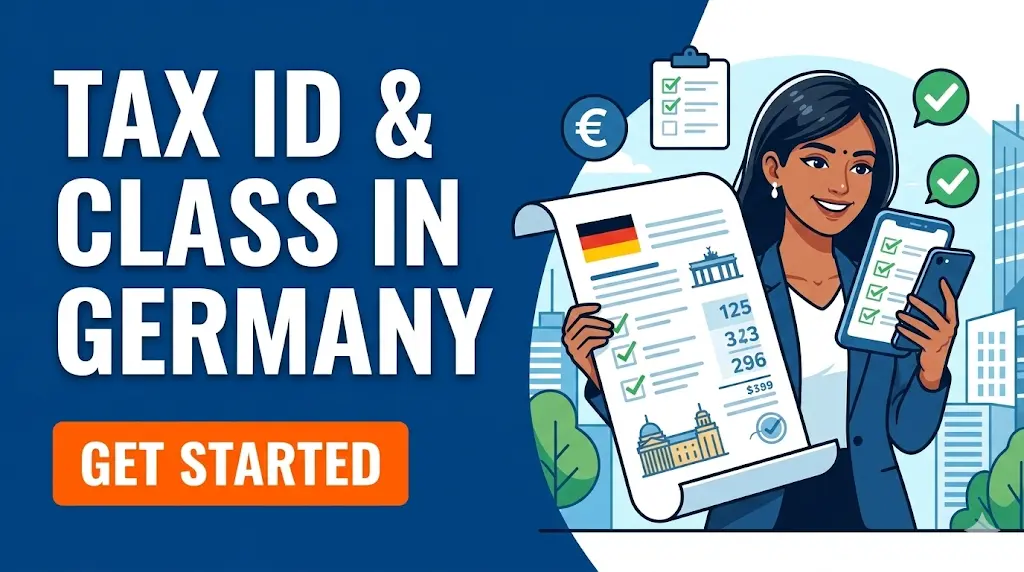
The German Tax Class System Explained Steuerklassen
How Tax Classes Affect Your Monthly Salary
In Germany, the income tax you owe is calculated progressively based on your total annual earnings. However, the government does not wait until the end of the year to collect this money; instead, it is deducted directly from your gross monthly salary as wage tax (Lohnsteuer). Your specific Tax Class (Steuerklasse) dictates exactly how much wage tax your employer withholds from your paycheck every month.
It is a common misconception among expats that changing your tax class somehow changes your total annual tax liability. This is mathematically false. Your tax class only determines your monthly cash flow—the difference between your gross pay (Brutto) and your net take-home pay (Netto). If your tax class causes your employer to withhold too much tax throughout the year, you will simply receive the excess back as a large refund when you file your annual tax return. If too little is withheld, you will owe the government a lump sum payment.
Understanding this dynamic is crucial for effective personal budgeting. The goal of selecting the correct tax class is to ensure your monthly take-home pay aligns as closely as possible with your actual annual tax liability, preventing you from giving the government an interest-free loan for twelve months, or conversely, facing a massive surprise tax bill in the spring. To contextualize these deductions against your everyday living expenses, explore our guide on Money Matters in Germany: Complete Financial Guide for Expats.
Breakdown of the Six Different Tax Classes
The German tax system categorizes employees into six distinct tax classes based primarily on their civil status, marital standing, and whether they are working multiple jobs. The table below outlines the basic criteria for each classification.
| Tax Class | German Name | Applicable Demographic | Key Characteristics |
| Class 1 | Steuerklasse I | Single, divorced, widowed, or permanently separated individuals. | Standard deductions apply. The default for unmarried expats. |
| Class 2 | Steuerklasse II | Single parents living alone with at least one dependent child. | Includes a specific single-parent tax relief allowance (Entlastungsbetrag). |
| Class 3 | Steuerklasse III | Married individuals whose spouse is in Tax Class 5. | Applies the marital tax-free allowance to one earner, resulting in very low monthly tax deductions. |
| Class 4 | Steuerklasse IV | Married couples where both spouses earn similar incomes. | The default assignment for married couples. Taxes are deducted similarly to Class 1. |
| Class 5 | Steuerklasse V | Married individuals whose spouse is in Tax Class 3. | Extremely high monthly tax deductions, as the tax-free allowance was shifted to the Class 3 spouse. |
| Class 6 | Steuerklasse VI | Individuals with a second (or multiple) additional jobs. | No basic tax-free allowances applied. Results in the highest possible monthly tax deduction for that specific income. |
How Your Civil Status Dictates Your Initial Assignment
When you complete your Anmeldung at the local citizens’ office, the municipal clerk enters your civil status—single, married, or divorced—into the federal database. This data point completely dictates your initial tax class assignment. If you register as single, the Finanzamt automatically places you in Tax Class 1. You do not need to take any further action; your employer will pull this data digitally and tax you accordingly.
If you register as married alongside your spouse, the system automatically assigns both of you to Tax Class 4. This is the default setting for married couples in Germany. It assumes that both partners will be working and earning roughly identical salaries. If this is not the case—for instance, if one spouse relocated without a job offer—you must proactively apply to change your tax classes, as the automated Class 4 assignment might severely restrict the primary earner’s monthly net income.
A critical point of friction for expats occurs when they are married, but their spouse has not yet relocated to Germany. If your spouse remains in your home country, German tax law generally dictates that you must be taxed as a single person in Tax Class 1 until your spouse officially registers an address in Germany. You cannot claim the advantageous marital tax classes if your partner is a non-resident. Understanding the timeline of family reunification is critical.
Strategic Tax Class Choices for Married Couples
The Default Assignment Class Four and Four
For married expat couples where both partners work and earn relatively similar salaries, remaining in the default Tax Class 4 / Tax Class 4 combination is almost always the optimal strategy. In this configuration, both spouses independently receive the standard basic tax-free allowance (Grundfreibetrag) applied to their respective monthly paychecks.
The primary advantage of the 4/4 split is administrative and financial predictability. Because the monthly tax deductions are highly accurate and proportionate to individual earnings, couples in this bracket rarely face massive, unexpected tax bills at the end of the fiscal year. The withheld wage tax usually covers the actual annual tax liability almost perfectly.
Furthermore, remaining in Class 4 ensures that both partners receive an equitable net income deposited into their individual accounts. This psychological parity is important for many modern couples managing shared household expenses. If you maintain joint budgets or need to coordinate shared utility and grocery costs effectively, this balanced cash flow is highly advantageous.
The Income Split Strategy Class Three and Five
When a married couple has a significant disparity in their incomes—typically when one spouse earns at least 60% of the household income, or when one spouse does not work at all—the Tax Class 3 / Tax Class 5 combination becomes highly lucrative for monthly cash flow. In this setup, the higher-earning spouse elects Tax Class 3, while the lower-earning (or non-earning) spouse is placed in Tax Class 5.
By choosing this combination, the basic tax-free allowance of the Class 5 spouse is transferred entirely to the Class 3 spouse. Consequently, the higher earner in Class 3 sees their monthly net salary skyrocket because very little wage tax is deducted. Conversely, the spouse in Class 5 is taxed heavily from their very first euro earned, resulting in a disproportionately low net income for their specific salary. Overall, the household’s total monthly net cash flow increases significantly.
Expats often use this strategy to maximize liquidity when initially settling in Germany. Having a larger net income immediately available makes it easier to pay high rental deposits or purchase furniture. If you are utilizing this extra cash flow to send remittances back to your home country to cover existing mortgages or support family, using an efficient platform like Wise ensures that your newly optimized net income is not eroded by terrible exchange rates and high international transfer fees. However, couples utilizing the 3/5 split must be incredibly disciplined; because this method often under-taxes the household on a monthly basis, a mandatory tax return must be filed, and a year-end payment (Nachzahlung) is frequently required.
The Modern Alternative Class Four with Factor
Recognizing the psychological friction of Tax Class 5—where the lower-earning spouse feels penalized by massive tax deductions—the German government introduced a highly sophisticated alternative: Tax Class 4 with Factor (Steuerklasse 4 mit Faktor). This method is designed specifically for couples with unequal incomes who want to avoid the year-end tax debts associated with the 3/5 split while maintaining fair monthly deductions.
When you apply for the Factor method, the Finanzamt calculates your combined projected annual income and determines exactly what your joint tax liability will be. They then generate a mathematical multiplier (the Factor) and apply it to your monthly payroll. This ensures that the tax-free allowances are distributed precisely in proportion to what each spouse actually earns.
The result is a highly accurate monthly tax deduction. The higher earner pays slightly more tax than they would in Class 3, and the lower earner pays significantly less tax than they would in Class 5. Most importantly, the Factor method practically guarantees that the couple’s annual tax liability is settled perfectly by December, completely eliminating the fear of a looming tax bill. This method provides immense financial peace of mind, allowing expats to securely invest their surplus income into portfolios via platforms like Interactive Brokers without holding back large cash reserves for the tax office.
Changing Your Tax Class and Managing Bureaucracy
When and How to Request a Tax Class Change
Changing your tax class is a relatively straightforward bureaucratic procedure. If you get married, divorce, or experience a massive shift in your household income distribution, you should actively update your tax classes to reflect your new reality. To initiate the change, married couples must jointly fill out an official form titled Antrag auf Steuerklassenwechsel bei Ehegatten (Application for Change of Tax Class for Spouses).
Historically, the German tax authorities strictly limited couples to only one tax class change per calendar year. However, recent legislative updates have introduced greater flexibility, allowing spouses to change their tax class combinations multiple times a year if their financial circumstances demand it. You can submit the required form via mail to your local Finanzamt, or, increasingly, process it entirely digitally through the official German tax portal, ELSTER.
Once the Finanzamt processes your application, the change is updated in the ELStAM (Electronic Wage Tax Deduction Features) database. Your employer’s payroll software automatically pulls this updated data, and the new tax class will typically take effect on the first day of the following month. You do not need to inform your HR department manually; the digital synchronization between the tax office and your employer handles the transition seamlessly.
The Impact on Parental Leave and State Benefits
One of the most critical, yet frequently overlooked, reasons to strategically change your tax class relates to German social welfare benefits. Wage-replacement benefits—specifically Parental Allowance (Elterngeld), Unemployment Benefit (Arbeitslosengeld I), and Sickness Benefit (Krankengeld)—are calculated based on your net income, not your gross income.
If you and your spouse are planning to have a child, the partner who intends to take the majority of the parental leave should switch into Tax Class 3 well in advance. Because Class 3 mathematically maximizes your monthly net income, the state will use this artificially inflated net figure to calculate your Elterngeld payouts. This completely legal loophole can result in receiving hundreds of extra euros per month in state support during your parental leave.
To utilize this strategy successfully, the expectant parent must switch into Tax Class 3 at least seven full months before the month their maternity protection (Mutterschutz) begins. The Finanzamt is strict about this timeline; if you switch too late, the tax class change will be ignored for the purpose of benefit calculations.
Filing Your Annual Tax Return After a Change
Your choice of tax class directly impacts your legal obligations regarding the annual tax return (Steuererklärung). If you and your spouse remain in the default Tax Class 4/4 combination, filing a tax return is generally voluntary, though highly recommended, as most expats receive substantial refunds for work-related expenses.
However, if you actively change your status to the 3/5 split, or if you utilize the Class 4 with Factor method, you trigger a legal obligation for mandatory assessment (Pflichtveranlagung). By choosing these optimized monthly cash flow strategies, the Finanzamt legally mandates that you file a joint tax return the following year so they can reconcile the exact numbers. The standard deadline for mandatory filing is usually July 31st of the subsequent year, though this is frequently extended if you utilize the services of a certified tax advisor (Steuerberater).
For expats facing mandatory filing requirements, navigating the German-only ELSTER portal can be a nightmare. Thankfully, the market is saturated with intuitive, English-language tax software designed explicitly for international professionals. These applications guide you through the deduction process via simple questionnaires, ensuring you remain fully compliant with your new tax class obligations while maximizing your legal deductions.
Integrating Your Tax Data with Financial Services
Providing Your Tax ID to Employers and Banks
Your Steuer-ID functions as the ultimate master key connecting your employment, your tax liabilities, and your private banking. When you sign a new employment contract in Germany, handing over your Steuer-ID to the HR department on your first day is critical. This allows the employer to register you correctly in the ELStAM system, ensuring you are taxed according to your actual civil status rather than the punitive Class 6 default rate.
The financial sector operates under equally strict compliance rules. Due to rigorous anti-money laundering (AML) laws and the fight against tax evasion, all banks operating in Germany must collect your tax ID. When you open an agile digital checking account with a provider like N26, the onboarding app will prompt you to input your 11-digit number. If you do not provide it within a specified grace period, the bank may legally restrict your account features or eventually freeze your funds until compliance is achieved.
Furthermore, providing your tax ID to your bank is the only way to activate your saver’s allowance (Sparer-Pauschbetrag). By submitting an exemption order to your bank alongside your tax ID, you ensure that the first €1,000 of interest or dividend income you earn annually is entirely shielded from capital gains tax, allowing your emergency funds to compound highly efficiently.
Tax Implications for Expat Investors
For expats aggressively building wealth through the stock market, your Steuer-ID is a permanent fixture in your investment infrastructure. Germany levies a flat withholding tax (Abgeltungsteuer) of approximately 26.375% on all capital gains, dividends, and interest income. If you use a German-based brokerage, they utilize your tax ID to automatically calculate, withhold, and remit this tax to the Finanzamt on your behalf the moment you execute a profitable trade.
However, many seasoned expats prefer utilizing sophisticated international platforms like Interactive Brokers for their significantly lower fees and access to broader global markets. Under the global Common Reporting Standard (CRS), international brokerages are legally required to ask for your German Steuer-ID to verify your tax residency.
Unlike local German brokers, international platforms like Interactive Brokers generally do not automatically withhold German capital gains taxes. You must manually report your capital gains and dividends on the Anlage KAP form during your annual tax return, referencing your Steuer-ID.
Securing Your Digital Financial Identity
Because your 11-digit Steuer-ID is the permanent, unchangeable anchor of your entire financial identity in Germany, protecting it from cyber threats is non-negotiable. As you manage your digital tax filings on ELSTER, upload payslips to mortgage brokers, or seamlessly shift money between N26 and Wise, you are constantly transmitting highly sensitive data across the internet.
Expats frequently manage these financial administrative tasks while traveling, working from local cafes, or utilizing airport Wi-Fi. Accessing tax portals or digital banks on unsecured public networks exposes your credentials to “man-in-the-middle” cyberattacks. If a malicious actor intercepts your tax ID and banking login, the resulting identity theft can devastate your credit score and drain your accounts.
To secure your digital financial footprint, utilizing a premium Virtual Private Network (VPN) is absolutely essential. By running NordVPN on your devices, you route all your financial traffic through military-grade encrypted tunnels. NordVPN ensures that your Steuer-ID, banking passwords, and tax return data remain completely invisible to hackers, allowing you to manage your German tax obligations safely from anywhere on the globe.
Conclusion
Navigating the complexities of the German tax system begins with understanding the foundational power of your Steuer-ID and the strategic application of your Steuerklasse. By recognizing that your tax class dictates your monthly cash flow rather than your final tax liability, you can make informed decisions—like leveraging the Class 3/5 split or the Factor method—to optimize your household’s net income.
Ensure you promptly provide your 11-digit tax ID to agile banking partners like N26 to secure your accounts, utilize Wise to efficiently manage your newly optimized monthly liquidity across borders, and protect your sensitive tax data with robust cybersecurity tools like NordVPN. Proactively managing these bureaucratic levers transforms the daunting German tax system into a predictable, manageable framework, empowering you to build a secure financial future abroad.
References
Primary sources official
- Bundeszentralamt für Steuern (BZSt): Official portal for information regarding the Tax Identification Number and online requests for lost IDs. https://www.bzst.de/EN/Private_individuals/Tax_identification_number/tax_identification_number_node.html
- Federal Ministry of Finance (BMF): Official information on wage tax, tax classes, and the factor procedure for married couples. https://www.bundesfinanzministerium.de/Web/EN/Home/home.html
Other helpful sources
- Make it in Germany: The official government portal providing comprehensive guides on taxes, salary deductions, and the German financial system for expats. https://www.make-it-in-germany.com/en/living-in-germany/money-insurance/taxes
- Lohnsteuerhilfeverein (VLH): Germany’s largest income tax assistance association, providing detailed breakdowns of tax class strategies for couples. https://www.vlh.de/
Disclaimer
The information provided in this article is for general informational and educational purposes only and does not constitute professional financial, tax, or legal advice. German tax laws, tax class algorithms, and the ELStAM registration processes are highly complex and subject to continuous legislative updates. Always consult directly with a certified Steuerberater (tax advisor), a registered income tax assistance association (Lohnsteuerhilfeverein), or the official Finanzamt regarding your unique civil status, specific tax liabilities, and legal obligations in Germany.