Liability Insurance (Haftpflicht): The Most Important Insurance in Germany?
If you are moving to Germany, you will quickly discover that personal liability insurance, known locally as Privathaftpflichtversicherung, is considered an absolute necessity. This comprehensive guide explores why this specific insurance is paramount, what it covers, and how to choose the right policy as an expat.
Disclosure: This post may contain affiliate links. We may earn a commission at no extra cost to you if you make a purchase through these links. Read full disclosure.
Understanding Personal Liability Insurance in Germany
To truly grasp the German approach to risk and responsibility, one must first understand the cultural and legal significance of personal liability insurance. Unlike in many other countries where liability is often a secondary concern or handled primarily through homeowner’s insurance, Germany treats personal liability as a standalone, almost mandatory pillar of a responsible adult’s life.
What Exactly Is Haftpflichtversicherung?
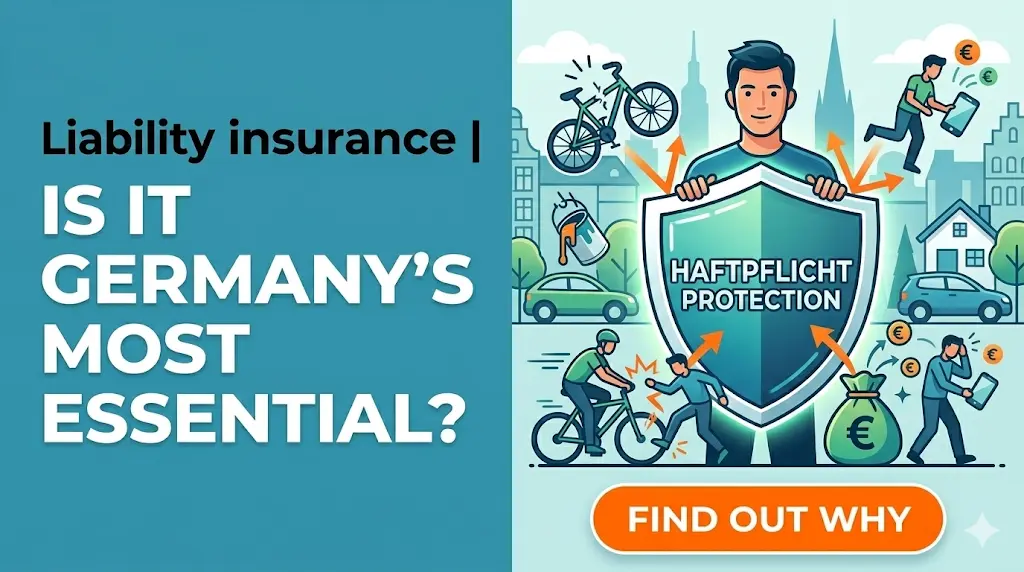
Privathaftpflichtversicherung (often shortened to Haftpflicht) is a private insurance policy designed to protect you from the financial consequences of accidentally causing harm to another person or damaging their property. If you clumsily knock over a friend’s expensive laptop, cause a traffic accident while riding your bicycle, or if a loose roof tile from your rented balcony damages a parked car below, this insurance steps in to cover the resulting costs. It acts as a financial shield between your personal assets and the legal claims of the injured party.
In Germany, the concept of liability is taken extremely seriously. If you cause damage, you are legally obligated to make the injured party whole again, regardless of how much it costs. This obligation extends to your current savings, your future income, and any assets you might acquire later in life. Therefore, Haftpflichtversicherung is not just about paying for broken glasses; it is about safeguarding your entire financial future from a momentary lapse in judgment or an unfortunate accident. When managing your finances abroad, using a modern banking solution like N26 to easily set up direct debits for your monthly or annual insurance premiums can streamline the process significantly.
Furthermore, this insurance provides what is known as “passive legal defense.” If someone falsely accuses you of causing damage, your liability insurer will act similarly to a legal defense team. They will investigate the claim, reject unjustified demands on your behalf, and even cover the legal costs if the dispute goes to court. This dual function—paying out justified claims and fighting unjustified ones—makes it an incredibly robust financial tool for expats navigating a new legal environment.
Why Germans Consider It Essential
While German healthcare system contributions and car insurance are legally mandated, private liability insurance remains technically voluntary. However, ask any German, and they will tell you it is the single most important voluntary insurance you can buy. An estimated 83% of German households hold a Haftpflicht policy. This high adoption rate is driven by a culturally ingrained aversion to unpredictable financial risk and a deep respect for personal responsibility.
Germans understand that a seemingly minor accident can lead to astronomical costs. Imagine crossing the street while looking at your phone, causing a bus to swerve, crash into a building, and injure several passengers. Without liability insurance, you would be personally liable for the property damage to the bus and the building, as well as the medical bills, rehabilitation costs, and lost wages of every injured passenger. Such an event would instantly bankrupt an uninsured individual. Because these existential risks exist in everyday life, having this insurance is considered a basic sign of being a responsible adult in German society.
For expats, integrating into this mindset is crucial. Landlords often implicitly expect, or explicitly request, proof of liability insurance before handing over the keys when renting an apartment in Germany. It signals to them that you are financially secure and culturally aware. Whether you are funding your everyday life from local income or transferring savings from home via Wise, ensuring a portion of your budget is allocated to this insurance is a non-negotiable aspect of living responsibly in the country.
The Legal Framework Behind Personal Liability
The foundation of this extreme liability lies in the German Civil Code (Bürgerliches Gesetzbuch, or BGB). Specifically, Section 823 of the BGB states that anyone who intentionally or negligently injures the life, body, health, freedom, property, or other rights of another person is obligated to compensate that person for the resulting damage. Crucially, the law places no upper limit on this liability. You are liable with all your present and future assets until the debt is fully settled.
This strict legal framework means there is no “bankruptcy protection” that magically wipes away liability debts if you cannot pay. If you cause a million-euro accident and only have ten thousand euros to your name, a court can garnish your future wages for decades until the victim is compensated. This harsh reality is exactly why consumer protection agencies in Germany relentlessly advocate for Haftpflichtversicherung. It is the only reliable way to cap your personal financial exposure to the limits set by the policy.
Understanding this legal context helps expats realize that selling or promoting liability insurance isn’t merely a fear tactic used by brokers; it is a practical response to a rigorous legal environment. When you use public Wi-Fi to research and sign up for these crucial financial services, ensuring your connection is secure with a tool like NordVPN is highly recommended, as you will be handling sensitive personal and banking data.
What Does Personal Liability Insurance Cover?
A standard Privathaftpflichtversicherung policy is remarkably broad in its coverage, designed to handle the myriad of ways a normal person going about their daily life might accidentally cause harm. The coverage is generally categorized into three main pillars: property damage, bodily injury, and financial loss.
Property Damage and Accidental Breakage
Property damage (Sachschäden) is the most commonly claimed category under personal liability insurance. This covers situations where you damage or destroy something belonging to someone else. The classic example is visiting a friend’s apartment and accidentally knocking a glass of red wine onto their expensive white rug. Your insurance will cover the cost of professional cleaning or replacing the rug.
Another common scenario involves accidentally dropping a friend’s smartphone or damaging borrowed items. However, it is vital to read the fine print regarding borrowed or rented items (Geliehene und gemietete Sachen). While basic policies might exclude items you have deliberately borrowed, most modern, comprehensive policies now include them up to a certain limit. This is particularly relevant for expats who might rent tools, borrow a friend’s camera for a weekend trip, or inadvertently damage fixtures in a furnished rental apartment.
When a property damage claim is approved, the insurance company will typically reimburse the “current value” (Zeitwert) of the item, not necessarily the “new replacement value” (Neuwert). This means if you break a five-year-old laptop, the insurer will pay what a five-year-old laptop is currently worth, which is significantly less than buying a brand-new model. Understanding this distinction prevents frustration when settling claims.
Bodily Injury and Medical Costs
While property damage is common, bodily injury (Personenschäden) represents the most severe financial risk. If your negligence causes physical harm to another person, the associated costs can quickly spiral into the millions. This includes not just immediate hospital bills, but long-term care, rehabilitation, compensation for pain and suffering (Schmerzensgeld), and compensation for lost wages if the victim is unable to work.
Consider a scenario where you are skiing in the Bavarian Alps and accidentally collide with another skier, causing them a severe spinal injury. If you are found at fault, you are liable for their lifelong medical care and loss of earnings. A robust Haftpflicht policy will step in to cover these catastrophic costs up to the agreed coverage limit (which should ideally be €50 million or more). This protection is what truly makes the insurance essential, as it shields you from life-ruining debt.
Bodily injury coverage also extends to less dramatic, everyday situations. For example, if you fail to clear the snow and ice from the pavement in front of your house (a legal duty for many tenants and homeowners in Germany) and the mail carrier slips and breaks their arm, your liability insurance will handle their medical claims and any resulting compensation demands.
Financial Loss and Passive Legal Defense
Financial loss (Vermögensschäden) occurs when your actions cause someone to lose money, even if no physical property was damaged and no one was hurt. For instance, if you accidentally block a neighbor’s driveway with your bicycle, preventing them from getting to the airport and causing them to miss a non-refundable business flight, they could sue you for the cost of the missed flight and the lost business opportunity. Your liability insurance covers these pure financial losses.
Equally important is the “passive legal defense” (Passiver Rechtsschutz) feature. Not every claim made against you will be justified. Sometimes people exaggerate damage or blame you for accidents that weren’t your fault. In these cases, your liability insurer acts as your legal shield. You forward the unjustified claim to them, and their lawyers will dispute it.
If the claimant decides to take the matter to court, your insurer will pay the court costs, lawyer fees, and expert witness fees necessary to defend you. If the court ultimately decides you are liable, the insurer will then pay the damages. This feature saves you from having to hire expensive lawyers to fight frivolous lawsuits out of your own pocket. If you are managing an investment portfolio through platforms like Interactive Brokers, knowing that your assets are shielded from frivolous lawsuits by a strong liability policy provides immense peace of mind.
What Is Excluded From Standard Policies?
While Privathaftpflichtversicherung is comprehensive, it is not a magic shield that covers every conceivable bad outcome. Insurers draw strict boundaries to prevent fraud and moral hazard, and to separate personal liability from specialized risks that require different types of insurance.
Intentional Damage and Criminal Acts
The most fundamental exclusion in any liability policy is intentional damage (Vorsatz). If you deliberately break someone’s window in a fit of rage, your insurance will absolutely not pay for it. Insurance is designed to cover accidents and negligence, not malicious acts. If an insurer determines that you acted with intent to cause harm, they will deny the claim, and you will be fully responsible for the costs.
Gross negligence (Grobe Fahrlässigkeit), however, is a gray area. Gross negligence means you ignored obvious risks that any reasonable person would have recognized—for example, leaving a lit candle unattended in a room full of dry curtains. Historically, insurers could reduce or deny payouts for gross negligence. However, many modern, high-quality premium policies now explicitly include coverage for gross negligence, recognizing that human error often borders on the careless.
Criminal acts are naturally excluded. Any fines, penalties, or punitive damages levied against you by a state authority or criminal court cannot be passed on to your insurance company. The insurance only covers civil claims for compensation made by private individuals or entities you have harmed.
Work-Related Incidents and Professional Liability
Privathaftpflichtversicherung is strictly for your private life. The moment you step into your professional role, standard personal liability coverage ceases to apply. If you accidentally spill coffee on a client’s server while performing your job as an IT consultant, your personal liability insurance will deny the claim.
For work-related risks, employees are generally covered by their employer’s corporate liability insurance. However, if you are self-employed, a freelancer, or running your own business, you must purchase a separate Professional Liability Insurance (Berufshaftpflichtversicherung) or Public Liability Insurance (Betriebshaftpflichtversicherung). This is a critical distinction for expats on a freelance visa in Germany, who must ensure they have the correct specialized coverage for their specific trade or profession.
There are minor exceptions. Some premium personal liability policies might offer limited coverage for side hustles or freelance work that generates very low annual revenue (e.g., occasional babysitting or tutoring). However, relying on this is risky, and anyone engaging in regular professional activity must secure dedicated commercial coverage.
Motor Vehicle Accidents and Specialized Insurance
Any damage caused while operating a motorized vehicle is strictly excluded from personal liability insurance. Motor vehicle liability (Kfz-Haftpflichtversicherung) is a completely separate, legally mandatory insurance in Germany. If you cause a car crash, your car insurance pays, not your personal liability insurance.
Similarly, standard policies exclude damage caused by certain types of animals, specifically dogs and horses. Because these animals are considered inherently unpredictable and capable of causing significant damage, owners must purchase dedicated Animal Owner Liability Insurance (Tierhalterhaftpflichtversicherung). Conversely, small, tame pets like cats, hamsters, and birds are usually covered under your standard personal liability policy.
Another specialized exclusion applies to landlords. While your policy covers you as a tenant, if you buy property and rent it out to others, you need a separate Landlord Liability Insurance (Haus- und Grundbesitzerhaftpflicht) to cover accidents happening on the property, such as a tenant slipping on an icy walkway that you failed to maintain.
How to Choose the Right Policy for Expats
Navigating the German insurance market can be daunting, especially with the language barrier. However, choosing the right Haftpflicht policy comes down to understanding a few key metrics and ensuring the coverage matches your specific living situation. Review our guide on the Cost of Living in Germany.
Coverage Limits and Deductibles
The most critical number in any liability policy is the coverage limit (Deckungssumme). This is the maximum amount the insurer will pay out per incident. While German law allows for unlimited liability, insurers must cap their risk. Consumer protection agencies strongly advise an absolute minimum coverage limit of €10 million for personal injury, property damage, and financial loss combined.
However, given that the price difference between a €10 million policy and a €50 million policy is often just a few euros a year, it is highly recommended to opt for limits of €50 million or even €100 million. This ensures that even in the absolute worst-case scenario—such as a mass-casualty accident where you are deemed at fault—your insurance will cover the astronomical costs without your personal assets ever being touched.
You also have the option to include a deductible (Selbstbeteiligung), which is the amount you pay out of pocket for each claim before the insurance kicks in. A common deductible is €150 or €250. Agreeing to a deductible will lower your annual premium. However, personal liability insurance is already incredibly affordable (often between €40 and €70 per year for excellent coverage). Therefore, many experts suggest opting for a €0 deductible so that you don’t hesitate to report even minor damages, maximizing the utility of the policy.
Family vs. Single Coverage Options
Insurance providers offer different tariff structures based on your household status. If you are moving to Germany alone, a “Single” (Single-Tarif) policy is the most cost-effective option. It covers you and only you.
If you are moving with a partner or a family, you should look for a “Family” (Familientarif) or “Partner” policy. A family policy covers the primary policyholder, their spouse or registered partner (as long as they live at the same address), and any dependent children. In Germany, children are generally considered dependents and are covered under their parents’ policy until they finish their first vocational training or university degree, even if they temporarily live away from home for their studies.
When comparing prices and structures, a useful breakdown helps clarify the options:
| Feature | Single Policy | Family / Partner Policy |
| Who is covered? | Only the policyholder. | Policyholder, spouse/partner, dependent children. |
| Cost (Approx. Annual) | €40 – €60 | €60 – €90 |
| Address requirement | N/A | Partners must be registered at the same address. |
| Coverage for children | No | Yes, up to completion of first degree/training. |
| Internal family claims | N/A | Usually excluded (you cannot claim against your spouse). |
It is important to note that damage caused by family members to each other is almost always excluded. If your child breaks your expensive television, your family liability insurance will not cover it, as the insurance is designed to protect against claims from third parties outside the household.
Key Add-Ons for Renters and Pet Owners
When customizing your policy, you must ensure it includes specific clauses relevant to your lifestyle. For expats, the most crucial inclusion is “damage to rented property” (Mietsachschäden). Since the vast majority of expats rent their apartments, you need coverage in case you accidentally damage the landlord’s property, such as severely scratching the parquet flooring or cracking a bathroom sink. A good policy will cover these damages, usually up to a specified limit.
Another vital add-on is the “loss of keys” (Schlüsselverlust) clause. In Germany, apartment buildings often use complex, centralized locking systems (Schließanlage). If you lose your apartment key, the landlord may be forced to replace the locks for the entire building to maintain security. This can easily cost several thousand euros. Ensuring your policy covers the loss of private and professional keys is a financial lifesaver.
Finally, check for the “bad debt loss” (Forderungsausfalldeckung) clause. This protects you if someone else damages your property or injures you, but they do not have liability insurance and cannot afford to pay you from their own pocket. In this scenario, your own insurance steps in and compensates you for the damages caused by the uninsured third party. This clause essentially turns your liability insurance into a protective net against the negligence of others.
Making a Claim and Navigating the Process
Hopefully, you will never need to use your liability insurance, but knowing how to handle a claim effectively is vital for a smooth resolution. The German bureaucratic process can be strict, and adhering to the correct steps is essential to avoid claim denial.
Immediate Steps After an Incident
If an accident occurs and you cause damage to a third party, the very first rule is: Do not admit liability and do not pay anything out of pocket. In Germany, admitting fault (Schuldanerkenntnis) or proactively handing over cash can severely complicate the insurance process. Your insurer has the right to investigate the claim to determine if you are actually legally liable. If you prematurely admit fault, you undermine their ability to defend you, and they may refuse to pay.
Instead, exchange contact information with the injured party and calmly explain that you will forward the matter to your liability insurance company. Document the scene thoroughly. Take photographs of the damage from multiple angles, note the exact time and location, and write down the contact details of any witnesses. The more evidence you can provide to your insurer, the faster and smoother the processing will be.
You must report the incident to your insurance company immediately, usually within a week of the event occurring. Most modern insurers offer online portals or apps where you can upload photos and submit the initial incident report. Waiting too long to report the damage violates your contractual obligations and can lead to a loss of coverage. Using a secure connection via NordVPN when uploading sensitive documents to an insurance portal is a wise practice.
Documentation and Communication
Once the claim is filed, the insurer will likely send you a detailed questionnaire. You must fill this out completely and truthfully. Do not exaggerate or omit details, as insurance fraud is taken very seriously in Germany and will lead to immediate policy cancellation and potential criminal charges. Describe exactly what happened, how it happened, and who was involved.
The insurance company will then communicate directly with the injured party. They may ask the injured party for repair estimates or original purchase receipts to determine the current value (Zeitwert) of the damaged item. During this time, you should forward any letters, emails, or demands you receive from the injured party directly to your insurer. Do not negotiate with the injured party yourself.
If you are paying your premiums or managing cross-border finances, platforms like Wise are excellent, but remember that insurance payouts for property damage will go directly to the injured party’s bank account, not yours. The only time you receive money from your own liability insurer is under the “bad debt loss” clause mentioned earlier.
Conclusion
In a straightforward case where the liability is clear and the damage is documented, payouts usually occur within a few weeks. However, disputes can arise. The injured party might disagree with the insurer’s assessment of the item’s current value, arguing they deserve the full replacement cost. Alternatively, the insurer might investigate and conclude that you were not legally negligent, thus rejecting the claim on your behalf.
If the injured party is unhappy with the insurer’s decision, they may threaten legal action. This is where your passive legal defense kicks in. You simply inform your insurer of the legal threat, and they will take over the correspondence with the claimant’s lawyers. You do not need to hire your own attorney unless the insurance company explicitly advises you to do so (which is rare, as they prefer to manage the defense to control costs).
If you yourself have a dispute with your insurance company—for example, if they refuse to cover a claim you believe is valid under your policy—you can escalate the issue. Before going to court, you can contact the Insurance Ombudsman (Versicherungsombudsmann), an independent arbitration board that settles disputes between consumers and insurance companies free of charge. Maintaining a good Schufa score by ensuring all your financial obligations, including insurance premiums managed through Interactive Brokers or your local bank, are met on time ensures you remain in good standing with financial institutions across the board.
References
Primary sources (official)
- BaFin (Federal Financial Supervisory Authority): Official Guide on Third-party Liability Insurance. Available at: https://www.bafin.de/EN/Verbraucher/Versicherung/Produkte/Haftpflicht/haftpflichtversicherung_node_en.html
- Verbraucherzentrale (Consumer Advice Center): Private Liability Insurance: An Absolute Must for Everyone. Available at: https://www.verbraucherzentrale.de/wissen/geld-versicherungen/weitere-versicherungen/private-haftpflichtversicherung-ein-absolutes-muss-fuer-alle-13891
Other helpful sources
- Make it in Germany (Federal Government Portal): Additional Insurances for Expats. Available at: https://www.make-it-in-germany.com/en/living-in-germany/money-insurance/additional
- German Civil Code (BGB): Section 823 – Liability in Damages. Available at: https://www.gesetze-im-internet.de/englisch_bgb/
Disclaimer
The information provided in this article is for general informational and educational purposes only and does not constitute professional financial, legal, or insurance advice. While every effort has been made to ensure the accuracy and completeness of the information at the time of publication, insurance regulations and policies in Germany are subject to change. We strongly recommend consulting with a certified insurance broker or financial advisor to discuss your specific personal circumstances before purchasing any insurance policy.