Public Holidays and Your Job: What You Need to Know (Vacation Planning)
Staring at a locked supermarket door on a random Thursday in spring, realizing you have no groceries because you completely missed a regional Catholic holiday, is a brutal expat rite of passage. I once lived on stale pasta for two days because of Corpus Christi. This guide demystifies Germany’s fragmented public holidays, bridge days, and vacation laws so you can plan effectively.
Disclosure: This post may contain affiliate links. We may earn a commission at no extra cost to you if you make a purchase through these links. Read full disclosure.
The German Public Holiday System Explained
Nationwide vs Regional Holidays The Federal Lottery
Germany is a deeply decentralized country, and this reality aggressively dictates your time off. There are currently only nine nationwide public holidays (Feiertage) that apply to every single person living in the country. These include the major cornerstones: New Year’s Day, Good Friday, Easter Monday, Labour Day, Ascension Day, Whit Monday, the Day of German Unity, Christmas Day, and Boxing Day. Beyond these nine, your time off is entirely determined by the specific federal state (Bundesland) where your employment contract is based.
This creates a massive regional disparity that expats often fail to consider during salary negotiations. The heavily Catholic southern states are essentially the jackpot of the German holiday lottery. If you are reviewing Living in Munich: Expat Guide to the Bavarian Capital, you will find that Bavarians enjoy up to thirteen or fourteen public holidays a year, benefiting from days like Epiphany, Corpus Christi, and Assumption Day.
Conversely, if you live in the secular north, your calendar is much bleaker. For those looking into Living in Berlin: Expat Guide to Neighborhoods and Lifestyle, the city historically had the fewest holidays in the country, recently adding International Women’s Day just to bring their total to a mere ten. This means a professional in Munich works nearly a full week less per year than a peer in Berlin for the exact same base salary. Furthermore, if your company is headquartered in Frankfurt but your registered home office is in Hamburg, your applicable holidays are dictated by the laws of Hamburg, leading to endlessly confusing out-of-office autoreplies among remote teams.
The Brutal Rule When Holidays Fall on Weekends
If you are relocating from the United Kingdom, the United States, or much of the Commonwealth, you are likely accustomed to the “substitute holiday” system. If a major national holiday falls on a Saturday, the government graciously grants you the following Monday off to ensure you get your rest. In Germany, this concept simply does not exist.
If a public holiday falls on a weekend, it vanishes into the void. You are granted absolutely no compensatory time off. The phrase you will hear repeated with a defeated sigh around the office watercooler is simply “Pech gehabt” (tough luck). In certain years, both Christmas Day and Boxing Day can fall perfectly on a Saturday and Sunday, effectively robbing the German workforce of their expected festive downtime.
While left-leaning political parties routinely propose introducing compensatory days to align Germany with the rest of the modern global workforce, the powerful employer associations consistently strike these proposals down. As an expat, you must manually review the calendar every single December to calculate how “lucky” or “unlucky” the upcoming year’s holiday placement will be for your overall rest.
Sonntagsruhe Why Everything is Closed on Holidays
The German approach to public holidays is governed by the Arbeitszeitgesetz (Working Hours Act), which treats public holidays exactly the same as Sundays. They are fiercely protected days of rest, governed by the principle of Sonntagsruhe (Sunday rest). This means that virtually all commercial and retail activity in the country comes to an absolute, grinding halt.
Supermarkets, shopping malls, clothing boutiques, and pharmacies lock their doors. The only exceptions permitted by law are essential services: hospitals, police stations, restaurants, gas stations, and the small, overpriced convenience kiosks located inside major train stations and airports.
For an unprepared newcomer, failing to secure your groceries before a long holiday weekend is a devastating logistical error. The evening before a major public holiday, German supermarkets transform into chaotic battlegrounds as locals horde bread, milk, and vegetables as if preparing for a minor apocalypse. Understanding this rhythm and adjusting your weekly logistical planning is a vital survival mechanism, echoing the societal boundaries explored deeply in Work-Life Balance in Germany: How Germans Balance Work and Leisure.
The Art of the Brückentag Bridge Day
What is a Brückentag and How Does it Work
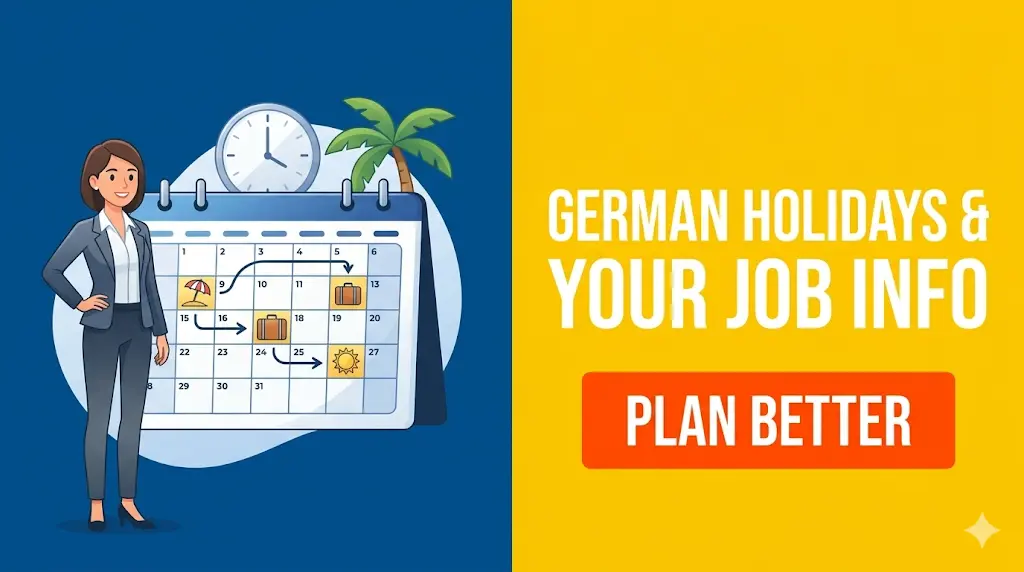
To combat the rigidity of the German holiday system, the local workforce has perfected the mathematical art of the Brückentag (bridge day). A bridge day is a standard working day that falls awkwardly between a public holiday and a weekend. The most classic example is Ascension Day (Christi Himmelfahrt), which is a nationwide public holiday that mathematically always falls on a Thursday.
By requesting a single vacation day for that specific Friday, a German employee secures four consecutive days of uninterrupted leisure. The efficiency is staggering. Through careful manipulation of these bridge days—particularly around Easter, Pentecost, and Christmas—savvy employees can frequently transform their standard 30 days of annual leave into over 60 days of actual time away from the office. It is a culturally celebrated optimization puzzle.
The Early Bird Strategy Why You Must Plan in January
Because the mathematics of bridge days are universally understood, securing them requires ruthless, proactive planning. In traditional German corporate culture, departments circulate the annual Urlaubsplan (vacation spreadsheet) in the first two weeks of January. You are expected to plot your major absences for the entire year immediately.
If you wait until mid-April to casually ask your boss for the Friday off after Ascension Day, your request will almost certainly be denied. Most departments have strict operational rules dictating that no more than ten or twenty percent of the team can be absent simultaneously. By April, your German colleagues will have long since claimed every available bridge day.
Navigating the internal politics of who gets priority for these coveted days—often defaulting to employees with school-aged children—can be an intimidating linguistic and cultural hurdle for a newcomer. If you struggle to politely but firmly advocate for your time off in German, enrolling in a targeted business communication class via Lingoda early in the year will equip you with the formal phrasing needed to secure your fair share of the corporate calendar.
Pros and Cons of Taking Bridge Days
While maximizing your time off sounds flawless on paper, the Brückentag lifestyle comes with significant logistical drawbacks that expats rarely anticipate. Because millions of Germans are executing the exact same vacation strategy simultaneously, the travel infrastructure buckles.
Prices for flights and hotels departing from Germany skyrocket on these specific Wednesday evenings. The legendary Autobahn system turns into a static parking lot of gridlocked traffic, and the regional Deutsche Bahn trains become claustrophobically overcrowded. Your relaxing four-day weekend can easily start with an eight-hour nightmare in transit.
Conversely, there is a highly strategic “anti-bridge day” maneuver favored by many seasoned professionals. By choosing to work on that awkward Friday while eighty percent of your office is on vacation, you experience the most peaceful, highly productive working day of the year. The phones do not ring, emails do not arrive, and you can catch up on deep, uninterrupted tasks without managerial oversight.
Working on Public Holidays Your Rights and Compensation
Who is Legally Allowed to Work
If you are a corporate expat grinding through a major project deadline, you might be tempted to log into your laptop on a public holiday to impress your manager and get ahead. Do not do this. In Germany, working on a public holiday is generally strictly prohibited by federal law for standard office and administrative workers. You cannot simply “volunteer” to waive your rights to rest.
If your employer actively pressures you to complete standard office work on a public holiday, they are committing a massive violation of the Working Hours Act, which can result in fines of up to €15,000 per instance for the company. However, the law provides massive, sweeping exemptions for specific industries where continuous operation is vital to society.
If you work in healthcare, emergency services, hospitality, public transport, broadcasting, or continuous-production manufacturing, you are legally permitted—and contractually obligated—to work on public holidays. Navigating these exemptions is a highly technical aspect of your employment that is further detailed in German Workplace Rights: Overtime, Breaks, and Vacation Days Explained.
Financial Compensation Feiertagszuschlag vs Time in Lieu
If you are employed in one of the exempt industries and are scheduled to work on Easter Sunday or May Day, the German state ensures you are heavily compensated for your sacrifice. By law, any employee who works on a public holiday must be granted an Ersatzruhetag (compensatory day of rest). This day off must be provided within an eight-week window surrounding the holiday worked.
Beyond the time off, the financial compensation is highly lucrative. Employees often receive a Feiertagszuschlag (public holiday premium) on top of their base hourly wage. Depending on your industry’s collective bargaining agreement (Tarifvertrag), this premium can range from 50% to 150% of your standard pay.
Crucially, the German tax authority heavily incentivizes this. Holiday premiums are generally tax-free up to 125% of your base wage (and up to 150% for high-value days like Christmas Eve and May 1st), provided your base hourly wage does not exceed a specific, high-income threshold. This makes working holidays incredibly attractive for young expats looking to rapidly build their savings.
Navigating Part Time and Shift Work Rules
For expats working part-time schedules, public holidays can feel like a game of roulette. The golden rule in German labor law is that if a public holiday falls on a day you are normally, contractually scheduled to work, you receive the day off with full, uninterrupted pay. You do not owe the company make-up hours for a state-mandated closure.
However, if you work a rigid part-time schedule—for example, exclusively Monday through Wednesday—and a public holiday happens to fall on a Thursday, you receive absolutely no benefit. You do not get an extra day off, nor do you get extra pay, because the holiday fell on a day you were already off the clock.
Vacation Days Urlaub vs Public Holidays
How Your Annual Leave Interacts with Feiertage
The German standard for annual leave (Urlaub) is phenomenal. While the legal baseline is 20 days for a five-day workweek, the corporate norm sits solidly between 28 and 30 paid days. A common point of confusion for new arrivals is how to officially book this time when public holidays intersect with their plans.
If you submit a request for a two-week vacation spanning Monday to Friday of the following week (which would normally cost 10 vacation days), but a public holiday like German Unity Day (October 3rd) falls on the Wednesday of that block, you only use 9 days of your annual allowance.
Public holidays are entirely separate from your vacation pool. Your company’s HR software will automatically identify the state holiday and shield your personal vacation balance from being deducted. This protection is what makes the aforementioned Brückentag strategy so mathematically viable.
Probation Periods and Requesting Time Off Early
One of the most pervasive myths among the international community is that you are legally forbidden from taking any vacation days during your Probezeit (the initial six-month probation period). This is factually incorrect. Under German law, you accrue exactly one-twelfth of your total annual leave entitlement for every full month you work.
If you have a 30-day allowance and you have worked for two months, you have legally earned 5 days of vacation. You have the absolute right to request these days during your probation. However, there is a strict cultural nuance here. Taking a single Friday off to create a long weekend during your third month is perfectly acceptable. Submitting a request to disappear for three weeks to travel Southeast Asia during your fourth month is a massive corporate faux pas that will likely result in the termination of your contract.
You must balance your legal rights with the optics of proving your reliability.
Sickness During a Holiday or Vacation
The German labor system operates on a fundamental principle: vacation days are explicitly meant for recovery and recreation (Erholung). If you fall violently ill during your approved vacation to Spain, the state dictates that your time off is no longer recreational; it is medical.
If you become sick on your vacation, you must immediately visit a doctor and secure an official medical certificate (Arbeitsunfähigkeitsbescheinigung or AU). You must send this certificate to your German employer on the very first day of illness. If you follow this protocol, every single day you were certified as sick will be legally refunded to your annual vacation balance to be used later in the year.
However, this magic refund does not apply to public holidays. If you are sick in bed on New Year’s Day, you simply receive your standard sick pay. You do not get to claim a “replacement” public holiday the following week. Communicating complex symptoms to a receptionist at a foreign clinic while on vacation is terrifying; proactively studying medical and emergency vocabulary through audio lessons on GermanPod101 during your daily commute is an investment that will literally save your hard-earned vacation days when disaster strikes.
Strategic Planning for Peak Seasons
The Easter and Pentecost Holiday Clusters
If you want to master the German calendar, you must look to the spring. The months of April, May, and June are a chaotic, beautiful cluster of state and religious holidays where very little substantial corporate work gets accomplished. The season kicks off with the Easter weekend, which guarantees both Good Friday (Karfreitag) and Easter Monday as nationwide days off.
Shortly after Easter arrives Labour Day (May 1st), followed swiftly by Ascension Day and Pentecost (Pfingsten), which gifts the workforce Whit Monday. In states like Bavaria and North Rhine-Westphalia, this cluster is extended even further by Corpus Christi (Fronleichnam).
A crucial cultural warning for expats: Good Friday in Germany operates under strict Tanzverbot (dancing ban) laws. Out of religious respect, public parties, loud musical events, and nightclub operations are strictly illegal and heavily fined. Do not plan a massive, loud house party on the Thursday night leading into Good Friday.
The Zwischen den Jahren Shutdown
The final major hurdle of the German holiday calendar is the unique period known as Zwischen den Jahren (between the years), referring to the week stretching from Christmas to New Year’s Day.
It is a massive shock to many expats to learn that December 24th (Christmas Eve) and December 31st (New Year’s Eve) are completely normal, legally binding work days. They are not public holidays. However, as a deeply entrenched corporate perk, the vast majority of German employers grant these days as paid half-days, or require you to submit only 0.5 of a vacation day to take the full day off.
Furthermore, many medium and large companies institute Betriebsferien (mandatory company shutdowns) during this entire week. The office locks its doors, the servers are powered down, and you are forcibly required to use your own annual vacation days to cover the non-public holiday dates within that window.
Managing Expat Guilt When Traveling Home
The greatest trap an international professional can fall into is the “expat guilt trip.” Because you are granted 30 days of vacation, there is immense internal and familial pressure to use every single one of those days flying back to your home country. You burn your entire annual allowance sleeping on your childhood bed, attending relatives’ weddings, and operating out of a suitcase for a month.
When you return to Germany, you have zero days left to take a mental health break, resulting in severe burnout by October. This completely defeats the purpose of the German work-life balance. You must fiercely protect your rest.
Use your bridge days strategically to take mini-breaks within Europe. Book a four-day weekend in the Black Forest or take the train to Amsterdam. Guard at least one week of your vacation balance exclusively for yourself, where you do not travel across time zones and do not appease family members.
Quick Reference Top Regional Holidays
To help you calculate your true time off, here is a quick breakdown of the most impactful regional holidays and where they apply.
| Holiday German Name | Date | Applies To Key States | Expat Impact |
| Epiphany (Heilige Drei Könige) | Jan 6 | Bavaria, Baden-Württemberg, Saxony-Anhalt | Extends the Christmas break if used with early January bridge days. |
| Int. Women’s Day (Frauentag) | Mar 8 | Berlin, Mecklenburg-Western Pomerania | A rare bonus for the historically holiday-starved capital city. |
| Corpus Christi (Fronleichnam) | Variable (Thursday) | Bavaria, NRW, Hesse, Baden-Württemberg | The ultimate spring Brückentag. Always falls on a Thursday. |
| Assumption Day (Mariä Himmelfahrt) | Aug 15 | Bavaria (mostly), Saarland | A rare late-summer break before the long stretch to October. |
| Reformation Day (Reformationstag) | Oct 31 | Northern/Eastern States (e.g., Hamburg, Saxony) | The Protestant counter-holiday to the Catholic All Saints’ Day. |
| All Saints’ Day (Allerheiligen) | Nov 1 | Bavaria, NRW, Baden-Württemberg | A deeply quiet holiday; frequently triggers a Tanzverbot (dancing ban). |
References
Primary sources (official)
- Federal Ministry of Labour and Social Affairs (BMAS) – Working Hours Act (Arbeitszeitgesetz): https://www.bmas.de/EN/Labour/Labour-Law/labour-law.html
- Make it in Germany (Official Federal Government Portal) – Vacation and Working Hours: https://www.make-it-in-germany.com/en/working-in-germany/working-environment/vacation-working-hours
Other helpful sources
- How To Germany – German Holidays Guide: https://howtogermany.com/culture/german-culture/german-holidays/
- Expatrio – Working Time in Germany: https://www.expatrio.com/about-germany/working-time-germany
Disclaimer
The labor laws, vacation minimums, and holiday schedules detailed in this guide are based on federal and state German regulations at the time of publication. The interpretation of working hours (Arbeitszeitgesetz) and compensation for holiday work can vary significantly depending on your specific industry, your individual employment contract, and collective bargaining agreements (Tarifverträge). Always consult your company’s HR department or a legal representative to fully understand your specific entitlements and obligations regarding time off.