Understanding Apotheke Signs: Green Crosses and Night Service Indicators
Navigating the German pharmacy system can be confusing for newcomers. This comprehensive guide explains the significance of the red Apotheke symbol, green crosses, and night service indicators, ensuring you can always find the medication you need, day or night.
Disclosure: This post may contain affiliate links. We may earn a commission at no extra cost to you if you make a purchase through these links. Read full disclosure.
Decoding the German Pharmacy System
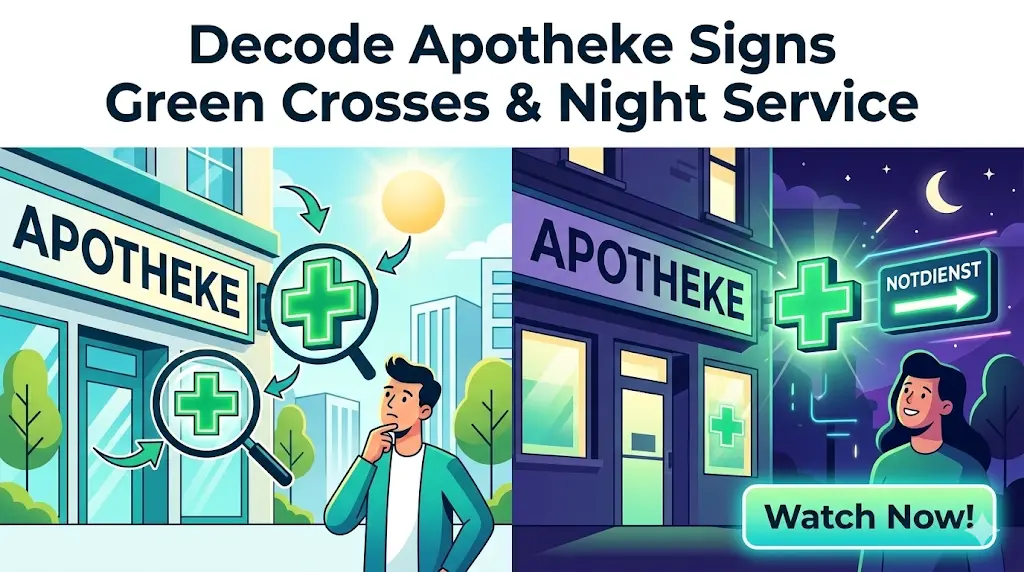
When moving to Germany, one of the most immediate culture shocks many expats experience revolves around healthcare and purchasing medication. Unlike in many other countries where you can easily pick up pain relievers, cold medicine, or allergy pills at the local supermarket or convenience store, Germany strictly regulates the sale of medications. To purchase anything from ibuprofen to prescription antibiotics, you must visit a dedicated, licensed pharmacy. Understanding the visual language of these establishments is your first step in successfully navigating the German healthcare system. In many countries, pharmacies (Apotheken) are marked by a green cross, a widely recognized symbol for medical assistance. Illuminated crosses often indicate the pharmacy is open. Special signs or displays show “night service” (Notdienst), informing customers which pharmacy is available after regular hours for urgent medication needs.
The Iconic Red Apotheke A
The most critical symbol to recognize in Germany is the large, stylized red letter “A”. This is the official, legally protected logo of the German pharmacy, known as the Apotheke. The design features a Gothic-style Fraktur letter “A” accompanied by a white chalice and a snake intertwined around it—a traditional symbol of medicine and healing derived from the Bowl of Hygieia. Illuminated signs or notices indicate Notdienst pharmacies open overnight, weekends, or public holidays.
Whenever you see this illuminated red “A” extending from a building facade, you are looking at a state-licensed pharmacy. It is important to distinguish the Apotheke from a Drogerie (drugstore), such as dm or Rossmann. While drugstores sell toiletries, cosmetics, cleaning supplies, and some basic dietary supplements, they are legally prohibited from selling any actual medication, including basic over-the-counter painkillers. To understand the broader framework of what is and isn’t covered by the state, read Public Health Insurance gesetzliche Krankenkasse: What It Covers and Costs.
The Green Cross Explained
Expats arriving from countries like France, Italy, or the United Kingdom are often conditioned to look for a glowing green cross when they need a pharmacy. In Germany, however, the green cross is not the primary official symbol for a standard pharmacy.
While you might occasionally spot a green cross in the window of a German Apotheke, it usually serves a secondary purpose. Sometimes it is simply used as an internationally recognized sign to signal to tourists that medicine is sold there. In other cases, a green cross in Germany can indicate that the pharmacy specializes in naturopathic remedies, homoeopathic treatments, or botanical medicines.
If you are specifically looking for vitamins, supplements, or specialized health foods rather than acute medication, you might find that German pharmacies charge premium prices. Many international residents prefer to order their routine health and wellness supplements online through platforms like iHerb to maintain their preferred regimens at lower costs. However, for any medicinal needs or expert health advice, the red “A” remains your primary destination.
Navigating After Hours Care and Night Service
Illness rarely respects standard business hours, and German retail laws are famously strict, with most shops closing by 8:00 PM and remaining entirely closed on Sundays. Fortunately, the German healthcare system mandates a robust emergency network to ensure that citizens and residents always have access to essential medications 24 hours a day, 365 days a year.
How the Apothekennotdienst Works
The after-hours pharmacy service is known as the Apothekennotdienst (emergency pharmacy service). By law, a specific number of pharmacies in every district must remain open through the night, on weekends, and during public holidays. This duty rotates daily among the local pharmacies.
If you need medication outside of regular business hours, you will not be able to just walk into the nearest Apotheke. Instead, you must locate the specific pharmacy assigned to emergency duty for that particular night. It is highly recommended to familiarize yourself with this system alongside learning the essential emergency numbers in Germany.
When you use the emergency night service, be prepared to pay a small statutory surcharge, known as the Notdienstgebühr. This fee is typically around 2.50 Euros and is added to your total bill. The fee is charged per visit, not per item. If you have private health insurance through a provider like Ottonova or comprehensive expat coverage from Feather Insurance, this emergency fee, along with the cost of prescribed medications, can often be submitted for reimbursement according to your policy terms.
Reading the Digital and Printed Signs
Finding the emergency pharmacy is a straightforward process once you know where to look. Every single Apotheke in Germany, when closed, is legally required to display a sign directing customers to the nearest open emergency pharmacy.
You will typically find this information posted near the main entrance or displayed in the front window. Modern pharmacies use illuminated digital screens that scroll through the names, exact addresses, and sometimes even small maps showing the location of the on-duty pharmacies. Older or smaller pharmacies might simply have a printed piece of paper taped to the glass door.
Once you arrive at the designated on-duty pharmacy, you will usually find the main doors locked. You must look for the Nachtglocke (night bell) and ring it. A pharmacist will come to a small service window or hatch in the door to assist you. You can hand over your prescription, explain your symptoms, and pay through this small window.
Practical Tips for Expats Using German Pharmacies
Beyond simply finding a pharmacy, understanding how transactions work inside the Apotheke is crucial for a smooth experience. German pharmacists undergo rigorous university training and serve as highly qualified healthcare professionals. They are often the first point of contact for minor ailments before visiting a doctor in Germany.
Prescriptions vs Over the Counter Medications
In Germany, prescriptions come on colored slips, and the color of the slip dictates how you pay for the medication.
The most common prescription colors include:
- Pink Slips: These are for individuals covered by the statutory public health insurance system. The insurance covers the bulk of the medication cost, and you only pay a small co-payment (Zuzahlung), usually between 5 and 10 Euros per medication.
- Blue Slips: These are issued to patients with private health insurance, such as those covered by Ottonova or certain Feather Insurance plans. You must pay the full price of the medication out-of-pocket at the pharmacy and then submit the receipt to your insurance provider for reimbursement.
- Green Slips: This is a doctor’s recommendation for an over-the-counter medication. Health insurance generally does not cover these items, so you must pay the full cost yourself. For general wellness recommendations found on green slips, some expats choose to source equivalents via iHerb if they are non-urgent.
If you are new to the country and have just received a blue slip for an expensive medication, you will need to ensure you have enough funds available to cover the upfront cost. Many expats use international financial tools like Wise to manage their funds efficiently across borders and avoid high currency conversion fees during their initial transition. Read Pharmacies in Germany: Apotheke vs Drogerie Explained.
Payment Methods and Insurance Coverage
When paying at a German pharmacy, cash is always accepted. Historically, Germany has been a cash-heavy society, and while this is changing, it is always wise to carry some Euros. The most common card payment method is the Girocard (formerly known as EC-Karte), which is issued by German banks.
Major credit cards like Visa and Mastercard are increasingly accepted at pharmacies, especially in larger cities and near major transit hubs, but it is not a universal guarantee. If you are relying on foreign bank accounts while settling in, utilizing a service like Wise to hold and spend Euros with a localized debit card can save you from unexpected point-of-sale rejections. You can learn more through our guide on Pharmacies in Germany Apotheke: How to Get Medication and Advice.
| Prescription Color | Meaning | Insurance Type | Validity Period |
| Pink | Fully or partially covered medication | Public Health Insurance | 28 days |
| Blue | Private prescription; requires upfront payment | Private Health Insurance | 3 months |
| Green | Non-prescription recommendation | Neither (Out of pocket) | Unlimited |
| Yellow | Narcotics or strictly regulated painkillers | Both (Strict regulations) | 7 days |
References
Primary sources (official)
- Federal Ministry of Health (Bundesministerium für Gesundheit): https://www.bundesgesundheitsministerium.de/
- Federal Union of German Associations of Pharmacists (ABDA): https://www.abda.de/
Other helpful sources
- Apotheken.de Emergency Search: https://www.apotheken.de/apotheken-und-notdienste-suchen
- German Missions in the US (General Expat Info): https://www.germany.info/
Disclaimer
The information provided in this article is for general informational and educational purposes only and should not be construed as professional medical or financial advice. Healthcare regulations, pharmacy operating procedures, and insurance policies in Germany are subject to change. Always consult with a qualified healthcare provider or licensed medical professional in Germany regarding any medical conditions, treatments, or emergencies. We make no representations or warranties of any kind regarding the completeness or accuracy of this information. Use of any services or products mentioned is at your own risk.