Children’s Healthcare: Pediatricians and Routine Check-ups (U-Untersuchungen)
Ensuring your child’s health and development is a top priority for any expat family in Germany. The German pediatric system is highly structured, offering a rigorous schedule of free routine check-ups and world-class care designed to support your child from birth through adolescence.
Disclosure: This post may contain affiliate links. We may earn a commission at no extra cost to you if you make a purchase through these links. Read full disclosure.
The Foundation of Pediatric Care in Germany
The Specialized Role of the Kinderarzt
In Germany, primary care for children is fundamentally specialized. While adults visit a Hausarzt (general practitioner), children from birth until their 18th birthday are primarily cared for by a Kinderarzt (pediatrician). These doctors are specialists in child development, age-specific illnesses, and pediatric preventative medicine. Establishing a relationship with a local Kinderarzt as soon as you arrive—or even before your child is born—is vital. They will manage your child’s medical history, administer all necessary vaccinations, and perform the mandatory routine check-ups that are required for school and daycare enrollment.
Children’s healthcare in Germany is highly structured and focuses strongly on prevention, early diagnosis, and regular development monitoring. Pediatricians play a central role in this system by providing routine examinations known as U-Untersuchungen, a series of scheduled health check-ups designed to monitor a child’s physical, cognitive, and social development from birth through adolescence.
These examinations begin shortly after birth and continue at specific intervals throughout childhood. Early check-ups evaluate basic health indicators such as weight, reflexes, hearing, and vision. As children grow, pediatricians also assess language development, motor skills, behavior, and emotional wellbeing. The goal is to detect potential developmental delays or health issues as early as possible so that treatment or support can begin promptly.
Parents receive a child health booklet, known as the “Gelbes Heft,” where doctors record the results of each examination. Attending these appointments is strongly recommended and, in some federal states, partially mandatory. Health insurance providers generally cover the cost of these routine check-ups. In addition to developmental monitoring, pediatricians provide vaccinations, nutritional advice, and guidance on common childhood illnesses. They also support parents with questions related to growth, sleep, or school readiness. Regular visits ensure children receive preventive care and continuous medical supervision during important stages of development.
Most pediatric practices function with a bifurcated schedule: they have dedicated “well-child” hours (Vorsorgeuntersuchung) for scheduled check-ups and “acute” hours (Akutsprechstunde) for sick visits. This ensures that healthy babies coming in for measurements aren’t sitting in the same waiting room as children with highly contagious viral infections. In urban centers like Berlin, Munich, or Hamburg, finding a practice that is accepting new patients can be a challenge. It is highly recommended to start your search early. Understanding how this fits into the broader system is a key part of Navigating Medical Care in Germany: Doctors, Hospitals, and Pharmacies.
Public vs Private Insurance for Dependents
The experience of pediatric care differs slightly depending on your insurance type, though the medical standard remains high across both. Under the statutory Public Health Insurance (gesetzliche Krankenkasse): What It Covers and Costs, children are usually co-insured for free under their parents’ policy through a system called Familienversicherung. All essential services, including the U-Untersuchungen, standard vaccinations, and basic dental care, are covered 100% with no out-of-pocket costs for the parents.
If you have opted for Private Health Insurance in Germany: Benefits, Costs, and Eligibility, each child requires their own individual paid policy, although premiums for minors are relatively low. Private patients often benefit from shorter waiting times for specialist appointments—such as pediatric dermatologists or radiologists—and may have access to a wider range of elective diagnostic tests or “IGeL” services without additional fees. For families navigating these choices, digital-first brokers like Feather Insurance or premium providers like Ottonova can help clarify the best setup for your dependents.
Overcoming the Language Barrier in the Clinic
For expat parents, communicating nuances about a child’s health—symptoms, behavior, or developmental concerns—is critical. Fortunately, English fluency is extremely high among German pediatricians, many of whom have studied or worked abroad. When searching for a doctor, many parents use platforms like Doctolib to filter specifically for English-speaking practitioners.
However, a common “expat trap” is the front desk. While the doctor may be fluent in English, the clinical staff (Arzthelfer) might not be. Learning a few basic German medical terms for common childhood ailments (like Fieber for fever or Bauchschmerzen for stomach ache) can make the registration process much smoother. For more general advice on settling into the German system and managing administrative hurdles, see How to Get Health Insurance in Germany: Step-by-Step for Newcomers.
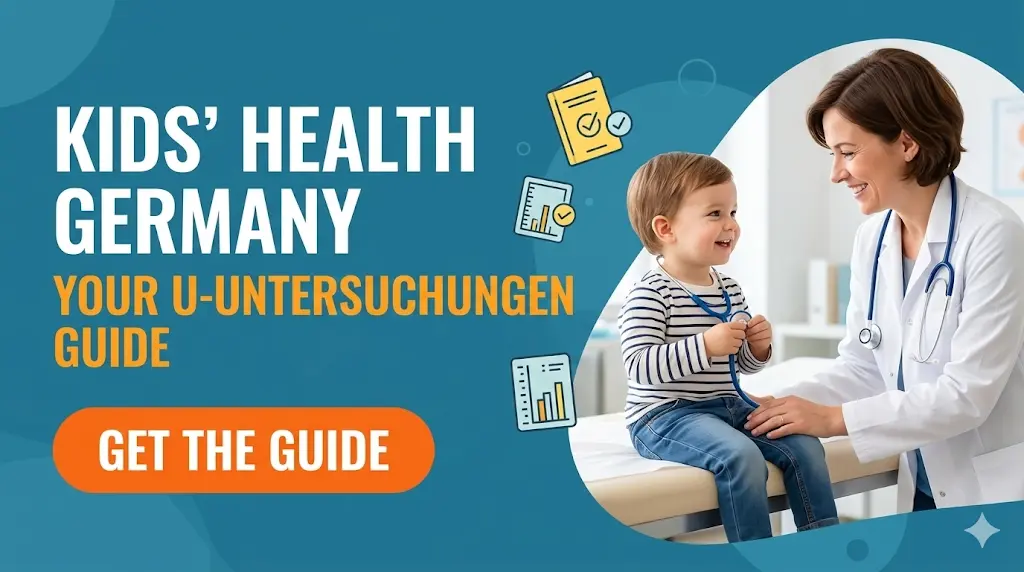
The U-Untersuchungen: Mandatory Routine Check-ups
Understanding the U-Heft and the Yellow Booklet
The U-Heft, or “Gelbes Heft” (yellow booklet), is the most important document in your child’s medical life in Germany. It is issued immediately after birth in the hospital or during the child’s first visit to a German pediatrician if they were born abroad. This booklet meticulously tracks every routine check-up from U1 to U9. Each page corresponds to a specific developmental milestone and records critical data: height, weight, head circumference, and the results of various screenings (hearing, vision, hip ultrasound).
The U-Heft is more than just a medical log; it is an administrative prerequisite for life in Germany. Most daycare centers (Kita) and elementary schools require proof of these completed check-ups for enrollment. The booklet contains a detachable card at the back that allows you to prove participation to schools without disclosing private medical details. Keeping this booklet safe is essential, as replacing the data can be a bureaucratic nightmare. This long-term documentation mirrors the advice in Family Health Insurance: Adding Your Spouse and Kids to Your Plan.
Detailed Schedule: From Newborn to School Age
The U-Untersuchungen follow a strict chronological schedule. These examinations are designed to detect physical, neurological, or developmental abnormalities at the earliest possible stage. If you miss the specific “window” for a check-up, your insurance may still cover it, but you might receive a reminder letter from the local health authority (Gesundheitsamt), as these checks are highly monitored by the state to ensure child welfare.
| Examination | Timing | Primary Focus and Screenings |
| U1 | Right after birth | Vital functions, reflexes, Apgar score, Vitamin K. |
| U2 | 3rd to 10th day | Metabolic screening (heel prick), hearing test, jaundice check. |
| U3 | 4th to 5th week | Hip ultrasound (checking for dysplasia), growth check. |
| U4 | 3rd to 4th month | Social response, eye tracking, head control, first vaccines. |
| U5 | 6th to 7th month | Motor skills (grabbing/sitting), solid food transition. |
| U6 | 10th to 12th month | First words, crawling, physical agility, one-year vaccines. |
| U7 | 21st to 24th month | “Two-year check”: Language (50 words), social behavior, walking. |
| U7a | 34th to 36th month | Pre-school readiness, advanced vision and speech checks. |
| U8 | 46th to 48th month | Cognitive skills, coordination, hearing/vision refinement. |
| U9 | 60th to 64th month | Final pre-school check: Fine motor skills, behavior, logic. |
The J-Untersuchungen and the Teen Years
Preventative care doesn’t stop after the U9. As children enter their teenage years, the system transitions to the J-Untersuchungen (J1 and J2). The J1, typically performed between ages 12 and 14, is a comprehensive health check that addresses both physical changes and mental well-being. It provides a private space for teens to discuss issues like sexuality, puberty, and mental health with a doctor without their parents present.
As children reach the age of 18, their care typically transitions from a Kinderarzt to a standard Hausarzt. This transition is a significant milestone in their independent health management, a concept explored in Health Insurance for Students in Germany: Affordable Options and Requirements.
Vaccinations and Preventative Screenings
The STIKO Vaccination Schedule and Legal Mandates
Vaccinations in Germany are guided by the recommendations of the Standing Committee on Vaccination (STIKO). While Germany does not have a general vaccination mandate for all diseases, the Measles Protection Act (Masernschutzgesetz) changed the landscape. It is now legally mandatory for all children attending daycare or school to be vaccinated against measles. You must provide proof of vaccination or immunity for your child to be legally admitted to these facilities.
The standard STIKO schedule includes vaccinations against Diphtheria, Tetanus, Pertussis (whooping cough), Polio, Hepatitis B, and Hib. These are typically administered during the U4, U5, and U6 check-ups. Maintaining an updated Impfpass (vaccination booklet) is crucial for administrative compliance. For a detailed breakdown of how these requirements interact with adult boosters, refer to Vaccinations in Germany: Recommended Shots for Adults and Children.
Sensory Screenings: Hearing and Vision
Early detection of sensory issues is a core part of the U-Untersuchungen. Newborns receive a mandatory hearing screening (usually during the U2), which uses automated otoacoustic emissions (OAE) to check inner ear function. Vision is monitored closely starting at the U4, with specialized eye-tracking tests. If the pediatrician suspects an issue, they will issue a referral (Überweisung) to a pediatric ophthalmologist.
While standard checks are covered, parents often want the best for their children’s visual health, especially as screen time increases. Understanding the retail aspects of vision care, such as choosing durable frames for kids, is detailed in Vision Care in Germany: Are Eye Exams and Glasses Covered?. For wellness products or supplements often recommended during these early stages (like Vitamin D “Vigantol” drops), many expats utilize iHerb for trusted international brands.
Pediatric Dental Care and Orthodontics
Dental health is integrated into the pediatric system early on. Starting from the age of six months (the eruption of the first tooth), children are entitled to six early-detection dental check-ups (Z1 to Z6). These focus on fluoride advice, cleaning education, and identifying early caries. As they grow older, statutory insurance covers routine cleanings and basic fillings.
For many parents, orthodontic work (Kieferorthopädie) later in life is a major financial concern. While public insurance covers braces for severe cases (graded KIG 3-5), it may not cover lighter cases (KIG 1-2) or high-end aesthetic materials. Many families choose Dental Insurance in Germany: Do You Need Extra Coverage for Teeth? to handle aesthetic or high-end orthodontic solutions as their children reach the J1 age.
Finding and Registering with a Pediatrician
Where to Search for a Kinderarzt
Finding the right doctor is the first step to securing consistent care. Most expats begin their search on Doctolib or Jameda, where you can read reviews and filter by the specific languages spoken in the practice. Additionally, your health insurance provider’s website (e.g., TK or AOK) will have a “Doctor Finder” tool tailored to their network.
In some federal states, the regional association of statutory health insurance physicians (KV) maintains a centralized search portal. If you are struggling to find a practice with availability, calling your insurance provider and asking for “Terminservice” (appointment service) can be effective. For more on managing your finances as you settle in and pay for initial travel or moving costs, Wise is an excellent tool for handling international transfers without high fees.
The Registration and First Visit Process
Registering your child is straightforward once you have a slot. For your first visit (the Anmeldung), you will need to bring:
- The child’s electronic health insurance card (eGK).
- The U-Heft (yellow booklet).
- The child’s Impfpass (vaccination record).
- The child’s passport or birth certificate (to verify age and identity).
Once your child is in the pediatrician’s database, booking future appointments—both acute and routine—becomes much simpler. Practices will often send you reminder postcards or digital notifications when the next U-Untersuchung is due. If you are a freelancer managing a busy schedule, these reminders are invaluable for staying compliant with state health checks, as noted in Health Insurance for Freelancers and Self-Employed: Navigating the System.
Dealing with Acute Illnesses and Emergencies
Kids often get sick outside of scheduled well-child visits. For acute issues during the day, most pediatricians offer “acute hours” (Notfallsprechstunde), usually early in the morning, where you can walk in without an appointment. Be prepared for a wait, as these are handled by severity.
If your child falls ill at night, on a Wednesday afternoon (when many clinics close), or on weekends, you should call 116 117 (the medical on-call service) or go to a dedicated children’s emergency clinic (Kinder-Notaufnahme). In life-threatening emergencies, always dial 112. For a full list of emergency contacts, see Emergency Numbers in Germany: Calling 112, Poison Control, and More.
Pediatric Healthcare Comparison: Public vs. Private
To summarize the landscape, let’s look at how the two main systems compare for pediatric care:
| Feature | Public Insurance (GKV) | Private Insurance (PKV) |
| Premiums | Usually €0 (Family insurance) | Individual premium for the child |
| U-Checks | 100% covered | 100% covered |
| Specialist Access | Requires referral; potential wait | Direct access; faster booking |
| Medication | Mostly €0 co-pay for kids | Pay upfront; 100% reimbursed |
| Hospital Stay | Standard ward | Option for private room/Chief Dr. |
| Orthodontics | Covered for severe cases only | Higher coverage for all cases |
Specialized Support: Therapies and Development
Speech and Occupational Therapy (Logo/Ergo)
If a pediatrician notices delays during the U7 or U8 check-ups, they may prescribe Logopädie (speech therapy) or Ergotherapie (occupational therapy). These are fully covered by public health insurance for children. Germany has a high density of these therapists, though wait times can be significant in large cities. The pediatrician will provide a Heilmittelverordnung (prescription for remedies), which you take to the therapist.
Mental Health Support for Children
Mental health is taken very seriously in the German pediatric system. If a child shows signs of behavioral issues, ADHD, or emotional distress, the Kinderarzt can refer them to a Kinder- und Jugendpsychotherapeut (child and adolescent psychotherapist). This process is covered by insurance, but finding an English-speaking therapist can be difficult. For more on the mental health landscape, see Mental Health Care in Germany: Finding Therapists and Psychologists.
Chronic Conditions and Inpatient Care
If your child has a chronic condition—such as asthma, Type 1 diabetes, or severe allergies—the pediatrician will coordinate care with specialized centers. In the rare event that your child needs to be hospitalized, German children’s hospitals (Kinderkliniken) allow one parent to stay in the room with the child (Begleitperson) at no extra cost for children under the age of six.
Conclusion
The German pediatric system provides a highly organized and supportive environment for raising a child. By adhering to the U-Untersuchungen schedule, maintaining your child’s U-Heft and Impfpass, and establishing a long-term relationship with a trusted Kinderarzt, you ensure your child receives the best preventative and acute care possible.
Whether you are navigating the system through public family co-insurance or the premium options of Ottonova or Feather Insurance, mastering these routines is the key to your family’s health and peace of mind in Germany.
References
Primary sources (official)
- Federal Ministry of Health (BMG): Health check-ups for children and adolescents https://www.bundesgesundheitsministerium.de/checkup-fuer-kinder-und-jugendliche
- Robert Koch Institute (RKI): STIKO vaccination recommendations for children https://www.rki.de/EN/Content/infections/vaccination/vaccination_node.html
Other helpful sources
- Make it in Germany: Healthcare for families in Germany https://www.make-it-in-germany.com/en/living-in-germany/family-reunification/healthcare
- 116 117: The medical on-call service and pediatric emergency search https://www.116117.de/de/index.php
Disclaimer
The information provided in this article is for general informational and educational purposes only and does not constitute professional medical, legal, or financial advice. German pediatric regulations and insurance policies are subject to change. Always consult directly with a qualified healthcare professional, your insurance provider, or a certified legal expert regarding your child’s specific medical needs and insurance obligations in Germany.