Bürgergeld (Unemployment Benefit) in Germany: Can Expats Qualify and How?
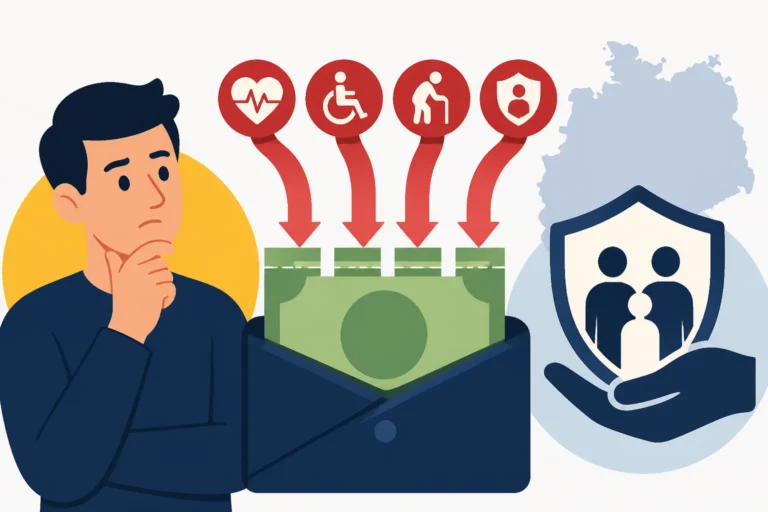
Losing your job in a foreign country triggers an instant, paralyzing fear of deportation and bankruptcy. I remember staring at my termination letter, terrified that my life in Berlin was over. This guide demystifies Germany’s Bürgergeld (the ultimate social safety net), explaining exactly how, when, and if non-EU expats can legally claim this unemployment benefit.
Disclosure: This post may contain affiliate links. We may earn a commission at no extra cost to you if you make a purchase through these links. Read full disclosure.
Demystifying Bürgergeld What It Actually Means
When you enter the German labor market, you contribute a massive portion of your paycheck to the social welfare system. Understanding what happens to those contributions when the worst-case scenario occurs is vital. However, the terminology surrounding German unemployment is a linguistic minefield that constantly traps foreigners.
The Shift from Hartz IV to Bürgergeld
For nearly two decades, the German welfare system for long-term job seekers was known as “Hartz IV” (officially Arbeitslosengeld II). The term Hartz IV carried an immense social stigma. It was deeply associated with poverty, punitive sanctions, and a bureaucracy designed to force people into the first available minimum-wage job, regardless of their professional qualifications. As an expat, hearing you might end up on Hartz IV was a terrifying prospect.
In 2023, the German government overhauled this system, rebranding it as Bürgergeld (Citizen’s Benefit). The core philosophy shifted from a purely punitive approach to one centered on respect, qualification, and sustainable integration into the labor market. The new system introduced a grace period (Karenzzeit) for housing costs and protected assets, allowing people to focus on finding a job that matches their skills rather than desperately accepting any manual labor just to keep their apartment.
For expats, this ideological shift is crucial. It means that if you are highly qualified, the system is now designed to support your search for a corresponding role, or even fund further training and German language classes. However, while the name is friendlier and the asset limits are more generous, Bürgergeld remains a tax-funded welfare program, which carries profound legal implications for anyone living in Germany on a temporary visa.
ALG I vs Bürgergeld Understanding the Difference
The single most common mistake expats make is confusing Arbeitslosengeld I (ALG I) with Bürgergeld (ALG II). They are entirely different systems managed by different authorities, and they affect your residency status in completely different ways.
ALG I is an unemployment insurance benefit. Every month you work in Germany, a percentage of your salary is deducted for unemployment insurance (Arbeitslosenversicherung). If you have contributed to this system for at least 12 months within the last 30 months, you are legally entitled to ALG I. This pays out approximately 60% (or 67% if you have children) of your last net salary for up to a year. Because it is an insurance payout that you paid into, claiming ALG I generally does not negatively impact your visa status.
Bürgergeld, on the other hand, is a tax-funded basic income support. It is meant for people who are destitute. You claim Bürgergeld either when your 12 months of ALG I run out, when your ALG I payout is so low that you cannot survive on it (known as Aufstocken), or if you never qualified for ALG I in the first place but have the legal right to reside and work in Germany. It is welfare, plain and simple, and claiming it comes with intense financial scrutiny.
How the Jobcenter Fits into the Picture
To add to the confusion, the two benefits are managed by completely separate bureaucratic fortresses. ALG I is managed by the Agentur für Arbeit (Federal Employment Agency). Bürgergeld is managed by the Jobcenter.
The Jobcenter is arguably the most intimidating administrative body in Germany. The waiting rooms are bleak, the caseworkers are notoriously overworked, and the bureaucracy is staggering. Unlike international startups in Berlin or Munich, the Jobcenter operates strictly in German. By law, their legally binding documents, rejection letters, and integration agreements are entirely in the local language, creating a massive barrier for freshly unemployed expats.
Surviving the Jobcenter requires meticulous record-keeping and an almost militant level of patience. If you have already struggled with local paperwork, you must mentally prepare yourself by reviewing German Bureaucracy 101: Understanding the Anmeldung, Schufa, and Tax ID. The Jobcenter will demand to see nearly every piece of official documentation you have accumulated since arriving in the country.

Eligibility Rules for Expats and Non EU Citizens
The hard truth about Bürgergeld is that it is not universally available to everyone holding a German address. The system differentiates fiercely between citizens, EU nationals, and non-EU expats, and your eligibility is entirely tethered to the specific legal wording on your plastic residence permit.
The Role of Your Residence Permit
To qualify for Bürgergeld, two core conditions must be met: you must be physically residing in Germany, and you must be “capable of working” (erwerbsfähig), meaning you can theoretically work at least three hours a day under standard labor market conditions. More importantly, your residence permit must legally allow you to take up employment.
If you are a non-EU expat who has survived the gauntlet and secured a Niederlassungserlaubnis (permanent settlement permit), congratulations. You have virtually the exact same access to the social safety net as a native German citizen. If you lose your job and run out of ALG I, you can apply for Bürgergeld without fear of immediate deportation.
However, if you are holding a student visa, a language learner visa, or a specific family reunification visa that bars employment, you are fundamentally excluded from Bürgergeld. The state expects you to be entirely self-sufficient on these specific pathways.
EU Citizens vs Non EU Nationals
If you hold a passport from another European Union country, you benefit from the EU’s freedom of movement. However, Germany has enacted strict laws to prevent “welfare tourism.” An EU citizen cannot simply move to Germany, sign a lease, and immediately apply for Bürgergeld the next day.
Generally, an EU citizen must have established themselves in the German labor market first. If an EU expat works in Germany for a few months and then loses their job, they can usually access Bürgergeld. Furthermore, after five years of continuous, legal residence in Germany, EU citizens earn the unconditional right to claim basic income support, just like locals.
For non-EU nationals, the rules are rigidly tied to the Ausländerbehörde (Immigration Office). You do not have freedom of movement. Your right to be in Germany is usually tied to a specific purpose, such as a highly skilled job. This brings us to the most dangerous aspect of the German welfare system for expats from outside the EU.
The Impact on Your Visa Status and Future
This is the “Visa Trap” that ruins lives. If you are in Germany on a temporary work visa, such as the EU Blue Card or a standard skilled worker visa (Section 18b), claiming Bürgergeld is incredibly dangerous.
The core requirement of a temporary work visa is that your livelihood is secure without relying on public funds. Bürgergeld is unequivocally a public fund. If you apply for Bürgergeld, the Jobcenter will notify the immigration authorities. The Ausländerbehörde can then determine that the foundation of your visa is no longer valid, refuse to extend your residence permit, or even issue a deadline for you to leave the country. You can read more about these stringent requirements in Understanding the Different Types of German Visas and Residence Permits.
Therefore, while you might technically be able to fill out the Jobcenter forms, doing so can effectively end your expat journey. If you lose your job on a temporary visa, your absolute priority must be finding a new role during your ALG I coverage period or the grace period granted by the immigration office, which you must navigate carefully as outlined in Navigating the Ausländerbehörde: Tips for Dealing with German Immigration Offices.
The Application Process and Dealing with German Bureaucracy
If you determine that you are legally and safely eligible to apply, you must immediately begin the application process. The German welfare state moves slowly, and any hesitation can cost you thousands of euros.
Registering as Unemployed Timelines and Deadlines
The timeline for registering your unemployment is strict. If you are applying for the insurance-based ALG I, you must register as a job seeker (arbeitssuchend) up to three months before your contract ends, and as unemployed (arbeitslos) on the very first day you are without a job.
Bürgergeld operates slightly differently, but urgency is still paramount. Bürgergeld is generally paid retroactively to the first day of the month in which you submit your application. If you apply on May 28th, you receive the benefit for the entire month of May. If you wait until June 1st, the money for May is gone forever.
Never wait until your bank account hits zero to initiate the process. The processing time at the Jobcenter can easily take four to eight weeks, depending on the complexity of your case and the volume of applications in your specific district. You must assume you will be waiting for your money.
Navigating the Paperwork and Language Barrier
The application forms for Bürgergeld are legendary in their complexity. You cannot just fill out a single page with your name and address. You must submit the Hauptantrag (main application), along with a dozen different Anlagen (annexes).
There is the Anlage WEP for details about your household, the Anlage KdU for your rent and heating costs, and the deeply invasive Anlage VM for your assets. Every single field is written in highly bureaucratic German. One misunderstood checkbox can delay your payout by a month or trigger a fraud investigation.
You must tackle these forms with help. If you do not speak fluent German, bring a trusted local friend or hire a professional translator to sit with you. There are also local charity organizations and expat support networks that offer free counseling for filling out Jobcenter applications. Do not attempt to guess what the forms are asking.
Financial Assessments and Asset Limits
Because Bürgergeld is welfare for the destitute, you must prove Hilfebedürftigkeit (financial neediness). The Jobcenter will demand total financial transparency. You will be asked to provide the last three to six months of bank statements for every account you own. Providing clean, exportable PDF statements from your N26 account is crucial to speed up the process and prevent caseworkers from demanding further clarifications.
Under the new Bürgergeld rules, there is a grace period (Karenzzeit) for your assets. During the first year of receiving benefits, a single person is allowed to keep up to 40,000 EUR in protected assets (Schonvermögen), plus 15,000 EUR for every additional person in the household. This prevents you from having to drain your life savings before getting help. However, after the first year, this limit drops to 15,000 EUR per person.
Crucially, you must disclose absolutely everything, regardless of the limits. This includes foreign assets. If you hold an international stock portfolio on platforms like Interactive Brokers, it must be declared on the Anlage VM. The Jobcenter cross-references tax data, and hiding assets on Interactive Brokers is considered fraud and leads to massive fines and criminal charges. Transparency is non-negotiable.
What Does Bürgergeld Actually Cover
If your application is approved, the relief is immense. The Bürgergeld system is designed to catch you and ensure you do not fall into homelessness or starvation, providing a multi-layered safety net.
The Standard Monthly Payouts Regelsatz
The core of the benefit is the Regelbedarf (standard need). This is a fixed monthly cash payout intended to cover your daily living expenses, including groceries, clothing, internet, electricity, and basic social participation. It is a survival baseline, not a comfortable living wage.
As of the latest updates leading into 2026, the standard rates are adjusted to combat inflation. Here is a breakdown of the standard monthly payouts:
| Category | Standard Monthly Rate (Approx.) |
| Single adult | 563 EUR |
| Partners living together (per person) | 506 EUR |
| Adults under 25 living with parents | 451 EUR |
| Adolescents aged 14 to 17 | 471 EUR |
| Children aged 6 to 13 | 390 EUR |
| Children under 6 | 357 EUR |
Payouts are usually made at the end of the month via SEPA transfer to your checking account, such as your standard N26 account, to ensure you have the funds available for the upcoming month.
Rent and Heating Costs Kosten der Unterkunft
Living on 563 EUR a month sounds impossible until you realize that the Jobcenter covers your rent separately. On top of the standard rate, you will receive the Kosten der Unterkunft und Heizung (KdU), which covers your cold rent and your heating bills.
A major feature of the Bürgergeld reform is the housing grace period. For the first 12 months of unemployment, the Jobcenter will cover your actual rent in full, regardless of how expensive your current apartment is. This prevents the immediate trauma of being forced to move out of your home while dealing with job loss.
However, after the 12-month grace period expires, the Jobcenter will only cover rent up to an angemessen (reasonable) limit, which is strictly defined by the local municipality. If your rent in Munich or Frankfurt exceeds this limit, the Jobcenter will send you a notice to lower your costs (usually by moving), or you will have to pay the difference out of your own meager standard rate. To understand just how tight these limits are compared to real-world prices, consult Cost of Living in Germany: Breakdown of Expenses (Rent, Food, Transport).
Health Insurance and Additional Benefits
Perhaps the greatest relief provided by the Bürgergeld system is continuous health coverage. Germany has a strict legal mandate for health insurance, and falling behind on premiums can ruin you financially.
If you are in the statutory public health insurance system (e.g., TK, AOK, Barmer), the Jobcenter will automatically pay your monthly premiums directly to your provider. You remain fully insured. If you opted out of the public system and are in a private health insurance plan, the situation is much more stressful. The Jobcenter only covers a fixed, capped amount for private premiums, and you are usually forced to switch to the provider’s stripped-down basic tariff (Basistarif). This massive bureaucratic headache highlights why choosing the right provider initially is so critical, a topic explored deeply in Health Insurance in Germany: Public vs Private.
Families on Bürgergeld also receive the Bildungspaket (Education and Participation Package). This covers the costs of school trips, tutoring, school supplies, and even membership fees for local sports clubs or music schools for your children, ensuring they do not suffer socially due to your temporary unemployment.
Jobcenter Obligations and Reentering the Workforce
Bürgergeld is not a passive universal basic income. The Jobcenter expects a return on their investment, and their ultimate goal is to get you off their payroll and back into the tax-paying workforce as quickly as possible.
The Integration Agreement Kooperationsplan
Under the old Hartz IV system, job seekers were forced to sign a punitive Eingliederungsvereinbarung. Under Bürgergeld, this has been replaced by a Kooperationsplan (Cooperation Plan).
This plan is a legally binding roadmap drawn up between you and your assigned caseworker. It outlines exactly what steps you will take to re-enter the workforce, and exactly what support the Jobcenter will provide. For an expat, this might include the Jobcenter agreeing to pay for an intensive B2 German language course or a specific IT certification, while you agree to submit a minimum of five job applications per month.
You must treat this document seriously. Your caseworker will regularly summon you to the Jobcenter to discuss your progress. You must show up with printed proof of your applications and rejection letters. If you are struggling to adapt your resume to local standards to meet these quotas, aggressively studying Job Hunting in Germany: A Guide to Finding Employment for Expats is mandatory.
Mandatory Job Applications and Sanctions
While Bürgergeld is designed to be more respectful, it still has teeth. If you fail to uphold your end of the Cooperation Plan, the Jobcenter can and will deploy financial sanctions (Leistungsminderungen).
If you miss a mandatory appointment without a valid medical sick note (Krankschreibung), your standard monthly payout can be cut by 10% for a month. If you deliberately refuse to apply for a reasonable job offer provided by your caseworker, or if you sabotage a job interview, your benefits can be slashed by up to 30%.
These sanctions are terrifying when you are already living on a baseline survival budget. If you happen to secure a new job, the Jobcenter’s control over you doesn’t end until your first paycheck arrives. It is vital to understand the timelines of your new employment, which you can decode by reviewing Understanding German Work Contracts: Probation, Notice Periods, and More.
Managing Finances During Unemployment
The journey from filing your application to receiving your first Bürgergeld payment is the most vulnerable phase of expat unemployment. The processing gap can stretch for weeks, and the bills do not stop arriving.
Many expats survive this dark period by tapping into emergency funds held in their home countries. Using services like Wise to transfer your home-country emergency funds ensures you aren’t burned by terrible bank exchange rates during this vulnerable period. You have to be incredibly strategic with your cash flow to avoid falling into debt before the state safety net catches you.
Your ultimate goal is to transition back to employment before the Jobcenter bureaucracy wears you down completely. Focus on targeted networking and updating your skills. If your German is still lagging, pivot your search toward international hubs. Exploring resources like English-Speaking Jobs in Germany: Finding Work When You Don’t Speak German can provide an immediate lifeline. And if you have ongoing financial commitments back home—like a mortgage or student loans—managing them via Wise can keep your international budget afloat until you sign a new German employment contract and reclaim your financial independence.
References
Primary sources (official)
- Bundesministerium für Arbeit und Soziales (BMAS): The Federal Ministry of Labour and Social Affairs provides the official, legal breakdown of Bürgergeld, including current standard rates and eligibility criteria. https://www.bmas.de/DE/Arbeit/Grundsicherung-Buergergeld/grundsicherung-buergergeld.html
- Bundesagentur für Arbeit (BA): The official portal of the Federal Employment Agency, detailing the exact application process, obligations, and differences between ALG I and Bürgergeld. https://www.arbeitsagentur.de/arbeitslos-arbeit-finden/buergergeld
Other helpful sources
- Make it in Germany: The government-backed portal for skilled workers, offering crucial insights into how claiming social benefits impacts various residence permits and the EU Blue Card. https://www.make-it-in-germany.com/en/living-in-germany/money-taxes/social-security
- Faire Integration: A publicly funded advisory network providing legal and practical support for refugees and third-country nationals navigating German labor and social laws. https://www.faire-integration.de/
Disclaimer
The information provided in this article is for general informational and educational purposes only and does not constitute professional financial, legal, or immigration advice. German social security laws, particularly the rules governing Bürgergeld (SGB II), asset limits (Schonvermögen), and standard monthly rates (Regelbedarf), are highly complex and subject to continuous updates by the federal government. Most importantly, claiming public funds can severely and permanently jeopardize the residency status of non-EU nationals holding temporary work visas. Your legal right to claim benefits without facing deportation depends entirely on your specific visa conditions and the discretionary decisions of the Ausländerbehörde. Always consult a certified German immigration lawyer (Fachanwalt für Migrationsrecht) or a recognized social advisory board before submitting an application to the Jobcenter.