German Integration Courses: Language & Orientation for New Residents
Arriving in Germany and realizing you cannot read a basic tax letter or understand how to properly sort your recycling is a massive wake-up call for expats. I remember staring blankly at the cashier in a local supermarket, completely overwhelmed by rapid-fire German, wishing someone had handed me an instruction manual. This guide breaks down exactly how German integration courses work, helping you overcome the language barrier and decode daily life.
Disclosure: This post may contain affiliate links. We may earn a commission at no extra cost to you if you make a purchase through these links. Read full disclosure.
What Are German Integration Courses and Who Needs Them?
The Core Structure: Language vs Orientation
A German Integration Course (Integrationskurs) is a state-subsidized educational program designed to help newcomers navigate daily life, communicate effectively, and understand the social fabric of the country. Sponsored by the Federal Office for Migration and Refugees (BAMF), the standard course consists of 700 teaching units (each lasting 45 minutes). It is split into two distinct phases.
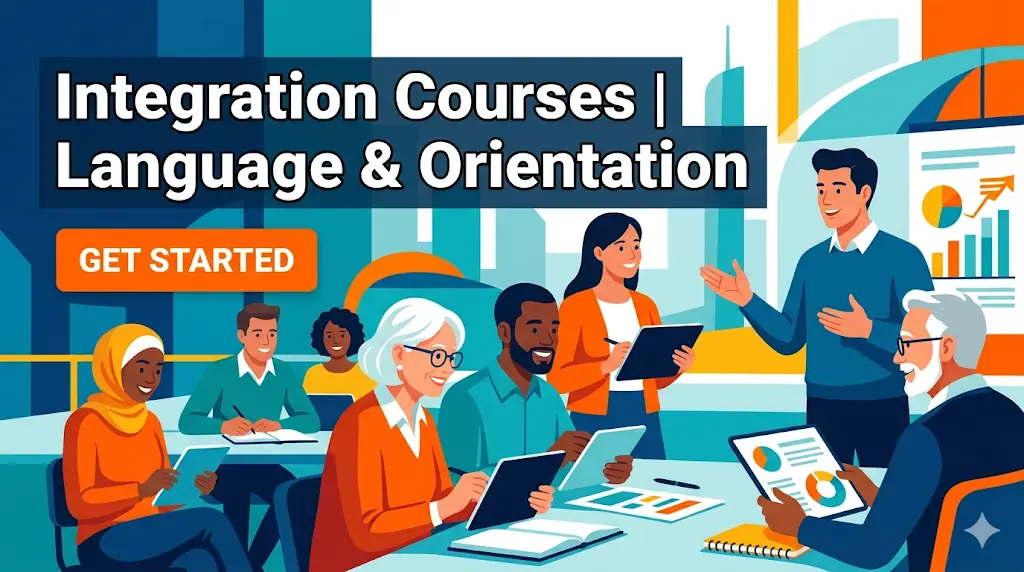
Integration courses in Germany help new residents develop language skills and understand German society, laws, culture, and daily life. Courses usually combine German language training with orientation lessons covering rights, responsibilities, history, and social systems. They are often organized through approved schools and supported by the Federal Office for Migration and Refugees. Some residents are required to attend, while others join voluntarily. Completing the course may improve employment opportunities, residence permit renewals, and long-term settlement prospects. Final examinations test language proficiency and civic knowledge. Reduced fees or financial assistance may be available for eligible participants and low income residents.
The first phase is the Language Course, which accounts for 600 units. It starts from absolute zero and aims to bring you up to the B1 proficiency level according to the Common European Framework of Reference for Languages (CEFR). You will learn practical vocabulary for renting an apartment, visiting doctors, shopping, and navigating the notorious German bureaucracy.
The second phase is the Orientation Course (Orientierungskurs), which lasts for 100 units. Rather than grammar, this section dives deep into German culture, recent history, the political system, and fundamental democratic values. It covers everything from equal rights and religious freedom to the structure of the federal government. To understand some of the unique cultural phrases you might encounter during this phase, check out our guide on German Corporate Buzzwords: Common Terms in Office Talk.
Mandatory vs Voluntary Participation
Whether you can take the course and whether you must take it depends heavily on your nationality and your current residency status.
For many non-EU citizens arriving on certain long-term visas—such as family reunification visas—participation is often legally mandatory. When you register at the local immigration office (Ausländerbehörde), the case worker will assess your German skills. If they determine you cannot communicate at a basic level, they will issue an Obligation to Attend (Verpflichtung). Failing to comply with this order can result in massive delays or outright rejections when it is time to renew your visa. If your spouse is dealing with this, refer to our guide on Bringing Your Family While Studying: Can Spouses Work or Kids Attend School?.
On the other hand, participation is largely voluntary for EU citizens, highly skilled workers (like EU Blue Card holders), and international university students. While the immigration office will not force you to go, you are highly encouraged to apply for a Certificate of Eligibility (Berechtigungsschein) from the BAMF. Getting a spot on a voluntary basis can sometimes take longer, but it grants you access to state-subsidized language learning that is drastically cheaper than private language academies.
Exceptions and Exemption Criteria
If you are ordered to take an integration course but you already speak German or hold equivalent qualifications, you can apply for an exemption. However, the authorities will not simply take your word for it. You must provide concrete proof, such as a German university degree, a recognized B1 certificate from the Goethe-Institut, or a high school diploma from a German-speaking school.
If your proof of exemption relies on foreign academic degrees or language certificates issued abroad, you must submit them alongside certified translations. The Ausländerbehörde strictly requires sworn translations recognized by the German courts. Using Lingoking is highly recommended here, as they provide legally certified translations that immigration officials accept without question.
Additionally, if your work schedule strictly prevents you from attending even a part-time course (for instance, if you work rotating night shifts), you may be able to secure a hardship exemption. However, you must prove that your full-time employment completely blocks your ability to attend, and any foreign employment records you submit must also be officially translated via Lingoking.
Navigating the Registration and Costs
How to Apply Through the BAMF
The registration process involves multiple bureaucratic layers. You cannot simply walk into a local language school and demand a subsidized seat. You must first secure your Berechtigungsschein (Certificate of Eligibility). If you are a non-EU citizen, you usually request this from the local Ausländerbehörde. If you are an EU citizen, you apply directly to the BAMF regional office by mailing a physical application form.
Once you have your eligibility certificate, you must find an approved course provider (Kursträger). This is usually a local adult education center (Volkshochschule or VHS) or an approved private language school. You can use the BAMF-NAvI online search portal to find schools near your registered address. For a refresher on establishing that address, read Registering Your Address (Anmeldung): Step-by-Step Guide.
When you arrive at the school with your certificate, they will make you sit a mandatory placement test (Einstufungstest). This ensures you aren’t placed in a beginner class if you already know basic vocabulary. Due to high demand, expect to wait anywhere from two to four months between registering and actually starting your first class.
Understanding the Financial Commitment and Subsidies
German integration courses are heavily subsidized by the state, but they are not entirely free for everyone. As of recent regulations, participants with an eligibility certificate must pay a contribution of €2.29 per teaching unit.
Because the standard course is 700 units long, the total out-of-pocket cost is approximately €1,600. You do not have to pay this lump sum upfront; it is usually billed in modules of 100 units (roughly €229 per module). If you pass the final exams within two years of starting the course, the BAMF will reward your diligence by refunding 50% of your total course fees.
If you are receiving unemployment benefits (Bürgergeld) or social assistance, you can apply for a complete exemption from the cost contribution, making the course 100% free. For expats who are living off savings while studying full-time, proving your financial stability to the immigration office is often required alongside your course enrollment. Using a digital provider like Expatrio to manage your blocked account ensures your monthly payouts are secure, allowing you to pay your course fees and rent smoothly without running out of funds.
Course Formats: Full-Time vs Part-Time
Finding the right balance between learning German and maintaining your livelihood is critical. Integration courses are offered in different intensities.
| Course Type | Weekly Hours | Estimated Duration | Best Suited For |
| Intensive / Full-Time | 20 – 25 hours | 6 – 8 months | Unemployed individuals, recent arrivals, spouses not currently working. |
| Part-Time (Morning/Evening) | 8 – 12 hours | 12 – 18 months | Working professionals, university students, parents with limited childcare. |
Part-time courses often take place in the evenings (e.g., 6:00 PM to 9:00 PM) or on weekends. While part-time courses accommodate a working schedule, they require immense stamina to complete after a long workday over the course of a year and a half.
Surviving the Language Course Component
Reaching the B1 Proficiency Level
The jump from A1 (absolute beginner) to B1 (intermediate) is notoriously brutal. German grammar—with its three genders (der, die, das), four cases, and complex sentence structures—can feel incredibly defeating. The course is fully immersive; the instructors will speak exclusively in German from day one, using gestures and pictures to explain concepts.
At the B1 level, you are expected to understand the main points of clear standard input on familiar matters encountered in work, school, and leisure. You should be able to write simple connected texts, describe experiences and events, and briefly give reasons for opinions. Supplementing your classroom time is highly advised; for tips on practicing outside of school, read Language Exchange Meetups: Practicing German and Making Friends.
Balancing Intensive Classes with Daily Life
Treating a full-time integration course like a casual hobby will guarantee failure. It requires the dedication of a part-time job. You will have daily homework, weekly vocabulary quizzes, and module exams. Many expats experience intense burnout around the A2.2 module, where the initial excitement fades and the grammar becomes highly complex.
If you are working a full-time job and taking evening classes, protecting your mental health is paramount. You will have very little free time. Set realistic expectations with your employer and your family. If the pace is too overwhelming, speak to your course provider; you can often request to pause the course between 100-hour modules and resume with a different cohort a few weeks later.
Managing Health and Absences During the Course
The BAMF is exceptionally strict regarding attendance. You are required to attend classes regularly to maintain your eligibility for the final exam and the 50% fee refund. If you are sick, you cannot simply stay home and email your teacher. You must present a Krankschreibung (official doctor’s note) from the very first day of absence.
Navigating the German medical system to get this note is daunting if you are just starting to learn the language. Having comprehensive, expat-friendly health coverage is crucial. Feather Insurance provides digital health insurance policies with excellent English-language support, allowing you to quickly find an English-speaking doctor to issue your sick note without the added stress of a language barrier at the clinic. Furthermore, maintaining continuous health coverage during your months of studying is a strict legal requirement in Germany, and Feather Insurance ensures you remain fully compliant while you focus on your vocabulary lists.
The Orientation Course and Final Exams
Demystifying German Culture and Legal Systems
Once you conquer the 600 hours of language training, you transition into the 100-hour Orientation Course. This is often the most enjoyable part of the integration process. You finally get to step away from strict grammar drills and discuss real-world topics.
The curriculum covers German politics (how the parliament works, the role of the Chancellor), modern history (World War II, the division and reunification of Germany), and societal values (freedom of speech, religious tolerance, LGBTQ+ rights). Understanding these cultural touchpoints is vital for integrating into the workplace. For a broader look at adapting to the country, explore our Moving to Germany: Comprehensive Visa & Immigration Guide.
Acing the Final Examinations
To officially graduate, you must pass two separate exams. The first is the German Test for Immigrants (Deutsch-Test für Zuwanderer or DTZ). This assesses your language skills in reading, listening, writing, and speaking. The exam is graded on a sliding scale; depending on your score, you will be awarded either a B1 or an A2 certificate. You must achieve B1 overall to fully pass.
The second exam, taken at the end of the orientation course, is the Life in Germany test (Leben in Deutschland). This is a multiple-choice exam consisting of 33 questions drawn from a pool of 310 possible questions. You have 60 minutes to complete it. To pass the orientation course, you only need to answer 15 questions correctly. However, if you answer 17 or more correctly, the test also officially qualifies you for German citizenship in the future.
What Happens If You Fail
Failing the DTZ is a common fear, but the BAMF has safety nets in place. If you diligently attended the classes but failed to achieve a B1 level on the final exam, you are not immediately deported or penalized.
You can apply to the BAMF for permission to repeat up to 300 teaching units of the language course (a one-time extension). You will also be allowed to retake the DTZ exam one more time for free. Do not panic if you need the extra time; the German government wants you to succeed and integrate. If your visa renewal is dependent on passing, communicate the delay to your immigration case worker immediately, a process detailed in Renewing Your German Visa or Residence Permit: Timeline and Process.
Next Steps After Successfully Integrating
Leveraging Your Certificate for Permanent Residency
When you pass both the DTZ at a B1 level and the Life in Germany test, you will be issued the highly coveted Zertifikat Integrationskurs (Integration Course Certificate). This document is incredibly powerful.
For non-EU citizens, possessing this certificate drastically accelerates your path to permanent residency (Niederlassungserlaubnis). In many standard immigration cases, having the integration certificate reduces the required waiting period from five years of residency down to just three years. It proves to the state that you are economically and socially invested in the country. To understand the exact timelines, read Permanent Residency in Germany: Requirements and How to Apply. Furthermore, when applying for permanent residency, your financial history must be spotless; having utilized Expatrio to manage your funds during your early transition makes proving your financial stability much smoother.
Advancing to Professional Language Courses
B1 is a massive milestone, but it is often not enough to comfortably navigate a professional corporate environment. Many expats use the momentum from the integration course to immediately enroll in Vocational Language Courses (Berufssprachkurse or DeuFöV).
These courses, also subsidized by the BAMF, pick up where the integration course leaves off, guiding you from B1 to B2, and eventually to C1. They focus heavily on professional email etiquette, giving presentations, and industry-specific vocabulary. Transitioning to a DeuFöV course is the best way to make yourself highly competitive in the German job market.
Navigating the Job Market with New Credentials
With a B1 certificate and a firm grasp of German work culture, you are significantly more employable. Employers value the resilience required to complete an integration course while managing an international move.
As you transition into full-time employment, your administrative needs will change. If your salary exceeds the compulsory insurance threshold, you may have the option to switch from statutory public health insurance to private insurance. Navigating this complex decision is exactly where Feather Insurance excels, offering unbiased advice to expats transitioning into higher tax brackets. Be sure to understand how your new salary will be taxed by reviewing Understanding Your German Payslip: Gross vs Net Salary Explained.
References
Primary sources (official)
- BAMF – Integration Course Guidance: https://www.bamf.de/EN/Themen/Integration/ZugewanderteTeilnehmende/Integrationskurse/integrationskurse-node.html
- BAMF – The Final Examination and Certificate: https://www.bamf.de/EN/Themen/Integration/ZugewanderteTeilnehmende/Integrationskurse/Abschlusspruefung/abschlusspruefung-node.html
- Make it in Germany – Integration Courses: https://www.make-it-in-germany.com/en/living-in-germany/learn-german/integration-courses
Other helpful sources
- Goethe-Institut – Integration Course Information: https://www.goethe.de/prj/mwd/en/idl/int.html
- Make it in Germany – German Language Courses for the Workplace: https://www.make-it-in-germany.com/en/looking-for-foreign-professionals/integration/german-courses
Disclaimer
The information provided in this article is for general informational purposes only and is based on the real-world experiences of expats navigating the German integration and immigration systems. Course structures, fees, eligibility requirements, and BAMF regulations are subject to frequent changes by the German government. This article does not constitute legal or immigration advice. Always consult the official website of the Federal Office for Migration and Refugees (BAMF) or your local Ausländerbehörde for the most current, legally binding requirements regarding your specific situation.