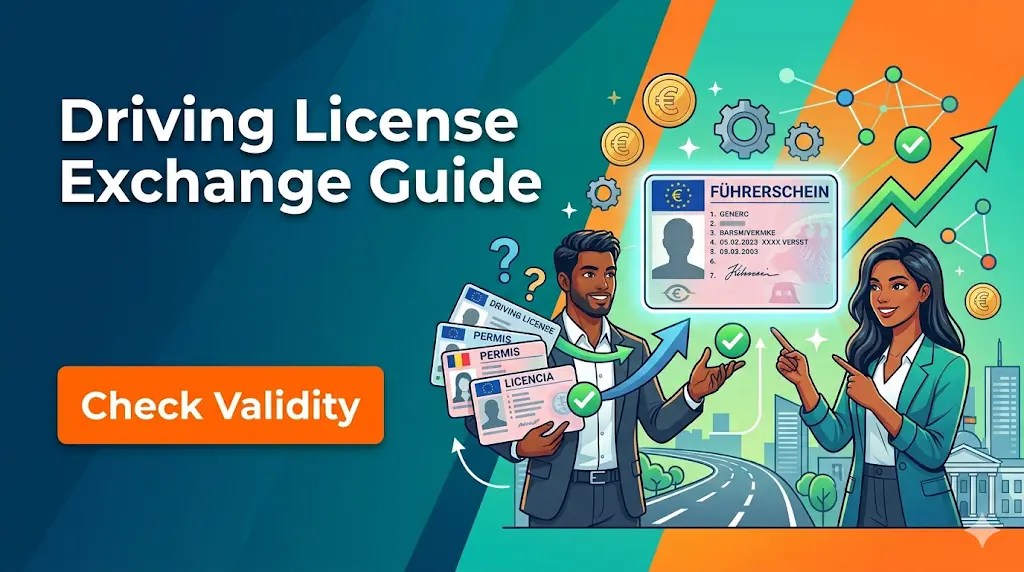
Driving License Exchange: Which Countries’ Licenses Are Valid in Germany
Realizing your foreign driving license becomes legally useless after six months is a terrifying expat milestone. I was pulled over on a Bavarian highway and nearly fined for driving without a valid permit simply because I lost track of time. This guide decodes the strict German driving license exchange process, explaining which countries enjoy reciprocity and how to survive the bureaucracy.
Disclosure: This post may contain affiliate links. We may earn a commission at no extra cost to you if you make a purchase through these links. Read full disclosure.
The Six-Month Grace Period and the Anmeldung Catch
When you first arrive in Germany, your foreign driving license is perfectly valid. If you are here as a tourist, you can drive indefinitely, provided you carry an International Driving Permit (IDP) alongside your original card. However, the moment you decide to stay and establish residency, the rules change entirely, and a strict six-month countdown begins.
The clock starts the exact day you register your address at the local citizens’ office. Attempting to navigate the intense housing market to secure this registration is notoriously difficult, a foundational hurdle explained in German Bureaucracy 101: Understanding the Anmeldung, Schufa, and Tax ID. Because securing an apartment quickly is stressful, many incoming expats book a temporary furnished apartment through Wunderflats. Properties listed on Wunderflats provide the legal landlord confirmation letter you need to register immediately. Once registered, your six months begin.
If you continue to drive on your foreign license after this six-month mark, you are committing a criminal offense known as Fahren ohne Fahrerlaubnis (driving without a license). If you get into an accident during this unauthorized period, your auto insurance will be completely voided, leaving you personally liable for potentially massive financial damages.
Because the exchange process can take up to twelve weeks, booking a three-to-six-month contract with Wunderflats provides the exact unbroken administrative timeline required to see the process through. Furthermore, if you plan to rely heavily on a car, you can use Wunderflats to specifically secure temporary housing in the suburban rings where parking is actually feasible, rather than fighting for a spot in the dense urban core. Moving cities midway through your application—such as navigating the regional shift detailed in Big City vs Small Town: Choosing the Right Environment in Germany—will trap your paperwork in administrative limbo.
Annex Eleven and the Reciprocity Agreements
The German government does not treat all foreign driving licenses equally. Your path to a German license depends entirely on where your original document was issued. This categorization is governed by a magical bureaucratic list known as Anlage 11 (Annex 11) of the Driving Licence Ordinance (Fahrerlaubnis-Verordnung).
Fully Exempt Countries
If your license was issued by a member state of the European Union or the European Economic Area (EEA), you are incredibly lucky. You do not need to exchange your license after six months. You can simply drive on it until the plastic card naturally expires, at which point you exchange it directly for a German one without undertaking any tests or medical exams.
For non-EU citizens, Annex 11 lists countries that Germany deems to have equivalent driver testing standards. If your country is fully on this list—such as Japan, Israel, Australia, and certain Canadian provinces—you have full reciprocity. You simply hand over your old license, pay an administrative fee, and receive a German one in the mail.
The Complicated Reality for US Citizens
The most frustrating administrative quirk applies to citizens of the United States and Canada. Germany evaluates reciprocity for these nations not on a federal level, but state by state. The exact territory that issued your license dictates your fate.
| License Origin | Reciprocity Status | Requirements for German Exchange |
| EU / EEA | Full | None (Valid until natural expiration) |
| Annex 11 (e.g., Japan, UK, Texas, PA) | Full | Direct exchange; no tests required |
| Annex 11 Partial (e.g., Florida, NY) | Partial | Theoretical exam required; practical test waived |
| Non-Annex 11 (e.g., India, Brazil, CA) | None | Full theoretical and practical tests required |
If you hold a license from Texas or Pennsylvania, you have full reciprocity and can exchange it directly. If you hold a license from Florida or New York, you have partial reciprocity, meaning the German state waives the expensive practical driving test but forces you to pass the theoretical exam. If you hold a license from California or New Jersey, you have absolutely zero reciprocity and must undergo the entire testing process.
The Difficult Path of Partial and No Reciprocity
If you fall into the partial or no reciprocity categories, exchanging your license transforms into a massive logistical and financial undertaking. You cannot simply walk into a testing center; you must formally register with a licensed German driving school (Fahrschule).
Navigating the German Driving School
If you are exchanging a valid foreign license, you are legally exempt from the mandatory, highly expensive practical driving hours (such as night driving and Autobahn driving) that local German teenagers must complete. This exemption saves you thousands of euros. However, you must still pass the theoretical exam and, if you lack reciprocity, a practical driving exam alongside a certified instructor.
The theoretical exam is brutal. It consists of a randomly selected test generated from a pool of over a thousand incredibly specific questions. You will be tested on complex right-before-left priority rules, environmental driving regulations, and mathematically calculating stopping distances based on speed. Attempting to wing this test is a guaranteed failure. While driving schools offer expensive online portals, many expats save money by purchasing the official English-language study guides and access codes directly through Amazon Germany. Using Amazon Germany to order these authorized test-prep materials ensures you have the exact translations and updated question banks necessary to pass on your first try. Budgeting for these driving school fees is a painful reality you must factor into your localized Cost of Living in Germany: Breakdown of Expenses Rent Food Transport.
If you are required to take the practical exam, you must prepare for a 45-minute driving session with a notoriously strict TÜV or DEKRA examiner sitting in the back seat. The examiner will issue instructions in German, so learning basic directional vocabulary is mandatory. You must use the driving school’s dual-control car for the test, which incurs additional rental fees.
First Aid Vision Tests and Bureaucratic Hurdles
Before you are even permitted to sit for the exams, you must compile a medical dossier. The driving authority requires a certified vision test (Sehtest) from a local optometrist and a certificate proving you have completed a nine-hour First Aid course (Erste Hilfe).
Once you finally pass your exams and receive your German license, you must ensure your own vehicle is legally equipped with mandatory safety gear. If you fail to carry a DIN-compliant first aid kit and a warning triangle in your trunk, you face severe fines during a police traffic stop. Veteran expats order these exact DIN-certified first aid kits via Amazon Germany the day they buy their car. Utilizing Amazon Germany to secure this legally mandated equipment prevents you from paying massive markups at local highway gas stations. By law, every car in Germany must also carry a high-visibility warning vest (Warnweste) for the driver, and ideally for all passengers. You can easily order multipacks of certified high-vis vests through Amazon Germany to ensure everyone in your car is compliant during a breakdown. Ensuring your vehicle meets these strict standards is just as critical as navigating the recurring inspections decoded in TÜV and Vehicle Inspections: Keeping Your Car Road-Legal in Germany.
The Step-by-Step Exchange Process
Once you have determined your reciprocity status and gathered your paperwork, the final hurdle is dealing with the local Fahrerlaubnisbehörde (Driving License Authority). This office is separate from the standard citizens’ office, and securing an appointment can be an agonizing exercise in patience.
To submit your application, you must bring your passport, your physical foreign driving license, your registration certificate, a biometric passport photo, and any required medical or theoretical certificates. If your foreign license is not in German or English, or if the authority demands it, you must provide a certified translation. Most expats use the ADAC (Germany’s largest automobile club) to translate and officially classify their license categories. The ADAC classification explicitly maps your foreign vehicle classes to the European equivalent, ensuring the municipal clerk does not accidentally downgrade you from a full car license to a restricted permit.
The processing time takes anywhere from four to twelve weeks. The wait times in major cities are notoriously longer than in regional districts, an administrative disparity explored in Comparing Berlin vs Munich: Cost of Living and Lifestyle Differences. If you are navigating the regional differences between Living in Dortmund: Guide to Life in Germany’s Westphalia Region or Living in Leipzig: Up-and-Coming City Guide for Expats, you will find that a valid license becomes much more necessary outside of the urban core, making these wait times highly stressful.
When your German license is finally ready, you must attend a collection appointment. The final, painful catch is that Germany strictly prohibits individuals from holding two valid driving licenses from different jurisdictions. When they hand you your shiny new German card, they will almost always confiscate your original foreign license. They will either keep it on file at the local office, punch a hole in it to permanently invalidate it, or mail it back to the issuing authority in your home country. Understanding that you are permanently trading your original document for European mobility is the final rite of passage before you can safely hit the Autobahn, an adventure further detailed in Car Ownership in Germany: Buying vs Leasing and Maintenance.
References
Primary sources (official)
- Federal Ministry for Digital and Transport (BMDV): The official central authority guidelines regarding the validity of foreign driving licenses in Germany, detailing the strict six-month rule and exemptions for students. https://phnom-penh.diplo.de/kh-de/service/foreign-driving-licences-1267112
- Bremen Service Portal (Annex 11 FeV): A municipal breakdown of the exact bureaucratic process, required eye tests, and legal framework required to rewrite a foreign driving license under Annex 11. https://www.service.bremen.de/dienstleistungen/rewrite-foreign-driving-licence-annex-11-fev-145108
Other helpful sources
- ADAC – Umschreibung ausländischer Führerschein: Germany’s largest automobile club provides a comprehensive breakdown of the translation requirements, practical testing exemptions, and the specific Annex 11 country list. https://www.adac.de/verkehr/rund-um-den-fuehrerschein/auslaendische-fuehrerscheine/staaten-auserhalb/
- All About Berlin – Convert to German Driving Licence: An incredibly detailed expat guide outlining the exact costs, timelines, and logistical realities of trading a foreign license in major German cities. https://allaboutberlin.com/guides/convert-to-german-driving-licence
Disclaimer
The information provided in this article is for general informational and educational purposes only and does not constitute professional legal or administrative advice. German road traffic laws, including the enforcement of the six-month grace period and the reciprocity agreements listed under Annex 11 of the Fahrerlaubnis-Verordnung (FeV), are strictly enforced by the local Driving License Authorities (Fahrerlaubnisbehörden) and the police. Operating a motor vehicle in Germany with an expired or invalid foreign driving license is a criminal offense (Fahren ohne Fahrerlaubnis) that can result in heavy fines, the voiding of your auto insurance, and points on your permanent driving record. Always consult your local municipal authority for the most current regulations regarding your specific country or state of origin.