How to Pay Less Tax Legally as a Freelancer in Germany
The crushing realization that nearly half of your hard-earned freelance income might vanish into the German tax system is a rite of passage for every expat professional. I remember staring at my first major tax assessment in a dimly lit Berlin cafe, wondering if I had made a massive mistake moving here. This guide will walk you through the labyrinth of legal deductions and strategic planning to ensure you keep as much of your revenue as possible.
Disclosure: This post may contain affiliate links. We may earn a commission at no extra cost to you if you make a purchase through these links. Read full disclosure.
Understanding the German Freelance Tax Framework
Before you can start saving money, you have to understand the ground rules of the Finanzamt. In Germany, the distinction between a Freiberufler (liberal profession) and a Gewerbetreibender (commercial trader) is the first hurdle. If you are a designer, writer, or consultant, you likely fall into the Freiberufler category, which spares you from the dreaded trade tax (Gewerbesteuer). However, regardless of your classification, your income tax is progressive, meaning the more you earn, the higher the percentage the state takes.
One of the most effective ways to lower your taxable income is to ensure you are correctly registered from day one. If you haven't done this yet, you should look into How to Register as a Freelancer With the Finanzamt in Germany to avoid any back-dated penalties that can wipe out your savings. Once registered, your focus shifts to the "Einnahmen-Überschuss-Rechnung" (EÜR), which is a simplified method of determining profit by subtracting business expenses from your total revenue. This is where the magic of tax reduction happens.
It is also vital to keep an eye on your social contributions. Unlike employees, freelancers are responsible for their own health coverage, which is a significant monthly cost. Understanding Health Insurance for Freelancers and the Self-Employed in Germany is essential because these premiums are often partially tax-deductible, reducing your overall burden. If you don't account for these properly, you are essentially leaving money on the table.
Maximizing Business Expense Deductions
The core strategy for paying less tax is simple: increase your legal business expenses. In Germany, an expense is deductible if it is "betrieblich veranlasst"—meaning it was caused by your business operations. This sounds straightforward, but the nuances are where many expats get tripped up. For instance, that laptop you bought isn't just a tool; it’s a high-value asset that might need to be depreciated over several years, though recent changes allow for immediate write-offs of certain digital assets.
The Home Office and Coworking Spaces
If you work from your apartment, you can claim a portion of your rent, heating, and electricity. There are two ways to do this: the "Homeoffice-Pauschale" or a dedicated study (Arbeitszimmer). The Pauschale is a flat rate of 6 EUR per day (up to 1,260 EUR per year) and is much easier to claim because it doesn't require a separate room. However, if you have a dedicated room used almost exclusively for work, you can deduct a percentage of your actual household costs based on the square footage. This is often a better deal for those living in expensive cities like Munich or Hamburg.
If you prefer the community of a coworking space, your entire membership fee is deductible. When I first moved to Berlin, I used a coworking space not just for the networking, but because it simplified my bookkeeping significantly compared to calculating the "warm" rent percentages of my flat. When paying for these services, using a dedicated business account like N26 makes it much easier to track these deductions without sifting through personal grocery receipts.
Travel, Education, and Networking
Every train ticket to a client meeting, every professional development course, and even some business meals are deductible. For business meals, you can typically deduct 70% of the cost, provided you keep a proper receipt (Bewirtungsbeleg) that includes the names of the attendees and the business purpose. Don't forget "Verpflegungsmehraufwand"—the per diem allowance for business trips. If you are away from your home and primary workplace for more than eight hours within Germany, you can claim a flat rate for additional meal expenses, regardless of what you actually spent.
Educational expenses are another goldmine. If you take a German language course to better communicate with local clients, or a specialized coding bootcamp, these costs are generally deductible as professional training. I’ve found that many expats overlook the cost of books, software subscriptions, and even the fees for international money transfers. If you are receiving payments from outside the Eurozone, tools like Wise are not only cheaper but provide clear statements that help you track the exact fees you’ve paid—which are, you guessed it, tax-deductible business expenses.
| Expense Category | Deductibility Status | Notes |
|---|---|---|
| Coworking Membership | 100% Deductible | Must have a valid VAT invoice (Rechnung). |
| Business Meals | 70% Deductible | Requires a "Bewirtungsbeleg" with names of guests. |
| Home Office (Flat Rate) | Up to 1,260 EUR | 6 EUR per day for up to 210 days per year. |
| Health Insurance | Partially Deductible | "Basisabsicherung" is deductible as a special expense. |
| Work Equipment | 100% Deductible | Digital assets can often be written off immediately. |
| Professional Training | 100% Deductible | Must be relevant to your current freelance field. |
Strategic Financial Tools and Professional Advice
Managing your taxes manually is a recipe for stress and missed opportunities. The German system rewards those who are organized and punishes those who guess. Using specialized software like Wundertax or Taxes for Expats can help you identify deductions you might have missed, especially those specific to the expat experience, such as relocation costs or double-household maintenance.
Choosing the Right Banking and Accounting Setup
Separating your finances is the first step toward tax efficiency. When your personal and business expenses are blurred, you are more likely to lose track of deductible items. I highly recommend Opening a Bank Account in Germany: Step-by-Step for Newcomers specifically for your freelance revenue. A dedicated business account from N26 allows for automated categorization of expenses, making the year-end EÜR much less painful.
Furthermore, if you are working with clients across the globe, you need a way to manage currency fluctuations and high transfer fees. Using Wise for international invoices ensures you get the real exchange rate, and the small fees they charge are fully deductible. Keeping these records in a central digital location is vital because the Finanzamt can audit you up to ten years after the fact. You want your paper trail to be bulletproof.
When to Hire a Steuerberater
While software like Wundertax is great for simple setups, there comes a point where a professional tax advisor (Steuerberater) pays for themselves. If your revenue exceeds 60,000 EUR or if you have complex international income, a professional can find legal loopholes that software might miss. For example, they can advise on the "Investitionsabzugsbetrag" (IAB), which allows you to deduct 50% of the planned acquisition costs of future assets up to three years before you actually buy them. This is a powerful tool to lower your profit in a high-earning year. You can find guidance on this in How to Find an English-Speaking Tax Advisor (Steuerberater) in Germany.
Advanced Tax-Saving Tactics
Once you have the basics down, you can look at more sophisticated ways to reduce your tax bill. These often involve long-term financial planning that benefits your future self while lowering your current taxable income.
Pension Contributions and Insurance
One of the most significant deductions for freelancers comes from private pension plans. The "Rürup-Rente" (Basis-Rente) was specifically designed for the self-employed. Contributions to a Rürup plan are tax-deductible up to a very high ceiling (over 25,000 EUR for single filers). By contributing to a pension, you are essentially moving money from the "taxable income" column to your "retirement savings" column. You can learn more about these structures in Pension Options in Germany: Riester, Rürup, and the State Pension.
Beyond pensions, your liability insurance (Haftpflichtversicherung) and disability insurance (Berufsunfähigkeitsversicherung) are also partially deductible. Since these are often considered "Vorsorgeaufwendungen" (precautionary expenses), they can lower your tax base. For a deep dive into which insurances are worth it, check Health Insurance for Freelancers: Budgeting for Public vs Private.
The Kleinunternehmerregelung (Small Business Regulation)
If your turnover was less than 22,000 EUR in the previous year and is expected to be less than 50,000 EUR in the current year, you can opt for the Kleinunternehmerregelung. This exempts you from charging and remitting VAT (Umsatzsteuer). While this doesn't technically change your income tax rate, it reduces your administrative burden significantly and can make your services 19% cheaper for private clients who cannot reclaim VAT. However, the downside is that you cannot deduct the VAT you pay on your own business expenses. It’s a strategic choice that depends heavily on who your clients are and how high your expenses are.
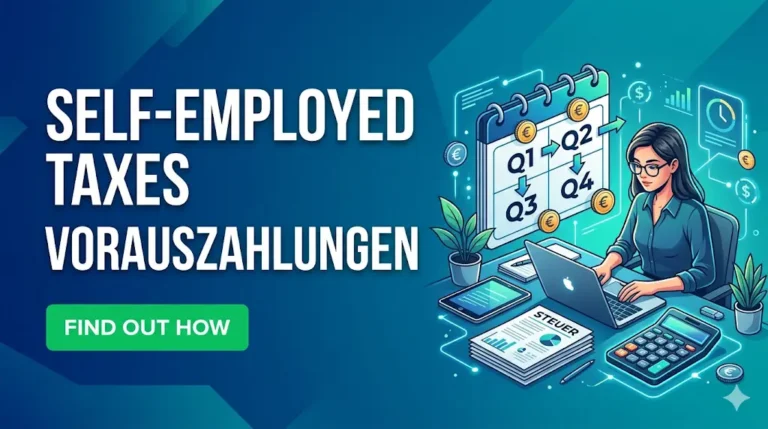
For more details on managing this, read through Freelancer Taxes in Germany: VAT, Income, and Prepayments. Balancing these factors is tricky, and I’ve seen many freelancers accidentally cross the threshold and end up with a surprise VAT bill. Keeping a clean credit history via The SCHUFA Credit Score in Germany: How It Works is also important if you ever need to pivot from freelancing to a business loan or a rental agreement.
Final Thoughts on Freelance Tax Efficiency
Paying less tax in Germany isn't about hiding money; it's about being meticulously organized and using the laws as they are written. Every digital subscription, every bus ticket to a workshop, and every Euro put into a Rürup pension is a step toward a more sustainable freelance career. The bureaucracy is intimidating, but once you have your systems in place—using tools like N26, Wise, and Wundertax—you'll spend less time on paperwork and more time doing the work you actually moved here to do.
Disclaimer
The information provided in this article is for general informational purposes only and does not constitute legal, financial, or professional tax advice. Tax laws in Germany are subject to change, and individual circumstances can vary significantly. You should always consult with a qualified Steuerberater (Tax Advisor) or legal professional before making any financial decisions or filing tax returns. We assume no liability for actions taken based on the content of this guide.