How to Register as an EU Citizen Living in Germany
Moving to Germany as an EU citizen often feels like a bait-and-switch where you expect "Freedom of Movement" but get hit with a wall of paper. I vividly remember sitting in a cold hallway in Neukölln, clutching my passport and wondering why I needed a landlord's signature just to say I lived there when the law said I was free to be here. This guide breaks down exactly how to navigate the registration process, from your first appointment to the documents that actually matter.
Disclosure: This post may contain affiliate links. We may earn a commission at no extra cost to you if you make a purchase through these links. Read full disclosure.
Understanding the Reality of Freedom of Movement in Germany
When we talk about EU Citizens Moving to Germany: Freizügigkeit and Registration, the phrase "Freedom of Movement" is the golden ticket. As a citizen of an EU member state, the EEA (Iceland, Liechtenstein, Norway), or Switzerland, you have the right to enter, live, and work in Germany without a visa or a residence permit. However, this freedom is not entirely unconditional, and it certainly does not exempt you from the German obsession with local registration.
Historically, EU citizens used to receive a physical document called a Freizügigkeitsbescheinigung (Certificate of Freedom of Movement). If you are reading old forums or talking to expats who moved here before 2013, they might tell you that you need to go to the Ausländerbehörde (Foreigners' Office) to get this. You can ignore that advice. The German government abolished this requirement to reduce bureaucracy for EU nationals. Today, your right to live here is inherent to your citizenship, but you still must fulfill the same basic administrative duties as a German citizen, primarily the address registration.
The catch is that your right to stay for more than three months is generally tied to "economic activity." This means you should be employed, self-employed, a student, or have sufficient financial means to support yourself without relying on the German social welfare system. During those first 90 days, you are essentially treated as a tourist with the right to look for work. Once you cross that threshold, the state expects you to be integrated into the system through health insurance and tax contributions.
The Essential First Step: Address Registration (Anmeldung)
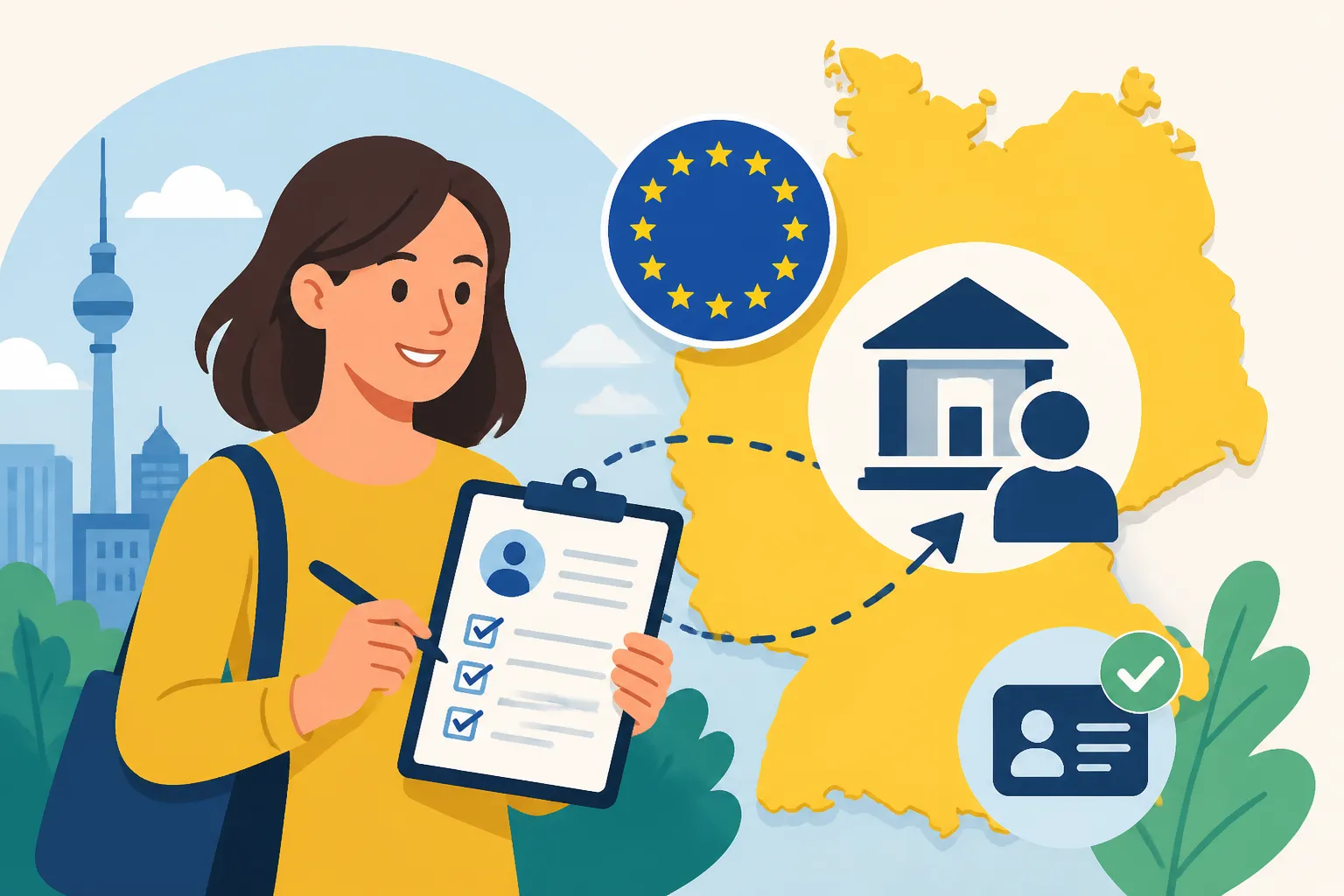
The very first thing you must do—ideally within 14 days of moving into your permanent or long-term accommodation—is the Anmeldung. This is the process of registering your address at the local Bürgeramt (Citizens' Office) or Bürgerbüro. You cannot open a bank account, sign a mobile phone contract, or get a tax ID without the Meldebescheinigung (registration certificate) you receive at the end of this appointment.
Finding an appointment can be a Herculean task, especially in cities like Berlin, Munich, or Hamburg. I remember refreshing the booking page at 7:00 AM every morning for a week just to find a slot. If you can't find an appointment within the legal 14-day window, don't panic. The authorities are well aware of the shortage of appointments. As long as you have booked a "Termin" (appointment), you are generally considered compliant. You can find more specific advice on How to Get an Anmeldung Appointment at the Bürgeramt to help you navigate this specific hurdle.
To complete your registration, you will need a specific set of documents. Do not show up empty-handed, or the clerk will likely send you away within seconds. You need your valid ID card or passport and, most importantly, the Wohnungsgeberbestätigung. This is a form signed by your landlord confirming that you have moved in. A rental contract alone is usually not enough. If you are staying with a friend, they can act as your "provider of living space," but they must have the landlord's permission to sub-let to you. For a deeper look at this document, check out The Wohnungsgeberbestätigung Explained.
| Document Required | Description | Necessity |
|---|---|---|
| National ID or Passport | Must be valid for the duration of your stay. | Mandatory |
| Wohnungsgeberbestätigung | A signed form from the person providing your housing. | Mandatory |
| Registration Form | The "Anmeldeformular," usually found on the city's website. | Mandatory |
| Civil Status Documents | Marriage or birth certificates if registering a family. | Optional/Contextual |
Navigating the German Health Insurance Requirement
One of the most common misconceptions among EU arrivals is that their European Health Insurance Card (EHIC) is sufficient for a long-term stay. While the EHIC is fantastic for a holiday, it is not a substitute for Health Insurance in Germany: Understanding Public vs Private Coverage. Once you register your address and start working, or once you have lived here for more than three months, you are legally required to have German-compliant health insurance.
If you are employed by a German company, this is relatively straightforward. Your employer will ask which Krankenkasse (public health insurance provider) you want to join, and they will handle the deductions from your salary. However, if you are a freelancer, a student, or currently looking for work, the burden is on you to find coverage. This is where many expats feel the "system shock." German insurance is mandatory, and if you go months without it, you may be hit with back-payments for the time you were uninsured but registered in the country.
For students and newcomers who need a bridge between their home country's coverage and the German system, services like Expatrio can be a lifesaver. They offer tailor-made insurance packages that meet German legal requirements, helping you avoid the headache of trying to explain your foreign policy to a skeptical German clerk. Using Expatrio can ensure you are covered from day one, which is vital because you cannot complete certain administrative steps without proof of insurance. For a step-by-step look at this, see How to Get Health Insurance in Germany: Step-by-Step for Newcomers.
Proving Financial Stability and Self-Sufficiency
While you don't need a visa, the German authorities do have the right to ask for proof that you can support yourself if they have reason to believe you are becoming a "burden on the state." This usually only happens if you are not working and are attempting to claim social benefits shortly after arrival. For the vast majority of EU citizens, simply having a work contract or proof of savings is more than enough to satisfy the "Right of Residence" under EU law.
If you are moving as a freelancer, you will need to register with the Finanzamt (Tax Office) to get a freelance tax number. This is a separate process from the initial address registration but is equally important for your legal standing. You can read more about Health Insurance for Freelancers and the Self-Employed: Navigating the System to understand how your insurance costs will scale with your income. The goal of the German system is to ensure everyone is a contributing member of the "Solidarity Principle" that funds their social services.
If you are a student, your proof of financial means is often linked to a scholarship, a part-time job, or support from parents. Again, Expatrio is highly active in this space, providing blocked accounts and insurance solutions that satisfy the university and local registration offices. Even though EU students have it easier than non-EU students, having your finances organized in a way that German bureaucracy recognizes can save you weeks of back-and-forth emails.
The Role of Language and Documentation
One of the most overlooked hurdles for EU citizens is the language barrier. While many clerks in big cities speak English, there is no legal requirement for them to do so. In fact, official business in Germany is conducted in German. If your birth certificate, marriage certificate, or professional qualifications are not in German, you will likely be asked for a certified translation.
I learned the hard way that a "standard" translation from a friend doesn't cut it for the Bürgeramt. You need a "beglaubigte Übersetzung" (certified translation) from a translator sworn in by a German court. This is where a service like Lingoking becomes essential. They specialize in providing court-recognized translations for all the documents you might need to prove your status or register your family. Whether it is a marriage certificate for Family Health Insurance: Adding Your Spouse and Kids to Your Plan or a degree for a job application, using Lingoking ensures that the German authorities will actually accept your paperwork.
Always keep original copies and several physical folders of your documents. Germany is a paper-heavy society. Even if you have a digital copy, the clerk will often insist on seeing the original with the stamp. If you are bringing a spouse from outside the EU, the documentation requirements become significantly stricter, and you should consult a guide on Bringing Non-EU Family Members to Germany to understand how your EU rights extend to them.
Life After Registration: Tax IDs and Social Security
Once your Anmeldung: Registering Your Address in Germany is complete, the wheels of the German state start turning automatically. Within a few weeks, you will receive two very important letters in the mail. The first will contain your Steuer-Identifikationsnummer (Tax ID). This 11-digit number is yours for life. You must give this to your employer so they can tax you at the correct rate. Without it, you will be put into "Tax Class 6," which is the highest possible rate, essentially taking almost half your paycheck until the number is provided.
The second letter (or process) involves your Sozialversicherungsnummer (Social Security Number). If this is your first job in Germany, your health insurance provider or your employer will usually apply for this for you. This number tracks your contributions to the pension fund and unemployment insurance. Understanding Social Security Contributions in Germany: What Comes Off Your Salary is vital for budgeting, as these deductions significantly lower your "Gross" salary to your "Net" take-home pay.
Don't forget the infamous Rundfunkbeitrag (TV and Radio Tax). Every household in Germany must pay roughly 18 Euros a month, regardless of whether you own a TV or even speak German. You will get a letter about this shortly after registration. Ignoring it is not an option; the "Beitragsservice" has powers similar to the tax office and can eventually freeze your bank account if you don't pay. It’s one of those "welcome to Germany" moments every expat eventually complains about over a beer.
Common Pitfalls and Veteran Tips for EU Newcomers
After living through the "German Shuffle" myself, I've noticed a few places where people consistently trip up. First, don't assume that because you are an EU citizen, the rules don't apply to you. The fines for not registering your address are real, though often at the discretion of the clerk. If you are polite and explain the difficulty of finding an appointment, they are usually lenient.
Second, be aware of the Church Tax (Kirchensteuer). During your registration, you will be asked if you are a member of a religion. If you say "Catholic" or "Protestant," the state will automatically deduct about 8-9% of your income tax and give it to the church. If you are not a practicing member and don't want to pay, you should state "none" (konfessionslos). If you make a mistake here, opting out later involves a separate appointment at a different office and a small fee.
Finally, keep your Meldebescheinigung in a safe place. You will need it for everything from Opening a Bank Account in Germany: Step-by-Step for Newcomers to getting a library card. Whenever you move to a new apartment within Germany, you must "Ummelden" (re-register) at your new local office. If you leave Germany permanently, you must "Abmelden" (de-register). Failing to de-register can lead to health insurance companies continuing to bill you even after you've moved back to your home country.
Disclaimer
This guide is for informational purposes only and does not constitute legal or professional advice. Immigration laws and local administrative procedures in Germany are subject to change. While every effort has been made to ensure the accuracy of this information, you should always verify requirements with the official German authorities, such as your local Bürgeramt or the Federal Office for Migration and Refugees (BAMF). The mention of specific services like Expatrio or Lingoking is based on their relevance to the expat experience and should not replace your own due diligence.