EU Citizens Moving to Germany: Freizügigkeit and Registration
I remember standing in the rain outside a Berlin Bürgeramt at 6:30 AM, clutching a soggy folder of documents and wondering why a "borderless" Europe felt so much like a bureaucratic obstacle course. Moving within the EU is legally a right, but in Germany, it is an administrative process that requires patience, precision, and an understanding of Freizügigkeit. This guide simplifies every step of your relocation and registration.
Disclosure: This post may contain affiliate links. We may earn a commission at no extra cost to you if you make a purchase through these links. Read full disclosure.
The Reality of Freizügigkeit in Germany
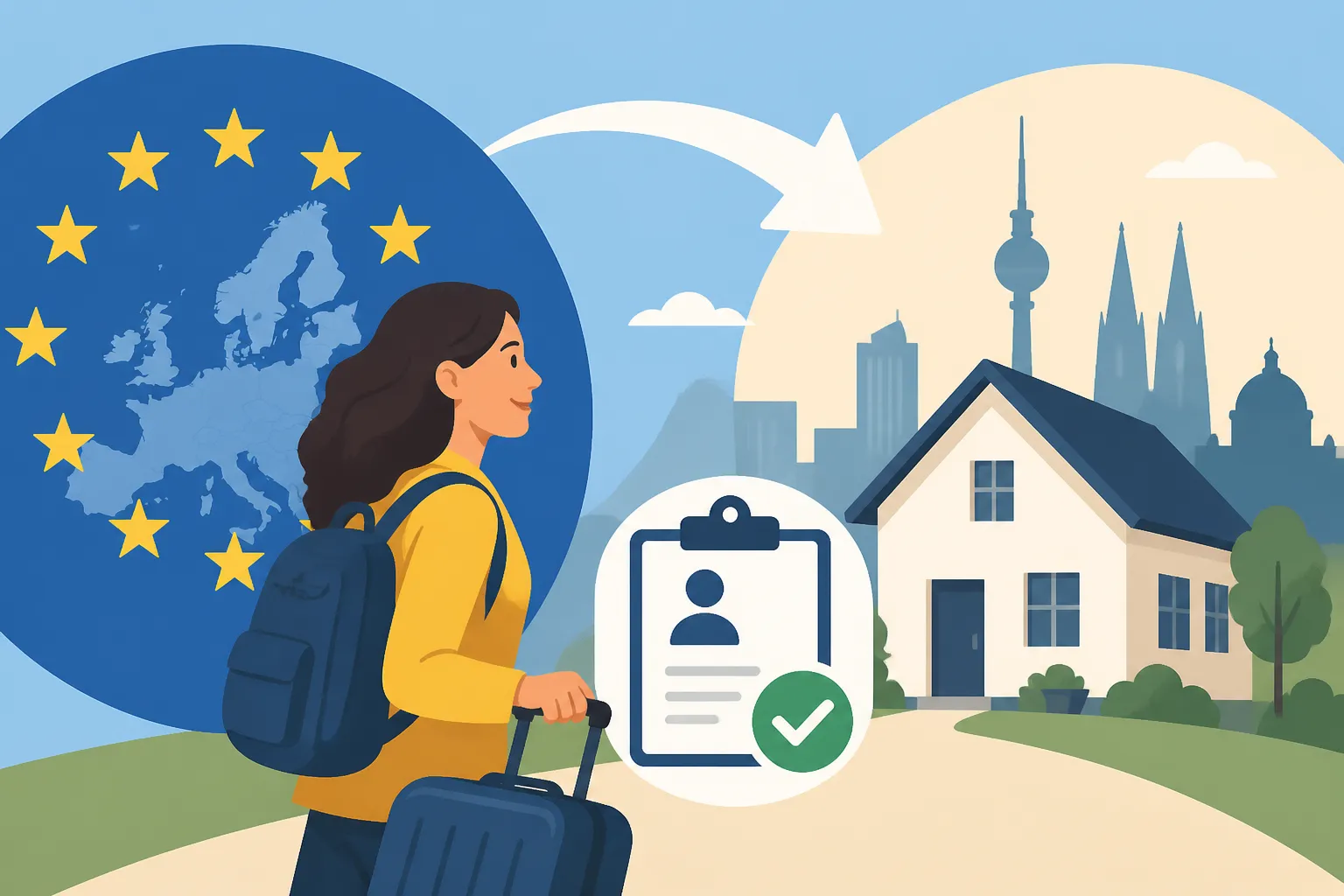
Freedom of movement, or Freizügigkeit, is the crown jewel of European integration, allowing any EU citizen to live, work, and study in Germany without a visa. However, many newcomers mistake "visa-free" for "form-free." While you won't need to visit an embassy in your home country, you are still subject to German residency laws once you cross the border. The German government operates on a system of mandatory registration that applies to everyone, including their own citizens.
What Freedom of Movement Actually Means
In a legal sense, Freizügigkeit gives you the right to stay in Germany for up to three months without any conditions other than holding a valid ID card or passport. If you intend to stay longer, you must fall into one of several categories: you are employed, self-employed, a student with sufficient means, or a non-active person with enough savings and health insurance to not become a burden on the state. It is a common misconception that you can simply arrive and claim social benefits immediately; Germany is quite strict about ensuring that those exercising their right to move are contributing to the economy or are self-sufficient.
The Right to Work and Seek Employment
As an EU citizen, you have the same access to the German labor market as a local. You do not need a work permit, and employers can hire you with no more paperwork than they would need for a German national. This is a massive advantage compared to non-EU expats who must navigate the complex EU Blue Card Germany: Eligibility, Benefits, and Application Process. You can also register as a job seeker for a reasonable period, usually up to six months, provided you can show you are actively looking for work and have a genuine chance of being hired.
Freedom of Movement for Non-Workers
If you are moving to Germany to retire or simply to live off your savings, you still have a right to reside here under Freizügigkeit. The caveat is that you must prove you have comprehensive health insurance and "sufficient resources." There is no fixed Euro amount for what constitutes "sufficient," but generally, it should be higher than the standard social welfare rates. If you find yourself in a situation where the authorities question your status, having your foreign financial documents professionally translated by a service like Lingoking can prevent misunderstandings during the verification process.
The Essential First Step: Address Registration (Anmeldung)
If there is one word that defines the first month of life in Germany, it is "Anmeldung." This is the process of registering your address at the local town hall or citizens' office (Bürgeramt). Without a registration certificate (Meldebescheinigung), you are effectively a ghost in the system. You cannot open a traditional bank account, get a tax ID, or even sign up for a gym membership without this piece of paper.
Navigating the Bürgeramt Appointment Chaos
The biggest hurdle to Registering Your Address (Anmeldung): Step-by-Step Guide is actually getting an appointment. In major hubs like Berlin, Munich, or Hamburg, slots are often booked out for weeks. I once spent three days refreshing the appointment page every ten minutes. Pro tip: most offices release cancellations between 7:30 AM and 8:30 AM every morning. If you are struggling with the German-only interface of the booking systems, using a relocation platform like Expatrio can provide you with the necessary checklists and support to ensure you don't miss any requirements when you finally get into that office.
Required Documentation for EU Citizens
When you attend your appointment, you need to be prepared. German bureaucrats are not known for their flexibility. You will need your passport or national ID card and a specific form called the Wohnungsgeberbestätigung. This is a document signed by your landlord confirming that you have moved in. Note that a rental contract is usually not enough on its own. If you are staying with a friend, they can act as your "provider of living space," but they must sign this form. Failure to provide this can lead to your registration being rejected, forcing you back into the appointment-hunting cycle.
The Wohnungsgeberbestätigung Explained
This document was introduced to prevent people from registering at addresses where they don't actually live. It must include the landlord’s name and address, the date you moved in, the address of the apartment, and your name. If you are subletting, the main tenant can sign it, but they often need permission from the owner to do so. It is vital to get this signed the moment you move in. If you find that your landlord is hesitant or provides a document in complex legal German, getting a quick translation from Lingoking can help you verify exactly what you are signing and ensure it meets the city's requirements.
Health Insurance and the German Social System
One of the biggest culture shocks for EU citizens is the complexity of Health Insurance in Germany: Understanding Public vs Private Coverage. In many EU countries, healthcare is tax-funded and universal. In Germany, it is a dual system of public and private insurance, and having coverage is a legal requirement from day one of your residency.
Transitioning from EHIC to German Insurance
Your European Health Insurance Card (EHIC) is wonderful for a holiday, but it is not a long-term solution for residents. Once you register your address or start a job, the EHIC is no longer valid for your primary care. You must join a German Krankenkasse (health insurance fund). If you are employed and earn below a certain threshold, you will almost certainly be placed in Public Health Insurance (gesetzliche Krankenkasse): What It Covers and Costs. Your employer pays half of the premium, and the other half is deducted directly from your gross salary.
Public vs. Private Insurance for EU Nationals
For high earners or the self-employed, Private Health Insurance in Germany: Benefits, Costs, and Eligibility becomes an option. Private insurance often offers faster access to specialists and more comfortable hospital stays, but the premiums can increase as you age. It is a decision that is very hard to reverse later in life. For students or those looking for a smooth transition, Expatrio offers integrated packages that help you navigate the application for public insurance, ensuring you are covered from the moment you arrive so you can focus on Finding a Hausarzt (Family Doctor) in Germany rather than worrying about medical bills.
Understanding Social Security Contributions
Your health insurance is just one part of the social safety net. When you work in Germany, you also pay into pension insurance, unemployment insurance, and long-term care insurance. These Social Security Contributions: What Are You Paying For in Germany? are mandatory. As an EU citizen, the time you spend working in Germany counts toward your pension totals across the entire EU, which is a significant benefit of the Freizügigkeit rules. You aren't just paying into a local pot; you are building a future that remains valid even if you move to another member state later.
Financial and Professional Setup for Newcomers
Once you have your registration and your insurance sorted, you need to integrate into the financial system. Germany is still a country that relies heavily on "officialdom," and you will receive a flurry of letters in your first few weeks, most of which are incredibly important.
Obtaining Your Tax ID and Social Security Number
After you register your address, the Federal Central Tax Office will automatically mail you your Tax ID (Steuer-ID). You need this for your employer to pay you the correct net salary. Without it, you might be taxed at the highest possible rate (Tax Class VI) until the system catches up. You will also need to understand German Tax Classes (Steuerklassen) Explained if you are married, as this can significantly change your monthly take-home pay. Your social security number (Sozialversicherungsnummer) is usually issued by your health insurance provider, so make sure to share that with your HR department as soon as possible.
Opening Your First German Bank Account
You will quickly find that many landlords and utility companies prefer SEPA direct debits from a German IBAN. While EU law technically forbids "IBAN discrimination," many local systems still struggle with non-DE codes. When Opening a Bank Account in Germany: Step-by-Step for Newcomers, you can choose between traditional "brick and mortar" banks like Sparkasse or Commerzbank, or mobile-first neobanks. If you want a smooth experience with English support, check out the Best Banks in Germany for Expats: Low Fees and English Support to find a provider that won't require a stack of paper forms.
Recognition of Professional Qualifications
If you are a doctor, architect, or teacher, your EU degree is legally recognized in Germany, but you still need to go through a formal recognition process (Anerkennung) to practice. Even for non-regulated professions, having a "Statement of Comparability" can help with salary negotiations. Often, this requires you to submit translated transcripts and diplomas. Using a professional service like Lingoking ensures that your academic achievements are translated using the correct German terminology, which is crucial for the authorities to evaluate your level of education accurately.
Family Reunification for EU Citizens
One of the best parts of the Freizügigkeit regulations is that your right to move extends to your family members, regardless of their own nationality. However, the process for non-EU family members is slightly different and requires a few extra steps at the local immigration office.
Bringing Non-EU Spouses and Partners
If you are an EU citizen and your spouse is from a country outside the EU, they have the right to join you under Family Reunification in Germany: Spouse and Children. They do not necessarily need to apply for a visa from abroad if they come from a country with visa-free entry to the Schengen area, but they must apply for a Residence Card (Aufenthaltskarte) once they arrive in Germany. Unlike the standard work visa, they have the immediate right to work in any capacity from the moment they arrive, provided they can prove their relationship to you.
The Residence Card (Aufenthaltskarte) Process
While the EU citizen only needs to register at the Bürgeramt, the non-EU spouse must visit the Ausländerbehörde (Foreigner’s Office). This can be a daunting experience. You will need to provide proof of your marriage (often an apostilled certificate with a certified translation), proof of your own Freizügigkeit (employment contract or proof of funds), and proof of shared housing. This residence card is usually valid for five years and serves as proof that they are living in Germany legally under EU law rather than German national law.
Rights of Children and Dependents
Your children and even dependent parents or grandparents can also join you in Germany under EU rules. Children have an immediate right to attend local schools, and your family members are generally eligible to be covered under your public health insurance at no extra cost through "family insurance" (Familienversicherung). Understanding Having a Baby in Germany: Hospital vs Birth Center and Postnatal Care is also useful if you are planning to expand your family after moving, as the support systems for parents in Germany are among the best in Europe.
| Step | Action Required | Document Needed | Where to Go |
|---|---|---|---|
| 1 | Move In | Rental Agreement | Your new home |
| 2 | Registration | Anmeldung | Bürgeramt |
| 3 | Health Insurance | Apply for a Krankenkasse | Insurance Provider / Expatrio |
| 4 | Tax Setup | Receive Steuer-ID | By mail automatically |
| 5 | Work/Finance | Open Bank Account | Bank / Online |
| 6 | Family (if non-EU) | Residence Card | Ausländerbehörde |
Long-Term Residence and Rights
After living in Germany for a while, your status shifts from a newcomer to a settled resident. As an EU citizen, you have unique political and residency rights that non-EU expats do not enjoy until much later in their journey.
Permanent Right of Residence
Once you have lived in Germany legally for a continuous period of five years, you automatically acquire a permanent right of residence. You no longer need to meet the conditions of Freizügigkeit (like being employed or having sufficient funds). You can apply for a document confirming this right, though it is not strictly mandatory because the right exists by law. This status is a great stepping stone if you eventually decide to explore Dual Citizenship in Germany (2024 Law Update): What Expats Should Know.
Voting and Civic Participation
EU citizens are eligible to vote and run as candidates in local municipal elections and European Parliament elections. You will usually receive a notification in the mail before an election. This allows you to have a direct say in how your neighborhood is run, from park maintenance to local school funding. Engaging in your local community is one of the fastest ways to overcome culture shock and truly feel at home in your new German life.
Disclaimer
The information provided in this guide is for informational purposes only and does not constitute legal advice. While every effort has been made to ensure accuracy, German immigration laws and local administrative procedures are subject to change. Always consult official government sources or a qualified legal professional for specific advice regarding your individual residency status.