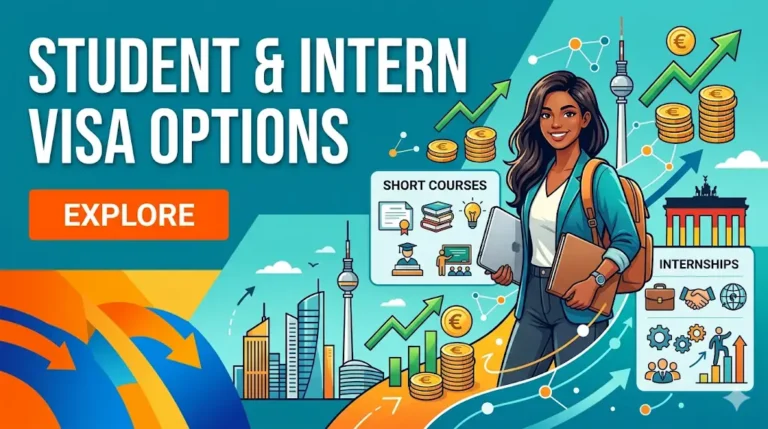
The German Student Visa and Post-Study Job Search
The sheer volume of paperwork required for a German student visa is enough to make even the most organized person want to give up before they’ve even packed a suitcase. I remember standing in the rain outside a German consulate, clutching a folder of documents so thick it wouldn't close, wondering if my dream of studying in Berlin was worth the stress. This guide breaks down every step of the student visa process and the post-study job search to ensure you don't just survive the bureaucracy, but thrive within it.
Disclosure: This post may contain affiliate links. We may earn a commission at no extra cost to you if you make a purchase through these links. Read full disclosure.
Navigating the German Student Visa Process
The journey to becoming a student in Germany begins long before you set foot in a lecture hall. The administrative framework is rigid, but once you understand the logic behind the "Prüfung" (examination) of your documents, it becomes manageable. Most students from outside the EU/EEA will need to apply for a National Visa (D-Visa) for study purposes at their local German embassy or consulate. This is not to be confused with a short-term Schengen visa, which does not allow for long-term residency or the right to work.
Types of Student Visas and Permits
There isn't just one single "student visa" in the eyes of the German government. Depending on where you are in your academic journey, you might apply for a Prospective Student Visa (Visum zur Studienbewerbung) if you haven't received your final admission letter yet but need to be in Germany for entrance exams or interviews. If you already have your Zulassungsbescheid (admission letter), you apply directly for the Student Visa.
The nuance here is critical. If you enter on a tourist visa hoping to switch to a student visa once you’re here, you will almost certainly be told to fly back home and start the process from your country of origin. I’ve seen many friends lose months of their lives and thousands of Euros because they tried to skip this step. You can find more details in our German Student Visa: Step-by-Step Application Guide. Once you arrive, this visa is usually valid for 90 to 180 days, after which you must convert it into a residence permit at the local Ausländerbehörde.
Financial Requirements and Blocked Accounts
Germany offers world-class education for nearly free, but the government wants to be absolutely certain you can afford to live here without relying on their social system. This is where the "Sperrkonto" or blocked account comes in. As of recent regulations, you are required to prove you have a specific amount of money—currently over 11,000 Euros—available for your first year of study.
This money is literally "blocked." You deposit it before you apply for your visa, and the bank releases a fixed amount to you each month. It’s a significant hurdle, and choosing the right provider can save you weeks of headaches. Services like Expatrio have become a lifeline for international students because they allow you to open these accounts digitally from your home country, which is a massive relief compared to the old days of sending physical letters to German banks. You can read more about how this works in our guide on the Student Visa Blocked Account (Sperrkonto): What It Is and How to Set It Up.
Health Insurance for Students
You cannot enroll in a German university without proof of health insurance. It is a non-negotiable part of the enrollment process. For most students under 30, the best option is public health insurance (gesetzliche Krankenkasse). It’s comprehensive and relatively affordable for students. However, if you are over 30 or coming for a preparatory language course, you might need to look at private options temporarily.
Navigating the transition from travel insurance to "proper" German insurance is a common pain point. I remember being rejected at the university registrar's office because my insurance wasn't "officially recognized," forcing me to run across town to find a provider. Bundling your blocked account with health insurance through providers like Expatrio can streamline this, as they ensure all documents meet the specific requirements of both the embassy and the university. For a deeper look at your options, check out our article on Health Insurance for Students in Germany: Affordable Options and Requirements.
Life as an International Student in Germany
Once you’ve cleared the visa hurdle and settled into your "Studentenwohnheim" (student dorm), the reality of German life sets in. It’s not just about exams; it’s about managing your legal status while trying to integrate into a new culture.
Working While Studying
Many students need to work to supplement their income, and Germany is actually quite generous with work rights for students, provided you follow the rules. Generally, non-EU students are allowed to work 120 full days or 240 half days per year. This might sound like a lot, but if you take a "HiWi" (research assistant) position at the university or work in a café, those days add up quickly.
The "half-day" rule is particularly useful if you have a job that only requires 4 hours of work at a time. It's vital to keep a personal log of your working hours because the Ausländerbehörde can ask for this when you renew your residence permit. Exceeding these hours can lead to the revocation of your visa, a risk that is never worth taking. You can find more specific advice on our page regarding Working on a Student Visa in Germany: Rules and Hours.
Address Registration and Resident Permits
In Germany, the concept of "Anmeldung" is king. Within two weeks of moving into a new flat, you must register your address at the Bürgeramt. Without that piece of paper (the Meldebescheinigung), you cannot get a bank account, a phone contract, or—most importantly—your long-term residence permit.
The struggle to find an apartment that offers "Wohnungsgeberbestätigung" (the landlord’s confirmation of residence) is the single biggest stressor for newcomers. Many students live in temporary hostels or sublets that don't allow registration, which puts their visa status at risk. It’s a Catch-22: you need the permit to stay, but you need an apartment to get the permit. My advice? Start your search months in advance and prioritize places that explicitly mention registration is possible. We’ve covered this process in detail in The Anmeldung: Registering Your Address in Germany.
The Post-Study Job Search Phase
The transition from being a student to a professional is perhaps the most exciting and terrifying time for an expat. Germany wants to keep its graduates, which is why the law allows you a generous window to find a job that matches your qualifications.
Transitioning to the Job Seeker Visa
Once you complete your studies—meaning the moment you receive your final grades, not necessarily your physical diploma—you are eligible for the 18-month post-study job seeker permit. This is one of the most flexible visas in the German system. During these 18 months, you can work any job (even "unskilled" labor like waiting tables) to support yourself while you hunt for a professional role in your field.
This extension is a gift, but it requires a new application at the Foreigners' Office. You will need to show proof of your degree, continued health insurance, and financial means to support yourself. This is the stage where many people realize they should have started networking much earlier. For a breakdown of how to switch, see Extending Your Stay: From Student Visa to Job Seeker Visa After Graduation.
Eligibility and Timing
Timing is everything. You cannot wait until your student visa expires to apply for the job seeker extension. Ideally, you should make your appointment at the Ausländerbehörde several months before your current permit ends. If your appointment date falls after your visa expires, the office will issue you a "Fiktionsbescheinigung," a temporary document that keeps your stay legal while they process your new permit.
I’ve spent many anxious mornings refreshing the appointment page of the Berlin Ausländerbehörde at 7:00 AM, hoping for a cancellation slot. It’s a rite of passage for every expat. Understanding the "2-year rule" is also vital; this relates to the simplified path to permanent residency for German university graduates. You can learn more about this in our guide on The 2-Year Rule: Using Your Post-Study Job Seeker Visa Effectively.
Finding Employment After Graduation
The German job market is robust, but it operates on specific cultural norms. Your degree is the "ticket," but your ability to navigate the application process is what gets you through the door.
Building a Professional Network
In Germany, "Vitamin B" (Bieziehung, or relationships) is often just as important as your CV. While English-speaking roles are common in tech hubs like Munich or Berlin, many industries still rely heavily on German-style networking. Joining professional associations, attending job fairs, and being active on LinkedIn and Xing (the German equivalent) are essential steps.
A common mistake is thinking that a high GPA is enough. German employers value "Praktika" (internships) and practical experience. If you haven't worked as a "Werkstudent" (working student) during your studies, you might find the entry-level competition stiff. For more on navigating these platforms, read our tips on How to Use LinkedIn and Xing to Find Jobs in Germany.
Language Skills and Career Preparation
Even if your job is in English, your life is in German. Being able to chat with colleagues in the breakroom or understand a contract without a translator will significantly boost your career prospects. Furthermore, your application documents must be flawless. German recruiters expect a very specific format for the "Lebenslauf" (CV), usually including a professional photo and a linear timeline.
When you start applying, you’ll likely need to provide certified translations of your non-German documents, such as your high school certificates or previous work references. This is where a service like Lingoking becomes invaluable. They specialize in the certified translations required by German authorities and employers, ensuring that your hard-earned qualifications aren't lost in translation. You can see why this matters in our guide to Apostilles and Certified Translations for German Immigration.
Switching to a Work Residence Permit
Once you land that dream job offer, the clock starts ticking to convert your job seeker visa into a residence permit for employment. This is a moment of triumph, but it involves one final round of bureaucracy.
The EU Blue Card Option
For many university graduates, the EU Blue Card is the "Gold Standard." It offers a faster track to permanent residency—sometimes in as little as 21 months if you have B1 German skills. To qualify, your job must pay a certain minimum salary and be related to your degree.
The Blue Card process is generally prioritized by the authorities because it attracts highly skilled labor. If you don't quite meet the salary threshold for the Blue Card, you can still get a standard work permit for qualified professionals. Both require your employer to fill out specific forms (Erklärung zum Beschäftigungsverhältnis) that describe your role and why you are the right fit for it. Find out more at The EU Blue Card in Germany: Requirements and Benefits. If you're ready to apply, follow our guide on How to Apply for an EU Blue Card in Germany.
Regular Work Permits and Settlement
If you don't qualify for a Blue Card, don't panic. The standard work permit for qualified professionals is still a solid path. After working for two years on this permit (if you have a German degree), you can often apply for a Niederlassungserlaubnis, which is permanent residency.
This is the ultimate goal for most expats. It means you are no longer tied to a specific employer and no longer have to visit the Ausländerbehörde every couple of years. It’s a feeling of absolute freedom that I still remember vividly—the first time I traveled outside the EU and didn't have to worry about whether my permit was still valid. We break down the path to this status in The Settlement Permit (Niederlassungserlaubnis) in Germany.
| Visa/Permit Type | Main Requirement | Duration | Work Rights |
|---|---|---|---|
| Student Visa | University Admission | Duration of Study | 120 full / 240 half days |
| Job Seeker (Post-Study) | German University Degree | 18 Months | Full work rights |
| EU Blue Card | High Salary + Degree | 4 Years (renewable) | Linked to Employer |
| Qualified Professional | Degree + Job Offer | Usually 2-4 Years | Linked to Employer |
| Permanent Residency | 2 Years working (graduates) | Indefinite | Unlimited |
Practical Tips and Common Pitfalls
Through my years in Germany, I’ve learned that the "system" isn't actually trying to stop you—it’s just very, very precise. If you miss one signature or one document, the whole process stalls.
Dealing with the Ausländerbehörde
The Foreigners' Office can be an intimidating place. The officials are often overworked, and the environment can feel cold. My best advice? Always bring a German speaker with you if your German isn't yet fluent. Even if the official speaks English, they are often legally required to conduct the interview in German.
Being polite, organized, and having every single document printed and sorted in a folder goes a long way. If you show up missing something, you won't get a "pass"—you'll get a new appointment three months away. Check out our survival guide for The Foreigners' Office (Ausländerbehörde): How to Deal With It for more cultural insights on how to handle these meetings.
Document Management and Translations
Keep a "Master Folder" of your life in Germany. Every contract, every pay slip, every social security letter, and every registration document should be kept in physical form. Germany is still a very "paper-heavy" society. Digital copies are great for your own records, but when you go to an official appointment, you need the originals.
For any documents from your home country, such as birth certificates or marriage licenses, you must have them translated by a court-certified translator in Germany. Using a reputable service like Lingoking ensures that your translations will be accepted without question by the Beamter (official) behind the desk. They are familiar with the exact terminology required by German law. You can find more info on this in How to Get a Certified Translation for German Immigration.
Disclaimer
This guide is intended for informational purposes only and does not constitute legal advice. Immigration laws in Germany are subject to frequent changes. Always verify the latest requirements with the official website of the Federal Foreign Office (Auswärtiges Amt) or consult with a licensed immigration lawyer before making major decisions.