Starting a Business in Germany: Financial and Legal Basics for Entrepreneurs
Launching a startup in Germany requires navigating a complex but highly rewarding economic ecosystem. This comprehensive guide explores the essential legal structures, bureaucratic registration steps, and vital financial management strategies every expat entrepreneur needs to successfully build a thriving business in Germany.
Disclosure: This post may contain affiliate links. We may earn a commission at no extra cost to you if you make a purchase through these links. Read full disclosure.
Legal Structures for Your German Business
Freiberufler vs Gewerbe The Crucial Distinction
Before you register any business entity in Germany, you must determine how the German state classifies your specific profession. The foundational split in German commercial law divides self-employed individuals into two distinct categories: Freiberufler (liberal professionals) and Gewerbetreibende (commercial traders). This classification is not a choice you make; it is dictated by the exact nature of your work and has massive financial and administrative implications for your future enterprise.
A Freiberufler typically belongs to cataloged professions that require specific academic training or creative independence. This includes doctors, lawyers, architects, journalists, independent software engineers, artists, and specialized consultants. The financial advantage of this status is immense. Freiberufler are entirely exempt from registering with the local trade office and, crucially, do not have to pay the Gewerbesteuer (trade tax). Their accounting requirements are also significantly simplified, usually only requiring a basic surplus revenue calculation at the end of the fiscal year.
Conversely, a Gewerbe encompasses almost everything else. If you are buying and selling physical goods, opening a restaurant, running an e-commerce store, or acting as a commercial broker, you are a commercial trader. Gewerbetreibende must officially register their business, pay mandatory membership fees to the local Chamber of Commerce, and are subject to the local trade tax once their annual profit exceeds €24,500. Misclassifying yourself can lead to severe back-tax penalties, making this the most important initial assessment for any expat entrepreneur. We explore the broader lifestyle implications of this choice in our guide on Freelancer vs Employee: Financial Pros and Cons in Germany.
Sole Proprietorship Einzelunternehmen
If you decide to start your business entirely on your own without forming a complex corporate entity, you will operate as an Einzelunternehmen (Sole Proprietorship). This is the most popular and straightforward legal form for solo founders, freelancers, and small shop owners across the country. Establishing an Einzelunternehmen is highly cost-effective and involves minimal bureaucratic friction compared to incorporating a limited liability company.
The primary advantage of a sole proprietorship is absolute control and the absence of a minimum capital requirement. You can start your business with zero euros in the bank. Furthermore, the decision-making process rests entirely on your shoulders, allowing for rapid pivots and total operational agility. Profits from the business are simply treated as your personal income and taxed progressively under your standard individual income tax bracket, simplifying the annual filing process.
However, the monumental disadvantage is unlimited personal liability. As an Einzelunternehmer, there is absolutely no legal separation between your business assets and your personal assets. If your business is sued by a client, incurs massive debt, or declares bankruptcy, creditors have the legal right to seize your personal bank accounts, your car, and even your private real estate to settle the obligations. For low-risk digital consulting, this structure works well, but for capital-intensive physical trades, the liability risk is often too severe.
Limited Liability Companies UG vs GmbH
To protect personal assets, ambitious entrepreneurs frequently opt to incorporate a limited liability company. In Germany, the absolute gold standard is the Gesellschaft mit beschränkter Haftung (GmbH). A GmbH is a highly respected, independent legal entity. If the company fails, your personal assets are completely shielded from corporate creditors. However, establishing a GmbH requires a massive upfront commitment: a minimum share capital (Stammkapital) of €25,000, of which at least €12,500 must be deposited in the corporate bank account before formal registration can occur.
For expats who desire the liability shield of a GmbH but lack the €25,000 startup capital, the German government created the Unternehmergesellschaft (UG), often referred to as the “Mini-GmbH.” You can legally incorporate a UG with exactly €1 in share capital. It provides the exact same robust liability protection as a standard GmbH.
The catch with a UG is a strict mandatory savings mechanism. The law dictates that a UG must retain 25% of its annual net profit in a designated reserve account. You cannot distribute this 25% as dividends. Once these reserved profits eventually accumulate to reach the €25,000 threshold, the UG can—and usually does—transform into a fully-fledged GmbH. Both entities require complex double-entry bookkeeping, expensive notary fees for incorporation, and corporate tax filings, making them structurally heavier than a sole proprietorship.
| Business Structure | Minimum Capital | Liability | Best Suited For |
| Einzelunternehmen | None (€0) | Unlimited personal liability | Solo freelancers, low-risk services |
| UG (Mini-GmbH) | €1 | Limited to corporate assets | Bootstrapped startups needing liability protection |
| GmbH | €25,000 | Limited to corporate assets | Established companies, seeking high market trust |

The Registration and Bureaucracy Process
Registering with the Trade Office Gewerbeamt
If your business model falls under the Gewerbe (commercial trade) classification, your first physical bureaucratic step is visiting the local Gewerbeamt (Trade Office) to file your Gewerbeanmeldung (business registration). This process officially informs the municipality that a new commercial entity is operating within its jurisdiction. The fee for this registration is remarkably low, usually ranging between €20 and €60 depending on the specific city.
The Gewerbeanmeldung requires you to provide a detailed, highly specific description of your planned business activities. Vague descriptions like “consulting” or “internet services” are routinely rejected. You must clearly state what you are buying, selling, or mediating. If your trade requires special permits—such as gastronomy, real estate brokerage, or specialized crafts (Handwerk)—you must present those respective licenses alongside your passport and residency permit.
Once the Gewerbeamt processes your application, they automatically notify other critical government bodies on your behalf, including the tax office, the local court, and the employer’s liability insurance association. It is important to note that Freiberufler completely bypass the Gewerbeamt and deal exclusively and directly with the tax authorities.
The Tax Office Finanzamt and Your Tax Numbers
Regardless of whether you are a sole proprietor, a UG, or a liberal professional, you must officially register your enterprise with the Finanzamt (Tax Office). You do this by completing the Fragebogen zur steuerlichen Erfassung (Tax Registration Questionnaire). In modern Germany, this dense, complex document must be submitted entirely digitally via the government’s ELSTER tax portal; paper forms are largely obsolete.
This questionnaire is the most critical administrative document you will file. It asks for your estimated revenue and profit for the first two years, which the tax office uses to immediately calculate your mandatory quarterly income tax prepayments. If you overestimate your initial profits out of sheer optimism, the Finanzamt will demand massive upfront tax payments that can instantly drain your startup’s cash flow. Furthermore, this form is where you declare whether you wish to utilize the small business VAT exemption (Kleinunternehmerregelung).
Upon processing this form, the tax office will issue your Steuernummer (tax number) and, if requested, your Umsatzsteuer-Identifikationsnummer (VAT ID). You legally cannot issue a proper invoice to a client without these numbers. Because accessing ELSTER and transmitting highly sensitive corporate financial projections requires an absolute guarantee of digital security, utilizing a premium Virtual Private Network like NordVPN is highly recommended to encrypt your connection, especially if you are setting up your business from a coworking space or public cafe. For an overview of how your personal tax IDs integrate into this, read Getting Your Tax ID (Steuer-ID) and Tax Class (Steuerklasse) in Germany.
Chamber of Commerce IHK Memberships
For all Gewerbetreibende (commercial traders) and corporations (UG and GmbH), membership in the Industrie- und Handelskammer (IHK) or the Handwerkskammer (HWK for skilled crafts) is strictly legally mandatory. You cannot opt out. Once the trade office processes your registration, your data is automatically forwarded to the local chamber, and you will receive a welcome letter and a subsequent invoice for your membership dues.
The fees are calculated based on a baseline corporate assessment and a percentage of your annual trade profit. For newly founded, small businesses with low initial profits, the IHK often waves the base fee or charges a vastly reduced rate for the first few years. However, as your enterprise scales, these mandatory chamber fees become a noticeable annual expense that must be factored into your corporate budgeting.
While many entrepreneurs view the IHK purely as an unavoidable bureaucratic tax, the chambers do offer substantial resources. They provide free legal templates, initial legal consultations regarding contract law, massive networking events, and crucial support for taking on apprentices (Auszubildende). Leveraging these resources is vital to extracting actual value from your mandatory membership.
Financial Management and Banking Basics
Opening a German Business Bank Account
One of the most catastrophic mistakes an expat entrepreneur can make is mixing personal and corporate finances. If you incorporate a UG or a GmbH, a dedicated corporate bank account is a strict legal requirement; the notary will not finalize your company registration until the share capital is deposited into an account bearing the company’s exact name. However, even for sole proprietors and Freiberufler, maintaining a strictly segregated business account is essential to survive a future tax audit.
Traditional German high-street banks are notorious for demanding extensive paperwork, in-person branch appointments, and hefty monthly account maintenance fees for business accounts. Furthermore, their interfaces are almost exclusively in German. For agile startups and solo founders, pivoting to modern, digital-first financial platforms is a massive operational upgrade.
By opening a business account with a digital bank like N26, you bypass the archaic bureaucracy. N26 provides a fully English-language interface, instant push notifications for client payments, and the ability to instantly export your transactional data in clean CSV files tailored for your accountant. Keeping your operational cash flow meticulously organized from day one prevents a forensic accounting nightmare at the end of the fiscal year. To review the landscape of available banking options, consult Best Banks in Germany for Expats: Low Fees and English Support.
Understanding VAT MwSt and Invoicing
Value Added Tax (VAT), known in Germany as Umsatzsteuer (USt) or Mehrwertsteuer (MwSt), fundamentally alters how you price your services and manage your cash flow. The standard VAT rate in Germany is 19%, with a reduced rate of 7% applied to specific goods like books, certain foods, and cultural event tickets. As a standard business, you must add this 19% to every invoice you issue to a domestic client.
You are effectively acting as an unpaid tax collector for the German government. You collect the VAT from your clients, but you must remit it to the Finanzamt via regular advance VAT returns (Umsatzsteuervoranmeldungen), typically filed monthly or quarterly. However, you are allowed to deduct the VAT you paid on your own business expenses (like buying a laptop or paying for a coworking space) from the VAT you owe the government, remitting only the difference. This mechanism is called Vorsteuerabzug.
To bypass this massive administrative burden, many new founders opt for the Kleinunternehmerregelung (small business regulation). If your revenue was under €22,000 in the previous year and is projected to be under €50,000 in the current year, you can choose not to charge VAT on your invoices. While this makes your services 19% cheaper for private consumers, it completely eliminates your ability to claim back the VAT on your own business purchases.
Managing International Transactions and Clients
Germany’s central location in Europe makes it an ideal launchpad for cross-border commerce. However, once your business begins serving clients outside the Eurozone—such as in the United States, the UK, or Asia—traditional German banking infrastructure becomes a massive financial liability.
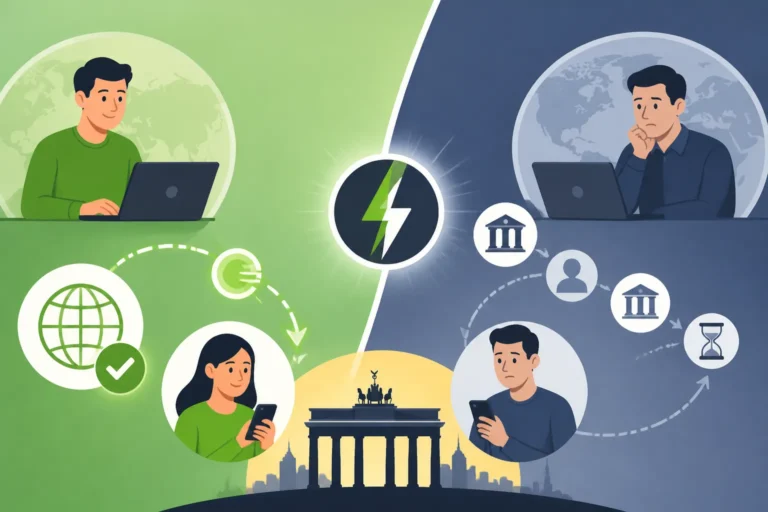
If a US-based client pays your €5,000 invoice via a standard international wire transfer, the SWIFT network will intercept the transaction. Your German bank and intermediate correspondent banks will apply terrible hidden exchange rate margins and extract flat processing fees, often shaving hundreds of euros off your hard-earned revenue before the money ever clears.
To protect your profit margins, utilizing specialized borderless financial platforms is critical. By invoicing your international clients using a Wise business account, you can provide them with local bank details in their native currency (like a US routing number or a UK sort code). The client pays locally, and Wise converts the funds to Euros at the exact mid-market exchange rate with total transparency. Bypassing SWIFT ensures your global revenue remains intact.
Taxes and Social Security for Entrepreneurs
Income Tax and Trade Tax Gewerbesteuer
The taxation of a business depends entirely on its legal structure. For sole proprietors and Freiberufler, corporate profit is treated simply as personal income. This profit is subjected to Germany’s highly progressive individual income tax (Einkommensteuer), which starts at a baseline rate of 14% (after the tax-free allowance) and scales up to 42% for higher earnings. Because you do not have an employer withholding this tax monthly, you must possess the iron discipline to save roughly 30% to 40% of your net invoices to pay your quarterly tax installments to the Finanzamt.
For Gewerbetreibende (commercial traders), an additional layer of taxation exists: the Gewerbesteuer (trade tax). Once your commercial profit exceeds the €24,500 allowance, the municipality levies a tax based on a federal base rate multiplied by a specific local multiplier (Hebesatz). This means a business in Munich pays significantly higher trade tax than the exact same business operating in a rural Brandenburg village. Fortunately, for sole proprietors, the trade tax can largely be offset against their personal income tax, mitigating double taxation.
Limited liability companies (UG and GmbH) face a completely different regime. They do not pay progressive personal income tax. Instead, corporate profits are subject to a flat Corporate Tax (Körperschaftsteuer) of 15%, plus the Solidarity Surcharge, and the local Trade Tax. If you then distribute those corporate profits to yourself as a dividend, you pay a flat 25% Capital Gains Tax (Abgeltungsteuer). Understanding these distinct tax landscapes is vital, and you should thoroughly review the core principles in Understanding Taxes in Germany: An Expat’s Guide to the German Tax System.
Health Insurance Public vs Private
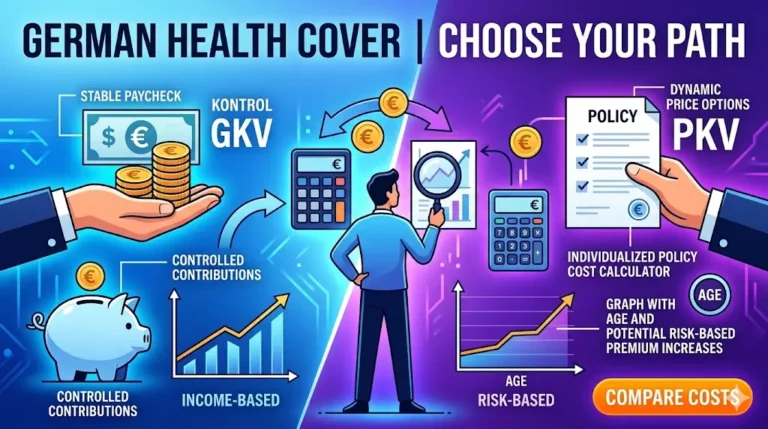
Unlike standard employees who are mandatorily enrolled in the public health insurance system, self-employed individuals in Germany face a monumental choice: remain voluntarily in the public system (Gesetzliche Krankenversicherung – GKV) or switch to a private provider (Private Krankenversicherung – PKV).
If you choose the public system, your monthly premium is calculated as a flat percentage (roughly 14.6% plus supplemental fees) of your total business profit. Because there is no employer to cover 50% of the cost, you must pay the entire premium yourself. For highly profitable entrepreneurs, this means paying the absolute maximum statutory premium, which easily exceeds €900 per month.
Because of this immense cost, many young, healthy expat founders immediately pivot to private health insurance. PKV premiums are calculated based on your age and health status upon entry, rather than your business profit. This can result in drastically lower monthly premiums during the critical early years of a startup. However, private premiums scale aggressively as you age, and returning to the public system later in life is notoriously difficult.
Pension Planning and Long-Term Wealth
When you transition from an employee to a founder, you exit the German statutory pension system. While a few highly specific freelance professions (like artists, midwives, and teachers) must remain in the public scheme, the vast majority of commercial founders and IT consultants are entirely exempt from mandatory state pension contributions.
This exemption provides a massive immediate boost to your startup’s cash flow, as you are no longer surrendering 18.6% of your income to the state. However, it shifts the entire burden of avoiding old-age poverty squarely onto your own shoulders. A business owner must proactively build their own private retirement infrastructure. Relying entirely on the future sale of your business to fund your retirement is a high-risk gamble.
Savvy expat entrepreneurs consistently divert a portion of their untaxed surplus revenue into global capital markets. By opening an account with a sophisticated, low-cost international brokerage like Interactive Brokers, founders can systematically purchase diversified ETFs and global equities. Interactive Brokers offers unparalleled market access and extremely low execution fees, allowing your corporate wealth to compound independently of your business operations. For a complete blueprint on structuring this long-term security, deeply explore Investing and Saving in Germany: Building Wealth as an Expat.
Conclusion
Starting a business in Germany is a rigorous but ultimately highly rewarding endeavor that requires precise administrative execution. Choosing the correct legal entity—whether shielding your assets with a UG or operating agilely as a Freiberufler—sets the entire financial trajectory of your enterprise.
By respecting the strict bureaucratic registration processes, securing your digital operations with NordVPN, and actively optimizing your daily cash flow with modern financial tools like N26 and Wise, you can neutralize the heavy German bureaucracy. Furthermore, recognizing that you are now entirely responsible for your own health insurance and utilizing platforms like Interactive Brokers to build independent wealth ensures that your startup success translates directly into lifelong financial security in the heart of Europe.
References
Primary sources (official)
- Federal Ministry for Economic Affairs and Climate Action (BMWK): Official federal portal providing extensive, authoritative guidance on founding a business, choosing legal structures, and securing state funding. https://www.existenzgruender.de/EN/Home/home_node.html
- Federal Central Tax Office (BZSt): Official documentation regarding VAT registration (USt-IdNr), the ELSTER portal, and corporate tax compliance. https://www.bzst.de/EN/Home/home_node.html
Other helpful sources
- Make it in Germany: The official government platform for international professionals, offering specific step-by-step checklists for expats setting up commercial trades or liberal professions. https://www.make-it-in-germany.com/en/working-in-germany/setting-up-business
- IHK (Chamber of Commerce and Industry): The central hub for regional trade regulations, mandatory membership fee structures, and specialized startup consulting services. https://www.ihk.de/
Disclaimer
The information provided in this article is for general informational and educational purposes only and does not constitute professional legal, tax, or financial advice. German corporate law, tax regulations, VAT compliance thresholds, and bureaucratic procedures are highly complex and subject to continuous legislative updates. The distinction between a Gewerbe and a Freiberufler is strictly determined by the local Finanzamt and carries severe retroactive financial implications if incorrectly assessed. Always consult directly with a certified Steuerberater (tax advisor), a corporate notary (Notar), or a specialized business attorney before formally incorporating an entity or commencing commercial operations in Germany.