Cathedrals and Churches of Germany
Navigating Germany's incredible landscape of ancient cathedrals and charming village churches can feel a bit daunting, especially when you're first figuring out the ropes of expat life or planning a focused trip. It's not just about seeing pretty buildings; it's about connecting with centuries of history, art, and the very soul of this country. This guide is here to cut through the confusion, offering a deep dive into the magnificent sacred spaces that tell Germany's story, helping you appreciate their grandeur, understand their history, and plan your visits like a seasoned pro.
Disclosure: This post may contain affiliate links. We may earn a commission at no extra cost to you if you make a purchase through these links. Read full disclosure.
A Walk Through German Church History: From Romanesque Roots to Modern Marvels
Germany's religious architecture is a tangible timeline of its past, reflecting shifts in power, belief, and artistic expression. From the stoic fortresses of early Christianity to the soaring pinnacles of Gothic ambition and the exuberant theatrics of Baroque, each era left an indelible mark. Understanding these styles isn't just for art historians; it genuinely enhances your appreciation as you step inside these hallowed halls.
Romanesque Grandeur: Enduring Fortresses of Faith
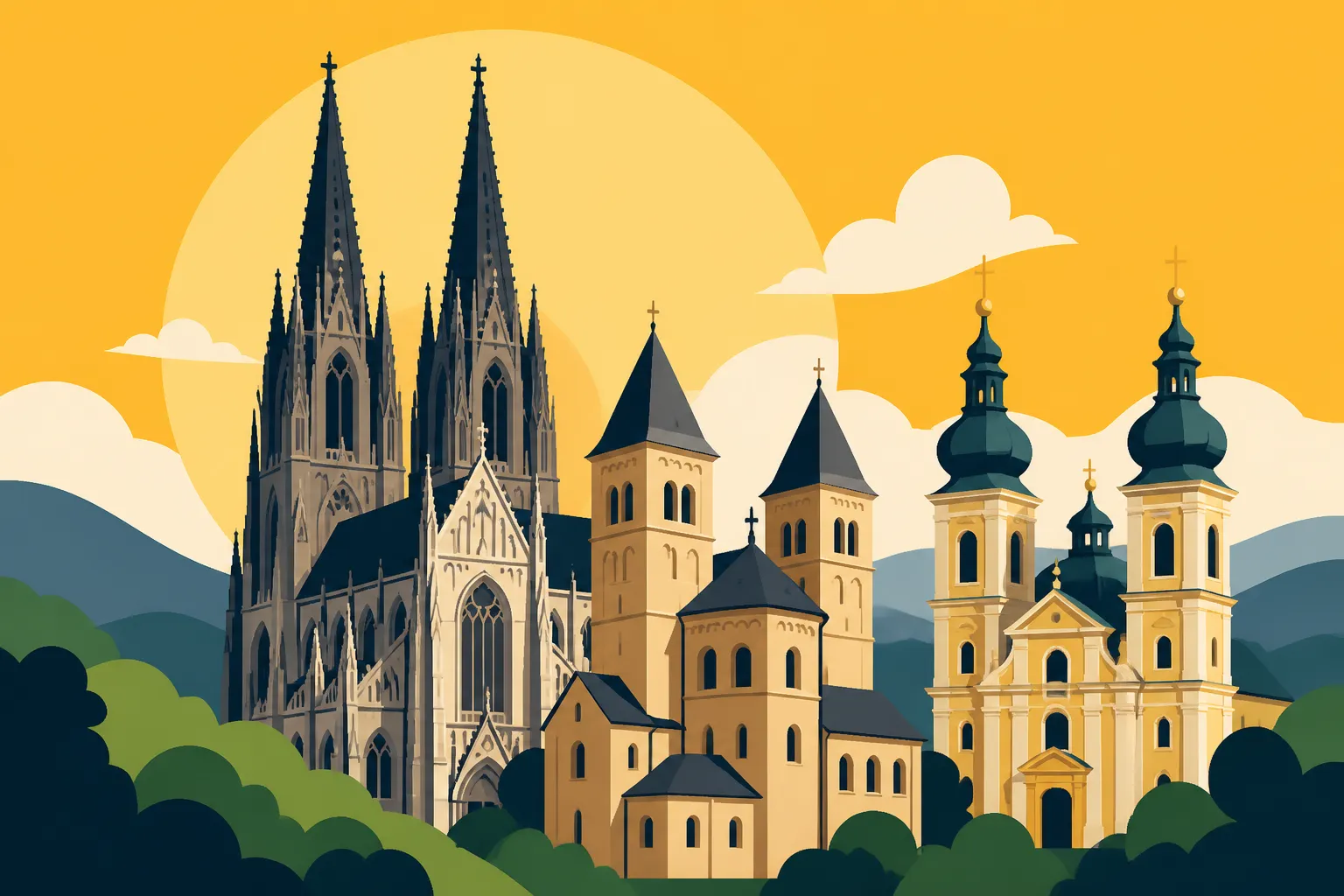
Imagine stepping back a thousand years. The Romanesque period, roughly from the 10th to the mid-13th century, was an age of emerging stability after centuries of upheaval. The churches built during this time were designed to impress, yes, but also to endure. They feel like massive stone fortresses, solid and unyielding, reflecting the turbulent times and the unwavering strength of the church. Think thick, heavy walls that could withstand a siege (or at least provide a sense of impregnable security), small, round-arched windows that let in limited, diffused light, and imposing, often multiple, towers that dominated the skyline. Inside, the spaces are typically quite dark, making the light that does filter through feel almost sacred. The low, round arches and barrel vaults create a sense of profound solidity and introspection.
These cathedrals, often built in strategic locations, were more than just places of worship; they were centers of political power, pilgrimage, and learning. For instance, the Imperial Cathedrals of Speyer, Mainz, and Worms along the Rhine are prime examples. Speyer Cathedral, a UNESCO World Heritage site, is particularly breathtaking. Walking through its immense nave, you can practically feel the weight of history, imagining emperors and bishops processing through its solemn spaces. Mainz Cathedral, with its distinctive red sandstone, and Worms Cathedral, famous for its association with Martin Luther, share this sense of enduring, powerful majesty. Visiting them is a powerful reminder of how deeply faith was intertwined with governance and society during the Holy Roman Empire, a far cry from the secular nature of much of modern German life. It's a stark, grounding experience that truly makes you feel like you've stepped into another epoch.
Gothic Spires Touching the Sky: The Age of Light and Height
Fast forward a couple of centuries, and suddenly, everything changes. The Gothic era, beginning in the mid-13th century and lasting into the 16th century, was a revolution in architecture. After the Romanesque period, builders yearned for more light, more height, and a greater sense of the divine reaching upwards. This ambition led to groundbreaking innovations like pointed arches, which could bear more weight than round ones, allowing for thinner walls. Then came ribbed vaults, which distributed the ceiling's immense weight more efficiently, and the truly ingenious flying buttresses – external supports that allowed builders to push walls ever higher and pierce them with vast windows. These windows, filled with dazzling stained glass, transformed the interior into a kaleidoscope of colored light, often depicting intricate biblical stories that illiterate congregants could "read."
The most famous example, of course, is Cologne Cathedral. Its twin spires, which took over 600 years to complete, dominate the city's skyline, an undeniable symbol of German perseverance and architectural ambition. Standing inside, your gaze is drawn inexorably upwards, a deliberate design choice meant to inspire awe and a sense of God's omnipresence. But it’s not just Cologne. Ulm Minster boasts the tallest church spire in the world, offering incredible panoramic views if you're brave enough to climb its dizzying heights. Freiburg Minster, with its delicate lacework spire, is another stunning testament to Gothic artistry. These buildings represent generations of dedicated craftsmanship, where entire families might have contributed to their construction over centuries. The sheer scale and intricate detail can be overwhelming, but in the best possible way, leaving you pondering the human capacity for devotion and engineering.
Baroque and Rococo Opulence: A Celebration of the Divine
After the solemnity of the Gothic era, and in the wake of the Reformation and the subsequent Counter-Reformation, came an explosion of color, light, and dramatic flair: the Baroque (early 17th to mid-18th century) and its even more playful successor, Rococo (mid-18th century). If Gothic churches drew you heavenward, Baroque and Rococo churches sought to engulf you in a celestial vision on earth. They are characterized by elaborate ornamentation, often reaching dizzying heights of intricacy. Think vibrant ceiling frescoes that create illusions of open sky and angels floating above, lavish use of gold leaf, dynamic and undulating forms in altars and pulpits, and an overwhelming sense of emotional intensity. Every surface seems to dance with cherubs, saints, and rich, swirling patterns.
These churches were often commissioned by powerful prince-bishops or monastic orders who wanted to display the glory and wealth of the Catholic Church. They stand in stark contrast to the more austere Protestant churches that emerged from the Reformation. The Würzburg Residence Chapel, a part of the UNESCO-listed Würzburg Residence, is an incredible example of this style, almost a jewel box of Baroque artistry. Another unmissable site is the Wieskirche (Pilgrimage Church of Wies), nestled in a picturesque Bavarian meadow. This UNESCO site epitomizes Rococo brilliance, designed to evoke wonder and joy in pilgrims. St. Michael's Church in Munich, a grand Jesuit church, also showcases the imposing grandeur of the early Baroque style. Walking into one of these churches can be a genuinely overwhelming experience, a feast for the senses that speaks to a very different, more flamboyant, approach to expressing faith. You can’t help but be swept up in the sheer, unadulterated beauty and the feeling of divine celebration that permeates every corner.
Protestant Simplicity and Modern Interpretations
The Reformation fundamentally altered the landscape of German church architecture. Protestant theology emphasized the spoken word of God and a more direct, less mediated relationship with the divine. Consequently, many Protestant churches, especially after the initial period of iconoclasm, moved away from the lavish ornamentation of their Catholic counterparts. While still beautiful, the focus shifted to the pulpit as the central element, with simpler aesthetics and clearer lines. The light in these churches is often less stained and more natural, designed to illuminate the congregation and the preaching.
A poignant example of Protestant resilience and reconstruction is the Frauenkirche in Dresden. Utterly destroyed during World War II, its painstaking reconstruction, completed in 2005, stands as a powerful symbol of hope and reconciliation. While historically Baroque, its present form, built from salvaged stones and new ones, embodies a modern spirit of remembrance and renewal. Similarly, the Kaiser Wilhelm Memorial Church in Berlin offers a stark visual dialogue between the past and present. Its bombed-out spire serves as a poignant war memorial, juxtaposed with a striking modern church building, a hexagon of blue glass and concrete. Many local Stadtkirchen (city churches) across Germany also reflect a blend of historical styles, adapted and simplified over centuries. These modern and reconstructed churches show how faith continues to find expression in new forms, blending tradition with contemporary design, or rising from the ashes of devastation to tell new stories.
Beyond the Big Names: Hidden Gems and Local Treasures
While the grand cathedrals draw headlines, Germany's true charm often lies in its myriad smaller, lesser-known churches. These local treasures offer a more intimate glimpse into regional history and community life, often providing unexpected moments of beauty and tranquility away from the bustling tourist paths.
Village Churches and Their Unique Charms
One of the real joys of exploring Germany is stumbling upon a charming, ancient village church. These aren't the towering cathedrals of the big cities; rather, they are often medieval, Romanesque, or early Gothic structures, built from local stone or brick, nestled into picturesque landscapes. They might be humble on the outside, but step inside, and you'll frequently find a trove of local history and artistry. Think intricately carved wooden altars, unique frescoes that have survived centuries, or a quiet simplicity that speaks volumes. These churches often served as the spiritual and social heart of a community for hundreds of years.
Imagine driving through Bavaria or along the Romantic Road and pulling over in a tiny village you’ve never heard of. You might discover a tiny church with a peeling fresco depicting a local saint, or an exquisitely carved pulpit from the 17th century. These are the places where you connect with Germany's deep historical roots, not just its major monuments. You'll often find that the doors are unlocked during the day, inviting quiet contemplation. It's a truly authentic experience, far from any crowds, where you can simply sit, absorb the silence, and imagine the countless generations who have worshipped in that very spot. These aren't typically on the main tourist routes, but if you're exploring the German countryside, especially through a leisurely road trip, keep an eye out for these unexpected jewels.
From Monastery to Museum: Churches with New Lives
Germany also has a fascinating array of former monasteries and churches that have found new purposes over the centuries. Wars, secularization, and changing demographics have often meant that religious buildings, no longer needed for worship, have been repurposed, sometimes dramatically. Many have become museums, cultural centers, or even unique hotels, allowing their architectural grandeur and historical significance to live on. This adaptive reuse is a testament to Germany's commitment to preserving its heritage, even if it means transforming a sacred space into something new.
A prime example is the Maulbronn Monastery, another UNESCO World Heritage site. This Cistercian monastery in Baden-Württemberg is one of the best-preserved medieval monastic complexes north of the Alps. While it no longer functions as an active monastery, its various buildings, including the church, cloisters, and workshops, are open to the public, offering a vivid insight into monastic life in the Middle Ages. You can walk through the refectory, imagine the monks chanting in the chapter house, and admire the intricate stone carvings. Similarly, throughout cities like Berlin or Leipzig, you’ll find former churches that have been converted into concert venues, art galleries, or community spaces. These transformations allow the public to experience the beauty of these buildings from a different perspective, highlighting their architectural merit and their continued relevance in contemporary society. It's a brilliant way to keep these structures alive and accessible.
Understanding Regional Differences in Church Architecture
Germany is a country of distinct regions, each with its own history, traditions, and even building materials. This regionalism is beautifully reflected in its church architecture. You wouldn't expect a church in the flat, northern plains to look exactly like one nestled in the Bavarian Alps, and indeed, they don't. These differences are a direct result of available resources, historical influences, and local patrons' preferences.
For instance, in Northern Germany, especially along the Baltic coast and into Brandenburg, you'll encounter numerous examples of "Brick Gothic" (Backsteingotik). Lacking natural stone, medieval builders in these regions became masters of brick, creating magnificent cathedrals and churches with intricate patterns and towering facades using only fired clay. Lübeck's Marienkirche, a stunning example, was a pioneering work of Brick Gothic and served as a model for many other churches in the Hanseatic League cities. Its rich, red brickwork creates a powerful visual contrast to the grey stone cathedrals of the Rhine. Down in Bavaria, on the other hand, you'll find a distinct concentration of opulent Baroque and Rococo churches, often painted in pastel colors with bright, airy interiors. This was largely due to the region's strong Catholic identity and the influence of powerful princely families and wealthy monasteries who favored these exuberant styles. Think of the intense gold and swirling frescoes common in the churches around Munich or the famous Wieskirche mentioned earlier. Exploring these regional variations offers a richer, more nuanced understanding of Germany's architectural tapestry, making each church visit a unique discovery.
Practical Tips for Visiting Germany's Sacred Spaces
Visiting churches and cathedrals in Germany is generally a welcoming experience, but a little preparation and cultural awareness can go a long way in ensuring a smooth and respectful visit. Remember, while these are often major tourist attractions, they are first and foremost active places of worship for many.
Respectful Etiquette and Cultural Norms
It's easy to get carried away with sightseeing, but when you step into a church or cathedral, it's essential to remember you are entering a sacred space. This isn't just a museum, even if it feels like one sometimes. General respect means a few simple things. Firstly, dress modestly. While there are rarely strict dress codes, especially in major cities, covering your shoulders and knees is always a good idea. Leave the beachwear for the beach. Secondly, keep your voice down. Even if you're excited, remember that others might be praying or simply seeking quiet contemplation. Children should also be encouraged to be quiet. Thirdly, photography rules vary. Always look for signs. Many places allow photography without flash, but some ban it entirely, especially during services. Certain areas, like altars or specific art pieces, might be off-limits. Using your flash is almost universally frowned upon, as it can damage delicate artworks and is generally disruptive.
It’s also important to distinguish between visiting as a tourist and attending a service. If you happen to visit during a Mass or a worship service, you are generally welcome to sit quietly in the back, but do not walk around, take photos, or disrupt the proceedings. If your primary goal is sightseeing, try to time your visit outside of service hours. It can feel a bit awkward at first, trying to balance your curiosity with being respectful, especially if you're not religious yourself, but a little thoughtfulness goes a long way. Germans generally appreciate quiet decorum in these settings.
Best Times to Visit and Avoiding Crowds
Nobody enjoys battling throngs of tourists to catch a glimpse of a centuries-old fresco. To make the most of your visit, timing is key. Generally, the earliest hours of the morning (shortly after opening) or later in the afternoon (an hour or two before closing) are the best times to experience these grand buildings with fewer crowds. Mid-day, especially during peak tourist season (summer and around Christmas markets), tends to be the busiest.
Weekdays are almost always less crowded than weekends. Sundays, of course, are when most churches hold their main services, so if you're solely there for sightseeing, it's best to avoid Sunday mornings altogether, unless you specifically wish to attend a service. Also, be mindful of major religious holidays like Easter or Christmas. While many churches will have special events or decorations, they will also be extremely busy with congregants. If you’re visiting a particularly popular site, consider if a guided tour is available via a platform like GetYourGuide. These tours often offer insights you wouldn't get on your own and sometimes have specific entry times that help manage the flow. Check their websites in advance for opening hours, service schedules, and any special events.
Accessibility and Facilities for Visitors
Germany is generally quite good about accessibility, but with ancient buildings, it's a mixed bag. Many larger cathedrals, especially those that have undergone modern renovations or are major tourist draws, often have ramps or lifts to provide access for wheelchair users or parents with pushchairs to the main nave. However, exploring smaller side chapels, crypts, or climbing towers (like in Ulm or Cologne) will almost certainly involve stairs and won't be accessible. It’s always best to check the specific church's website beforehand if accessibility is a concern.
Regarding facilities, most major cathedrals and larger churches will have restrooms (sometimes requiring a small fee, which is typical in Germany), gift shops selling postcards, guidebooks, and religious items, and sometimes small cafés or refreshment stands. Information desks are also common, where you can often pick up brochures in multiple languages. For smaller village churches, facilities will be much more limited, so plan accordingly. Don't expect English-speaking staff in every village church, but even a few words of German can help you feel more comfortable if you need to ask a question. Learning some basic German phrases, perhaps from resources like German Language and Everyday Communication for Visitors, can significantly enhance your experience.
Planning Your Church and Cathedral Tour of Germany
Germany's sheer number of magnificent churches means you can easily tailor a trip to focus on specific architectural styles, regions, or themes. Whether you prefer the efficiency of public transport or the freedom of a rental car, a bit of planning will ensure you make the most of your sacred journey.
Crafting Your Itinerary: Major Hubs and Routes
Deciding where to focus your attention is the first step. If you're passionate about Romanesque architecture, consider the "Romanesque Road" in Saxony-Anhalt, a defined route that links over 80 churches, cathedrals, and monasteries from that era. Alternatively, the Imperial Cathedrals along the Rhine (Speyer, Mainz, Worms) form another excellent, concentrated Romanesque itinerary. For Gothic grandeur, Cologne is a must-see, but coupling it with a visit to Ulm and Freiburg will give you a broader appreciation. If Baroque and Rococo opulence is your calling, Bavaria is your playground, with Munich, Passau, and the surrounding countryside (home to Wieskirche and Ottobeuren Abbey) offering an abundance of spectacular examples.
Consider combining cities with rich architectural heritage. Cologne, with its iconic cathedral, is also home to a dozen stunning Romanesque churches within its city limits, making it a fantastic hub. Trier, Germany's oldest city, boasts impressive Roman monuments alongside its cathedral. Munich offers a blend of Baroque, Gothic, and modern churches. Berlin, while not traditionally known for its ancient cathedrals, provides interesting examples of Protestant churches and significant modern reconstructions like the Kaiser Wilhelm Memorial Church. You can efficiently travel between these cities by train or bus. Platforms like Omio are incredibly useful for comparing and booking train and bus tickets across Germany, helping you piece together an efficient itinerary. For more general travel insights, check out Getting Around Germany: Trains, Buses, Flights, and Car Hire.
Accommodation and Nearby Attractions
When planning your church and cathedral tour, think about how these visits fit into your broader travel plans. Staying in larger cities like Cologne, Munich, Berlin, or Dresden not only puts you close to major architectural highlights but also offers a wealth of other attractions. You can spend your mornings exploring sacred spaces and your afternoons delving into art museums, historical sites, or simply enjoying the local culture. For example, a visit to the Frauenkirche in Dresden can be combined with exploring the historic city center and the Zwinger Palace. In Regensburg, a UNESCO World Heritage city, its stunning Gothic cathedral stands proudly amidst a beautifully preserved medieval old town.
Finding suitable accommodation is crucial for making your trip enjoyable. Websites like Booking.com are fantastic for finding everything from quaint guesthouses in historic towns to modern hotels in bustling city centers, allowing you to choose places that are conveniently located for your planned visits. Don't forget to look into Accommodation in Germany: Hotels, Pensionen, and Hostels for different options. Furthermore, many of Germany's significant churches are part of larger historical complexes or are situated in areas with other attractions. For instance, after marveling at a cathedral, you might find yourself exploring a nearby castle, a charming market square, or a regional museum. This integrated approach not only enriches your experience but also makes for more efficient travel, whether you're taking Day Trips and Weekend Getaways Across Germany or planning a longer journey.
| Architectural Style | Period (Approx.) | Key Characteristics | Representative Examples |
|---|---|---|---|
| Romanesque | 10th – 13th C. | Thick walls, round arches, barrel vaults, massive towers, limited light, heavy, fortified appearance. | Speyer Cathedral, Mainz Cathedral, Worms Cathedral |
| Gothic | 13th – 16th C. | Pointed arches, ribbed vaults, flying buttresses, large stained-glass windows, verticality, light and airy interiors. | Cologne Cathedral, Ulm Minster, Freiburg Minster |
| Baroque | 17th – mid-18th C. | Ornate decoration, frescoes, gold leaf, dynamic forms, emotional intensity, grand scale, opulent. | St. Michael's Church (Munich), Würzburg Residence Chapel, Passau Cathedral |
| Rococo | mid-18th C. | Even lighter, more playful and intricate than Baroque, delicate ornamentation, pastel colors, natural motifs. | Wieskirche, Ottobeuren Abbey |
| Modern | 20th C. onwards | Innovative materials (concrete, glass), minimalist or unconventional designs, focus on function, symbolic reconstruction. | Kaiser Wilhelm Memorial Church (New), Frauenkirche (Dresden – reconstructed) |
Disclaimer
Please remember that while we strive to provide the most accurate and up-to-date information, circumstances in Germany, particularly regarding opening hours, accessibility, or specific regulations for religious sites, can change. It is always advisable to check the official websites of the specific churches or cathedrals you plan to visit before your trip. This guide is for informational purposes only and does not constitute official travel advice.