How to Order Beer in Germany Like a Local
Entering a German Brauhaus for the first time can feel like walking onto a stage without a script. You see the massive wooden barrels, hear the clinking of heavy glass, and notice the waitstaff moving with a level of efficiency that borders on intimidating. Most foreigners make the mistake of assuming a beer is just a beer, only to be met with a confused look or a lecture on regional traditions. This guide solves the social friction of the German beer scene, ensuring you order the right brew, in the right glass, with the right etiquette to earn the respect of the locals.
Disclosure: This post may contain affiliate links. We may earn a commission at no extra cost to you if you make a purchase through these links. Read full disclosure.
Understanding Regional Varieties: The What Before the How
Before you even open your mouth to order, you need to understand that beer in Germany is fiercely regional. If you try to order a Southern-style wheat beer in a traditional Cologne pub, you might as well be asking for a glass of tap water. The first rule of ordering like a local is knowing what belongs on the table in front of you. Germany’s brewing tradition is governed by the Reinheitsgebot (Purity Law), but the output varies wildly as you move across the map.
Southern Classics: Helles and Weissbier
In Bavaria and much of southern Germany, the "Helles" is the undisputed king. This is a pale lager, mild, malty, and incredibly easy to drink. When you sit down in a Munich beer garden, if you simply ask for "ein Bier," this is likely what you will get. It is usually served in a half-liter glass or a full-liter "Maß." I remember my first week in Munich, thinking I was being adventurous by looking for a craft IPA, only to have a local tell me that the Helles has been perfected over centuries, so why fix what isn't broken?
Then there is the Weissbier (wheat beer). This is a cloudy, top-fermented brew that is almost a meal in itself. There is a very specific way to pour this—the bottle is tilted, and the last bit of yeast is swirled and dumped on top to create a massive, creamy head. If you are staying in a southern city, perhaps booked via Booking.com to be near the historic center, you’ll notice locals drinking Weissbier primarily before noon or with a hearty lunch of Weisswurst. It is a social beer, meant for slow sipping and deep conversation.
The Northern and Central Pilsner Dominance
As you travel north, the beer gets crispier and more bitter. The German Pilsner is the standard here. It has a much stronger hop profile than the Southern Helles. In cities like Hamburg or Berlin, the pour is a serious matter. A proper Pilsner takes time to pour because the head must be firm and perfectly formed. If you’re using Omio to navigate the rail lines from Munich up to Hamburg, the shift in beer culture is one of the first things you’ll notice.
The glasses get smaller as the bitterness increases. While a Bavarian might scoff at anything smaller than a half-liter, Northern Germans often enjoy a 0.3-liter pour. This ensures the beer stays cold and carbonated until the very last drop. Ordering a "Pils" is a safe bet anywhere in the north, but don't expect the malty sweetness of the south; this is a sharp, refreshing drink meant to cut through the salt of northern seafood or heavy meat dishes.
The Specialty Cities: Cologne and Düsseldorf
This is where things get truly specific—and where you can most easily out yourself as a tourist. Cologne is famous for Kölsch, a light, clear beer served in a thin, cylindrical 0.2-liter glass called a "Stange." In Cologne, the waiters (called Köbes) will keep bringing you fresh glasses without you asking until you place your coaster on top of your glass to signal you are finished.
Just a short train ride away in Düsseldorf, they drink Altbier. It is darker, copper-colored, and has a nutty, hoppy finish. There is a legendary rivalry between these two cities. Never order a Kölsch in Düsseldorf or an Altbier in Cologne. It’s a cultural faux pas that will immediately mark you as someone who hasn't done their homework. For a deep dive into these local nuances, you might want to look at German Beer Culture: Styles, Beer Gardens, and Breweries to understand why these traditions are so fiercely guarded.
The Etiquette of the Order: From Bitte to the Bill
Ordering beer in Germany is less about the words you use and more about the non-verbal cues you give. It is a functional transaction. The staff in a busy Brauhaus are not there to be your best friend; they are there to ensure no one has an empty glass. To order like a local, you need to be direct, use the correct terminology, and understand the "silent" contract you enter when you sit down.
Essential Phrases and Vocabulary
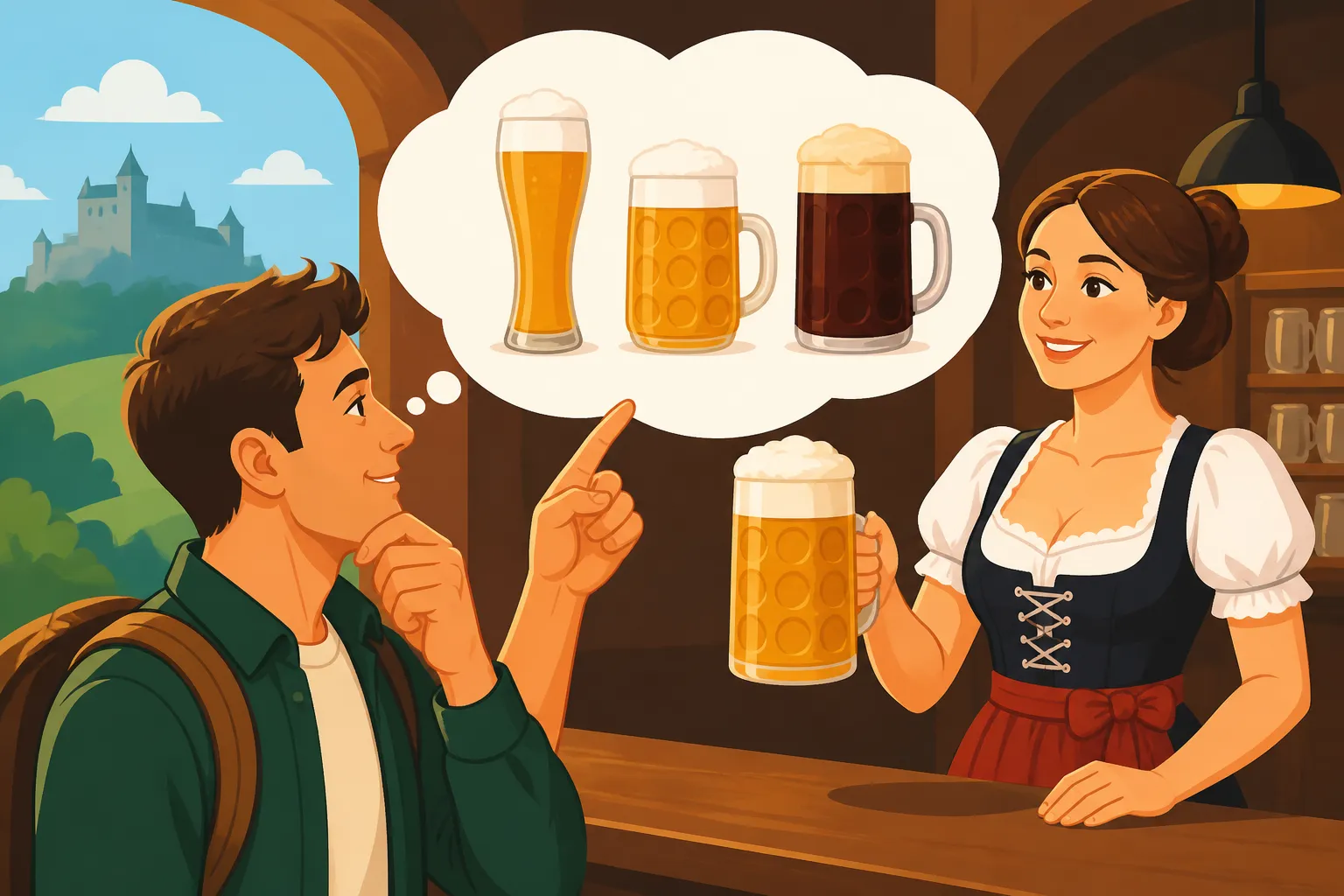
You don’t need to be fluent in German to order beer, but a few key phrases will save you from being ignored. The most basic order is "Ein Bier, bitte" (One beer, please). However, it is better to be specific. "Ein Helles, bitte" or "Ein Pils, bitte" shows you know the menu. If you are with a friend, you might say "Zwei Halbe" (Two halves—referring to half-liter pours).
One of the most important things to remember is the use of the word "bitte." It isn't just "please"; it’s a universal lubricant for social interactions. When the waiter brings your drink, they will say "Bitte," and you should respond with "Danke." If you want another round, you catch the waiter’s eye and say, "Noch eins, bitte." Efficiency is the goal. For more tips on navigating these interactions, check out German Social Etiquette for Visitors: Greetings and Punctuality to ensure you're striking the right tone with the staff.
The Concept of the Deckel (Coaster)
In traditional German pubs, especially in the Rhineland and Bavaria, your beer mat (the Bierdeckel) is your tab. Every time the waiter brings a beer, they will make a pencil mark on your coaster. This is a sacred system of trust. Do not doodle on your coaster, and certainly do not lose it. When it’s time to leave, the waiter will count the tally marks and tell you the total.
This system is designed for speed. It allows the waiter to serve dozens of tables without ever needing to go back to a central computer or cash register to "open a tab." It is also why you should always keep your coaster visible. If it's tucked under a plate or hidden in your hand, you're disrupting the flow of the room. This system is a great example of the practical nature of German life, which you can read more about in German Dining Etiquette: Eating Out, Tipping, and Table Manners.
When and How to Signal for a Refill
In many traditional spots, silence equals consent. If your glass is empty, a fresh one will often appear automatically. This is especially true in Cologne. If you don't want another beer, you must place your coaster on top of the glass. In other regions, like the massive Beer Gardens and Beer Halls in Germany, you might need to be more proactive.
A simple raised hand or a nod to the waiter is usually enough. Do not shout "Kellner!" or snap your fingers; it is considered incredibly rude. If you are in a self-service area of a beer garden (usually marked by "Selbstbedienung" signs), you simply take your glass back to the counter. Remember that many places still prefer physical currency, so it’s wise to read up on Cash vs Card in Germany: What Visitors Should Know before you head out for the evening.
Navigating the Beer Garden vs. The Kneipe
Where you drink is just as important as what you drink. The atmosphere and rules of a Munich beer garden are worlds apart from a smoky neighborhood Kneipe (pub) in Berlin. Understanding the geography of the space will help you blend in and avoid the "clueless tourist" label.
Self-Service vs. Table Service
In the massive beer gardens of the south, the space is often divided. If you see tablecloths, that area is likely table service, and you should wait to be seated or wait for a waiter to approach. The areas with bare wooden benches are usually self-service. Here, you'll go to a central hatch to get your beer and food. If you're planning a trip to a famous spot like the Hofbräuhaus, you can find great guided experiences on GetYourGuide that explain these layouts in detail.
In a Kneipe, it is almost always table service, but the vibe is much more informal. You find a spot, sit down, and the waiter will find you. If the place is packed, it is perfectly acceptable—even expected—to share a table. You simply ask, "Ist hier noch frei?" (Is this spot free?), and sit down. You don't need to engage in small talk with your tablemates, but a polite nod is standard.
Sharing Tables and Prosing (The Toast)
Shared seating is one of the best parts of German beer culture. It breaks down social barriers. However, there is a very strict ritual for the "Prost" (the toast). When you clink glasses, you must make eye contact with the person you are toasting. Failing to do so is famously said to bring seven years of bad luck in the romance department.
Also, avoid clinking the tops of the glasses, especially with Weissbier glasses, which are thin at the rim. Clink the heavy bottoms instead. If you're at a large table, you don't need to clink with everyone individually; a general "Prost!" to the group while raising your glass is sufficient. This is a common sight at Oktoberfest in Munich: A First-Timer's Guide, where the sheer volume of people makes individual toasting impossible.
Dealing with Pfand (Glass Deposits)
In many beer gardens and outdoor festivals, you will pay a "Pfand" (deposit) on your glass. This is usually a Euro or two added to the price of the beer. When you finish, you return the glass to the "Pfandrückgabe" (deposit return) counter to get your coin back, or you might get a plastic token (Pfandmarke) when you buy the beer that you must return with the glass.
Newcomers often leave their glasses on the table, effectively throwing away a couple of Euros and annoying the staff who have to clear them. If you’re trying to stay on a budget, these small amounts add up. For more ways to manage your money while traveling, you might want to look at some German Souvenirs Worth Buying (and What to Skip) to see where else your Euros might go.
| Region | Popular Beer Style | Standard Glass Size | Serving Tradition |
|---|---|---|---|
| Bavaria (Munich) | Helles / Weissbier | 0.5L (Halbe) or 1.0L (Maß) | Relaxed, often self-service in gardens |
| Cologne | Kölsch | 0.2L (Stange) | Automatic refills until stopped |
| Düsseldorf | Altbier | 0.2L or 0.25L | Served in traditional Brauhaus settings |
| Berlin / North | Pilsner | 0.3L or 0.5L | High emphasis on a "clean" pour and head |
| Frankfurt | Apfelwein (Cider) | 0.3L (Geripptes) | Served in "Bembel" stone jugs for groups |
Technical Details and Practical Information
Finally, let’s talk about the logistics. The German beer experience is highly regulated and incredibly consistent. Knowing the "specs" of what you’re drinking will help you pace yourself and avoid a massive hangover the next morning.
Glass Sizes and Measurements
German law is very strict about pouring. Every beer glass has an "Eichstrich" (calibration mark). The liquid must reach this line. If your beer is mostly foam and the liquid is significantly below the line, you are legally entitled to ask for a top-up. However, wait a minute for the foam to settle before you complain; the foam is a sign of a fresh, properly pressurized pour.
The sizes are standard:
- 0.2L / 0.25L: Typical for Kölsch or Altbier.
- 0.3L: A common small Pilsner or "Tulpe."
- 0.5L: The "Halbe," the standard size for most of Germany.
- 1.0L: The "Maß," mostly found in Bavarian beer halls and during festivals.
Alcohol Content and the Radler Alternative
Most German lagers and pilsners sit between 4.8% and 5.2% ABV. Weissbier can be a bit higher, often around 5.4%. While this sounds standard, the "drinkability" of German beer means it goes down much faster than heavy craft ales.
If you want to slow down or if it’s a hot afternoon, do what the locals do: order a Radler. This is a 50/50 mix of beer and sparkling lemon soda. It is incredibly refreshing and socially acceptable for everyone from hikers to grandmas. In the north, it’s sometimes called an Alsterwasser. It’s a great way to stay hydrated if you have a busy day of sightseeing ahead. Just keep in mind that on certain days, like Sundays, your options for buying backup drinks might be limited; see What Closes on Sundays in Germany? for more on that.
When you’re ready to wrap up your session, you’ll need to flag down the waiter one last time. Catch their eye and say, "Zahlen, bitte" (Pay, please). They will come to your table, tally up your Bierdeckel, and give you the total. At this point, you should be ready to tip. A few coins or rounding up to the next even Euro is standard for drinks. For a more detailed breakdown of the math, check out How to Ask for the Bill in a German Restaurant.
Disclaimer
This guide is for informational purposes only. Alcohol consumption should be handled responsibly and in accordance with local German laws. Brewing traditions and prices may vary by establishment and region. Always check local signage for specific house rules regarding service and payments.