How to Cross the Street in Germany (Jaywalking Norms)
You are standing at a deserted intersection in a quiet German neighborhood at 2:00 AM. There is not a single car in sight for miles, and the air is perfectly still. You step off the curb to cross against the red light, and suddenly, a sharp "Stopp!" rings out from a window above or a passerby you didn't see. This guide solves the mystery of Germany’s rigid jaywalking norms, helping you navigate the legal, social, and psychological minefields of simply crossing the street.
Disclosure: This post may contain affiliate links. We may earn a commission at no extra cost to you if you make a purchase through these links. Read full disclosure.
The Legal Reality of Crossing the Street in Germany
In many parts of the world, a red light for pedestrians is viewed as a suggestion—a data point to be weighed against the actual speed of oncoming traffic. In Germany, the red light is an absolute command. This isn't just a cultural preference; it is codified in the Straßenverkehrs-Ordnung (StVO), the German road traffic regulations. If you are caught crossing a street when the "Ampelmännchen" is red, you are committing an administrative offense.
Understanding the Bußgeldkatalog and Fines
The German legal system utilizes a comprehensive catalog of fines known as the Bußgeldkatalog. For a pedestrian, the cost of jaywalking is generally low in monetary terms but high in bureaucratic annoyance. If a police officer witnesses you crossing on red, you can expect an on-the-spot fine (Verwarnungsgeld) of approximately 5 to 10 Euros. While this might seem like a trivial amount, the process of being stopped, having your ID checked, and receiving the ticket can take twenty minutes of your day.
Furthermore, if your jaywalking causes an accident, the financial and legal stakes skyrocket. You could be held liable for damages to vehicles or injuries to others, and your personal liability insurance might refuse to pay if they determine you acted with "gross negligence." For those who are also drivers, a common expat myth is that jaywalking can lead to points on your driving license (Flensburg points). While this is rare, it is legally possible if the infraction is deemed a significant endangerment to traffic safety. This is one of the Common Cultural Surprises for First-Time Visitors to Germany that often catches people off guard.
The Iconography of the Ampelmännchen
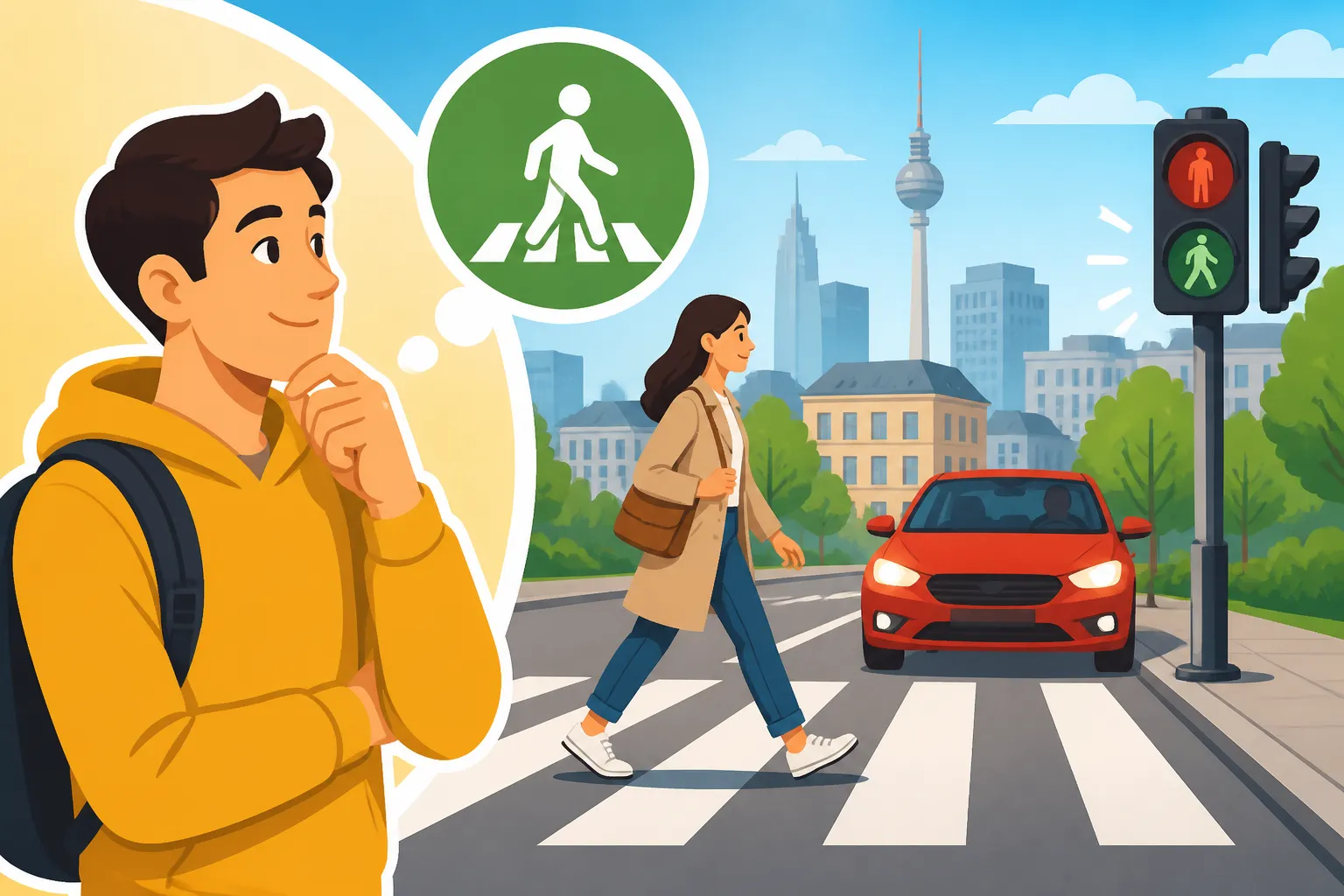
One of the most charming yet authoritative aspects of German crossings is the Ampelmännchen. In the former East Germany (DDR), the figure is a stout man wearing a brimmed hat, while the West German version is a leaner, more generic figure. After reunification, the "East" man became a cult symbol of "Ostalgie" (nostalgia for the East) and can now be found all over the country. Regardless of which version you encounter, the message is the same: the red figure is a wall, and the green figure is a door.
When you are walking between sights or heading to a meeting you booked through platforms like GetYourGuide, you will notice that even if the street is narrow and the traffic is nonexistent, Germans will wait for the green man. This isn't necessarily because they fear the 5-Euro fine. It is because the signal represents order. To a German, the light is a contract with the community. If everyone agrees to wait for the green, then the system functions predictably and safely for everyone, including the elderly and the visually impaired.
Police Presence and Enforcement Strategy
Enforcement is not consistent, which is perhaps the most frustrating part for newcomers. You might see a hundred people jaywalking in the middle of a busy shopping district in Berlin without a single officer in sight. Then, on a Tuesday morning in a quiet suburb of Munich, you might be pulled over by a patrol car for crossing a side street. The German police often conduct "traffic safety weeks" where they specifically target pedestrians and cyclists to reinforce the rules.
During these periods, they are not interested in excuses about being late for a train or a tour. They view their role as preventative. By stopping you, they believe they are preventing a future accident. If you are navigating the country and using services like Omio to catch your intercity connections, always build in an extra five minutes for "pedestrian delays." The last thing you want is to miss a high-speed train because you were held up by a lecture from a Polizeihauptmeister about the sanctity of the red light.
The Social Stigma and the Role Model Mentality
If the law doesn't scare you, the social pressure should. In Germany, public shaming is a highly effective tool for social regulation. You are much more likely to be scolded by a grandmother (Oma) than you are to be ticketed by a police officer. This stems from a deep-seated cultural belief in the "Vorbildfunktion" or the "role model function."
Protecting the Children (Vorbildfunktion)
The most common reason a German will yell at you for jaywalking is the presence of children. In German culture, every adult is seen as a collective guardian and a role model for the youth. If a child sees an adult crossing on red, the logic goes, that child will think it is safe to do so, and they may eventually be hit by a car because they lack the adult's ability to judge speed and distance.
If you cross on red in front of a child, you are not just breaking a traffic rule; you are endangering the future of the neighborhood. You will often hear a sharp "Halt!" or "Es ist rot!" directed at you. The correct response is not to argue, but to look appropriately sheepish. Arguing with a German parent about traffic safety is a battle you will never win. This is an essential part of German Etiquette and Social Life for Visitors that helps maintain the social fabric of the country.
The Dreaded Zeigefinger and Public Scolding
The "Zeigefinger" (index finger) is a powerful weapon in Germany. When someone wags it at you or points at the red light, they are asserting a moral high ground. This directness can feel aggressive to expats from more "polite" or indirect cultures, but in Germany, it is considered a civic duty to correct someone who is acting outside the norms.
You might also encounter the "Kopfschütteln" (shaking of the head) or a loud, tsk-ing sound. This is meant to signal that your behavior is "unvernünftig" (unreasonable). In the German mind, there is no logical reason to break a rule that is designed for safety. Validating these frustrations is part of being an expat; we have all felt the sting of a public correction. It’s a rite of passage, much like your first visit to the Bürgeramt.
How to React When You Get Caught
If you find yourself being scolded by a stranger, the best course of action is silence and a quick correction of your behavior. Do not try to explain that you checked both ways or that the car was a block away. Simply stop, wait for the light to turn green, and move on. Attempting to defend your jaywalking will only result in a longer, more heated lecture about the rules of the Zusammenleben (living together).
If you are a student or a new resident, understanding these nuances is as important as knowing How to Register Your Address (Anmeldung) in Germany. It shows that you respect the local culture and are willing to integrate into the orderly German way of life. Over time, you might even find yourself silently shaking your head at the next tourist who darts across the road.
Practical Tips for Navigating German Intersections
Beyond the social and legal aspects, there are mechanical realities to German streets that differ from those in the US, UK, or other European nations. Knowing how the hardware works can save you from standing at a light that will never turn green.
Understanding the Pedestrian Button
At many intersections, the light will not change unless you press a button. However, these buttons are often hidden or look different than what you might expect. Some are small, yellow boxes with a sensor on the bottom rather than a button on the front. On the bottom of these yellow boxes, there is often a small vibrating plate or a hidden button designed for the visually impaired to signal that they want to cross.
Interestingly, many Germans believe in "placebo buttons." There is a widespread urban myth that pressing the button multiple times or holding it down will make the light change faster. It won't. In many modern systems, the button simply tells the computer that a pedestrian is present, and the computer fits the pedestrian phase into the next available cycle of the traffic flow. If you have used Booking.com to find a hotel in a busy city center, you’ll likely encounter these "begging buttons" every time you step outside.
Zebra Crossings vs. Signalized Crossings
In Germany, a "Zebrastreifen" (zebra crossing) gives pedestrians the absolute right of way. Drivers are legally required to stop if they see a pedestrian even approaching the curb of a zebra crossing. This is one area where German drivers are incredibly disciplined. However, do not confuse a zebra crossing with a simple "Fußgängerfurt" (pedestrian path marked by two dashed lines).
| Type of Crossing | Right of Way | Driver Behavior |
|---|---|---|
| Zebra Crossing (Zebrastreifen) | Pedestrian has priority | Drivers will stop as soon as you step toward the curb. |
| Signalized Crossing (Ampel) | Determined by light | Drivers will not stop if their light is green, even if you are in the road. |
| Dashed Lines (Furt) | Vehicle has priority | This is merely a suggested path; drivers are not required to stop. |
| Shared Space | Equal priority | Common in "Beruhigte Zonen"; everyone must move at walking speed. |
When you are on a tour with GetYourGuide and the guide says, "Wait for the light," they mean it. German drivers expect pedestrians to follow the signals. If a driver has a green light, they will often drive through the intersection at full speed, assuming no pedestrian would be foolish enough to be in the way. They are not being aggressive; they are simply following the rules, and they expect you to do the same. This is a critical component of Staying Safe in Germany: Common-Sense Tips for Travelers.
Planning Your Routes and Travel Logistics
If you are in a rush to catch a train or bus, it is tempting to jaywalk to save thirty seconds. However, German public transport is generally very punctual, and the city layouts are designed to be walkable. Using apps like Omio can help you see the most efficient way to get from point A to point B, often reducing the need to cross major, multi-lane roads where jaywalking is most dangerous.
When you are walking, look for the "U" (U-Bahn) or "S" (S-Bahn) signs. Often, you can use the underground station tunnels to cross a busy street without ever having to wait for a surface-level light. This is a pro-tip for those rainy days in Hamburg or Berlin when the wait for the green man feels like an eternity.
Exceptions and Regional Differences
While the "no jaywalking" rule is a national trait, its application varies significantly depending on where you are. The Germany you experience in a high-tech hub like Munich is quite different from the "arm aber sexy" (poor but sexy) vibe of Berlin.
Berlin vs. Small Villages
Berlin is the great exception to almost every German rule. It is a sprawling, international metropolis where the "Vorbildfunktion" often takes a backseat to the frantic pace of city life. In neighborhoods like Neukölln or Kreuzberg, you will see plenty of Berliners jaywalking, even in front of police. There is a certain level of "Berliner Schnauze" (Berlin lip) that permeates the culture, leading to a more relaxed attitude toward minor infractions.
In contrast, if you are in a small village in Bavaria or Baden-Württemberg, the rules are ironclad. In these communities, everyone knows everyone, and your reputation is tied to your adherence to local norms. Jaywalking in a village is a quick way to be labeled as a "rücksichtsloser Fremder" (inconsiderate stranger). If you have a German Residence Permit: Your Rights and Limits and are living in a smaller town, you will find that following these small rules goes a long way in gaining the respect of your neighbors.
Nighttime and Low-Visibility Situations
At night, some traffic lights in Germany switch to a blinking yellow mode for cars and turn off completely for pedestrians. In this case, the intersection reverts to standard right-of-way rules (usually "right before left"). However, if the light is still operational, the rule remains: red means stop.
Many expats find it absurd to wait at a red light at 3:00 AM on a Tuesday with zero cars in sight. However, remember the hidden cameras and the occasional plainclothes police officer. More importantly, remember the "quiet hours" or Ruhezeit (Quiet Hours) in Germany. If you jaywalk and a car has to slam on its brakes, the resulting screech of tires is considered a major disturbance of the peace.
Shared Spaces and Modern Urban Design
In recent years, many German cities have introduced "Verkehrsberuhigte Bereiche" (traffic-calmed zones), often marked by a blue sign showing a pedestrian, a child playing ball, and a house. In these areas, pedestrians have the right of way across the entire width of the street, and vehicles must move at "Schrittgeschwindigkeit" (walking speed, usually interpreted as 4-7 km/h).
In these zones, jaywalking doesn't exist because the entire street is a pedestrian zone. Understanding these different types of street designations is a hallmark of a veteran expat. Whether you are catching an ICE train you found on Omio or just wandering back to your hotel from Booking.com, always keep an eye out for these blue signs—they are a rare haven of pedestrian freedom in an otherwise regulated landscape.
Disclaimer
The information provided in this guide is for informational purposes only and does not constitute legal advice. While we strive to keep our content accurate and up-to-date, German traffic laws and local enforcement practices can change. Always follow the instructions of local authorities and use your best judgment to ensure your safety and the safety of those around you.