How to Use the Berlin U-Bahn and S-Bahn as a Visitor
You step off the train at Berlin Hauptbahnhof, find a ticket machine covered in zone letters and fare options, and see no turnstiles anywhere. Do you need to stamp the ticket? Is the S-Bahn different from the U-Bahn? This guide covers buying the right ticket, validating it, and moving around Berlin’s rail network without getting fined.
Disclosure: This post may contain affiliate links. We may earn a commission at no extra cost to you if you make a purchase through these links. Read full disclosure.
Understanding How Berlin’s Rail Network Actually Works
My first week in Berlin, I treated the U-Bahn and S-Bahn as one system. That’s mostly correct, and it’s the most useful thing to know. The two networks share one fare system run by the regional transport association, so one valid ticket covers both, plus trams, buses and even some regional trains within your zones. The differences are about who runs the trains and where they go, not about what you pay.
U-Bahn Versus S-Bahn in Plain Terms
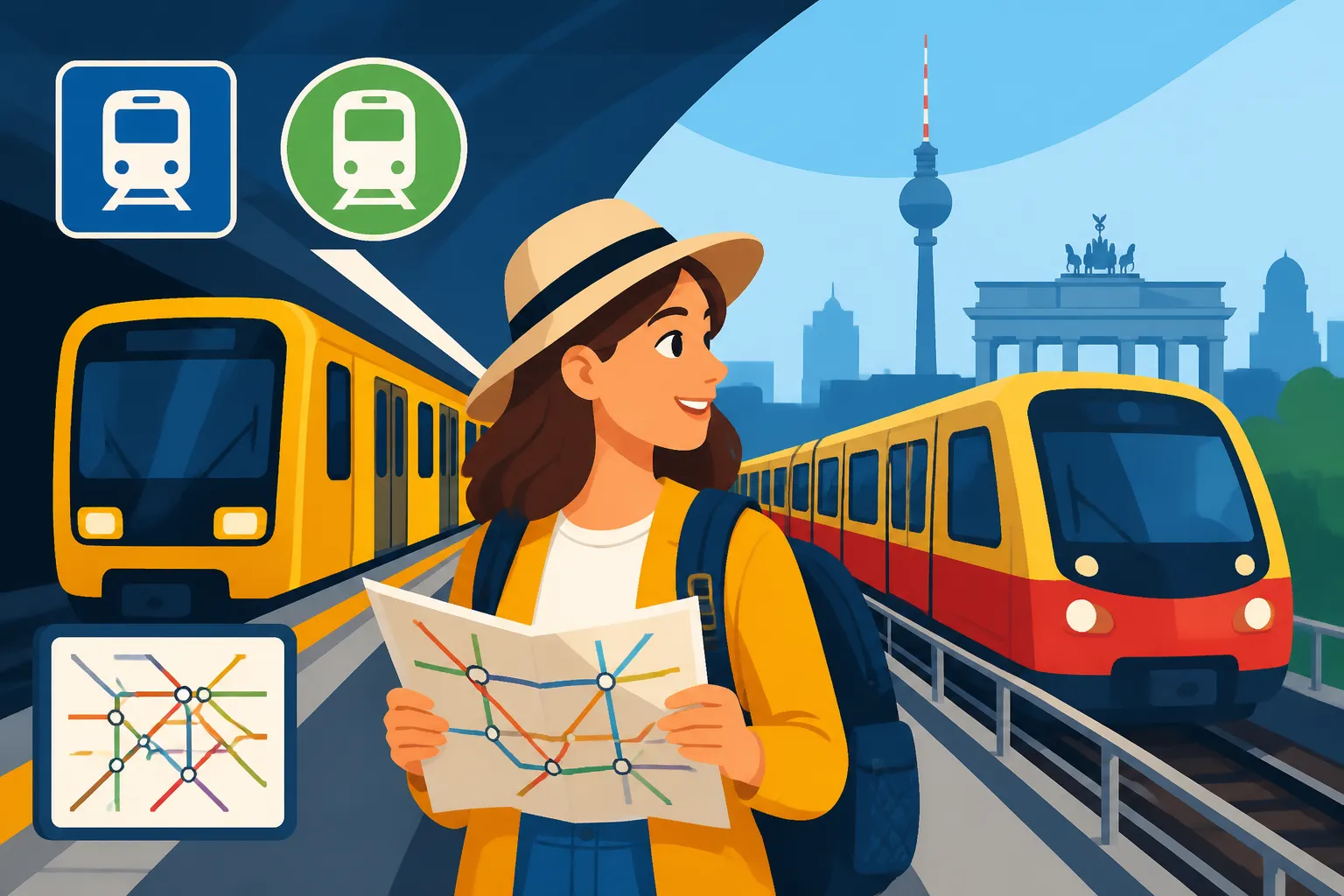
The U-Bahn is the underground, though plenty of it runs on elevated viaducts. The yellow trains through Kreuzberg on the U1 are a famous example. It is operated by BVG, the city transport company. Stations are marked with a white U on a blue square. Lines are numbered U1 to U9, and they mainly serve the inner city with frequent, closely spaced stops.
The S-Bahn is a suburban rail network operated by a Deutsche Bahn subsidiary. Its symbol is a white S on a green circle. S-Bahn trains cover longer distances, run out to the suburbs and beyond, and often share stations with regional and long-distance trains. If you plan to go to Wannsee, Potsdam or the airport, you will probably use the S-Bahn.
For a wider overview of how this compares to other cities, read Getting Around German Cities: U-Bahn, S-Bahn, Trams, and Buses.
The Ringbahn and Why It Matters
The Ringbahn is the S-Bahn loop around central Berlin. The S41 runs clockwise and the S42 runs anti-clockwise. Locals sometimes call the area inside it the “Hundekopf” because the shape on the map looks a little like a dog’s head. The ring matters because it marks the border of fare zone A. Most famous sights, from Brandenburger Tor to Alexanderplatz to the East Side Gallery, sit inside or right on it.
Here’s a scenario I see constantly. A visitor staying in Neukölln wants to reach Prenzlauer Berg and assumes they must go through the centre. Often the quickest option is to jump on the Ringbahn and ride around the edge.
Fare Zones A, B and C
Berlin’s fares are built around three zones:
| Zone | Rough coverage | Typical visitor use |
|---|---|---|
| A | Inside the Ringbahn | Mitte, Kreuzberg, Friedrichshain, Prenzlauer Berg, most sightseeing |
| B | From the Ringbahn to the city boundary | Outer districts such as Spandau, Köpenick, parts of Charlottenburg and Steglitz |
| C | The surrounding Brandenburg area | Berlin Brandenburg Airport, Potsdam, Oranienburg |
Most visitors only need an AB ticket. You need an ABC ticket for the airport or Potsdam. People get caught out by this all the time, because a Zone C trip looks quick on a map.
Before you buy anything for arrival day, read How to Get From Berlin Brandenburg Airport to the City. If you are planning a palace day, read How to Take a Day Trip to Potsdam From Berlin.
Choosing and Buying the Right Ticket
Ticket choice is where most visitors either overpay or quietly ride without valid fare. There is no barrier to stop you boarding, so the system relies on your honesty and on inspections.
Ticket Types Compared
Fares change regularly, so check the BVG website or the ticket machine for prices before you buy. The table below shows how the options work rather than what they cost.
| Ticket type | How it works | Best for |
|---|---|---|
| Single ticket | One journey in one direction within a set time window, with transfers allowed | Occasional rides, one-off trips |
| Short-trip ticket | A few stops only, with restrictions on transfers | Hopping a couple of stations |
| 4-trip ticket | A strip of single tickets, each validated separately | Couples or light users over a few days |
| Day ticket | Unlimited rides until early the following morning in the zones chosen | Heavy sightseeing days |
| Multi-day and 7-day tickets | Unlimited rides for a set period from validation | Week-long stays |
| Group day ticket | One ticket for a small group travelling together | Families and friends sightseeing together |
| Tourist cards | Transit plus discounts at attractions | Visitors planning many museum and tour visits |
| Deutschland-Ticket | Monthly subscription valid on local transport nationwide | Longer stays or regional trips beyond Berlin |
My rule of thumb is simple. If you will ride more than two or three times in a day, a day ticket usually comes out ahead. If you are in town for most of a week, look at the 7-day ticket.
Tourist cards such as the Berlin WelcomeCard can be bought through GetYourGuide. That works well if you are already booking a museum pass or walking tour and want everything in one place. Before you buy one, compare the attraction discounts with what you will actually visit.
If you are staying several weeks or travelling around Germany, read What Is the Deutschland-Ticket and Is It Worth It? before deciding. It is a subscription, and you need to know how cancellation works.
Where and How to Buy
You have four main options:
- Ticket machines on platforms and station entrances. Most have an English option. They show zones and ticket types clearly, but some older machines are fussy about which cards they accept.
- The BVG Tickets app. You can buy single, day and multi-day tickets on your phone, and app tickets are validated from the moment you buy or activate them.
- The DB Navigator app. It sells Berlin local tickets as well as long-distance trains, which is handy if you already use it. How to Use the DB Navigator App in Germany walks through the setup.
- Ticket machines inside trams and some buses. These are useful on surface routes, but you cannot buy tickets on board U-Bahn or S-Bahn trains.
If your foreign card is declined at a machine, don’t panic and don’t board anyway. Try another machine, switch to the app, or use contactless payment where the machine allows it. Paying for German Transport With a Foreign Card: Declines and Fixes covers the common fixes in detail.
Booking Train Travel Into Berlin
If you are arriving from another German city or a neighbouring country, platforms such as Omio let you compare train and bus options side by side before you arrive. Once you are in Berlin, though, local tickets are a separate purchase. A long-distance ticket generally does not cover your onward ride across the city unless it specifically includes a city ticket. Check your booking confirmation for that line before you assume.
Validating Your Ticket and Riding Without Stress
This is the part that causes most of the expensive mistakes I’ve seen among visiting friends. Nobody checks you at the entrance, so it is easy to think nobody checks you at all.
How Ticket Validation Works
Paper tickets from machines often come unvalidated, especially multi-ride strips and day tickets bought in advance. An unvalidated ticket is not a valid ticket. You must stamp it in one of the small red or yellow boxes marked “Entwerten” before you board.
Here’s the process:
- Buy your ticket from the machine.
- Check whether the ticket already shows a date and time printed on it.
- If there is no date and time, find the validator box. It is usually near the platform entrance or the top of the stairs.
- Insert the ticket in the direction of the arrow printed on the ticket itself, and wait for the stamp.
- Check that the date and time have been printed before you head down to the train.
App tickets don’t need a stamp. Just make sure your phone has battery and the ticket loads offline in case your signal drops underground.
Ticket Inspections and Fines
Inspectors in Berlin often wear ordinary clothes. They board, the doors close, and they show an ID badge and ask for “die Fahrscheine, bitte.” If you have no valid ticket, or an unvalidated one, you will be fined on the spot or asked for your details. Saying you are a tourist rarely changes anything. The size of the fine is set by the transport operators and can change, so check the BVG website if you want the figure.
A typical tourist scenario: someone buys a 4-trip ticket, validates the first strip, and forgets the second strip on the return journey. Get into the habit of checking your ticket every time you go through a station entrance.
Platform Etiquette and Practical Habits
A few local habits make the ride smoother:
- Find your direction by the last stop. Platform signs list lines with “Richtung” and the final station. Know where your line ends, not just where you are going.
- Stand right on escalators so people can walk past on the left.
- Let passengers off first before stepping on.
- Press the door button. On many trains the doors don’t open automatically.
- Take bikes only where allowed. They need their own ticket and go in marked carriages. If you would rather explore on two wheels, see Cycling in German Cities: Bikes and Bike-Sharing.
- Watch for announcements about disruptions. Weekend construction replaces trains with buses on some sections. Look for signs marked “Ersatzverkehr” or SEV.
Getting the Most Out of Berlin Transit as a Visitor
Once the ticket side is sorted, the network becomes a real pleasure to use. Here’s how I would suggest planning around it.
Late Nights and Night Services
Berlin’s nightlife doesn’t stop early, and neither does its transport. On Friday and Saturday nights, many U-Bahn lines and the main S-Bahn routes run through the night. On weeknights, night buses with an N in their number cover many of the U-Bahn routes after the trains stop. It isn’t as frequent as daytime service, but it is reliable enough that you rarely need a taxi.
If you are heading out to clubs in Friedrichshain or Kreuzberg, plan your return journey before you go. Check that your day ticket is still valid at that hour. Day tickets usually run until early the next morning, but read the conditions printed on yours. For more on planning a night out, see How to Experience Berlin’s Club Scene as a Visitor.
Choosing Where to Stay Based on Transit
Being close to a good station saves more time than almost anything else. A hotel next to a Ringbahn station or a major hub like Alexanderplatz, Friedrichstraße, Warschauer Straße or Zoologischer Garten makes every day easier. When you browse on Booking.com, use the map view to check the walking distance to the nearest U or S symbol. Don’t rely on vague descriptions like “central.”
For a neighbourhood-by-neighbourhood breakdown, read Where to Stay in Berlin: Mitte, Kreuzberg, Prenzlauer Berg, and Charlottenburg. I’d generally suggest visitors on short trips stay inside zone A.
Sample Routes for a First Visit
To show how the network helps you sightsee efficiently, here are some example connections:
| From | To | Typical route idea |
|---|---|---|
| Hauptbahnhof | Brandenburger Tor | S-Bahn east, or U5 toward the centre |
| Alexanderplatz | East Side Gallery | S-Bahn east toward Warschauer Straße |
| Friedrichstraße | Museum Island | Short walk, or tram |
| Kreuzberg | Charlottenburg Palace | U-Bahn west with a change |
| City centre | Potsdam | S-Bahn west with an ABC ticket |
These are rough ideas rather than guaranteed fastest options. Check a journey planner for live connections, because construction regularly changes the best route.
If you want a ready-made itinerary built around these connections, see How to Spend 48 Hours in Berlin. For a broader introduction to the city’s highlights, read Berlin for First-Time Visitors: Neighborhoods and Highlights.
A Final Word From Someone Who Learned the Hard Way
My first Berlin fine came from a 4-trip strip I bought, put in my pocket, and forgot to stamp. I’d lived in Germany long enough to know better, and I still got caught on a quiet Sunday morning on the U8. The system isn’t designed to trap tourists, but it does assume you know the rules.
Buy the right zones, validate paper tickets, and keep your app ticket ready to show. Do those three things and you’ll find Berlin’s U-Bahn and S-Bahn among the easiest city networks in Europe to use.
Disclaimer
This article is for general informational purposes only and does not constitute professional advice. Laws, prices and regulations vary by location and change over time. Consult a qualified professional for guidance on your specific situation.