How to Spend 48 Hours in Berlin
You land at BER on a Friday, have two days before your flight home, and every list online seems to want you in five places at once. Berlin is huge, spread out, and confusing on a first visit. This guide gives you a realistic 48-hour plan, built on routes I have walked many times, so you see the essentials without spending the weekend on the S-Bahn.
Disclosure: This post may contain affiliate links. We may earn a commission at no extra cost to you if you make a purchase through these links. Read full disclosure.
Before You Land: Setting Up Your 48 Hours
The main thing first-time visitors get wrong is scale. Berlin is not a compact old town like Bamberg or Heidelberg. It is a collection of former villages and two former city halves stitched together, and the distance between sights can surprise you. A “quick hop” from Charlottenburg to Friedrichshain takes longer than you would expect. So the decisions you make before you arrive matter a lot.
Choosing a Base That Saves Time
For a 48-hour trip, stay inside or right next to the S-Bahn Ring, and ideally near a station served by several lines. My usual advice is Mitte near Hackescher Markt or Alexanderplatz, or the Prenzlauer Berg edge near Eberswalder Strasse. From either one you can reach most of this itinerary in fifteen to twenty minutes.
Kreuzberg suits you if you want bars and late food on your doorstep. Charlottenburg is calmer and more elegant, but it puts you on the western side while most of the famous sights sit in the east. For a closer look at the neighbourhoods, see What’s the Best Area to Stay in Berlin?
When I book a short city stay, I use the map view on Booking.com. I pick properties within a short walk of a U-Bahn or S-Bahn stop and check recent reviews for comments about street noise. Berlin’s nights are long, and a room above a busy bar street can ruin the one full night of sleep you get. If you arrive by train from Munich, Hamburg or Prague, Omio is handy for comparing train and bus departures side by side before you commit to an arrival time.
Tickets, Zones, and the Validation Trap
Berlin’s public transport runs on the honour system, and that catches out many visitors. There are no barriers at most stations, but plain-clothes inspectors are common. If you are caught with an unvalidated paper ticket, you pay the fine on the spot, and explaining that you are a tourist does not help. If you buy a paper ticket from a machine, stamp it in the small validator box on the platform or inside the tram or bus before you travel.
The network is split into zones A, B and C. The city proper is AB. The airport BER sits in zone C, so you need an ABC ticket for the ride in and out. For a weekend packed with sightseeing, a 24-hour or multi-day ticket almost always beats buying single rides. The Berlin WelcomeCard can also make sense if you plan to visit several museums. If you already hold a Deutschland-Ticket, it covers local buses, trams, U-Bahn and S-Bahn here too. Check the BVG app or the operator’s website for current options.
Two linked guides cover this in detail: How to Get From Berlin Brandenburg Airport to the City and How to Use the Berlin U-Bahn and S-Bahn as a Visitor. Read both on the flight. They will save you that first-hour panic at the ticket machine.
Day One: History, Monuments, and the Old East
Day one covers the postcard sights, packed into a walkable stretch of Mitte. Wear comfortable shoes. You will walk more than you think, and Berlin pavements are hard on the feet.
Morning at the Reichstag and Brandenburg Gate
Start early at the Reichstag building. Visits to the glass dome are free, but you must register in advance on the German Bundestag’s website, and slots fill up, especially at weekends. Bring the ID you registered with, because security checks it. The spiral ramp gives you a slow 360-degree view of the government quarter, the Tiergarten and the TV tower in the distance. Going early means fewer people and softer light for photos.
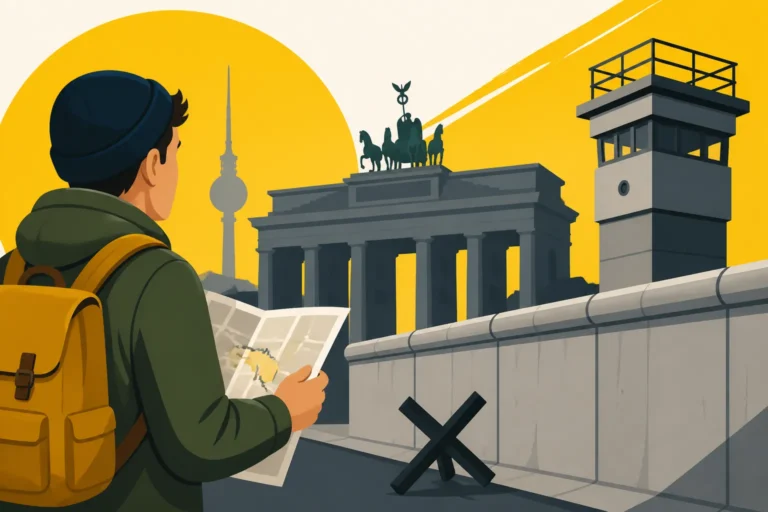
From there it is a short walk to the Brandenburg Gate. Walk through it from the Tiergarten side, the way it is usually photographed, and stop for a moment on Pariser Platz. For decades this square sat in the border zone, and it is worth remembering that while tour groups mill about with selfie sticks.
A few minutes south is the Memorial to the Murdered Jews of Europe: thousands of concrete slabs on uneven, sloping ground. Walk into the middle of it. The sounds of the city fade, the slabs rise above your head, and you lose sight of the people you came with. It is deeply moving, and many visitors go quiet without being told. Please do not climb or jump on the slabs. The information centre underneath is free to enter and tells individual family stories that stay with you.
Afternoon on Museum Island and Along the Spree
Walk east along Unter den Linden, past the Humboldt University and the State Opera, to Museum Island. Here a realistic plan matters. You will not see everything on the island in an afternoon, and trying to do so leaves you exhausted and with a blur of memories. Pick one museum. The Neues Museum, home of the Nefertiti bust, is my choice for first-timers. The Alte Nationalgalerie is a calmer option if you prefer paintings. Some parts of the island have been under long-term renovation, so check which halls are open before you go.
Buy a timed ticket online in advance. On a rainy Saturday, the walk-up queue can eat a large part of your afternoon. For a museum-by-museum breakdown, see How to Visit Berlin’s Museum Island
After the museum, rest your legs on the water. River cruises on the Spree leave from piers near the Berlin Cathedral and the Nikolaiviertel. They pass the government buildings and give you a different view of the city. I usually book a slot through GetYourGuide on the morning of the trip, once I know the weather. Most departures allow flexible cancellation, which helps when Berlin’s grey skies change their mind. Check the listing for the current terms.
Evening in Mitte or Prenzlauer Berg
Head up to Alexanderplatz for the Fernsehturm, the TV tower, around sunset. Book a time slot online, because evening slots are the first to go. If you would rather keep your feet on the ground, skip the tower and walk around Hackescher Markt. Duck into the Hackesche Höfe courtyards and the graffiti-covered Haus Schwarzenberg passage next door, which feels like the Berlin of the early nineties.
For dinner, take the tram up to Prenzlauer Berg. The streets around Kollwitzplatz and Kastanienallee are full of good, unfussy restaurants. Konnopke’s Imbiss, under the U-Bahn tracks at Eberswalder Strasse, has served currywurst for generations and is worth a stop even after dinner. If you eat plant-based, Berlin is one of the easiest cities in Europe for you; see How to Find Vegan Currywurst and Plant-Based Food in Berlin
One cultural note: many small Imbiss stands and some old-school bars still prefer cash. Carry some euros, even if you pay by card everywhere at home.
Day Two: The Wall, Kreuzberg, and Real Berlin
Day two is less about monuments and more about how Berlin lives with its history. It is the day most people end up remembering best.
Morning at Bernauer Strasse
Skip Checkpoint Charlie as your main Wall stop. It is a reconstruction surrounded by souvenir shops, and the actors in uniform posing for photos can feel uncomfortable once you know what happened there. Go instead to the Berlin Wall Memorial on Bernauer Strasse. Here you can see an original stretch of the death strip, with the watchtower, the patrol road and the inner wall all still in place. Climb the viewing platform at the Documentation Centre for the clearest view of how the system worked.
Walk the length of the outdoor exhibition. Markers in the ground show where escape tunnels ran, and the photos of people leaping from apartment windows into firefighters’ nets are hard to forget. Allow at least ninety minutes. Afterwards, if it is Sunday, Mauerpark is a short walk away. Its flea market and the open-air karaoke in the amphitheatre are pure Berlin.
Then take the S-Bahn to Ostbahnhof for the East Side Gallery, the longest remaining stretch of the Wall, covered in murals. Walk it from the Ostbahnhof end so you finish at the Oberbaum Bridge, one of the city’s most photogenic crossings. The whole Wall story is laid out in How to Visit the Berlin Wall and Its Memorials
Afternoon in Kreuzberg and on Tempelhofer Feld
Cross the Oberbaum Bridge into Kreuzberg. This is where Turkish-German Berlin, the old squatter scene and the newer café crowd overlap. Walk along the Landwehr Canal towards Maybachufer. If you are in town on market day, the Turkish market there is loud, colourful and great for a cheap lunch. Markthalle Neun in the Wrangelkiez is another good food stop, though its schedule varies by day.
Spend the late afternoon on Tempelhofer Feld, the former airport turned public park. You can walk or cycle the actual runways, past kite-surfers and families with barbecues. Few places tell you more about Berlin than an airfield that residents voted to keep wild instead of building on. On a sunny day it is pure joy. On a windy one, bring a jacket, because the open field gives no shelter.
If you would prefer to leave the city, swap this afternoon for Sanssouci; see How to Take a Day Trip to Potsdam From Berlin. Be honest with yourself, though. In a 48-hour trip, that choice costs you most of Kreuzberg.
Your Last Night
For your final evening, eat in Kreuzberg or neighbouring Neukölln. Bergmannstrasse and the streets around Graefekiez are good bets. Expect Berliners to eat later than you might be used to, and expect service to be efficient rather than chatty. That is not rudeness. It is just the local style.
If clubbing is on your list, the big clubs do not get going until well after midnight and peak through Sunday morning. Door policies are famously unpredictable, so set your expectations accordingly. Read How to Experience Berlin’s Club Scene as a Visitor before you queue for an hour in the cold.
Your 48-Hour Berlin Plan at a Glance
Here is the full plan, condensed. Screenshot it before you leave the hotel Wi-Fi.
| Time Block | Area | Main Highlights | Practical Tip |
|---|---|---|---|
| Day 1 morning | Government Quarter | Reichstag dome, Brandenburg Gate, Holocaust Memorial | Register for the dome in advance and bring matching ID |
| Day 1 afternoon | Museum Island and Spree | One museum, river cruise | Buy timed museum tickets online |
| Day 1 evening | Alexanderplatz, Prenzlauer Berg | TV tower, Hackesche Höfe, dinner | Carry cash for Imbiss stands |
| Day 2 morning | Bernauer Strasse, Friedrichshain | Wall Memorial, East Side Gallery | Start at the Ostbahnhof end of the gallery |
| Day 2 afternoon | Kreuzberg, Tempelhof | Canal walk, markets, Tempelhofer Feld | Bring a windproof layer |
| Day 2 evening | Kreuzberg, Neukölln | Late dinner, bars or clubs | Clubs start very late |
Common Mistakes That Waste Your Weekend
Follow these steps and you will avoid the most common problems first-time visitors run into:
- Do not plan shopping for Sunday. Most shops close, though cafés, museums and the Mauerpark flea market stay open. More detail: What Closes on Sundays in Germany?
- Validate every paper ticket before boarding. “I didn’t know” never works with Berlin inspectors.
- Book the Reichstag dome, the TV tower and your chosen museum before you arrive, not on the day.
- Group sights by district, as this plan does, rather than zig-zagging across the city.
- Keep one flexible block for rain. Berlin weather changes quickly, so swap the Tempelhof afternoon for a second museum if needed.
- Download the BVG app and an offline map so a dead phone battery does not leave you stranded at a tram stop.
If you finish this trip and feel you only scratched the surface, that is normal. Berlin rewards a slower second visit, and How Many Days Do You Need in Berlin? will help you plan a longer stay next time.
Disclaimer
This article is for general informational purposes only and does not constitute professional advice. Laws, prices and regulations vary by location and change over time. Consult a qualified professional for guidance on your specific situation.