How to Visit the Berlin Wall and Its Memorials
When you first step off the train in Berlin, you might expect to see a massive, looming concrete barrier slicing through the city center. Instead, you find a city that has largely healed its scars, leaving many visitors wondering where the history actually is. This guide solves that confusion by mapping out the most impactful memorials and hidden remnants of the Berlin Wall.
Disclosure: This post may contain affiliate links. We may earn a commission at no extra cost to you if you make a purchase through these links. Read full disclosure.
Understanding the Layout: Why the Wall Isn't Just One Place
The most common mistake I see newcomers make is hopping off the U-Bahn and asking, "Where is the Wall?" In reality, the Berlin Wall was a 155-kilometer-long complex security system that encircled West Berlin, not just a single line through the middle. After the fall of the Wall in 1989, Berliners were understandably eager to tear it down. This means that today, the Wall exists in fragments, memorial sites, and a line of double cobblestones set into the asphalt that traces its former path through the city streets.
To truly understand what you are looking at, you have to realize that the "Wall" was actually two walls with a "death strip" in between. This space was filled with watchtowers, tripwires, and raked sand to show footprints. When you visit these sites today, you aren't just looking at concrete; you are standing in a space that was once a vacuum of human rights. If you are just starting your journey, checking out Berlin for First-Time Visitors: Neighborhoods and Highlights will give you a better sense of how these historical zones sit within the modern districts like Mitte and Friedrichshain.
If you are traveling from another part of Europe or a different German city, using a service like Omio can help you find the best train or bus connections to Berlin Central Station (Hauptbahnhof). From there, the city’s history is at your fingertips, but you need a plan. Walking aimlessly won't get you far because the remnants are spread out. I always suggest starting with a broad view of the city's 20th-century trauma by reading Berlin's 20th-Century History: Wall, Memorials, and Museums to contextualize the Cold War within the larger framework of German history.
The Double Wall System and the Cobblestone Line
If you look down while walking through Mitte, you’ll notice a double row of cobblestones snaking across the road and sidewalk. This is the "Mauerweg" trace. It’s a haunting reminder that where people now sip lattes in sidewalk cafes, there was once a barrier that divided families for nearly three decades. As an expat who has walked these streets for years, I still find it jarring to see that line go right through a residential building’s front door or a busy intersection.
The sophistication of the border was terrifying. The inner wall faced East Berlin, and the outer wall faced West Berlin. In between was the "No Man's Land." Today, many of these spaces have been turned into parks or bike paths. If you want to see the most authentic preserved section of this entire system, you have to head to the Bernauer Straße memorial. It is the only place where you can see the depth and the layers of the fortifications as they actually were.
Where to Start Your Journey
I always tell my visiting friends to start their morning at the Nordbahnhof S-Bahn station. Not only is it a gateway to the most important memorial, but the station itself houses an exhibition on "Ghost Stations." During the division, some North-South subway lines from West Berlin ran under East Berlin territory. The trains weren't allowed to stop at the East Berlin stations, which were heavily guarded and dimly lit. Imagine being a West Berliner sitting on a train, looking out the window, and seeing East German soldiers with machine guns standing on a dark, dusty platform. It’s a chilling way to begin your historical tour.
Before you set out, make sure you know How to Use the Berlin U-Bahn and S-Bahn as a Visitor because the memorial sites are scattered across different zones. Having a day pass for the AB zone will save you a lot of stress and money. Berlin is a massive city, and while walking is great, the distance between the East Side Gallery and the Berlin Wall Memorial is several miles.
The Essential Memorial Sites You Can't Miss
While there are dozens of spots to see bits of the Wall, three locations are non-negotiable for anyone wanting to understand the human cost of the division. These sites offer very different perspectives: one is somber and educational, one is artistic and celebratory, and one is… well, it’s a bit of a tourist circus, but it's a rite of passage nonetheless.
Navigating these sites can be emotionally taxing. I’ve seen people moved to tears at the Window of Remembrance. It’s helpful to have a comfortable base to return to after a long day of walking. I usually check Booking.com to find hotels in the Mitte or Prenzlauer Berg areas, as they put you within walking distance of the most poignant historical markers while offering plenty of quiet spots to decompress.
The Berlin Wall Memorial (Gedenkstätte Berliner Mauer)
This is, without a doubt, the most important site in the city. Located on Bernauer Straße, it stretches for 1.4 kilometers along the former border strip. This street was famous because the houses on the East side of the street had their front doors in the East and their windows looking out into the West. In the early days of the Wall, people literally jumped out of their apartment windows to reach freedom.
The memorial includes a preserved section of the Wall with a watchtower, an outdoor exhibition, and the Chapel of Reconciliation. The original church on this site was blown up by the GDR government because it sat right in the death strip. The new chapel is a beautiful, minimalist structure made of rammed earth. Every day, they hold a short prayer service for the victims of the Wall. It is a deeply moving experience that puts a human face on the abstract concept of "geopolitics."
The East Side Gallery
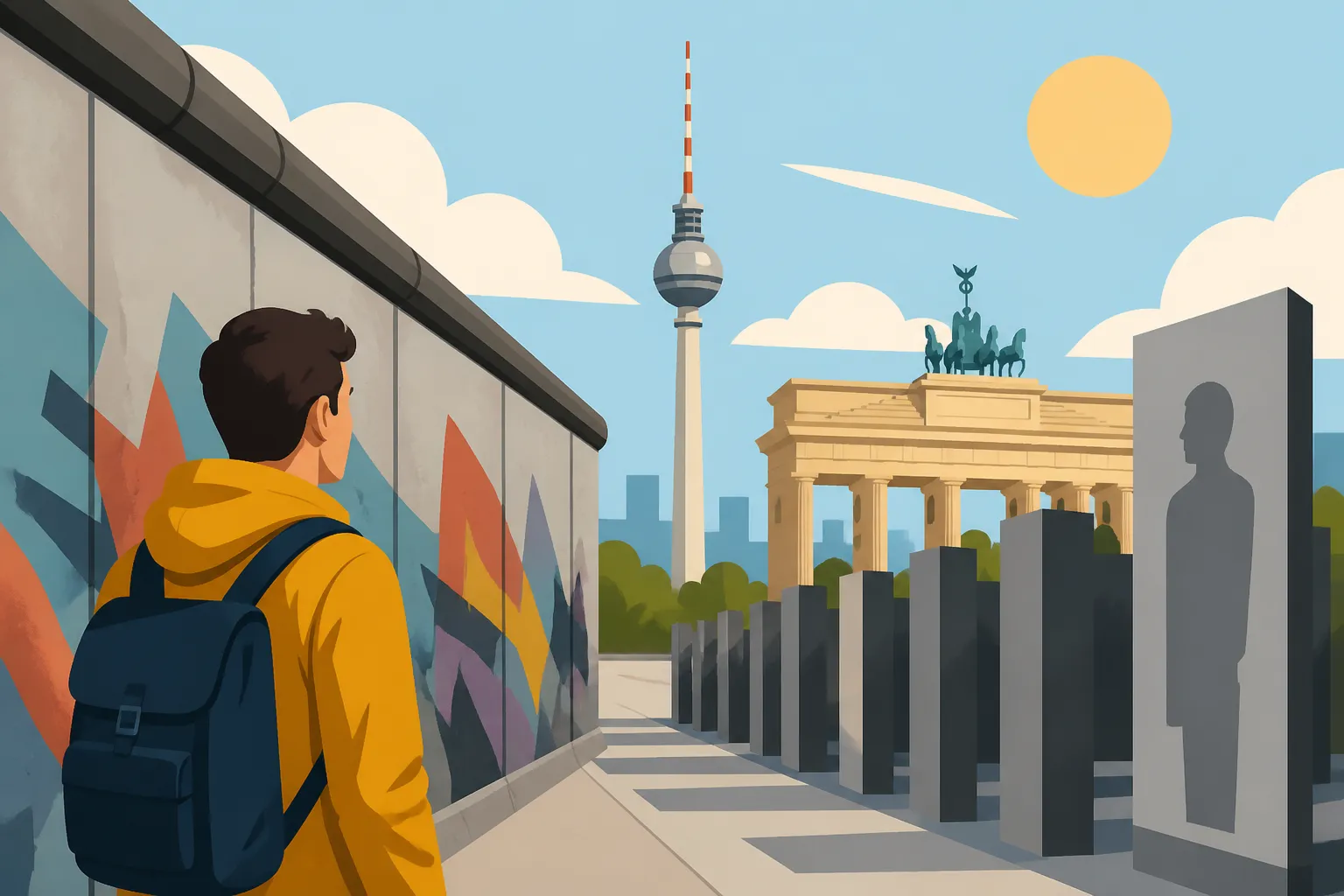
If Bernauer Straße represents the tragedy of the Wall, the East Side Gallery represents the joy of its fall. Located in Friedrichshain along the Spree River, this is a 1.3-kilometer section of the "inner" wall that was painted by artists from all over the world in 1990. It is the longest continuous section of the Wall still standing. You’ve likely seen photos of the "Fraternal Kiss" (Dmitri Vrubel's painting of Brezhnev and Honecker).
A word of advice from someone who has been there a hundred times: go early. By midday, the crowds are thick, and it’s hard to see the art through the forest of selfie sticks. Also, stay alert. Because it's such a popular spot, pickpockets sometimes operate in the area. I always recommend reading Staying Safe in Germany: Common-Sense Tips for Travelers to keep your wits about you while you're distracted by the incredible murals.
Checkpoint Charlie
I have a love-hate relationship with Checkpoint Charlie. On one hand, it was the most famous crossing point between East and West, the site of the 1961 tank standoff that nearly started World War III. On the other hand, it is now the epicenter of Berlin tourism "kitsch." You’ll see actors dressed as soldiers charging for photos and shops selling "authentic" pieces of the Wall that probably came from a local hardware store.
However, the outdoor gallery surrounding the intersection is actually very good. It tells the story of the many escape attempts and the diplomatic tensions of the time. The Mauermuseum (Wall Museum) right next to the checkpoint is also worth a visit, though it is very dense and can feel a bit cluttered. If you prefer a more structured experience, I often suggest booking a guided walking tour via GetYourGuide. A local guide can help you filter out the noise and explain the actual mechanics of the border crossing that the flashy signs don't quite capture.
| Site Name | Location | Vibe | Entry Cost | Nearest Station |
|---|---|---|---|---|
| Berlin Wall Memorial | Bernauer Straße | Somber / Educational | Free | S Nordbahnhof |
| East Side Gallery | Mühlenstraße | Artistic / Vibrant | Free | S+U Warschauer Str. |
| Checkpoint Charlie | Friedrichstraße | Busy / Touristy | Free (Street) | U Kochstraße |
| Mauerpark | Eberswalder Str. | Local / Relaxed | Free | U Eberswalder Str. |
| Topography of Terror | Niederkirchnerstr. | Intense / Historic | Free | S+U Potsdamer Platz |
Off-the-Beaten-Path Wall Remnants
If you want to escape the crowds and see the Wall as it exists in the daily lives of Berliners, you need to head a bit further afield. These spots are where the "real" Berlin happens—where history meets the messy, vibrant present. These are the places where I take my friends when they say they want to see the Berlin that doesn't make it into the five-minute news clips.
While exploring these areas, you might find that the signage isn't always in English. Knowing a few basics from Survival German for Travelers: Key Phrases to Learn First can be incredibly helpful when you're trying to read a commemorative plaque or ask a local for directions to a hidden watchtower.
Mauerpark and the Death Strip
On Sundays, Mauerpark is the place to be for the famous flea market and karaoke. But look at the hill overlooking the park. That was part of the death strip. The "Rainbow Wall" at the top is a section of the Hinterland wall (the inner wall) where graffiti is actually legal. It changes every single day. Walking along that ridge gives you a perfect view of how the Wall cut through the Prenzlauer Berg district.
This area is also great for getting a feel for the local culture. After exploring the history, you might want to stop for a bite. Just remember that many local spots are traditional. Check Cash vs Card in Germany: What Visitors Should Know before you head out, as some of the best currywurst stands near Mauerpark still don't take credit cards.
The Günter Litfin Memorial
This is a hidden gem located near the Invalidenfriedhof (Invalid's Cemetery). Günter Litfin was the first person to be shot and killed while trying to escape to the West, just days after the Wall was started in 1961. His brother turned a former GDR watchtower into a small, private memorial. It’s a tiny, cramped space, but standing in the top of that tower and looking out over the canal gives you a terrifying perspective of what the guards saw.
The surrounding cemetery is also worth a walk. It was one of the oldest in Berlin, but the GDR government destroyed most of the graves because they were in the way of the border. Today, you can see the Wall fragments running right through the rows of headstones. It is one of the most hauntingly beautiful places in the city. If you're visiting in the colder months, the atmosphere here is particularly stark; for more on handling the emotional and physical chill of the city, see Dealing with Seasonal Affective Disorder: Coping with Dark Winters in Germany.
Bösebrücke at Bornholmer Straße
If you want to stand exactly where the Wall first "fell," head to the Bösebrücke. On the night of November 9, 1989, following a confused announcement by a GDR official, thousands of East Berliners gathered here and demanded the gates be opened. The overwhelmed border guards finally gave in, and this became the first crossing point to open. There is an exhibition on the bridge today with photos from that night. It’s a powerful place to visit, especially when you realize how close the situation came to ending in violence.
Practical Tips for Navigating the History
Visiting the Berlin Wall isn't like visiting a museum with a clear entrance and exit. It requires a bit of logistical planning to make sure you aren't spending your whole day on the train. My advice is to group your visits. Spend a morning at Bernauer Straße and Mauerpark, then take the M10 tram (often called the "party tram" because it connects the nightlife districts) down to the East Side Gallery.
For a lunch break, don't just grab a sandwich at a station. Berlin has a fantastic food scene. If you're curious about what to order, check out Tipping in Germany: When, Where, and How Much so you can navigate the "paying the bill" dance like a local. Usually, a simple "Stimmt so" (keep the change) is enough for a small cafe bill.
Using Public Transport and Walking Tours
As I mentioned earlier, the Berlin S-Bahn and U-Bahn are your best friends. Most Wall sites are within a five-minute walk of a station. If you're feeling adventurous, you can also rent a bike. The "Berliner Mauerweg" is a fully signposted bike path that follows the entire 155km perimeter of the former Wall. It’s a great way to see the transition from the dense city center to the lush forests of the outskirts.
If you are tight on time, a guided tour from GetYourGuide is highly recommended. Many of these tours focus specifically on the "Third Reich and Cold War" history, connecting the dots between how the end of WWII led directly to the construction of the Wall. Having a guide to explain why certain buildings look the way they do (the socialist "Plattenbau" vs. Western "Altbau") adds a layer of depth you won't get from just looking at the concrete.
Managing Expectations and Timing
Lastly, realize that you cannot see everything in one day. If you try to hit Bernauer Straße, the East Side Gallery, Checkpoint Charlie, and the Topography of Terror in six hours, you will end up with "history fatigue." Pick two main sites and leave time for a long walk or a coffee. Berlin is a city that reveals itself slowly.
If you have an extra day, consider taking a breather from the heavy history. There are amazing Best Day Trips From Berlin like Potsdam or the Spreewald that offer a different perspective on German culture and nature. History is vital, but so is seeing how the country has moved forward.
Disclaimer
This guide is for informational purposes only. While every effort has been made to ensure the accuracy of the historical and logistical information provided, sites, opening hours, and public transport routes in Berlin are subject to change. Always check the official websites of the memorial sites and local transport authorities (VBB/BVG) before planning your visit. The author and publisher are not responsible for any inconveniences or issues encountered during your travels.