How to Visit Sanssouci Palace in Potsdam
You’ve seen the photos of that golden yellow palace on its terraced vineyard, and you’ve decided to go. Then you find that the palace tickets for the day you wanted are already gone, nobody can agree which station to use, and the park is far bigger than it looked. This guide covers how to get to Sanssouci Palace, how to get tickets, and how to plan the day.
Disclosure: This post may contain affiliate links. We may earn a commission at no extra cost to you if you make a purchase through these links. Read full disclosure.
Planning Your Sanssouci Visit: What You Are Actually Going To See
First-time visitors often expect one palace, see it, and leave. Sanssouci is really a large landscaped park full of palaces, pavilions, follies, greenhouses, fountains and statues, spread along a long axis that takes a good while to walk from end to end. Frederick the Great built the main palace as his private summer retreat. Its name roughly means “without worries,” and it is the heart of the ensemble. The whole cultural landscape of Potsdam and Berlin’s palaces and parks is a UNESCO World Heritage Site. If you are collecting those, my overview Germany’s UNESCO World Heritage Sites: A Visitor’s Guide puts Sanssouci in context with the rest.
The foundation that runs the Prussian palaces in Berlin and Brandenburg manages the site. That matters because their website, not a third-party blog, is the final word on opening days, which buildings are open, and how tickets work.
The Main Palace and the Vineyard Terraces
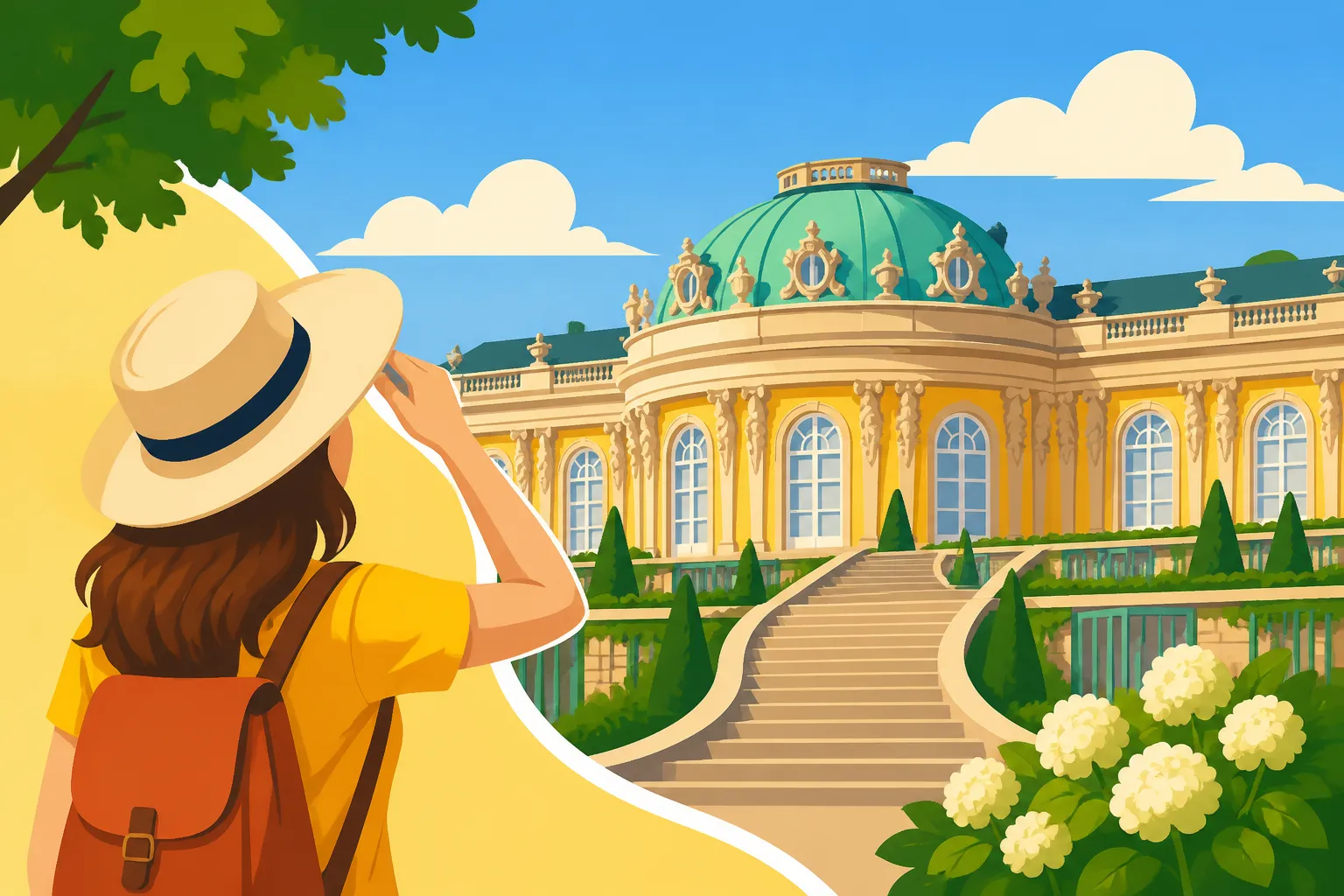
Most people picture the view from the bottom of the terraces. A wide staircase climbs the vineyard steps, with glass-fronted niches for figs and vines, and the low single-storey palace sits on top. In person it feels surprisingly intimate. There is no towering facade like Versailles, just a long, sunny building that is more pleasure house than seat of government.
Inside, the rooms are rococo: gilded woodwork, mirrors, delicate ceilings. They include the round library and the concert room where the king played the flute. The interior is small, so access is controlled by timed entry. That is why tickets run out, and I’ll come back to it.
On the top terrace, just beside the palace, is Frederick’s grave. It is a simple flat slab, and you will almost always see potatoes on it. Visitors leave them as a nod to the story that he promoted potato farming in Prussia. It’s a slightly odd and touching moment, and many people remember it more than the gilded rooms.
The Rest of the Park: Pavilions, Galleries and the Historic Mill
Within easy walking distance of the main palace you will find several other buildings:
- The Picture Gallery (Bildergalerie) sits to the east of the terraces. It is one of the oldest purpose-built gallery buildings in Germany and is hung floor to ceiling with Baroque paintings.
- The New Chambers (Neue Kammern) were a former orangery turned guest palace, on the western side of the terraces.
- The Historic Mill (Historische Mühle) is a reconstructed Dutch-style windmill with a gallery around its body and sails turned to catch the wind. The legend goes that the king lost a dispute with the miller next door, which is why the mill still stands beside the palace.
- The Chinese House (Chinesisches Haus) is a gilded garden pavilion surrounded by golden figures. It reflects the European fashion for chinoiserie.
- The Orangery Palace (Orangerieschloss) is a long Italian Renaissance-style building on a hill, with a viewing platform.
- The Church of Peace (Friedenskirche) is a calm, Italian-looking church near the eastern edge of the park.
- The Roman Baths and Charlottenhof Palace are in the quieter southern section, and are often skipped by rushed tour groups.
- The New Palace (Neues Palais) is the huge red-brick-and-sandstone palace at the far western end. It is the opposite of Sanssouci’s intimacy, built to show that Prussia was still powerful.
Several of the smaller pavilions only open during the warmer season. In winter you may find them shuttered even though the park itself stays open. The Ruinenberg, a hill north of the main palace with artificial ruins built to decorate the view, is a nice detour if you want a less crowded vantage point.
Comparing the Key Sites at a Glance
| Site | What It Is | Interior Visit | Best For |
|---|---|---|---|
| Sanssouci Palace | Frederick’s rococo summer palace on the terraces | Timed ticket, limited capacity | First-timers, the classic photo |
| Picture Gallery | Baroque painting gallery beside the terraces | Ticketed, usually seasonal | Art lovers, rainy moments |
| New Chambers | Former orangery turned guest palace | Ticketed, usually seasonal | Lavish interiors, shorter queues |
| Historic Mill | Reconstructed Dutch-style gallery windmill | Exhibition inside, seasonal | Families, the miller legend |
| Chinese House | Gilded chinoiserie pavilion | Ticketed, seasonal | Photography, porcelain fans |
| Orangery Palace | Renaissance-style hilltop building | Seasonal, includes viewing terrace | Panoramic views over the park |
| New Palace | Monumental palace at the western end | Ticketed, larger capacity | Grand state rooms, a full day out |
| Park grounds | Gardens, fountains, avenues | Free to walk, voluntary donation | Anyone, any season |
When you want to compare Sanssouci with other royal residences, my roundup Germany’s Best Castles: Neuschwanstein and Beyond is a good companion.
Getting to Sanssouci From Berlin and Within Potsdam
Potsdam is right on Berlin’s southwestern edge, which is why Sanssouci is one of the most popular half-day and full-day excursions from the capital. You don’t need a car. In my experience a car is more trouble than it’s worth here, because parking near the park fills up quickly on good-weather weekends.
If you’re still deciding whether Potsdam is the right excursion for you, my list Best Day Trips From Berlin compares it with the other options. For a whole-city itinerary that goes beyond the palace, see How to Take a Day Trip to Potsdam From Berlin.
Which Train to Take and Which Ticket You Need
There are two main rail options from central Berlin:
- The S-Bahn line S7. It runs from stations like Alexanderplatz, Friedrichstraße, Hauptbahnhof and Zoologischer Garten out to Potsdam Hauptbahnhof. It is slower because it stops everywhere. The upside is that it runs very frequently and you can hop on without thinking about it.
- Regional express trains (RE). These run from the same central Berlin stations and are noticeably faster. Some regional services also stop at Potsdam Park Sanssouci station, which sits right beside the New Palace at the western end of the park.
The ticket is the point where visitors most often get caught out. Potsdam lies in Berlin’s outer fare zone C, so a standard Berlin AB ticket is not valid. You need an ABC ticket. Ticket inspectors in the Berlin area are not known for leniency toward confused tourists, and “I didn’t know” won’t save you from the fine. If you hold a Deutschland-Ticket, it covers the S-Bahn, regional trains, buses and trams in Potsdam, so you can relax. The details are in Regional Trains and the Deutschland-Ticket Explained. If you’ve never used the Berlin network before, How to Use the Berlin U-Bahn and S-Bahn as a Visitor explains validating, zones and platforms.
If you’re coming from further away, say Hamburg or Leipzig, and want to compare the train, the long-distance bus and the timing in one place, an aggregator like Omio is handy for seeing the options side by side before you book.
From the Station to the Palace Gates
Once you reach Potsdam, you have a few ways to cover the last stretch:
| Arrival Point | How to Reach the Park | Where You Enter | Who It Suits |
|---|---|---|---|
| Potsdam Hauptbahnhof | Bus 695 toward the palace stops | Near the main palace and terraces | Most first-time visitors |
| Potsdam Hauptbahnhof | Tram to the city centre, then walk via the Brandenburg Gate and the avenue to the park | Eastern entrance, near the Church of Peace | People combining the old town and the park |
| Potsdam Hauptbahnhof | Walk the whole way | Eastern side of the park | Good weather, comfortable shoes, no rush |
| Potsdam Park Sanssouci station | Short walk | Western end, beside the New Palace | Visitors starting with the New Palace |
My preferred route for a first visit is the one I gave a friend from Toronto who came over last spring. She took the S-Bahn to Hauptbahnhof, then the bus to the main palace for her timed slot. After her slot she walked west through the park to the New Palace and took a regional train back to Berlin from Park Sanssouci station. Doing it this way means you never walk the same path twice, and the long axis of the park becomes the backbone of your day instead of an obstacle.
Bus numbers and seasonal routes do change, so check the local transport app on the day.
Accessibility Realities
The terraces are the obvious obstacle: there is a lot of staircase between the bottom fountain and the palace. You can avoid the stairs by approaching the main palace from the side paths and the upper level, where the bus drops you off. The park’s paths are mostly gravel, which is tiring with a wheelchair, stroller or walking frame. Some historic interiors also have thresholds and narrow passages. If mobility is a concern for you or someone in your group, contact the visitor service before you go and ask which buildings are step-free. My broader advice is in Accessible Travel in Germany: Mobility and Planning Tips.
Tickets, Timed Entry and Beating the Sell-Outs
This is where people lose their day. Here’s the scenario I see over and over. A couple arrives on a sunny Saturday around lunchtime, walks up the terraces, takes a beautiful photo, goes into the visitor centre, and learns that every timed slot for the main palace interior is sold out until closing. It isn’t a scam or bad luck. The palace is small, the rooms are fragile, and capacity is deliberately limited.
How Timed Entry Works
The main palace interior is visited in time slots. You choose a slot when you buy your ticket, and you have to show up at the entrance at that time. Visits come with an audio guide, available in several languages including English, so you can go at your own pace through the rooms. You can’t really linger beyond the flow, though.
The other palaces in the park have their own tickets and opening patterns. There is also a combined day ticket that covers several palaces in the park on the same day. It is worth it if you plan to go inside three or more buildings. If you only want the main palace and a walk in the gardens, a single ticket is enough.
Here’s how I’d do it:
- Check the foundation’s official website for opening days. Most palaces close one weekday each week, which is traditionally Monday. Many seasonal buildings are only open part of the year.
- Book the main palace slot online in advance, especially for weekends, school holidays and summer.
- Choose an early slot if possible. The rooms are calmer, the light is softer on the terraces afterwards, and you have the rest of the day free for the park.
- Plan your day around that slot: before it, the Picture Gallery or the Historic Mill; after it, a walk west toward the Orangery and the New Palace.
- Keep your confirmation on your phone and arrive early enough to deposit bags. Large bags and backpacks generally have to go in lockers or the cloakroom before you enter the historic rooms.
For a wider look at how palace and castle ticketing works across the country, including the timed-slot habit you’ll also meet at Neuschwanstein, see How to Get Tickets for Neuschwanstein and Other Castles.
What to Do if the Slots Are Gone
Don’t panic, and don’t write off the day. You have several options:
- Go inside a different palace. The New Palace has bigger rooms and more capacity, and many visitors find its state rooms more impressive anyway. The New Chambers are lavish and often much quieter.
- Book a guided tour. Platforms like GetYourGuide list guided day tours from Berlin that include Sanssouci. Some come with reserved palace entry, which helps when the individual slots are booked out. Read the listing carefully. Some tours only walk the gardens and the exterior, and that is a very different experience from going inside.
- Make it a garden day. Honestly, the park is the bigger experience. Walk the terraces, find the grave and the potatoes, look at the mill, circle the Chinese House, climb up to the Orangery terrace, and finish at the New Palace. You’ll walk a lot and you won’t regret it.
- Come back on a weekday. If you live in Berlin, this is the easy fix. A Tuesday morning at Sanssouci is a completely different place from a Sunday afternoon.
Free Park, Paid Palaces
The park grounds are free to walk around. You’ll see boxes or signs asking for a voluntary donation toward upkeep, and I’d encourage you to drop something in, because maintaining all of this is enormously expensive. Only the palace interiors and some exhibitions are ticketed. A garden-only visit is one of the best low-cost days out in the Berlin area. I’m not quoting entry prices here because they change; check the official site for the current figures.
Making a Full Day of It: Timing, Food and Staying Over
Sanssouci rewards slowness. The visitors who come away disappointed are usually the ones who tried to “do Potsdam” in three hours between brunch and dinner in Berlin.
Best Seasons and Times of Day
| Season | What You Get | The Catch |
|---|---|---|
| Spring | Fresh greenery, blossoms, fountains starting up, seasonal buildings reopening | Weather changes quickly, so bring a layer |
| Summer | All pavilions and fountains running, long evenings in the park | Peak crowds and sold-out palace slots on weekends |
| Autumn | Golden foliage on the avenues, softer light, thinner crowds | Seasonal buildings start closing toward the end of the season |
| Winter | Quiet park, frosty terraces, a calm atmosphere | Many pavilions closed, statues boxed up against frost, short daylight |
Spring and autumn are my favourites, for the reasons in Spring and Autumn in Germany: The Best Travel Seasons. In winter the statues are often enclosed in wooden boxes to protect them from frost. It looks a little strange, so don’t be surprised. Winter is still lovely for a crisp walk, as long as you aren’t counting on seeing every interior.
As for time of day, arrive in the morning. Tour buses and large groups tend to peak from late morning into the early afternoon. Late afternoon in the warmer months is also beautiful, because the terraces glow in the evening light.
Sundays and public holidays are busy at the palace, and some shops in town are closed. Cafés and restaurants usually stay open. My explainer What Closes on Sundays in Germany? tells you what to expect so you don’t get caught out.
Food, Coffee and Breaks
Within the park, catering is limited and seasonal: a few cafés and kiosks near the main sights. Pack water and a snack, especially if you plan to walk the full length of the park.
For a proper meal, head into Potsdam’s old town. The Dutch Quarter (Holländisches Viertel) is a cluster of red-brick gabled houses a short walk from the eastern end of the park, and it is full of cafés and small restaurants. Brandenburger Straße, the pedestrian shopping street that leads from the Potsdam Brandenburg Gate toward the Church of St. Peter and Paul, also has plenty of places to eat. A late-afternoon cake and coffee after a long walk through the park is about as German as a day out gets. If that ritual is new to you, German Cafés and Kaffee und Kuchen Culture explains it.
Staying Overnight in Potsdam
Most people treat Sanssouci as a day trip from Berlin, but staying a night in Potsdam is worth thinking about if:
- you want an early slot at the main palace without rushing across Berlin at dawn,
- you want to see other parts of Potsdam too, such as Cecilienhof Palace in the New Garden, where the Potsdam Conference was held, or the Babelsberg area,
- or you’re travelling with kids or older relatives and want to break the day up.
Accommodation in Potsdam ranges from small guesthouses near the Dutch Quarter to hotels near the main station and lakeside places further out. Booking.com is a practical place to compare what’s available near the park and the old town. Filter by distance to the park or to Hauptbahnhof, depending on how you plan to get around.
A Realistic Full-Day Plan
Here’s the itinerary I’d suggest for a relaxed first visit without a car:
- Take a mid-morning S-Bahn or regional train from central Berlin to Potsdam Hauptbahnhof with an ABC ticket or a Deutschland-Ticket.
- Take the bus to the main palace area and arrive with time to spare before your slot. Leave your bag in a locker.
- Visit the main palace interior with the audio guide.
- Walk out onto the top terrace, visit Frederick’s grave and look over the vineyard steps.
- Walk over to the Historic Mill and the New Chambers, then down through the gardens.
- Continue west past the Chinese House and up to the Orangery Palace’s viewing terrace if it’s open.
- Finish at the New Palace at the western end, going inside if you have a ticket or simply admiring the scale of the building.
- Either take a regional train from Potsdam Park Sanssouci station back to Berlin, or head into the old town for dinner in the Dutch Quarter first.
It’s a long walk. Comfortable shoes are not optional, and the gravel paths will remind you of that. But as the park gradually unfolds, from the intimate rococo palace to the grand New Palace, you understand why people make this trip again and again. I’ve lived near Berlin for years, and I still go back every season.
Disclaimer
This article is for general informational purposes only and does not constitute professional advice. Laws, prices and regulations vary by location and change over time. Consult a qualified professional for guidance on your specific situation.