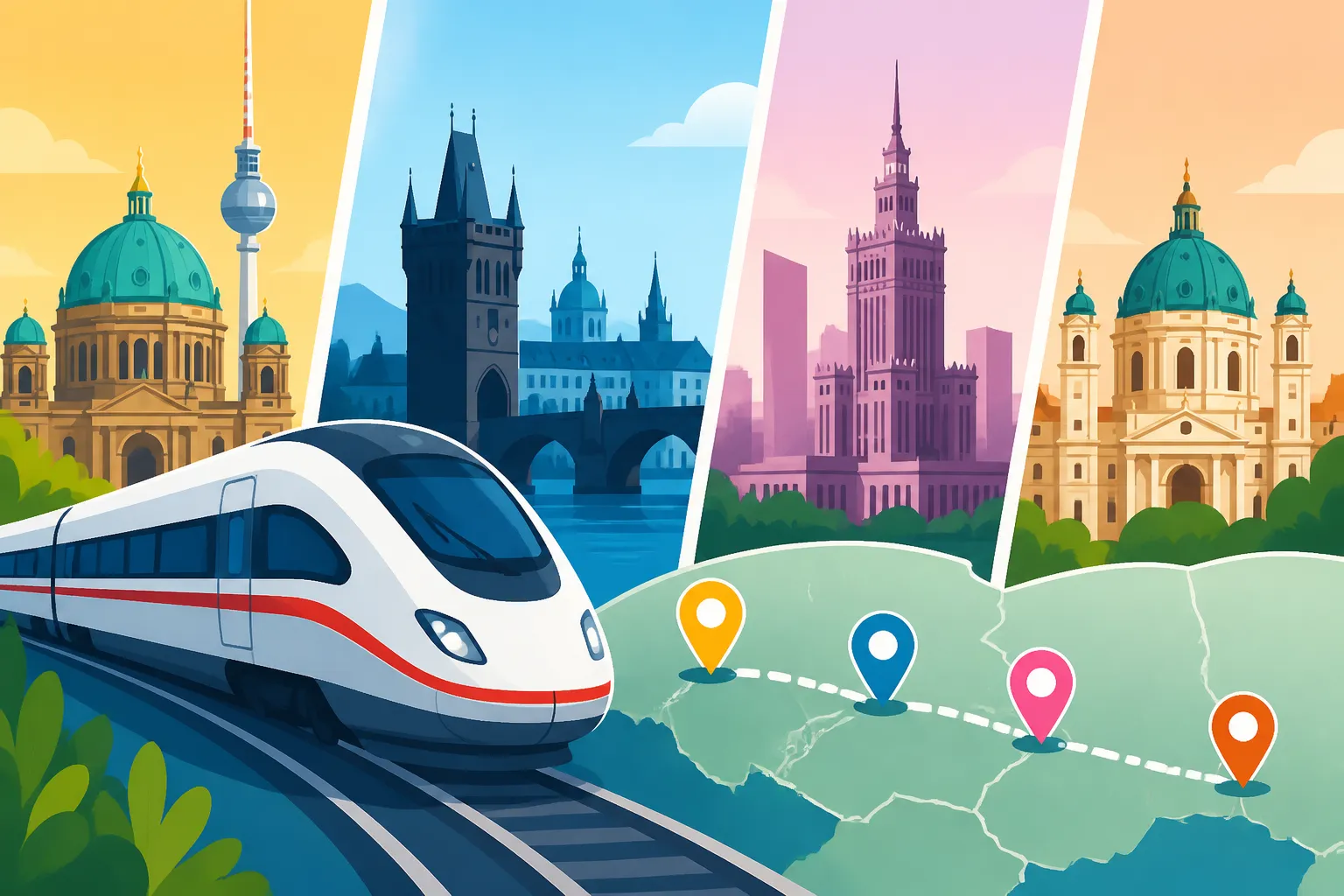
Berlin to Prague, Warsaw, and Vienna: Cross-Border Rail Bookings
Oh, the romantic notion of hopping on a train in Berlin and waking up in a different European capital! It sounds idyllic, doesn't it? But if you've lived in Germany for any length of time, you know that even the simplest administrative task can feel like navigating a labyrinth designed by Franz Kafka. Booking cross-border train tickets can be just as bewildering, with different national railway companies, confusing websites, and language barriers galore. This guide is here to cut through that complexity, helping you confidently plan your rail adventures from Berlin to Prague, Warsaw, and Vienna, with a little help from a truly indispensable tool.
Disclosure: This post may contain affiliate links. We may earn a commission at no extra cost to you if you make a purchase through these links. Read full disclosure.
The Joys (and Headaches) of Cross-Border Rail Travel from Germany
Let's be honest, the allure of train travel across Europe is undeniable. You bypass the airport hustle, avoid endless security lines, and often get to see stunning landscapes roll by your window. Plus, it's generally a more sustainable way to explore this incredible continent. From Berlin's bustling Hauptbahnhof, you're perfectly positioned to launch into Eastern and Central Europe, hitting vibrant cities like Prague, historic Warsaw, and imperial Vienna. The connectivity is fantastic, on paper anyway.
However, the reality of booking these trips can quickly dampen that wanderlust. You're dealing with Deutsche Bahn for the German leg, then potentially České dráhy in the Czech Republic, PKP Intercity in Poland, and ÖBB in Austria. Each has its own website, its own quirks, its own pricing structure, and often, its own language. I remember spending hours once, trying to piece together a single journey across three countries, switching between browser tabs and translation tools, wondering if I'd accidentally booked a ticket for a donkey instead of a human. It's frustrating, time-consuming, and frankly, a barrier to spontaneous adventure for many expats. You just want a straightforward way to see your options and click "book."
The dream is to find a single, reliable source that pulls all this information together, allows you to compare routes and prices, and book your tickets without a deep dive into five different national rail systems. Thankfully, that dream is now a very accessible reality, and it makes planning these cross-border escapades so much smoother. Before diving into the specifics of these fantastic routes, let's explore how to make the booking process as painless as possible. If you’re also thinking about how to get around within Germany, check out our guide on High-Speed Trains in Germany ICE Deutsche Bahn Routes and Savings.
Your Central European Adventure: Berlin to Prague, Warsaw, and Vienna by Train
Each of these cities offers a unique flavor of Central European charm, and the train journey to get there is part of the experience. Let's break down what you can expect for each route, focusing on the practicalities from Berlin.
Berlin to Prague: Bohemian Rhapsody by Rail
The journey from Berlin to Prague is one of the most popular and scenic cross-border routes. You'll generally depart from Berlin Hauptbahnhof, and arrive directly into Praha hlavní nádraží, Prague's main train station, right in the city center.
The direct EuroCity (EC) trains, often operated jointly by Deutsche Bahn (DB) and České dráhy (ČD), are your best bet. These trains are comfortable, offer dining cars, and usually take around 4 to 4.5 hours. As you leave Germany, you'll pass through picturesque Saxon Switzerland with its dramatic rock formations and eventually cross into the Czech Republic, often following the Elbe river. Booking this route can be done directly through DB or ČD, but as a veteran expat, I can tell you that trying to compare the best fares between the two, or even understand the sometimes-cryptic fare classes, can be a headache. This is exactly where a platform like Omio shines, consolidating all options and making it incredibly easy to choose. Consider what you need to bring for such a trip, you might want to read up on Travel Insurance for Trips to and Within Germany to ensure you're covered.
Berlin to Warsaw: A Journey Through History
Traveling from Berlin to Warsaw by train connects two cities with a profound shared history. The journey is typically handled by the EuroCity (EC) "Berlin-Warszawa-Express," a direct service operated by Deutsche Bahn (DB) and PKP Intercity (PKP IC). These trains also offer a good standard of comfort, often with catering services on board.
The direct train usually takes about 5.5 to 6 hours, dropping you off at Warszawa Centralna, the city's central station. While the landscape isn't as dramatic as the Prague route, it's a comfortable and efficient way to travel, allowing you to catch up on reading or simply watch the scenery change from German farmlands to the more varied Polish countryside. Again, dealing with two different national rail operators for ticketing can be a bit of a dance. I've found that using a single platform that handles both, like Omio, makes the process infinitely simpler, showing you all available times and prices from both sides in one go. For those concerned about general safety while traveling, our guide on Staying Safe in Germany Common-Sense Tips for Travelers has some excellent tips that apply to cross-border journeys too.
Berlin to Vienna: Imperial Grandeur Awaits
The route from Berlin to Vienna is a longer, but equally rewarding journey, often feeling like a proper cross-European expedition. While there are some direct connections, particularly overnight trains, many daytime services involve a change, most commonly in Dresden or sometimes Prague. The main operators involved are Deutsche Bahn (DB) and Austrian Federal Railways (ÖBB).
Direct trains can take around 7.5 to 8 hours, while connections might extend that to 8-9 hours, depending on the transfer time. You'll arrive at Wien Hauptbahnhof (Vienna Main Station), a modern hub with excellent connections to the rest of the city. The scenery can vary from the German plains and hills to the more rolling landscapes of Austria. For longer journeys like this, the convenience of a single booking platform is paramount. Imagine trying to coordinate tickets across three different national systems (Germany, Czech Republic if you transfer there, and Austria) – it's enough to make you just fly! That's precisely why a service like Omio becomes your best ally, allowing you to see all connection options, whether direct or with transfers, and book them seamlessly. If you're pondering payment methods for your trip, consider reading Money for Travel in Germany Cash Cards and ATMs.
Simplifying Your Journey: Why Omio is Your Best Friend for Cross-Border Bookings
Alright, let's talk about how to make these travel dreams a reality without tearing your hair out. As an expat who's navigated the intricacies of German and European bureaucracy for years, I can tell you that finding a straightforward solution for multi-country travel planning is a godsend. And that's where Omio truly shines, becoming the unsung hero for cross-border rail bookings.
Think of Omio as your personal travel agent, but without the fees and with all the power of the internet. Instead of jumping between Deutsche Bahn's site, then PKP's, then ÖBB's, trying to compare prices and routes, Omio aggregates all this information for you. It pulls data from various transport providers – trains, buses, and even flights – into one easy-to-understand interface. This means you can see all your options from Berlin to Prague, Warsaw, or Vienna at a glance, in your own language, and convert prices to your preferred currency. No more guessing games, no more mistranslations!
How Omio Cuts Through the Confusion
Let me walk you through why Omio is such a game-changer for these specific routes:
- Unified Search and Comparison: This is the big one. Instead of having to know which train operator serves which route, or if a direct train exists, you just plug in your departure (Berlin) and your destination (Prague, Warsaw, or Vienna). Omio then displays all available train options, including combinations of different operators (e.g., DB + ČD for Prague), along with their prices and journey times. You'll instantly see the cheapest, fastest, or most convenient options, allowing you to make an informed decision without a doctoral degree in European rail networks.
- Language and Currency Support: Oh, the joy of seeing prices in Euros and reading all the details in English (or your native language, if available)! This removes a huge mental hurdle. No more fumbling with Google Translate on a foreign rail website, second-guessing if "cena" means price or pain. Omio standardizes the information, giving you peace of mind.
- Mobile Tickets and Convenience: In today's digital age, who wants paper tickets? Most tickets booked through Omio are e-tickets, accessible directly on your smartphone. You just show your phone to the conductor, and you're good to go. This simplifies travel immensely, eliminating the worry of losing physical tickets or having to print them out before a trip.
- Booking Management in One Place: If you're planning a multi-city tour (Berlin-Prague-Vienna, anyone?), being able to manage all your bookings from a single app or website is incredibly helpful. This centralizes your travel plans, making it easy to review your itineraries, access ticket details, and even make changes if needed.
Using Omio truly streamlines the cross-border booking process, turning a potentially stressful task into a simple click-and-confirm experience. It's the kind of practical solution that makes expat life in Germany, and wider European travel, genuinely more enjoyable. So, before you start frantically searching individual railway websites, do yourself a favor and give Omio a try. You'll thank me later.
Here's a quick comparison of your options for these popular routes:
| Route | Typical Duration (Train) | Main Operators (Germany) | Main Operators (Destination) | Booking Convenience with Omio |
|---|---|---|---|---|
| Berlin to Prague | 4h 30m – 5h 00m | Deutsche Bahn (DB) | České dráhy (ČD) | Excellent (Aggregates DB & ČD) |
| Berlin to Warsaw | 5h 30m – 6h 00m | Deutsche Bahn (DB) | PKP Intercity (PKP IC) | Excellent (Aggregates DB & PKP IC) |
| Berlin to Vienna | 7h 30m – 9h 00m | Deutsche Bahn (DB) | ÖBB (Austrian Railways) | Excellent (Aggregates DB & ÖBB, finds connections) |
Practical Tips for a Smooth International Rail Experience
Booking your tickets is just the first step. To ensure your actual journey is as stress-free as possible, here are a few seasoned expat tips for international train travel from Germany. Whether you're a first-timer or a seasoned traveler, these pointers will help.
Booking Strategy: When to Buy Your Tickets
Just like with flights, train tickets, especially for international routes, tend to get more expensive the closer you get to your departure date. The "Sparpreis" (saver fare) tickets from Deutsche Bahn, or similar equivalents from other operators, are released well in advance – usually up to six months ahead of time – and are limited in quantity.
My advice? As soon as your travel dates are firm, check prices. Omio will show you these advance fares, often offering significant savings compared to buying last minute. For popular routes like Berlin to Prague, these cheaper tickets can vanish quickly, especially for weekend travel. If you're flexible with your travel times or even the day of the week, you might snag an even better deal. Don't be afraid to check different departure times. Sometimes an early morning or late evening train can be significantly cheaper. Understanding How to Buy Deutsche Bahn Tickets and Save Money can also provide valuable context, but for cross-border, Omio often simplifies the comparison.
Onboard Experience and Amenities
International trains in Europe are generally comfortable. Most EuroCity (EC) trains, which you'll likely be taking for these routes, offer both 1st and 2nd class seating, often with power outlets and Wi-Fi, though Wi-Fi can be spotty, especially when crossing borders. There's usually a dining car or a bistro carriage where you can grab a coffee, snacks, or a full meal. These aren't Michelin-star restaurants, but they're perfectly adequate for a train journey and offer a chance to stretch your legs.
For longer journeys, consider bringing your own water bottle and snacks, especially if you have specific dietary needs. It's always a good idea to pack a good book, headphones, and maybe even a portable charger to keep your devices juiced up. Remember that while within the Schengen Area, border checks are usually minimal or non-existent, it’s always wise to have your passport or ID card readily accessible, just in case.
Border Crossings and Documents
Since Germany, the Czech Republic, Poland, and Austria are all part of the Schengen Area, you won't typically experience formal border checks on these train journeys. This means you won't have to get off the train or go through customs. However, conductors may randomly check passports or ID cards, so always have valid identification with you. This is crucial not just for the train, but for your entire trip abroad.
If you're a non-EU citizen traveling on a German residence permit, your permit, along with your passport, is your proof of legal stay and allows you to travel freely within the Schengen zone. Just make sure your passport is valid for at least three months beyond your intended return date, and that your residence permit isn't nearing expiration. If you're curious about general Travel Logistics in Germany Money Safety and Connectivity, that article covers even more ground!
Dealing with Delays and Disruptions
While European rail systems are generally efficient, delays can happen. Weather, technical issues, or track work can all cause disruptions. If you book through Omio, you'll usually get real-time updates through their app, which can be a lifesaver.
If a significant delay occurs, especially one that causes you to miss a connection, speak to the train staff immediately. They can often provide information, endorse your ticket for a later train, or offer alternative travel arrangements. Keep proof of your delay (like a stamped ticket or confirmation from staff) as you might be entitled to compensation under EU passenger rights, especially for delays over 60 minutes. It's important to remember that these protections are there for you, even if you’re traveling cross-border. If you're using your phone abroad, ensure you're aware of options like Mobile Data and eSIMs for Travel in Germany to stay connected. And for those planning longer trips or wanting to understand various transport options in Germany, our comprehensive guide on Getting Around Germany Trains Buses Flights and Car Hire is a fantastic resource.
Cross-border rail travel from Berlin offers incredible opportunities to explore some of Europe's most captivating cities. With the right approach, and a powerful tool like Omio, you can transform what used to be a complicated booking process into a smooth, enjoyable start to your next adventure. Happy travels!
Disclaimer
Please note that while I strive to provide accurate and up-to-date information based on my experience and available data, travel regulations, prices, and service offerings can change. Always verify current requirements and conditions directly with transport providers or official sources before making your travel plans. This guide is for informational purposes only and does not constitute professional advice.